Post-Impressionism
After Work (Edward William Stott)
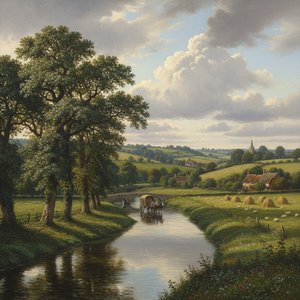
Edward William Stott (1859–1918) har skapt After Work. Det tilhører Post-Impressionism-bevegelsen. Laget i Oil On Canvas.
- Oil On Canvas

 Forhåndsvisning

 Håndmalt oljemaleri
 Send
 Del
 Faktablad for elever


 Last ned bilde
 Liknende objekter
 Røntgenundersøkelse
 Lysbildefremvisning
 Spørsmål og svar

 Statistikk
After Work, kort fortalt
- Tittel
- After Work
- Kunstner
- Edward William Stott (1859–1918)
- Kunstner født i
- Rochdale, Storbritannia
- Materiale
- Oil On Canvas
- Bevegelse
- Post-Impressionism
- Tidsperiode
- 19th Century
- Motiv
- landscape, solitude, travel, rural, dusk, horseback
Hva forestiller After Work?
Identification of After Work by Edward William Stott
In this work, titled After Work, we encounter a quiet moment of transition captured by the English painter Edward William Stott. Born in 1859, Stott developed a sensibility deeply rooted in the nuances of the natural world, a focus that remains central to this piece. The painting presents a solitary figure on horseback navigating a desolate landscape, a scene that reflects the artist's lifelong interest in the rhythms of rural life and the changing qualities of light.
Edward William Stott, who lived until 1918, possessed a specific ability to render the atmosphere of the English countryside. In After Work, this is expressed through a somber, melancholic mood, established by an overcast sky and a palette of earthy browns and muted yellows. The composition relies on strong horizontal lines—the rider's back, the terrain, and the distant horizon—to create a sense of vastness and isolation within the frame.
The subject matter centers on a lone traveler in a rugged environment, suggesting themes of solitude and resilience. There is a palpable sense of the weight of the day's labor, as the figure moves through a landscape where the background recedes into a hazy darkness. It is a study of a quiet, singular moment caught between the physical reality of the terrain and the emotional stillness of the evening.
The Composition and Visual Elements
The composition is defined by a series of heavy horizontal lines. The horse’s back, the uneven ground, and the distant horizon all pull the eye across the canvas, emphasizing a sense of vastness and isolation. This structural choice anchors the solitary figure on horseback as they traverse a desolate landscape. The subject is a lone traveler moving through a rugged environment, a figure that seems small against the weight of the terrain.
The color palette is restrained, relying primarily on earthy browns and muted yellows. These tones contribute to a somber mood, mirroring the quietude of the scene. Lighting is diffused and flat, lacking any strong highlights that might disrupt the stillness. Instead, the light settles softly over the landscape, allowing the forms to emerge through subtle shifts in tone rather than sharp contrast. In the distance, the background recedes into a hazy darkness, creating a sense of depth that feels both immense and impenetrable.
Technique and Artistic Style
The work is executed in oil on canvas, a choice that allows for the heavy, moisture-laden texture characteristic of the artist's approach to the landscape. There is a palpable sense of weight in the application of the paint. Thick brushstrokes define the terrain and the figure, suggesting a painterly technique that prioritizes the physical presence of the medium. This tactile quality gives the organic shapes of the horse and rider a tangible, grounded reality.
The style leans toward realism, yet it is handled with an expressive brushstroke technique that avoids clinical precision. Lines are loose and expressive, defining the forms of the traveler and the rugged environment without relying on sharp or rigid edges. This softness allows the subject to merge subtly with the atmosphere of the desolate landscape. The shapes remain largely organic, rendered with a visible texture that emphasizes the raw, unpolished nature of the scene.
Høyoppløselige bilder av After Work
Fritlig eiendom: kunstneren døde i 1918.
Edward William Stott, After Work. Fri tilgjengelighet
Spørsmål om After Work, besvart
Hvilket medium er "After Work" av Edward William Stott utført i?
"After Work" er utført i Oil On Canvas.
Hva forestiller "After Work" av Edward William Stott?
Temaene i "After Work" av Edward William Stott inkluderer landscape, solitude, travel, rural, dusk, horseback, melancholy, vastness. Sammen oppsummerer de verkets motiv.
Er "After Work" av Edward William Stott i det frie domene?
"After Work" av Edward William Stott er fritt tilgjengelig – opphavsretten har utløpt. Denne statusen avgjør hvordan bildet av verket kan reproduseres.
Hvilken kunstner kan "After Work" tilskrives?
Kunstneren bak "After Work" er Edward William Stott. Verket er katalogisert under Edward William Stott sitt navn.
Hvilken stilart tilhører "After Work"?
"After Work" er et verk innenfor Post-Impressionism. Retningen angir den kunstneriske tradisjonen verket er en del av.
Hvilken fase av Edward William Stott sin kunstneriske utvikling representerer "After Work"?
I Edward William Stott sin karriere tilhører "After Work" Late Victorian. Denne perioden gjør det mulig å sammenligne verket med kunstnerens øvrige arbeider.
Hvorfor er den opphavsrettslige statusen til "After Work" slik den er?
"After Work" av Edward William Stott er fritt tilgjengelig – opphavsretten har utløpt. Opphavsretten løper fra kunstnerens dødsår, som var i 1918.
Hvor plasserer "After Work" seg i Edward William Stott sitt samlede kunstnerskap?
I Edward William Stott sitt kunstnerskap befinner "After Work" seg innenfor Post-Impressionism-stilen, sammen med temaene sussex colony's artistic hub, domestic scenes, fading light focus, bastien-lepage, impressionism, linnell, palmer – english tradition.
Er "After Work" typisk for det Edward William Stott vanligvis skapte?
Blant Edward William Stott sine dokumenterte temaer – sussex colony's artistic hub, domestic scenes, fading light focus, bastien-lepage, impressionism, linnell, palmer – english tradition – retter "After Work" sitt eget fokus mot landscape, solitude, travel, rural, dusk, horseback, melancholy, vastness.
Om kunstneren, Edward William Stott

1859–1918, Storbritannia
Edward William Stott
Det engelske landskapets atmosfæriske sjel Edward William Stott forblir en fengslende skikkelse i den britiske kunstens vev, en maler hvis verk ånder med den stille, melankolske skjønnheten fra den sene viktorianske æraen. Født i 1855 midt i det industrielle støvet i Rochdale, Lancashire, var Stotts kunstneriske sanser langt fjernt fra sotet og jernet i hans fødested. I stedet søkte han en dyp forbindelse med naturen, og fant til slutt sitt åndelige og kreative hjem i de bølgende, fredfulle landskapene i det landlige Sussex. Hans reise var preget av konstant foredling, fra de strukturerte akademiske miljøene i Manchester og Paris til de spontane, lysfylte markene på den engelske landsbygda.
Om Edward William Stott Fremtredende verk av Edward William Stott
Andre verk av Edward William Stott
 Black And White Cat
 The Labourer's Cottage
 Hagar And Ishmael Beside A Well In The Desert
 Ploughing
Essays om After Work
 1800-tallets Mesterverk: 10 Kunstverk som Definerer Epoken – OriginalUniqueArt.noOpplev 1800-tallets kunst gjennom 10 ikoniske mesterverk! Fra romantikk til impresjonisme – lær om Munch, Van Gogh og Monet. Finn museumskv…
 John Constable: Nature, Light & the Romantic Vision of Rural EnglandExplore the life & art of John Constable, the Romantic painter who revolutionized landscape with emotive scenes of rural England. Discover …
 American artworks of the 1850s1850s American landscapes by Asher Brown Durand and John Frederick Kensett showcase the era's beauty. View the full collection at OriginalU…