Portrett av Nikolaj Ge

De 95 mest kjente maleriene av Nikolaj Ge, et gallerivalg

Oppdatert October 2026 · rangert etter vår popularitetsscore (søk, besøk og bestillinger for hvert verk) · 95 verk av Nikolaj Ge i vår katalog

Kort fortalt

Av alle originalverkene Nikolaj Ge etterlot seg, er det mest kjente Peter the Great Interrogating the Tsarevich Alexei Petrovich at Peterhof (1871), som er en del av samlingen til Tretyakov-galleriet i Moskva. Like bak følger Christ and his disciples entered the Garden of Gethsemane (1888) og Harbingers of the Resurrection (1867). Vår katalog inneholder 95 verk av Nikolaj Ge; galleriet har bevart de 95 verkene som verden beundrer mest, hver vist med sin dato, sitt museum og sin historie.

1831 – 1894, Voronezj Realism Flest verk: Tretyakov-galleriet

Nikolaj Ges topp 10 malerier: galleriets utvalg

1
Peter the Great Interrogating the Tsarevich Alexei Petrovich at Peterhof (1871) av Nikolaj Ge

Peter the Great Interrogating the Tsarevich Alexei Petrovich at Peterhof

1871 · Oil On Canvas · Tretyakov-galleriet, Moskva

The oil painting depicts a somber historical scene set within the interior of the Monplaisir Palace in Peterhof. The composition centers on two figures positioned on opposite sides of a large, ornate table. On the right, Peter I is seated in an upholstered chair trimmed with red velvet, leaning slightly forward with an authoritative gaze. On the left, Tsarevich Alexei Petrovich stands upright with a bowed head and a dejected…

2
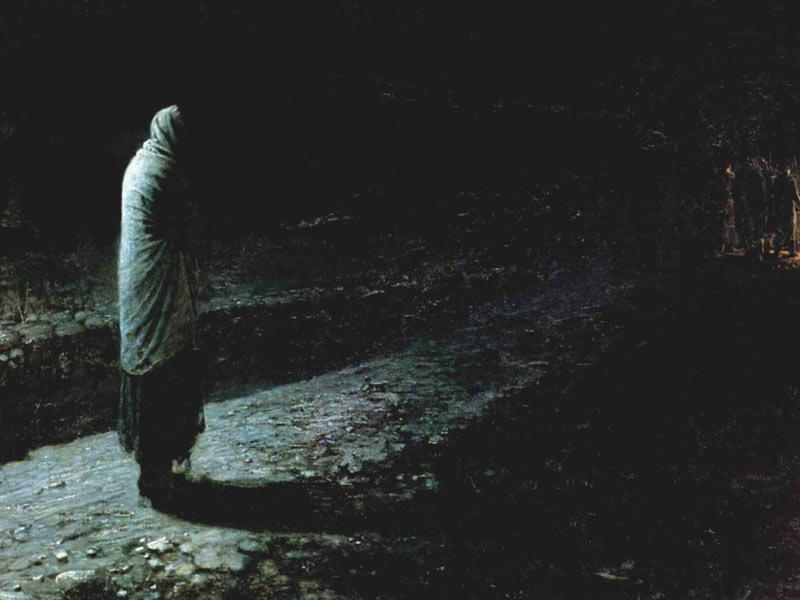
Christ and his disciples entered the Garden of Gethsemane (1888) av Nikolaj Ge

Christ and his disciples entered the Garden of Gethsemane

1888 · Oil On Canvas

Nikolai Ge’s Christ and his disciples entered the Garden of Gethsemane, painted about 1888, captures a pivotal moment from the New Testament. The religious subject matter focuses on the group of figures gathered in the garden. Christ stands prominently with outstretched arms, a gesture suggesting sacrifice and the acceptance of fate. Around him, the disciples are clustered in a solemn assembly. Their somber expressions convey a sense of anxiety and…

3
Harbingers of the Resurrection (1867) av Nikolaj Ge

Harbingers of the Resurrection

1867 · Oil

In the painting Harbingers of the Resurrection, created by Nikolai Ge about 1867, the central figure is Jesus Christ. He is positioned in the middle of the composition, flanked by two men. These two figures on either side of Christ appear to be angels or messengers. Each of these men holds a staff, an object that may symbolize their functions as protectors or guides. The presence of these figures establishes…

4
Portrait of Nikolai Nekrasov (1872) av Nikolaj Ge

Portrait of Nikolai Nekrasov

1872 · Oil On Canvas · Eremitasjen, St. Petersburg

An elderly man sits within the heavy embrace of a patterned armchair. The fabric of his suit carries a palpable weight, rendered in deep blacks and muted earth tones that seem to absorb the surrounding light. His face, pale against the dark void of the background, holds a quiet melancholy. Light falls sharply across his forehead and eyes, catching the texture of skin and the silvered strands of facial hair.…

5
Leila and Khaji-Abrek (1852) av Nikolaj Ge

Leila and Khaji-Abrek

1852 · Oil

In the painting Leila and Khaji-Abrek by Nikolai Ge, two figures occupy the central space of the composition. Created about 1852, the work depicts a woman and a man in a specific physical arrangement. The woman is positioned kneeling on the ground, facing the man. He is situated before her, appearing as a soldier or a leader in stature and presence. Both individuals are dressed in traditional clothing that covers…

6
Bridge in Viko (1858) av Nikolaj Ge

Bridge in Viko

1858 · Oil On Paper

We are looking at Bridge in Viko, a work from 1858 by the Russian artist Nikolai Ge. This piece belongs to the Realism movement, a period where the focus shifted toward a more direct and unadorned representation of the world. It is a quiet study of landscape and structure, captured during a formative time in the artist's career.

7
Returning from the burial of Christ (1859) av Nikolaj Ge

Returning from the burial of Christ

1859 · Oil

In this quiet composition titled Returning from the burial of Christ, we encounter a profound moment of transition. The work is attributed to the Russian artist Nikolai Ge and dates to 1859. It captures a solemn procession of figures moving through a natural landscape, their presence marked by the heavy folds of their long robes. There is a stillness here that invites a closer look at the gravity of the…

8
Portrait of Leo Tolstoy (1884) av Nikolaj Ge

Portrait of Leo Tolstoy

1884 · Oil On Canvas · Tretyakov-galleriet, Moskva

In the quiet, amber-hued atmosphere of a Moscow study, time seems to suspend itself within Nikolai Ge’s 1884 masterpiece, Portrait of Leo Tolstoy. This is not merely a depiction of a man at work; it is an intimate window into the very soul of Russian literature. The painting captures the legendary author seated at his desk, enveloped by the weight of his own profound thoughts. As he leans over his…

9
Portrait of Alexander Herzen (1867) av Nikolaj Ge

Portrait of Alexander Herzen

1867 · Oil On Canvas · Eremitasjen, St. Petersburg

This oil painting is a somber and intense psychological portrait of an older man, presented as an oval-shaped bust-length figure. Set against a dark, indistinct background, the subject is illuminated by directional lighting coming from the upper left, which casts one side of his face and much of his clothing into deep shadow. This technique creates a sense of depth and three-dimensionality through dramatic chiaroscuro. The color palette is dominated…

10
Catherine II at the Coffin of Empress Elizabeth (1709) av Nikolaj Ge

Catherine II at the Coffin of Empress Elizabeth

1709 · Oil

In Catherine II at the Coffin of Empress Elizabeth, Nikolai Ge constructs a grand hall where history feels heavy and crowded. The composition is a dense gathering of figures, a chaotic assembly of dignitaries and attendants that fills the space with ceremonial weight. Amidst this throng, the eye is drawn to Catherine II, positioned slightly off-center. She exists within a shallow perspective that pushes the solemnity of the court toward…

Utvalget av Nikolaj Ge fortsetter, fra 11 til 95

11Achilles and the body of Patroclus av Nikolaj GeAchilles and the body of PatroclusNational Art Museum of The Republic of Belarus 12Mary, sister of Lazarus, Greets Jesus (1863) av Nikolaj GeMary, sister of Lazarus, Greets Jesus1863 13Portrait of Russian baritone opera singer Gennady Kondratiev (1863) av Nikolaj GePortrait of Russian baritone opera singer Gennady Kondratiev1863 14Portrait of V.N.Rostovtseva (1861) av Nikolaj GePortrait of V.N.Rostovtseva1861 15Portrait of Joseph Daumang (1868) av Nikolaj GePortrait of Joseph Daumang1868 16Portrait of Princess Olga Volkonskaya (nee Kleinmichel) (1882) av Nikolaj GePortrait of Princess Olga Volkonskaya (nee Kleinmichel)1882 · Eremitasjen 17Conscience, Judas (1891) av Nikolaj GeConscience, Judas1891 18Portrait of P.A. Kostichev (1892) av Nikolaj GePortrait of P.A. Kostichev1892 19Portrait of Yelena Likhachova (1892) av Nikolaj GePortrait of Yelena Likhachova1892 20Portrait of Yekaterina Ge, the Artist's Daughter-in-Law (1880) av Nikolaj GePortrait of Yekaterina Ge, the Artist's Daughter-in-Law1880 · Eremitasjen 21Crucifixion av Nikolaj GeCrucifixion 22Portrait of Evdokiya Nikolaevna Kostycheva (1845) av Nikolaj GePortrait of Evdokiya Nikolaevna Kostycheva1845 23Portrait of Yakov Merkulov (1855) av Nikolaj GePortrait of Yakov Merkulov1855 24Portrait of Nikolay O.Ge, Artist's Father (1854) av Nikolaj GePortrait of Nikolay O.Ge, Artist's Father1854 25Frascati Clouds (1859) av Nikolaj GeFrascati Clouds1859 26The view from Santo Terenzo at Lerici by night (1862) av Nikolaj GeThe view from Santo Terenzo at Lerici by night1862 27Portrait of Piotr Zabela (1856) av Nikolaj GePortrait of Piotr Zabela1856 28Bay in Livorno. sunset (1862) av Nikolaj GeBay in Livorno. sunset1862 29Death of Imelda Lambertatstsi (1860) av Nikolaj GeDeath of Imelda Lambertatstsi1860 30Death of Virginia, Study (1857) av Nikolaj GeDeath of Virginia, Study1857 31Witch of Endor (1857) av Nikolaj GeWitch of Endor1857 32The destruction of the Temple in Jerusalem (1859) av Nikolaj GeThe destruction of the Temple in Jerusalem1859 33love of Vestal (1857) av Nikolaj Gelove of Vestal1857 34Portrait of the Artist's Wife Anna Ge (1858) av Nikolaj GePortrait of the Artist's Wife Anna Ge1858 · Kiev National Picture Gallery 35Portrait of Shestova with daughter (1859) av Nikolaj GePortrait of Shestova with daughter1859 36Death of Virginia, Study (1857) av Nikolaj GeDeath of Virginia, Study1857 37Vineyard at Vico (1858) av Nikolaj GeVineyard at Vico1858 38Death of Virginia, Study (1857) av Nikolaj GeDeath of Virginia, Study1857 39Livorno. Road to the Sea at Antiniano near Livorno (1862) av Nikolaj GeLivorno. Road to the Sea at Antiniano near Livorno1862 40Sorrento (1869) av Nikolaj GeSorrento1869 41Oaks in the mountains of Carrara (1868) av Nikolaj GeOaks in the mountains of Carrara1868 42Marble Saw in Carrara (1868) av Nikolaj GeMarble Saw in Carrara1868 43Loading marble (1868) av Nikolaj GeLoading marble1868 44Portrait of the Author Alexander Herzen (1867) av Nikolaj GePortrait of the Author Alexander Herzen1867 45The Transportation of Marble at Carrara (1868) av Nikolaj GeThe Transportation of Marble at Carrara1868 46Christ in front of Annas (1868) av Nikolaj GeChrist in front of Annas1868 47Portrait of an Unknown Woman in a blue blouse (1868) av Nikolaj GePortrait of an Unknown Woman in a blue blouse1868 48Christ in the synagogue (1868) av Nikolaj GeChrist in the synagogue1868 49Portrait of A.N.Pypin (1871) av Nikolaj GePortrait of A.N.Pypin1871 50Florence. The Cascina Park (1868) av Nikolaj GeFlorence. The Cascina Park1868 51Portrait of the Poet Nikolay Nekrasov (1872) av Nikolaj GePortrait of the Poet Nikolay Nekrasov1872 52Tsar Boris and the Queen Martha (1874) av Nikolaj GeTsar Boris and the Queen Martha1874 53Portrait of Alexei Antipowitsch Potechin (1876) av Nikolaj GePortrait of Alexei Antipowitsch Potechin1876 54Portrait of Anna Olsufyeva (1881) av Nikolaj GePortrait of Anna Olsufyeva1881 55An Old Peasant (1880) av Nikolaj GeAn Old Peasant1880 56Portrait of Adam Olsufyev (1881) av Nikolaj GePortrait of Adam Olsufyev1881 57On the Mount of Olives (1880) av Nikolaj GeOn the Mount of Olives1880 58Portrait of Natalia Petrunkevich (1892) av Nikolaj GePortrait of Natalia Petrunkevich1892 59Self-Portrait (1892) av Nikolaj GeSelf-Portrait1892 · Kiev National Picture Gallery 60Sophia Tolstaya (1886) av Nikolaj GeSophia Tolstaya1886 61Portrait of Maria Gabayeva (1886) av Nikolaj GePortrait of Maria Gabayeva1886 62Portrait of Tatyana Tolstaya, Leo Tolstoy's Daughter (1887) av Nikolaj GePortrait of Tatyana Tolstaya, Leo Tolstoy's Daughter1887 63Portrait of Nikolay Ge, the Artist's Grandson (1889) av Nikolaj GePortrait of Nikolay Ge, the Artist's Grandson1889 64Old Park (1893) av Nikolaj GeOld Park1893 65Crusifixion av Nikolaj GeCrusifixion 66Mother at the funeral of her child av Nikolaj GeMother at the funeral of her child 67Portrait of Barbara Kochubey av Nikolaj GePortrait of Barbara Kochubey 68Portrait of Olga Kostycheva av Nikolaj GePortrait of Olga Kostycheva 69Return of Tobias av Nikolaj GeReturn of Tobias 70Carrara av Nikolaj GeCarrara 71Judah av Nikolaj GeJudah 72The Temptation of Christ av Nikolaj GeThe Temptation of Christ 73Pushkin in the village Mihaylovskoye av Nikolaj GePushkin in the village Mihaylovskoye 74Ruslan and Lyudmila av Nikolaj GeRuslan and Lyudmila 75The road into the forest av Nikolaj GeThe road into the forest 76Bay in Livorno av Nikolaj GeBay in Livorno 77Boys at the beach. Study av Nikolaj GeBoys at the beach. Study 78Bay. Vyko av Nikolaj GeBay. Vyko 79Portrait of Historian M.Kostomarov av Nikolaj GePortrait of Historian M.Kostomarov 80Gorge in the mountains of Carrara av Nikolaj GeGorge in the mountains of Carrara 81Portrait of M.P.Svet av Nikolaj GePortrait of M.P.Svet 82Portrait of the Author Mikhail Saltykov-Shchedrin av Nikolaj GePortrait of the Author Mikhail Saltykov-Shchedrin 83Christ Head av Nikolaj GeChrist HeadKiev National Picture Gallery 84Portrait of the Ukrainian boy av Nikolaj GePortrait of the Ukrainian boy 85The head of John the Apostle av Nikolaj GeThe head of John the Apostle 86Katerina Ivanovna Zabello av Nikolaj GeKaterina Ivanovna Zabello 87Portrait of Maria Tolstaya, Leo Tolstoy's Daughter av Nikolaj GePortrait of Maria Tolstaya, Leo Tolstoy's Daughter 88Portrait of M.V. Alekhin av Nikolaj GePortrait of M.V. Alekhin 89Christand Robber av Nikolaj GeChristand Robber 90Peter I interrogates Tsarevich Alexei av Nikolaj GePeter I interrogates Tsarevich Alexei 91The Judgment of King Solomon av Nikolaj GeThe Judgment of King Solomon 92Last Supper (1863) av Nikolaj GeLast Supper1863 · Den russiske statsmuseet 93What is Truth. Christ and Pilate (1890) av Nikolaj GeWhat is Truth. Christ and Pilate1890 · Tretyakov-galleriet 94Golgotha (1893) av Nikolaj GeGolgotha1893 · Tretyakov-galleriet 95The Judgment of the Sanhedrin (1892) av Nikolaj GeThe Judgment of the Sanhedrin1892 · Tretyakov-galleriet

Nikolaj Ges berømte malerier, periode for periode

Motivene som fanget Nikolaj Ges blikk

De fire motivene som går igjen hyppigst i disse originalverkene, hver med sitt fremste eksempel.

Museene som har Nikolaj Ges originalverk

De 5 museene som innehar flest av maleriene på denne siden.

Museum By Verker av Nikolaj Ge Malerier fra denne listen
Tretyakov-galleriet, MoskvaTretyakov-galleriet Moskva 5 Peter the Great Interrogating the Tsarevich Alexei Petrovich at Peterhof, Portrait of Leo Tolstoy, What is Truth. Christ and Pilate
Eremitasjen, St. PetersburgEremitasjen St. Petersburg 4 Portrait of Nikolai Nekrasov, Portrait of Alexander Herzen, Portrait of Princess Olga Volkonskaya (nee Kleinmichel)
Kiev National Picture Gallery, KyivKiev National Picture Gallery Kyiv 3 Portrait of the Artist's Wife Anna Ge, Self-Portrait, Christ Head
National Art Museum of The Republic of Belarus, MinskNational Art Museum of The Republic of Belarus Minsk 1 Achilles and the body of Patroclus
Den russiske statsmuseet, St. PetersburgDen russiske statsmuseet St. Petersburg 1 Last Supper

Nikolaj Ge tiår for tiår: originalverket som definerer hvert av dem

Verk per tiår

Velg et tiår for å se originalverket som definerer det.

Samlere spør om maleriene til Nikolaj Ge

Hvilket verk er Nikolaj Ge mest kjent for?Avslør svaret

Peter the Great Interrogating the Tsarevich Alexei Petrovich at Peterhof (1871), Tretyakov-galleriet, Moskva. Deretter følger Christ and his disciples entered the Garden of Gethsemane (1888) og Harbingers of the Resurrection (1867).

Hvor gammel var Nikolaj Ge da Peter the Great Interrogating the Tsarevich Alexei Petrovich at Peterhof ble laget?Avslør svaret

40 år gammel: Peter the Great Interrogating the Tsarevich Alexei Petrovich at Peterhof er fra 1871, og Nikolaj Ge ble født i 1831.

Hva er de ti mest kjente maleriene til Nikolaj Ge?Avslør svaret

Peter the Great Interrogating the Tsarevich Alexei Petrovich at Peterhof, Christ and his disciples entered the Garden of Gethsemane, Harbingers of the Resurrection, Portrait of Nikolai Nekrasov, Leila and Khaji-Abrek, Bridge in Viko, Returning from the burial of Christ, Portrait of Leo Tolstoy, Portrait of Alexander Herzen og Catherine II at the Coffin of Empress Elizabeth. Rangeringen ovenfor viser årstall og museum for hvert verk.

Hvor mange malerier etterlot Nikolaj Ge?Avslør svaret

Vår katalog inneholder 95 verk av Nikolaj Ge, datert fra 1845 til 1893.

I hvilke museer henger mesterverkene til Nikolaj Ge?Avslør svaret

Hovedsakelig i Tretyakov-galleriet (Moskva), Eremitasjen (St. Petersburg) og Kiev National Picture Gallery (Kyiv). Museumslisten ovenfor viser alle.

I hvilke år malte Nikolaj Ge sine mest kjente verk?Avslør svaret

I 1860s: 21 av de 95 verkene på denne siden ble laget da, Harbingers of the Resurrection av dem.

Hva er de første og de siste kjente originalverkene til Nikolaj Ge?Avslør svaret

På denne siden er det eldste Portrait of Evdokiya Nikolaevna Kostycheva (1845) og det nyeste Old Park (1893).

Hvilke motiver valgte Nikolaj Ge oftest?Avslør svaret

Portraits (25), Men (18) og Women (11), fordelt på 95 verk på denne siden.

Hvilken teknikk brukte Nikolaj Ge mest?Avslør svaret

Oil On Canvas, for 7 av de 95 verkene på denne siden.

Hvilken kunstretning tilhører Nikolaj Ge?Avslør svaret

Realism, basert på originalene på denne siden.

Hvilke verk av Nikolaj Ge stilles ut på Tretyakov-galleriet?Avslør svaret

Peter the Great Interrogating the Tsarevich Alexei Petrovich at Peterhof, Portrait of Leo Tolstoy og What is Truth. Christ and Pilate: Tretyakov-galleriet, Moskva har 5 av verkene på denne siden.

Nikolaj Ge: liv og virke

Nikolai Ge: En Kunstner mellom Realisme og Filosofi

Nikolai Nikolaevich Ge (1831-1894) er en sentral figur i russisk kunsthistorie, en mann hvis liv og verk representerer et fascinerende møte mellom akademisk tradisjon, nytenkende eksperimentering og dyp filosofisk refleksjon. Født inn i en adelig familie av fransk opprinnelse, ble Ge’s reise fra vitenskapelige studier til å bli en markant kunstner preget av intellektuell nysgjerrighet og et ønske om å utforske menneskets eksistensielle spørsmål. Hans tid i St. Petersburg markerte en brytningstid, hvor han utfordret konvensjonene og banet vei for nye retninger innen russisk kunst.

Tidlig Utdannelse og Inspirasjoner

Ge’s kunstneriske reise begynte ved Imperial Academy of Arts i St. Petersburg, der han studerte under den anerkjente maleren Pyotr Basin. I 1857 mottok han en gullmedalje for sin allegoriske scene “The Witch of Endor Invoking the Spirit of the Prophet Samuel,” et verk som allerede viste hans tekniske dyktighet og evne til å skape stemningsfulle bilder. Et viktig element i hans tidlige utvikling var påvirkningen fra Karl Bryullov, en ledende akademiker som la grunnlaget for Ge’s klassiske maleteknikk. I tillegg ble han sterkt inspirert av reiser gjennom Europa – Tyskland, Sveits og Frankrike – hvor han fikk muligheten til å studere antikk kunst og de nyeste trendene i europeisk kunstliv.

Pionerarbeid med Fotografi og Kontroversielle Verk

Et vendepunkt i Ge’s karriere kom i 1861 da han malte “The Last Supper,” et verk som skapte stor debatt. I stedet for å bruke tradisjonelle modeller, benyttet han seg av et fotografi tatt av Sergei Lvovich Levitsky av Aleksandr Ivanovich Herzen, en fremtredende radikal tenker. Denne bruken av fotografisk materiale var banebrytende og utfordret den konvensjonelle forståelsen av kunstens rolle. Dette valget ble møtt med skepsis fra noen kritikere som mente det undergravde tradisjonell representasjon og fremmet materialisme, men det markerte også begynnelsen på en ny æra i kunstens forhold til teknologi og visuell kommunikasjon. Ge fortsatte å utforske disse temaene gjennom sine senere verk, inkludert portrettet av Alexander Herzen.

Historiske Malerier og Tolstojs Innflytelse

Etter sin tid ved akademiet ble Ge utnevnt til professor i 1863. Han fortsatte å produsere historiske malerier som var både realistiske og engasjerende, blant annet “Peter the Great Interrogates Tsarevich Alexei at Peterhof” (1871). Samtidig utviklet han et nært vennskap med den store filosofen og forfatteren Leo Tolstoy. Tolstojs ideer om enkelhet, moral og menneskelighet påvirket Ge’s kunstneriske syn og hans valg av emner. Ge malte også portretter av Tolstoj selv, som reflekterer hans dype respekt for den russiske intellektuelle.

Religiøse Temaer og Filosofisk Forankring

I de senere årene av sitt liv vendte Ge tilbake til religiøse temaer, men han tolket dem på en måte som var både original og kontroversiell. Hans maleri “Quid Est Veritas? Christ and Pilate” (1890) ble ansett som blasfemisk av konservative kritikere, og det ble forbudt å vise frem. Likevel fortsatte Ge å utforske spørsmål om tro, sannhet og menneskelig eksistens gjennom sine kunstverk. Hans engasjement for enkelhet og hans ønske om å gjøre kunst tilgjengelig for alle, reflekteres i hans praksis med å male portretter for enhver som kunne betale.

Arv og Oppdagelse

Etter Ge’s død ble mange av hans malerier deponert hos hans sveitsiske benefaktress, Beatrice de Vattville, men disse forsvant etter hennes død i 1952. Det var først i 1974 at en rekke av hans tegninger ble funnet på et loppemarked i Sveits. I 2011 ble en betydelig samling av hans verk returnert til Russland, og dermed ble Ge’s kunst gjenopptatt som en viktig del av russisk kunsthistorie. Hans banebrytende bruk av fotografi, hans utforskning av komplekse filosofiske temaer og hans engasjement for å representere menneskeheten med både realisme og dybde fortsetter å inspirere kunstnere og betraktninger i dag.