Portrett av Joseph Noël Paton

De 46 mest kjente maleriene av Joseph Noël Paton, et gallerivalg

Oppdatert November 2026 · rangert etter vår popularitetsscore (søk, besøk og bestillinger for hvert verk) · 46 verk av Joseph Noël Paton i vår katalog

Kort fortalt

Av alle originalverkene Joseph Noël Paton etterlot seg, er det mest kjente Hesperus, the Evening Star, Sacred to Lovers (1857). Like bak følger Puck and Fairies, from "A Midsummer Night's Dream" (1850) og Michelangelo's dream. Vår katalog inneholder 46 verk av Joseph Noël Paton; galleriet har bevart de 46 verkene som verden beundrer mest, hver vist med sin dato, sitt museum og sin historie.

1821 – 1901, Dunfermline Pre-raphaelite Flest verk: Scottish National Gallery

Joseph Noël Patons topp 10 malerier: galleriets utvalg

1
Hesperus, the Evening Star, Sacred to Lovers (1857) av Joseph Noël Paton

Hesperus, the Evening Star, Sacred to Lovers

1857 · Oil On Board

A man kneels before a woman in a secluded natural setting, their figures framed by the dense foliage of trees. He holds her hands in a gesture of devotion, his gaze fixed upon her as she looks down at him. The scene is quiet, set within a clearing where the soft light of the evening begins to settle. A single star hangs in the sky above them, casting a subtle…

2
Puck and Fairies, from "A Midsummer Night's Dream" (1850) av Joseph Noël Paton

Puck and Fairies, from "A Midsummer Night's Dream"

1850 · Oil On Board · Yale Center for British Art, New Haven

The forest breathes with a secret life as the moonlight filters through a dense canopy of tangled vegetation. In this intimate clearing, the air feels heavy with the scent of damp earth and the hum of unseen magic. Puck leans over the scene from the upper right, his large, rounded form casting a watchful presence over the delicate gathering below. The sprites move with a fluid, organic grace, their soft…

3
Michelangelo's dream av Joseph Noël Paton

Michelangelo's dream

Oil On Canvas

The artwork presents a dramatic portrait of a figure draped in a deep red robe, positioned within an archway formed by classical columns. This central figure dominates the vertically oriented composition, creating a sense of enclosure. Through the arch, a landscape is visible, featuring a crescent moon and a distant horizon line suggesting twilight or dawn. The scene is characterized by a strong use of chiaroscuro, with a single light…

4
The Temptations of St. Anthony (1860) av Joseph Noël Paton

The Temptations of St. Anthony

1860 · Terracotta · Israels Museum, Jerusalem

In this circular, terracotta-colored relief sculpture, Joseph Noel Paton presents a quiet, intimate scene titled The Temptations of St. Anthony. The composition is centered on two figures rendered in classical attire, creating a focused, balanced arrangement. A seated female figure is captured in profile, facing toward the left. She is dressed in a draped garment characterized by fine vertical folds that catch the light. Opposite her, a smaller winged figure…

5
In Memoriam (1863) av Joseph Noël Paton

In Memoriam

1863 · Watercolor · Royal Collection, London

The scene unfolds within the delicate, translucent layers of In Memoriam, a poignant watercolor or gouache study by the Scottish artist Joseph Noel Paton. Created in 1863, this work captures a quiet, spectral moment where the boundaries between the physical and the spiritual begin to dissolve. The paper holds a vision of memory, rendered with a softness that suggests the fleeting nature of life itself.

6
The Man with the Muck Rake (study) (1872) av Joseph Noël Paton

The Man with the Muck Rake (study)

1872 · Oil

The Man with the Muck Rake (study) emerges from the brush of Joseph Noel Paton, a man whose hands were shaped by the intricate patterns of the Scottish textile industry. Born in 1821 in Dunfermline, United Kingdom, Paton carries the precision of a weaver into his work as an artist, illustrator, and sculptor. This particular piece, dating to 1872, captures a moment of intense spiritual or moral focus. It exists…

7
Michelangelo Sculpting the Statue of 'Night' av Joseph Noël Paton

Michelangelo Sculpting the Statue of 'Night'

Painting

Michelangelo Sculpting the Statue of 'Night' is a painting by Joseph Noel Paton. The artist, born in 1821 in Dunfermline, United Kingdom, lived until 1901. His hand moved through the Victorian era, capturing scenes that bridge the gap between the tangible and the imagined.

8
The choice av Joseph Noël Paton

The choice

In "The choice" by Joseph Noel Paton, a heavy tension hangs in the air, freezing a moment of profound conflict. Three figures dressed in medieval clothing occupy the center of the scene, their bodies angled toward one another in a struggle of words or wills. On the left, a man clad in armor stands as a rigid presence, his metallic attire catching the light amidst the unfolding drama. The others…

9
Oskold and the Elle Maids av Joseph Noël Paton

Oskold and the Elle Maids

Oil

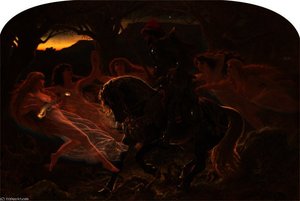
A man sits atop a horse, a solitary figure amidst a sudden surge of movement. Around him, the forest breathes with the presence of the Elle Maids. These women, appearing as nymphs or fairies, drift through the shadows and the light, their forms scattered like fallen petals across the woodland floor. Some linger in the foreground, their presence felt in the immediate air, while others recede into the deep green…

10
The Reconciliation of Oberon and Titania av Joseph Noël Paton

The Reconciliation of Oberon and Titania

Oil On Canvas · Scottish National Gallery, Edinburgh

The Reconciliation of Oberon and Titania emerges from the shadows of a Scottish forest, a scene where magic and emotion collide. Painted in 1847, this oil on canvas work by Sir Joseph Noel Paton captures a moment of profound transition. The air feels heavy with the aftermath of a great dispute, as the fairy rulers move toward a delicate peace. It is a sequel to a previous quarrel, a continuation…

Utvalget av Joseph Noël Paton fortsetter, fra 11 til 46

Motivene som fanget Joseph Noël Patons blikk

De fire motivene som går igjen hyppigst i disse originalverkene, hver med sitt fremste eksempel.

Museene som har Joseph Noël Patons originalverk

De 7 museene som innehar flest av maleriene på denne siden.

Museum By Verker av Joseph Noël Paton Malerier fra denne listen
Scottish National Gallery, EdinburghScottish National Gallery Edinburgh 3 The Reconciliation of Oberon and Titania, Dawn - Luther at Erfurt, The Quarrel of Oberon and Titania
Royal Collection, LondonRoyal Collection London 2 In Memoriam, 'Home': The Return from the Crimea
Yale Center for British Art, New HavenYale Center for British Art New Haven 1 Puck and Fairies, from "A Midsummer Night's Dream"
Israels Museum, JerusalemIsraels Museum Jerusalem 1 The Temptations of St. Anthony
Laing Art Gallery, New South WalesLaing Art Gallery New South Wales 1 The Man of Sorrows
Sheffield City Art Galleries, SheffieldSheffield City Art Galleries Sheffield 1 The Fairy Queen
Musée de Grenoble, GrenobleMusée de Grenoble Grenoble 1 Beati mundo corde

Joseph Noël Paton tiår for tiår: originalverket som definerer hvert av dem

Verk per tiår

Velg et tiår for å se originalverket som definerer det.

Samlere spør om maleriene til Joseph Noël Paton

Hvilket verk er Joseph Noël Paton mest kjent for?Avslør svaret

Hesperus, the Evening Star, Sacred to Lovers (1857). Deretter følger Puck and Fairies, from "A Midsummer Night's Dream" (1850) og Michelangelo's dream.

Hvor gammel var Joseph Noël Paton da Hesperus, the Evening Star, Sacred to Lovers ble laget?Avslør svaret

36 år gammel: Hesperus, the Evening Star, Sacred to Lovers er fra 1857, og Joseph Noël Paton ble født i 1821.

Hva er de ti mest kjente maleriene til Joseph Noël Paton?Avslør svaret

Hesperus, the Evening Star, Sacred to Lovers, Puck and Fairies, from "A Midsummer Night's Dream", Michelangelo's dream, The Temptations of St. Anthony, In Memoriam, The Man with the Muck Rake (study), Michelangelo Sculpting the Statue of 'Night', The choice, Oskold and the Elle Maids og The Reconciliation of Oberon and Titania. Rangeringen ovenfor viser årstall og museum for hvert verk.

Hvor mange malerier etterlot Joseph Noël Paton?Avslør svaret

Vår katalog inneholder 46 verk av Joseph Noël Paton, datert fra 1849 til 1875.

I hvilke museer henger mesterverkene til Joseph Noël Paton?Avslør svaret

Hovedsakelig i Scottish National Gallery (Edinburgh), Royal Collection (London) og Yale Center for British Art (New Haven). Museumslisten ovenfor viser alle.

I hvilke år malte Joseph Noël Paton sine mest kjente verk?Avslør svaret

I 1850s: 4 av de 46 verkene på denne siden ble laget da, Hesperus, the Evening Star, Sacred to Lovers av dem.

Hva er de første og de siste kjente originalverkene til Joseph Noël Paton?Avslør svaret

På denne siden er det eldste The Quarrel of Oberon and Titania (1849) og det nyeste The Man of Sorrows (1875).

Hvilke motiver valgte Joseph Noël Paton oftest?Avslør svaret

Man (5), Woman (5) og Forest (5), fordelt på 46 verk på denne siden.

Hvilken teknikk brukte Joseph Noël Paton mest?Avslør svaret

Oil On Canvas, for 4 av de 46 verkene på denne siden.

Hvilken kunstretning tilhører Joseph Noël Paton?Avslør svaret

Pre-raphaelite og Romanticism, basert på originalene på denne siden.

Hvilke verk av Joseph Noël Paton stilles ut på Scottish National Gallery?Avslør svaret

The Reconciliation of Oberon and Titania, Dawn - Luther at Erfurt og The Quarrel of Oberon and Titania: Scottish National Gallery, Edinburgh har 3 av verkene på denne siden.

Joseph Noël Paton: liv og virke

A Scottish Visionary: The Life and Art of Sir Joseph Noel Paton

Born in Dunfermline, Scotland, on December 13, 1821, Sir Joseph Noel Paton emerged as a unique voice within the Victorian art world. His upbringing amidst the intricate designs of damask weaving—his parents were skilled designers and weavers themselves—instilled in him an early appreciation for detail and pattern that would profoundly influence his artistic style. Though initially involved in the family business, directing design at a muslin factory, Paton’s true calling lay elsewhere. A thirst for artistic knowledge led him to Dunfermline Art Academy, laying the foundation for a career deeply rooted in Scottish folklore, Celtic legends, and religious narratives. A brief period of study at the Royal Academy in London in 1843 exposed him to the prevailing artistic currents, and an invitation from John Everett Millais to join the Pre-Raphaelite Brotherhood—an offer Paton ultimately declined—demonstrates his connection to this influential movement, even as he forged his own distinct path.

Early Influences and Artistic Development

Paton’s formative years were shaped by a profound engagement with visual culture. Witnessing the meticulous craftsmanship of damask weaving instilled in him an unwavering dedication to precision and textural richness—qualities that would permeate his artistic endeavors throughout his life. His decision to pursue formal art training at Dunfermline Art Academy solidified this commitment, equipping him with the technical skills necessary to translate imaginative visions into compelling artworks. The Royal Academy School provided exposure to the broader artistic landscape of London, fostering a dialogue between Victorian aesthetics and classical traditions. However, it was Millais’s encouragement that propelled Paton toward the Pre-Raphaelite Brotherhood—a movement characterized by its rejection of academic conventions and its embrace of Romantic idealism. This association profoundly impacted Paton's stylistic trajectory, influencing his penchant for dramatic lighting, vibrant color palettes, and psychologically nuanced depictions of human subjects.

The Quarrel of Oberon and Titania: A Triumph of Imagination

Paton’s artistic breakthrough arrived in 1847 with “The Quarrel of Oberon and Titania,” a monumental painting inspired by Shakespeare's *A Midsummer Night’s Dream*. This work instantly established Paton’s reputation for capturing fantastical scenes with remarkable realism—a hallmark of Pre-Raphaelite technique. Unlike many artists of his time who prioritized idealized beauty, Paton sought to convey the emotional intensity of the mythological drama through meticulous observation and expressive brushwork. He didn't merely depict fairies; he portrayed their passions, conflicts, and vulnerabilities—capturing a level of psychological complexity rarely achieved in Victorian art. The painting’s dramatic lighting—particularly the ethereal glow emanating from Titania’s crown—further enhanced its visual impact, creating an immersive experience for viewers. Its inclusion in the National Gallery of Scotland cemented Paton's place as one of Scotland’s foremost artistic figures.

Religious Narratives and Artistic Style

Beyond folklore, Paton explored religious themes with equal fervor, producing works that reflected his deep spiritual convictions. “Luther Discovering Justification by Faith,” completed in 1866, exemplifies Paton’s masterful ability to convey profound theological concepts through visual storytelling. Like “The Quarrel of Oberon and Titania,” this painting utilizes dramatic lighting and rich color palettes to heighten emotional resonance—a stylistic hallmark of his oeuvre. He skillfully blended elements of Nazarene art—characterized by its austere aesthetic and symbolic imagery—with Victorian sensibilities, resulting in artworks that are both aesthetically compelling and intellectually stimulating. His meticulous attention to detail—evident in the expressive faces of Luther and Felix Mendelssohn—underscores Paton’s commitment to artistic excellence.

Legacy and Recognition

Sir Joseph Noel Paton received widespread acclaim throughout his lifetime for his artistic achievements and contributions to Scottish culture. He was elected Associate of the Royal Scottish Academy in 1847 and Full Member in 1850—honors bestowed upon him by fellow artists recognizing his exceptional talent. Queen Victoria appointed him Her Majesty’s Linmer for Scotland in 1866—a prestigious position reflecting Paton's stature as a national icon. Two years later, he was knighted—acknowledging his significant impact on the arts and Scottish society. His enduring legacy resides not only in his celebrated paintings but also in his poetic endeavors—which explored themes of nature, spirituality, and human experience with lyrical grace. He published two volumes of poetry that captured the spirit of Victorian Scotland—demonstrating his multifaceted artistic vision. Paton’s works continue to inspire admiration for their beauty, psychological depth, and masterful execution—ensuring his place as a pivotal figure in Victorian art history.