Portrett av Giovanni Antonio Guardi

De 32 mest kjente Giovanni Antonio Guardi-maleriene, hvert og ett unikt

Oppdatert November 2026 · rangert etter vår popularitetsscore (søk, besøk og bestillinger for hvert verk) · 32 verk av Giovanni Antonio Guardi i vår katalog

Kort fortalt

Interior: A Sultana taking Coffee in the Harem (1742) er maleriet av Giovanni Antonio Guardi som vekker mest oppmerksomhet; originalen befinner seg i Art Institute of Chicago, Chicago. Deretter går blikket til Madonna on the cresent (1723) og Saint John the Baptist in the Wilderness (1738). Blant de 32 verkene til Giovanni Antonio Guardi i vår katalog, er disse 32 de mest kjente – hver og en et unikt originalverk presentert med sitt årstall, sitt museum og årsaken til at det består.

1699 – 1760, Vienna Baroque Flest verk: Chiesa dell'Angelo Raffaele

Topp 10 malerier av Giovanni Antonio Guardi, sett gjennom galleriets øyne

1
Interior: A Sultana taking Coffee in the Harem (1742) av Giovanni Antonio Guardi

Interior: A Sultana taking Coffee in the Harem

1742 · Oil On Canvas · Art Institute of Chicago, Chicago

The oil on canvas painting titled Interior: A Sultana taking Coffee in the Harem was created by Giovanni Antonio Guardi. This 18th-century work captures a Turkish scene of daily life within a harem. It presents a Sultana taking coffee in an elaborately imagined setting. The scene reflects a specific European fascination with the perceived luxury of the Ottoman world.

2
Madonna on the cresent (1723) av Giovanni Antonio Guardi

Madonna on the cresent

1723 · Oil On Canvas

In Madonna on the cresent by Giovanni Antonio Guardi, the vertical composition pulls the eye upward through a state of spiritual ecstasy. The Virgin Mary is positioned slightly off-center, her body caught in a moment of ascension. She gazes toward a celestial light source that breaks through the darkness. A halo of stars encircles her head, marking her place among the heavens. At her feet, a small cherub or putto…

4
Head of a Woman (1739) av Giovanni Antonio Guardi

Head of a Woman

1739 · Oil On Canvas · Cleveland Museum of Art, Cleveland

The portrait known as Head of a Woman emerges from the shadows of the early eighteenth century, a quiet moment captured in oil on canvas. This work, titled Head of a Woman, carries the hand of the Italian artist Giovanni Antonio Guardi. Born in 1699 and passing in 1760, Guardi brings a sense of presence to this figure, whose gaze and posture suggest a life lived within the elegant circles…

6
Two Odalisques Playing Mancala in the Harem (1742) av Giovanni Antonio Guardi

Two Odalisques Playing Mancala in the Harem

1742 · Oil On Canvas · Museum Kunstpalast, Düsseldorf

An intimate scene unfolds within a lavishly decorated interior, where three women occupy a space defined by heavy drapery and patterned textiles. Two figures are seated upon a divan, their attention fixed upon a board game, while a third woman stands facing the viewer. The composition relies on a dynamic, asymmetrical arrangement, anchored by a sweeping red curtain that descends from the upper right to create a sense of theatrical…

7
The Fight between Tancred and Argante With Clorinda in the Background (1737) av Giovanni Antonio Guardi

The Fight between Tancred and Argante With Clorinda in the Background

1737 · Oil · Statens Museum for Kunst, København

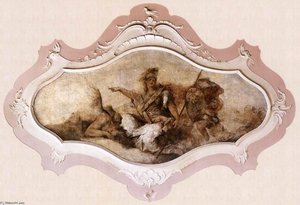
The Fight between Tancred and Argante With Clorinda in the Background is an oil painting by Giovanni Antonio Guardi. Created in 1737, this work captures a moment of intense physical struggle. The composition focuses on the duel between two armored warriors, while a third figure, Clorinda, is positioned in the distance on horseback. This arrangement provides a sense of narrative depth to the central conflict.

8
Jacopo Marcello Directing the Assault of Gallipoli (1760) av Giovanni Antonio Guardi

Jacopo Marcello Directing the Assault of Gallipoli

1760 · Drawing · Cleveland Museum of Art, Cleveland

In the evocative realm of eighteenth-century artistry, few works capture the tension of historical narrative as poignantly as Gianantonio Guardi’s Jacopo Marcello Directing the Assault of Gallipoli. Though rendered with the delicate precision characteristic of the Venetian Baroque, this piece serves as a window into a moment of profound command and impending conflict. The composition centers on the commanding presence of Jacopo Marcello, whose figure emerges from the shadows of…

9
The Amorous Turk (1742) av Giovanni Antonio Guardi

The Amorous Turk

1742 · Oil On Canvas

The Amorous Turk emerges from the canvas as a staged moment of intimacy, a scene captured by the hand of Giovanni Antonio Guardi. Created in 1742, this oil on canvas presents a glimpse into a choreographed world of romance and status. The figures within the frame seem caught in a private exchange, their presence defined by the textures of their attire and the architectural grandeur that surrounds them. One can…

10
The Sultan Being Brought Food and Drink (1742) av Giovanni Antonio Guardi

The Sultan Being Brought Food and Drink

1742 · Oil On Canvas

The painting titled The Sultan Being Brought Food and Drink was executed by the artist Giovanni Antonio Guardi. Created in 1742, this work belongs to the Rococo period. The composition focuses on a ceremonial scene within an Ottoman court, depicting a central figure seated on a throne-like structure while attendants present food and drink. The figures are dressed in traditional Ottoman attire, and the setting includes large windows with intricate…

Giovanni Antonio Guardis berømte malerier, nummer 11 til 32

Motivene som fanget Giovanni Antonio Guardis blikk

De fire motivene som går igjen hyppigst i disse originalverkene, hver med sitt fremste eksempel.

Museene som har Giovanni Antonio Guardis originalverk

De 8 museene som innehar flest av maleriene på denne siden.

Museum By Verker av Giovanni Antonio Guardi Malerier fra denne listen
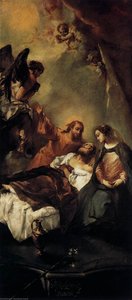
Chiesa dell'Angelo Raffaele, VeniceChiesa dell'Angelo Raffaele Venice 4 The Marriage of Tobias, The Healing of Tobias's Father, The Angel Appears to Tobias
Cleveland Museum of Art, ClevelandCleveland Museum of Art Cleveland 2 Head of a Woman, Jacopo Marcello Directing the Assault of Gallipoli
Museum Kunstpalast, DüsseldorfMuseum Kunstpalast Düsseldorf 2 Two Odalisques Playing Music in the Harem, Two Odalisques Playing Mancala in the Harem
Fitzwilliam MuseumFitzwilliam Museum 2 The Sala grande of the Ridotto, Palazzo Dandolo, S. Moisè, Pharoah's Daughter, after Palma il Giovane
Szépművészeti Múzeum, BudapestSzépművészeti Múzeum Budapest 2 Virgin and Child with Sts Dominic and Rosa of Lima (detail), Virgin and Child with Sts Dominic and Rosa of Lima
Art Institute of Chicago, ChicagoArt Institute of Chicago Chicago 1 Interior: A Sultana taking Coffee in the Harem
National Gallery of Ireland, DublinNational Gallery of Ireland Dublin 1 Saint John the Baptist in the Wilderness
Statens Museum for Kunst, KøbenhavnStatens Museum for Kunst København 1 The Fight between Tancred and Argante With Clorinda in the Background

Giovanni Antonio Guardi gjennom tiårene: ett unikt originalverk for hvert tiår

Verk per tiår

Velg et tiår for å se originalverket som definerer det.

Giovanni Antonio Guardis malerier: spørsmål til galleriet

Hva er det mest kjente verket til Giovanni Antonio Guardi?Avslør svaret

Interior: A Sultana taking Coffee in the Harem (1742), Art Institute of Chicago, Chicago. Deretter følger Madonna on the cresent (1723) og Saint John the Baptist in the Wilderness (1738).

Hvor gammel var Giovanni Antonio Guardi da Interior: A Sultana taking Coffee in the Harem ble skapt?Avslør svaret

43 år gammel: Interior: A Sultana taking Coffee in the Harem er fra 1742, og Giovanni Antonio Guardi ble født i 1699.

Hvilke ti malerier av Giovanni Antonio Guardi er de mest kjente?Avslør svaret

Interior: A Sultana taking Coffee in the Harem, Madonna on the cresent, Saint John the Baptist in the Wilderness, Head of a Woman, Two Odalisques Playing Music in the Harem, Two Odalisques Playing Mancala in the Harem, The Fight between Tancred and Argante With Clorinda in the Background, Jacopo Marcello Directing the Assault of Gallipoli, The Amorous Turk og The Sultan Being Brought Food and Drink. Rangeringen ovenfor viser årstall og museum for hvert verk.

Hvor mange verk av Giovanni Antonio Guardi er kjent?Avslør svaret

Vår katalog inneholder 32 verk av Giovanni Antonio Guardi, datert fra 1723 til 1760.

Hvor kan de mest kjente originalverkene til Giovanni Antonio Guardi ses?Avslør svaret

Hovedsakelig i Chiesa dell'Angelo Raffaele (Venice), Cleveland Museum of Art (Cleveland) og Museum Kunstpalast (Düsseldorf). Museumslisten ovenfor viser alle.

I hvilken periode malte Giovanni Antonio Guardi sine mest kjente malerier?Avslør svaret

I 1750s: 10 av de 32 verkene på denne siden ble laget da, Herminia and Vaprino Find the Wounded Tancred (detail) av dem.

Hvilket kjent maleri av Giovanni Antonio Guardi er det eldste, og hvilket er det nyeste?Avslør svaret

På denne siden er det eldste Madonna on the cresent (1723) og det nyeste Jacopo Marcello Directing the Assault of Gallipoli (1760).

Hvilke motiver foretrakk Giovanni Antonio Guardi?Avslør svaret

Man (10), Woman (9) og People (6), fordelt på 32 verk på denne siden.

Hvilke materialer brukte Giovanni Antonio Guardi mest av?Avslør svaret

Oil On Canvas, for 16 av de 32 verkene på denne siden.

Hvilken kunstretning tilhører verkene til Giovanni Antonio Guardi?Avslør svaret

Baroque, basert på originalene på denne siden.

Hvilke originalverk av Giovanni Antonio Guardi kan jeg se på Chiesa dell'Angelo Raffaele?Avslør svaret

The Marriage of Tobias, The Healing of Tobias's Father og The Angel Appears to Tobias: Chiesa dell'Angelo Raffaele, Venice har 4 av verkene på denne siden.

Giovanni Antonio Guardi: et portrett av kunstneren

The Dramatic Visionary of the Venetian Baroque

Gianantonio Guardi, a name synonymous with the theatrical splendor of the 18th century, stands as a pivotal figure in the evolution of the Venetian Baroque. Born in Vienna in 1699 into a noble family deeply rooted in artistic tradition, his life was shaped by the vibrant cultural currents that flowed between the imperial grandeur of Austria and the shimmering canals of Venice. As the son of the respected painter Domenico Guardi, Giovanni Antonio did not merely learn a craft; he inherited a legacy of meticulous observation and technical mastery. His formative years were spent immersed in an environment where art was both a familial duty and a profound way of interpreting the world, leading him to develop a style that would eventually capture the very soul of Venice.

The development of Guardi’s artistry was deeply intertwined with his family's collaborative spirit. Alongside his brothers, Francesco and Niccolò, he helped establish a studio that became a cornerstone of mid-18th-century Venetian painting. This period of his life was marked by a rigorous pursuit of excellence, further solidified by his involvement in the founding of the Accademia Veneziana. Through this institution, Guardi championed a unique synthesis of scientific accuracy and aesthetic beauty, pushing the boundaries of what Venetian art could achieve. His work moved away from the purely idealized forms of the past, seeking instead to document the pulse of the city with an almost journalistic precision, yet elevated by the dramatic flair characteristic of the Baroque era.

Mastery of Light and the Pulse of Daily Life

To gaze upon a Guardi masterpiece is to witness a masterclass in chiaroscuro. He possessed an unparalleled ability to manipulate the interplay between light and shadow, creating compositions that feel as though they are breathing with life. This dramatic lighting was never used merely for effect; rather, it served to direct the viewer's eye through complex, dynamic landscapes and bustling urban scenes. His brushwork captured the fleeting nature of light reflecting off canal waters or the soft glow of a religious procession moving through a crowded campo.

What truly distinguishes Guardi from his contemporaries was his profound commitment to realism and the celebration of the mundane. While other artists sought the divine in distant, mythological realms, Guardi found it in the streets of Venice. His canvases are populated by the true inhabitants of the Venetian Republic:

  • Market vendors engaged in the spirited haggling of daily commerce.
  • Gondoliers navigating the intricate labyrinth of the city's waterways.
  • Ordinary citizens participating in the grand religious and civic rituals that defined the era.

By focusing on these commonplace activities, Guardi achieved a level of palpable realism that allowed his work to resonate with both spiritual fervor and human connection. He did not just paint scenes; he captured the atmosphere, the noise, and the very texture of 18th-century life.

Legacy and Historical Significance

The historical significance of Gianantonio Guardi lies in his ability to bridge the gap between the grandiosity of the Baroque and a burgeoning interest in the observational realism that would define later centuries. He transformed the cityscape from a mere backdrop into a living, breathing protagonist. His meticulous attention to detail—capturing everything from the weathered stone of the Colleoni Statue to the lively energy of Campo Santi Paolo—ensured that his work serves as a vital historical record of a vanished era.

Today, Guardi is remembered not just as a painter of views, but as a storyteller of the human condition. His legacy persists in the way we perceive the intersection of architecture and life, reminding us that there is profound beauty to be found in the shadows of the everyday. Through his dynamic compositions and emotive use of light, he remains a definitive voice of the Venetian Baroque, leaving behind a visual testament to the enduring spirit of Venice.