Portret van Wincenty Smokowski

De 24 beroemdste schilderijen van Wincenty Smokowski, elk uniek

Bijgewerkt in november 2026 · gerangschikt op basis van onze populariteitsscore (zoekopdrachten, bezoeken en bestellingen per kunstwerk) · 24 werken van Wincenty Smokowski in onze catalogus

Kortom

Conversation (1800) is het schilderij van Wincenty Smokowski dat de meeste aandacht trekt; het origineel bevindt zich in het Lithuanian Art Fund, Vilnius. Daarna gaat de blik naar Peasant talk (1800) en Entry of Boleslaus the Brave into Kiev. (1830). Van de 24 werken van Wincenty Smokowski in onze catalogus zijn dit de 24 bekendste, elk een uniek origineel gepresenteerd met het jaar, het museum en de reden waarom het blijft voortbestaan.

1797 – 1876, Vilnius Academicism Meeste werken: Lithuanian Art Fund

Top 10 schilderijen van Wincenty Smokowski, door de ogen van de galerie

1
Conversation (1800) door Wincenty Smokowski

Conversation

1800 · Lithograph · Lithuanian Art Fund, Vilnius

This black and white lithograph captures a fleeting social moment through a group of four figures. Rendered with a loose, sketchy quality, the work functions as a preparatory study, prioritizing the immediacy of gesture and character over finished precision. The composition is centered on the group, utilizing an asymmetrical arrangement to create a sense of movement within the quietude of the scene. Lines are used expressively to define the anatomy…
2
Peasant talk (1800) door Wincenty Smokowski

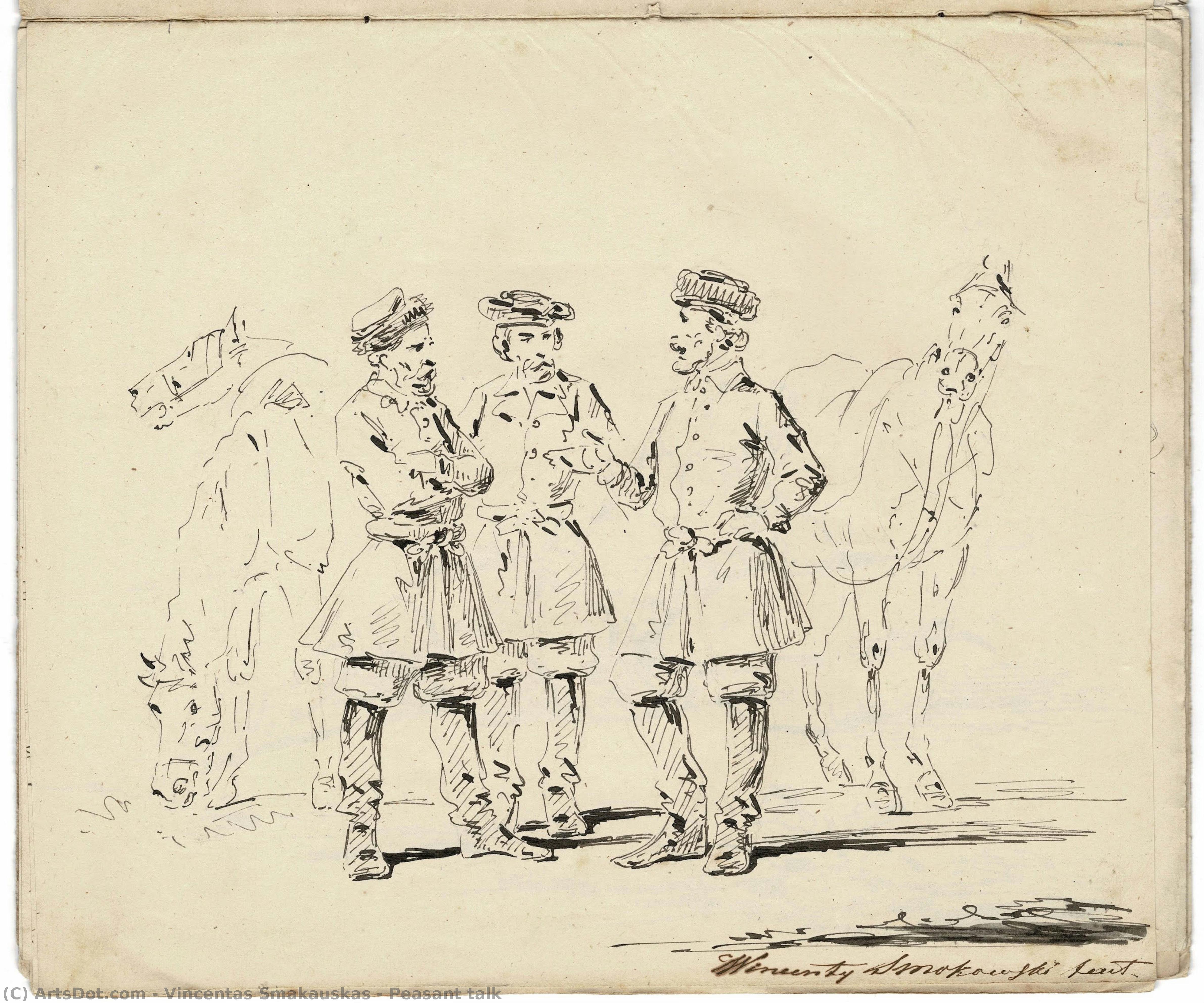
Peasant talk

1800 · Ink On Paper · Lithuanian Art Fund, Vilnius

Four men stand locked in a quiet, urgent circle, their bodies leaning inward as if the very air between them holds a secret. They wear the heavy, structured uniforms of soldiers, yet the rigidity of their attire contrasts with the loose, spontaneous energy of their interaction. This is a study of human connection caught in a fleeting instant. The scene feels less like a formal portrait and more like a…

3
Entry of Boleslaus the Brave into Kiev. (1830) door Wincenty Smokowski

Entry of Boleslaus the Brave into Kiev.

1830 · Oil · Nationaal Museum in Warschau, Warschau

The composition centers on a white horse carrying a knight, positioned within a crowded, dynamic military procession. This central figure moves through a fortified city gate, framed by an arched upper boundary that directs the eye toward the cavalry. The scene is filled with movement, established by the diagonal placement of horses and the upward gestures of the surrounding crowd. Deep reds appear in the banners and clothing of the…

4
Gypsy encampment upon a creek. (1850) door Wincenty Smokowski

Gypsy encampment upon a creek.

1850 · Oil On Canvas · Nationaal Museum in Warschau, Warschau

The air feels heavy with the scent of damp earth and woodsmoke as twilight descends upon this secluded forest clearing. Shadows stretch long and deep from the massive, dark tree trunks that frame the scene, creating a sense of profound intimacy within the grove. At the center of this quiet drama, a group of figures gathers on a sandy bank beside a slow-moving creek. The light seems to emanate from…

5
Jewish wedding. (1858) door Wincenty Smokowski

Jewish wedding.

1858 · Oil On Canvas · Nationaal Museum in Warschau, Warschau

The village street narrows under the weight of a celebration. A wedding procession moves through the earthy landscape, a slow river of humanity flowing between thatched-roof cottages. The air feels thick with the scent of dry straw and the sound of wood and string. Musicians lead the way, their cello and violin carving melodies into the late afternoon light. A bride moves through the center, her attire a quiet contrast…

6
Rest (1800) door Wincenty Smokowski

Rest

1800 · Drawing · Lithuanian Art Fund, Vilnius

The drawing, rendered in black and white, depicts a solitary man lying on the ground in a state of repose. His head rests upon a large, solid stone, which provides a hard contrast to the softer lines of his body. The man's limbs appear heavy, suggesting a state of deep sleep or total exhaustion. The composition is quiet, focusing on the physical contact between the human form and the natural…

7
Domestic scene (Children and nannies) (1800) door Wincenty Smokowski

Domestic scene (Children and nannies)

1800 · Drawing · Lithuanian Art Fund, Vilnius

In the delicate, monochromatic strokes of Vincentas Smakauskas’s 1800 drawing, Domestic scene (Children and nannies), we are invited to step through a portal into the private sanctums of nineteenth-century life. This exquisite work captures a fleeting moment of familial cohesion, where the boundaries between generations blur in a shared space of warmth and togetherness. The composition presents a gathering of at least nine individuals, a tapestry of souls woven together…

8
Domestic scene (noble family) (1800) door Wincenty Smokowski

Domestic scene (noble family)

1800 · Drawing · Lithuanian Art Fund, Vilnius

The year 1800 arrives through a window of ink and shadow. In this black and white drawing, a mother exists as the center of a small, breathing universe. She holds an infant close, her form the anchor for a circle of children who gravitate toward her warmth. There is a stillness here, a held breath in the middle of a domestic afternoon. The light does not shout; it merely traces…

9
Sacrifice for beggar (1800) door Wincenty Smokowski

Sacrifice for beggar

1800 · Ink · Lithuanian Art Fund, Vilnius

Around 1800, Vincentas Smakauskas captured a spirited street dance in this monochromatic drawing. The scene depicts figures moving in synchronized harmony, their forms etched with rhythmic precision. Light and shadow define the dancers, creating a sense of motion that transcends the stillness of the paper. Within the composition, two bowls sit placed in the frame, suggesting a narrative of shared sustenance and communal care. This small 6 x 17 cm…

10
Grief (1800) door Wincenty Smokowski

Grief

1800 · Drawing · Lithuanian Art Fund, Vilnius

The work titled Grief is a creation of Wincenty Smokowski. Born in 1797 in Vilnius, Lithuania, the artist was a prominent Polish-Lithuanian painter and illustrator. His hand moved through the academic and classical styles, seeking to map the contours of the human experience. This specific piece remains a poignant example of his ability to capture such internal weight.

De beroemde schilderijen van Wincenty Smokowski, nummer 11 tot 24

De beroemde schilderijen van Wincenty Smokowski, periode voor periode

De onderwerpen die de aandacht van Wincenty Smokowski troffen

De vier onderwerpen die het meest voorkomen in deze originelen, elk met zijn mooiste voorbeeld.

De musea waar de originele werken van Wincenty Smokowski worden bewaard

De 2 musea met de meeste schilderijen op deze pagina.

Museum Stad Werken van Wincenty Smokowski Schilderijen uit deze lijst
Lithuanian Art Fund, VilniusLithuanian Art Fund Vilnius 19 Conversation, Peasant talk, Rest
Nationaal Museum in Warschau, WarschauNationaal Museum in Warschau Warschau 5 Entry of Boleslaus the Brave into Kiev., Gypsy encampment upon a creek., Jewish wedding.

Wincenty Smokowski door de decennia heen: elk een uniek origineel

Werken per decennium

Kies een decennium om het origineel te zien dat dit tijdperk definieert.

Schilderijen van Wincenty Smokowski: vragen voor de galerie

Wat is het bekendste werk van Wincenty Smokowski?Onthul het antwoord

Conversation (1800), Lithuanian Art Fund, Vilnius. Peasant talk (1800) en Entry of Boleslaus the Brave into Kiev. (1830) volgen.

Welke tien schilderijen van Wincenty Smokowski zijn het meest bekend?Onthul het antwoord

Conversation, Peasant talk, Entry of Boleslaus the Brave into Kiev., Gypsy encampment upon a creek., Jewish wedding., Rest, Domestic scene (Children and nannies), Domestic scene (noble family), Sacrifice for beggar en Grief. De bovenstaande ranglijst vermeldt het jaar en het museum van elk werk.

Hoeveel werken van Wincenty Smokowski zijn er bekend?Onthul het antwoord

Onze catalogus bevat 24 werken van Wincenty Smokowski, daterend van 1830 tot 1858.

Waar kunnen de beroemdste originelen van Wincenty Smokowski worden bekeken?Onthul het antwoord

Voornamelijk in Lithuanian Art Fund (Vilnius) en Nationaal Museum in Warschau (Warschau). De bovenstaande museumtabel bevat een volledig overzicht.

In welke periode creëerde Wincenty Smokowski de bekendste schilderijen?Onthul het antwoord

In 1850s: 2 van de 24 werken op deze pagina werden toen gemaakt, waaronder Gypsy encampment upon a creek..

Welk beroemd schilderij van Wincenty Smokowski is de vroegste, en welke de laatste?Onthul het antwoord

Op deze pagina is het vroegste Entry of Boleslaus the Brave into Kiev. (1830) en het laatste Jewish wedding. (1858).

Welke onderwerpen had Wincenty Smokowski de voorkeur?Onthul het antwoord

People (9), Black and white (9) en Man (6), verspreid over de 24 werken op deze pagina.

Met welke materialen schilderde Wincenty Smokowski het meest?Onthul het antwoord

Drawing, voor 13 van de 24 werken op deze pagina.

Bij welke stroming behoort het werk van Wincenty Smokowski?Onthul het antwoord

Academicism, te oordelen aan de originelen op deze pagina.

Welke originele werken van Wincenty Smokowski kan ik zien in het Lithuanian Art Fund?Onthul het antwoord

Conversation, Peasant talk en Rest: het Lithuanian Art Fund, Vilnius herbergt 19 van de werken op deze pagina.

Wincenty Smokowski: een portret van de kunstenaar

vroege jaren en opleiding

vincentas smakauskas, ook bekend als wincenty smokowski, was een vooraanstaande Pools-Litouwse schilder en illustrator, geboren in vilnius, litouwen in 1797. zijn artistieke reis begon aan de vilnius universiteit, waar hij van 1817 tot 1822 studeerde onder de begeleiding van de engelse graveur en professor in de schone kunsten, joseph saunders. smakauskas vervolgde zijn vorming vervolgens aan de keizerlijke academie voor kunst in sint-pietersburg tussen 1823 en 1829. tijdens deze periode bewees hij zijn talent op internation niveau door in 1825 een zilveren medaille te winnen en in 1827 een gouden medaille te ontvangen voor zijn indrukwekkende interpretatie van de dood van epaminondas.

artistieke carrière en bemerkenswaardige werken

smakauskas verwierf grote bekendheid door zijn veelzijdige oeuvre, variërend van diepgaande portretten en historische scènes tot verstilde landschappen en genreschilderkunst. wat zijn werk bijzonder maakt, is de ongekunstelde en vooroordelingsvrije weergave van het dagelijks leven, met een bijzondere aandacht voor de portrettering van joden en zigeuners. onder zijn meest sprekende werken behoren:
  • grief (lithuanian art fund, vilnius, litouwen), een ontroerend voorbeeld van zijn vermogen om de diepste menselijke emoties te vangen.
  • bathing (lithuanian art fund, vilnius, litouwen), waarin hij zijn meesterschap in het afbeelden van alledaagse momenten toont.
  • mischievous children (lithunian art fund, vilnius, litouwen), een hartverwarmende weergave van de onschuld van de kindertijd.
      deze werken zijn te bewonderen op de vincentas smakauskas pagina van OriginalUniqueArt.com, die een uitgebreide collectie van zijn kunstwerken herbergt.

      medische carrière en latere leven

      naast zijn artistieke passies volgde smakauskas ook een wetenschappelijk pad; hij studeerde in 1836 af aan de "vilnius medico-surgical academy". van 1841 tot 1856 diende hij als arts in de regio švenčionys en oefende later de geneeskunst uit op het landgoed van zijn vrouw in krikonys, waar hij bleef tot aan zijn overlijden in 1876.

      erfenis

      de bijdrage van smakauskas aan de kunstwereld reikt verder dan alleen zijn eigen schilderijen. hij leverde eveneens prachtige illustraties voor belangrijke literaire meesterwerken, zoals konrad wallenrod (1828) en pan tadeusz (1860) van adam mickiewicz. dat een straat in de pašilaičiai wijk van vilnius naar hem is vernoemd, dient als een blijvend eerbetoon aan zijn nalatenschap. voor verdere verdieping in het leven van deze fascinerende kunstenaar kunt u terecht op de wincenty smokowski pagina op wikipedia. voor meer informatie over de kunstwerken van smakauskas en andere vooraanstaande kunstenaars, bezoek OriginalUniqueArt.com.