Portret van William Henry Hunt

De 100 beroemdste schilderijen van William Henry Hunt, elk uniek

Bijgewerkt in november 2026 · gerangschikt op basis van onze populariteitsscore (zoekopdrachten, bezoeken en bestellingen per kunstwerk) · 102 werken van William Henry Hunt in onze catalogus

Kortom

Still Life Of A Dead Goose With A Basket, (1835) is het schilderij van William Henry Hunt dat de meeste aandacht trekt. Daarna gaat de blik naar The gardener (1825) en A Sportsman with a Boy, a Pony and a Dog (1827). Van de 102 werken van William Henry Hunt in onze catalogus zijn dit de 100 bekendste, elk een uniek origineel gepresenteerd met het jaar, het museum en de reden waarom het blijft voortbestaan.

1827 – 1910, Cheapside Naturalism Meeste werken: Birmingham Museum and Art Gallery

Top 10 schilderijen van William Henry Hunt, door de ogen van de galerie

1
Still Life Of A Dead Goose With A Basket, (1835) door William Henry Hunt

Still Life Of A Dead Goose With A Basket,

1835 · Watercolor

A single goose rests within a basket, its form settled deeply into a bed of hay. The bird appears motionless, its presence defined by a quietude that borders on sleep. This composition focuses on the textures of the natural world: the coarse weave of the basket, the dry, scattered stalks of hay, and the soft, organic contours of the bird. The scene captures a moment of profound stillness, stripping away…

2
The gardener (1825) door William Henry Hunt

The gardener

1825 · Watercolor

A man stands in profile, his weight settled against the steady rhythm of rural labor. He is a gardener, captured in the soft, diffused light of a day that feels neither bright nor dark, but merely present. His silhouette is defined by a simple waistcoat and a tall hat, the attire of a man whose life is measured by the seasons and the soil. Across his shoulders, two heavy baskets…

3
A Sportsman with a Boy, a Pony and a Dog (1827) door William Henry Hunt

A Sportsman with a Boy, a Pony and a Dog

1827 · Oil On Canvas

In A Sportsman with a Boy, a Pony and a Dog, William Henry Hunt captures a quiet moment from 19th-century rural life. The scene unfolds with a sportsman walking alongside a young boy, accompanied by a sturdy pony and a loyal dog. They move through a landscape that feels lived-in and breathing, a world where the pace of life follows the rhythms of the countryside. This gathering of figures suggests…

4
Sunday morning (1831) door William Henry Hunt

Sunday morning

1831 · Watercolor

In "Sunday morning" by William Henry Hunt, the composition centers on a single female figure. Positioned slightly off-center, she anchors the domestic scene. A large window dominates the background, establishing the primary architectural boundary of the room. Around the woman, various furniture elements—including a chair, a table, and a dresser—are arranged to define the intimate interior space.

5
The farmers daughter (1837) door William Henry Hunt

The farmers daughter

1837 · Watercolor

The farmers daughter, painted by William Henry Hunt about 1837, presents a quiet study of youth and rural life. The subject is a young girl, likely from an agricultural background, as suggested by the title. She is positioned centrally, seated in a chair and facing the viewer directly. Her expression is marked by a sense of quiet introspection or a slight melancholy, lending a wistful quality to the portrait.

6
Mrs Gurney Hoare (1837) door William Henry Hunt

Mrs Gurney Hoare

1837 · Oil On Canvas

In Mrs Gurney Hoare, William Henry Hunt positions the subject slightly off-center to the right, creating a balanced tension with the fireplace situated on the left. The woman is seated within an interior setting, her attention entirely absorbed by a book. This quiet, domestic arrangement focuses the viewer's eye on her contemplative posture. The composition relies on a series of intersecting lines, where the verticality of the architectural elements and…

7
Slumber (1840) door William Henry Hunt

Slumber

1840 · Oil On Canvas · Birmingham Museum and Art Gallery, Birmingham

In the artwork Slumber by William Henry Hunt, a young girl is shown asleep within the confines of a rustic barn or shed. The subject matter focuses on a quiet moment of rural life, centered on the figure of the child resting amidst hay. This scene, painted about 1840, captures a period of stillness and innocence through its depiction of a child in a simple, agricultural setting.

8
Boy and goat (1836) door William Henry Hunt

Boy and goat

1836 · Watercolor · Victoria and Albert Museum, Londen

William Henry Hunt's “Boy and Goat,” painted in 1836, isn’t merely a depiction of rural life; it’s a carefully constructed tableau brimming with quiet observation and a subtle yearning for simpler times. The watercolor captures a young boy, seemingly lost in contemplation, standing beside a sturdy black goat within a sun-drenched field. The scene unfolds with an immediacy that draws the viewer into its gentle embrace – a feeling of…

9
A Primula And A Bird's Nest On A Mossy Bank door William Henry Hunt

A Primula And A Bird's Nest On A Mossy Bank

Watercolor

A quiet corner of the English countryside is distilled into a concentrated study of life and fragility. In this composition, a bird's nest containing three eggs rests within a lush, mossy embankment, tucked away from the wider landscape. Nearby, a cluster of primula flowers provides a soft counterpoint to the structural complexity of the nest. The scene focuses on the minute details of the natural world, where the texture of…

10
Lobster, Crab and Cucumber (1827) door William Henry Hunt

Lobster, Crab and Cucumber

1827 · Oil On Canvas · Birmingham Museum and Art Gallery, Birmingham

We are looking at Lobster, Crab and Cucumber, a quiet still life painting by William Henry Hunt. This particular work dates to about 1827, a period when the artist was establishing his presence within the London art scene. The composition focuses on a simple, horizontal arrangement of seafood and vegetables resting upon a wooden surface.

De beroemde schilderijen van William Henry Hunt, nummer 11 tot 100

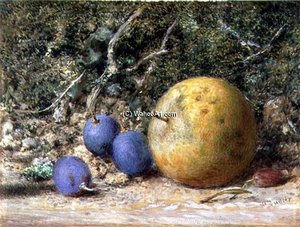
11An Oysterman, (1827) door William Henry HuntAn Oysterman,1827 12Barn Interior, (1836) door William Henry HuntBarn Interior,1836 13Boy And Goat, (1836) door William Henry HuntBoy And Goat,1836 14The Turnip Lantern, (1838) door William Henry HuntThe Turnip Lantern,1838 15Still Life of a dead goose with a Basket (1835) door William Henry HuntStill Life of a dead goose with a Basket1835 16Old Mill and Lock Gates (St.Catherine's) (1840) door William Henry HuntOld Mill and Lock Gates (St.Catherine's)1840 17A Young Woman Sewing door William Henry HuntA Young Woman Sewing 18Study Of A Young Girl door William Henry HuntStudy Of A Young Girl 19Astonishment, Lithograph door William Henry HuntAstonishment, Lithograph 20A Woman Sewing In A Cottage Garden, Edgware door William Henry HuntA Woman Sewing In A Cottage Garden, Edgware 21Head Of A Bearded Man door William Henry HuntHead Of A Bearded Man 22A Study Of A Boy With A Dog door William Henry HuntA Study Of A Boy With A Dog 23Christmas Pie door William Henry HuntChristmas Pie 24Interior Of A Barn With Chickens door William Henry HuntInterior Of A Barn With Chickens 25A Boy With A Begging Dog door William Henry HuntA Boy With A Begging Dog 26Mother and child door William Henry HuntMother and child 27Morris river landscape door William Henry HuntMorris river landscape 28Fancy Dress door William Henry HuntFancy DressNationaal Museum in Warschau 29Cottages At St. Albans door William Henry HuntCottages At St. Albans 30Study From Nature At Twickenham door William Henry HuntStudy From Nature At Twickenham 31A Young Lady, Seated On A Chair, Seen From The Back door William Henry HuntA Young Lady, Seated On A Chair, Seen From The Back 32Still Life door William Henry HuntStill Life 33Still Life_2 door William Henry HuntStill Life_2 34A Mulatto Boy door William Henry HuntA Mulatto Boy 35Grapes And Peaches, 19th Century door William Henry HuntGrapes And Peaches, 19th Century 36Roses And Bird's Nest door William Henry HuntRoses And Bird's Nest 37The Frugal Meal door William Henry HuntThe Frugal Meal 38Primulas And A Bird's Nest On A Mossy Bank door William Henry HuntPrimulas And A Bird's Nest On A Mossy Bank 39Bubbles door William Henry HuntBubbles 40Wild Roses And Birds' Nests door William Henry HuntWild Roses And Birds' Nests 41Long Tailed Tits' Nest door William Henry HuntLong Tailed Tits' Nest 42Still Life With Fruit In A Basket And A Peony door William Henry HuntStill Life With Fruit In A Basket And A Peony 43The Broken Pitcher door William Henry HuntThe Broken Pitcher 44A Field On The Outskirts Of Bushey, Hertfordshire door William Henry HuntA Field On The Outskirts Of Bushey, Hertfordshire 45Schoolboys With A Stolen Nest door William Henry HuntSchoolboys With A Stolen Nest 46The butcher's boy door William Henry HuntThe butcher's boy 47The Eavesdropper door William Henry HuntThe Eavesdropper 48Hearing Lessons door William Henry HuntHearing Lessons 49Still Life Of A Shell And Berries On A Mossy Bank door William Henry HuntStill Life Of A Shell And Berries On A Mossy Bank 50The silver lining door William Henry HuntThe silver lining 51Still Life With Bird's Nest door William Henry HuntStill Life With Bird's Nest 52Magnum Bonum And Orleans Plums door William Henry HuntMagnum Bonum And Orleans Plums 53Head Of A Gypsy Boy door William Henry HuntHead Of A Gypsy Boy 54Portrait Of One Of The Swain Brothers Holding A Pitcher door William Henry HuntPortrait Of One Of The Swain Brothers Holding A Pitcher 55Still Life With Fruit door William Henry HuntStill Life With Fruit 56Still-life With White And Black Grapes And Redcurrents door William Henry HuntStill-life With White And Black Grapes And Redcurrents 57A Young Boy Viewing A Picture By Candlelight door William Henry HuntA Young Boy Viewing A Picture By Candlelight 58Study Of A Young Girl Reclining On A Sofa door William Henry HuntStudy Of A Young Girl Reclining On A Sofa 59Still-life Of Rosehips, Blackberries And Plums, On A Mossy Bank door William Henry HuntStill-life Of Rosehips, Blackberries And Plums, On A Mossy Bank 60The Faithful Old Servant door William Henry HuntThe Faithful Old Servant 61Still-life With Basket, Nest, Egg, Red Currants And Ladybird door William Henry HuntStill-life With Basket, Nest, Egg, Red Currants And Ladybird 62The Barber door William Henry HuntThe Barber 63The Finishing Touches door William Henry HuntThe Finishing Touches 64Still Life With Plums And Hazelnuts On A Mossy Bank door William Henry HuntStill Life With Plums And Hazelnuts On A Mossy Bank 65Plumsplums door William Henry HuntPlumsplums 66Still Life Of Grapes, A Tankard And A Sprig Of Holly door William Henry HuntStill Life Of Grapes, A Tankard And A Sprig Of Holly 67Three Grapes And An Apple door William Henry HuntThree Grapes And An Apple 68The Faggot-gatherers Meal door William Henry HuntThe Faggot-gatherers Meal 69Still-life With Birds Nest And Hawthorne On A Mossy Bank door William Henry HuntStill-life With Birds Nest And Hawthorne On A Mossy Bank 70Still Life With Birds' Nests door William Henry HuntStill Life With Birds' Nests 71Still Life With Two Apples And A Snail Shell door William Henry HuntStill Life With Two Apples And A Snail Shell 72Landscape With Elm Trees And A Farm, Near Bayswater door William Henry HuntLandscape With Elm Trees And A Farm, Near Bayswater 73New Court door William Henry HuntNew Court 74Asking For Trouble door William Henry HuntAsking For Trouble 75Grapes And A Pineapple door William Henry HuntGrapes And A Pineapple 76Chaffinch Nest And May Blossom door William Henry HuntChaffinch Nest And May Blossom 77The Young Connoisseur door William Henry HuntThe Young Connoisseur 78The Musical Conversation - door William Henry HuntThe Musical Conversation - 79Still Life Of Flowers And Nest door William Henry HuntStill Life Of Flowers And Nest 80Girl in Candlelight door William Henry HuntGirl in Candlelight 81A Lady Reading, called Mrs William Hunt, c.1835 door William Henry HuntA Lady Reading, called Mrs William Hunt, c.1835 82The Musical Conversation door William Henry HuntThe Musical Conversation 83A Gardener In His Potting Shed door William Henry HuntA Gardener In His Potting Shed 84Farmyard With Pond door William Henry HuntFarmyard With Pond 85A Lady At Her Toilette door William Henry HuntA Lady At Her Toilette 86Portrait of a boy, bust-length, wearing a hat door William Henry HuntPortrait of a boy, bust-length, wearing a hat 87Branch Of Apple Blossom And Bird's Nest door William Henry HuntBranch Of Apple Blossom And Bird's Nest 88A Distant View Of Windsor Castle door William Henry HuntA Distant View Of Windsor CastleAnglesey Abbey 89Still Life Of A Dead Bird; And Still Life Of Two Shells On A Mossy Bank door William Henry HuntStill Life Of A Dead Bird; And Still Life Of Two Shells On A Mossy Bank 90Still Life With A Pineapple And Three Plums door William Henry HuntStill Life With A Pineapple And Three Plums 91Still Life Of Fruit door William Henry HuntStill Life Of Fruit 92Self Portrait - door William Henry HuntSelf Portrait -National Portrait Gallery 93Glass Vase And Flowers door William Henry HuntGlass Vase And Flowers 94Self Portrait door William Henry HuntSelf Portrait 95Head Study Of A Gentleman, Traditionally Identified As The Artist's Uncle door William Henry HuntHead Study Of A Gentleman, Traditionally Identified As The Artist's Uncle 96The Green Drawing Room Of The Earl Of Essex At Cassiobury door William Henry HuntThe Green Drawing Room Of The Earl Of Essex At Cassiobury 97Plucking The Fowl door William Henry HuntPlucking The Fowl 98Still life with greengages and plums on a mossy bank door William Henry HuntStill life with greengages and plums on a mossy bank 99Still Life With roses In A vase And A Birds Nest door William Henry HuntStill Life With roses In A vase And A Birds Nest 100Still life with sea shells on a mossy bank door William Henry HuntStill life with sea shells on a mossy bank

De beroemde schilderijen van William Henry Hunt, periode voor periode

De onderwerpen die de aandacht van William Henry Hunt troffen

De vier onderwerpen die het meest voorkomen in deze originelen, elk met zijn mooiste voorbeeld.

De musea waar de originele werken van William Henry Hunt worden bewaard

De 5 musea met de meeste schilderijen op deze pagina.

Museum Stad Werken van William Henry Hunt Schilderijen uit deze lijst
Birmingham Museum and Art Gallery, BirminghamBirmingham Museum and Art Gallery Birmingham 2 Slumber, Lobster, Crab and Cucumber
Victoria and Albert Museum, LondenVictoria and Albert Museum Londen 1 Boy and goat
Nationaal Museum in Warschau, WarschauNationaal Museum in Warschau Warschau 1 Fancy Dress
Anglesey AbbeyAnglesey Abbey 1 A Distant View Of Windsor Castle
National Portrait Gallery, LondenNational Portrait Gallery Londen 1 Self Portrait -

William Henry Hunt door de jaren heen: de unieke originelen van elk werk

Tussen 1835 en 1840, in totaal 6 jaar, maakte William Henry Hunt elk gedateerd origineel dat hier wordt getoond: een korte periode, jaar na jaar gevolgd.

Werken per jaar

Selecteer een jaar om de originele werken te bekijken.

Schilderijen van William Henry Hunt: vragen voor de galerie

Wat is het bekendste werk van William Henry Hunt?Onthul het antwoord

Still Life Of A Dead Goose With A Basket, (1835). The gardener (1825) en A Sportsman with a Boy, a Pony and a Dog (1827) volgen.

Op welke leeftijd creëerde William Henry Hunt Still Life Of A Dead Goose With A Basket,?Onthul het antwoord

8 jaar oud: Still Life Of A Dead Goose With A Basket, dateert uit 1835, en William Henry Hunt werd geboren in 1827.

Welke tien schilderijen van William Henry Hunt zijn het meest bekend?Onthul het antwoord

Still Life Of A Dead Goose With A Basket,, The gardener, A Sportsman with a Boy, a Pony and a Dog, Sunday morning, The farmers daughter, Mrs Gurney Hoare, Slumber, Boy and goat, A Primula And A Bird's Nest On A Mossy Bank en Lobster, Crab and Cucumber. De bovenstaande ranglijst vermeldt het jaar en het museum van elk werk.

Hoeveel werken van William Henry Hunt zijn er bekend?Onthul het antwoord

Onze catalogus bevat 102 werken van William Henry Hunt, daterend van 1835 tot 1840.

Waar kunnen de beroemdste originelen van William Henry Hunt worden bekeken?Onthul het antwoord

Voornamelijk in Birmingham Museum and Art Gallery (Birmingham), Victoria and Albert Museum (Londen) en Nationaal Museum in Warschau (Warschau). De bovenstaande museumtabel bevat een volledig overzicht.

In welke periode creëerde William Henry Hunt de bekendste schilderijen?Onthul het antwoord

In 1836: 3 van de 100 werken op deze pagina werden toen gemaakt, waaronder Boy and goat.

Welk beroemd schilderij van William Henry Hunt is de vroegste, en welke de laatste?Onthul het antwoord

Op deze pagina is het vroegste Still Life Of A Dead Goose With A Basket, (1835) en het laatste Slumber (1840).

Welke onderwerpen had William Henry Hunt de voorkeur?Onthul het antwoord

Life (19), Animals (7) en Still life (6), verspreid over de 100 werken op deze pagina.

Met welke materialen schilderde William Henry Hunt het meest?Onthul het antwoord

Watercolor, voor 12 van de 100 werken op deze pagina.

Bij welke stroming behoort het werk van William Henry Hunt?Onthul het antwoord

Naturalism, te oordelen aan de originelen op deze pagina.

Welke originele werken van William Henry Hunt kan ik zien in het Birmingham Museum and Art Gallery?Onthul het antwoord

Slumber en Lobster, Crab and Cucumber: het Birmingham Museum and Art Gallery, Birmingham herbergt 2 van de werken op deze pagina.

William Henry Hunt: een portret van de kunstenaar

De lichtgevende erfenis van William Henry Hunt

In de gouden eeuw van de Britse aquarel beschikten weinig handen over de delicate precisie en bezielde observatiekracht van William Henry Hunt. Geboren in het bruisende hart van Cheapside, Londen, kwam Hunt naar voren als een spilfiguur van het Victoriaanse tijdperlt, een periode waarin de intimiteit van de natuur vaak werd gevangen door een lens van diepe spirituele en esthetische gevoeligheid. Zijn reis naar het meesterschap van licht en pigment begon onder de begeleiding van de gewaardeerde John Varley, een relatie die veel meer was dan louter een leertijd. Via Varley werd Hunt geïntroduceerd in een lijn van visionair denken, diep verbonden met de mystieke en symbolische tradities van kunstenaars als William Blake. Deze vroege blootstelling gaf hem een levenslange gave om voorbij het oppervlak van een onderwerp te kijken, waarbij hij de stille, ademende essentie vond in een eenvoudig vogelnest of een tros wilde bloemen.

Naarmate zijn technische vaardigheid volwassen werd, werd Hunt een integraal onderdeel van de opkomende Londense kunstwereld, specifiek door zijn gevierde betrokkenheid bij de Society of Painters in Watercolors. Zijn opmars binnen deze prestigieuze instelling—waarbij hij in 1827 van geassocieerd lid tot voltijdig lid promoveerde—merkte hem aan als een leidende stem onder zijn tijdgenoten. In tegenstelling tot de rigide academische stijlen die het grootste deel van het tijdperk domineerden, omarmde het werk van Hunt de vloeiende, emotieve mogelijkheden van het medium. Hij beheerste de kunst van het aanbrengen van transparante glazuren om een gevoel van interne lichtkracht te creëren, waarbij hij vaak speelde met de ruwe texturen van het papier om de organische complexiteit van de natuurlijke wereld te suggereren. Zijn composities waren nooit louter decoratief; het waren zorgvuldig georkestreerde studies in textuur en atmosfeer.

Een meesterschap over de natuur en het stilleven

De ware magie van Hunts oeuvre ligt in zijn vermogen om het alledaagse tot iets groots te verheffen. Hij bezat een uniek talent voor het stilleven, met name wanneer hij zich richtte op het botanische en het ornithologische. Zijn werken, zoals het adembenemende Primulas And A Bird's Nest On A Mossy Bank, tonen een bijna wetenschappelijke aandacht voor detail, gepaard met een romantische, droomachtige sfeer. In deze stukken kan men de delicate nerven van een bloemblad of de fragiele architectuur van een nest volgen, allemaal weergegeven met een zachtheid die de vergankelijkheid van het leven zelf suggereert. Deze preoccupatie met de kleine, vaak over het hoofd geziene wonderen van de aarde stelde hem in staat een gevoel van intimiteit te creëren dat diep resoneerde met de Victoriaanse fascinatie voor natuurhistorie en huiselijke schoonheid.

Naast zijn botanische studies strekte Hunts repertoire zich uit tot charmante narratieve scènes die de pastorale ritmes van het 19e-eeuwse leven vastlegden. Of hij nu de stille kameraadschap in Boy and Goat afbeeldde of de ijverige, nuchtere realiteit van A Gardener In His Potting Shed, zijn werk behield altijd een gevoel van warmte en toegankelijkheid. Zijn techniek stelde hem in staat om naadloos te schakelen tussen:

  • Atmosferische landschappen: Het gebruik van losse penseelstreken en zachte wassingen om het mistige, veranderlijke licht van het Engelse platteland op te roepen.
  • Gedetailleerde botanische studies: Het hanteren van fijne, precieze lijnen om de ingewikkelde schoonheid van de flora te vieren.
  • Narratieve genrescènes: Het doordrenken van alledaagse rurale activiteiten met een gevoel van waardigheid en stille emotie.

Historisch belang en artistieke impact

Het historische belang van William Henry Hunt reikt veel verder dan zijn technische prestaties. Hij stond op het kruispunt van de Romantiek en het opkomende realisme van het midden van de 19e eeuw. Door de zware, ondoorzichtige conventies van de traditionele olieverfschilderkunst te verwerpen ten gunste van de transparantie en het licht van de aquarel, hielp hij de grenzen te herdefiniëren van wat het medium kon bereiken. Zijn werk diende als een brug tussen de visionaire, symbolische tradities van zijn mentoren en de meer observerende, naturalistische bewegingen die zouden volgen.

Vandaag de dag wordt de nalatenschap van Hunt bewaard in de stille schoonheid van zijn overgebleven werken, die verzamelaars en kunsthistorici nog steeds weten te boeien. Hij blijft een hoeksteen van de Engelse School, herinnerd niet alleen als een bekwame ambachtsman, maar als een dichter van het miniatuur—een kunstenaar die een heel universum kon vinden in een enkele druppel pigment of de curve van een bemoste oever. Zijn vermogen om de natuurlijke wereld te doordrenken met een gevoel van blijvende kracht en gratie zorgt ervoor dat zijn bijdrage aan de Britse kunst even lichtgevend blijft als de aquarellen die hij zo meesterlijk creëerde.