

1

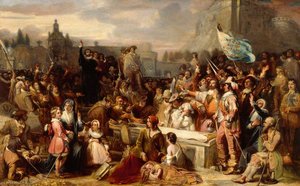
The Slave Market, Constantinople
The painting titled The Slave Market, Constantinople is a work by the artist William Allan. This specific piece was created about 1838. The canvas measures 129 x 198 cm.

Bijgewerkt in oktober 2026 · gerangschikt op basis van onze populariteitsscore (zoekopdrachten, bezoeken en bestellingen per kunstwerk) · 56 werken van William Allan in onze catalogus
Kortom
Volgens de visie van de galerie is het beroemdste schilderij van William Allan The Slave Market, Constantinople (1838), waarvan het origineel in het Scottish National Gallery in Edinburgh hangt. The Signing of the National Covenant in Greyfriars Kirkyard, Edinburgh (1838) en Tartar Robbers Dividing Spoil (1817) maken het trio compleet dat elk oog herkent. Van de 56 werken van William Allan in onze catalogus presenteert de galerie hieronder de 48 bekendste werken, elk een origineel met de jaartal, het museum en wat het uniek maakt.
The painting titled The Slave Market, Constantinople is a work by the artist William Allan. This specific piece was created about 1838. The canvas measures 129 x 198 cm.

The oil painting titled The Signing of the National Covenant in Greyfriars Kirkyard, Edinburgh is a work by the artist William Allan. Created in 1838, this piece depicts the historical event of the signing of the National Covenant within the Greyfriars Kirkyard in Edinburgh. The scene captures a specific moment of religious and political significance in Scottish history.

The scene unfolds in Tartar Robbers Dividing Spoil, a work painted by William Allan around 1817. Within the shadows of a cavernous space, the tension of a sudden encounter hangs heavy in the air. The composition centers on the interaction between two men, their presence illuminated against the dark, textured stone of their surroundings. Every brushstroke captures a moment of high drama, frozen in time as the figures negotiate their…

This large-scale oil painting, created in 1824, presents a crowded and dynamic street scene reminiscent of a public disturbance or uprising. The composition is defined by a diagonal thrust, driven by a central group of people and a horse, which creates a sense of instability and movement. Within this chaotic scene, numerous figures are engaged in various actions; some are seen falling, others are gesturing, and many are observing the…

The air inside the room feels thick with the scent of woodsmoke and spilled ale. Shadows dance across the walls, cast by the flickering light of candles and the glowing embers of a fireplace. In this crowded, rustic space, a lively chaos unfolds as figures press together in a moment of boisterous celebration. There is a sense of movement in every corner; some guests lean in to share a whispered…

This black and white pen and ink drawing presents a study of form and gesture, focusing on a single male figure depicted in profile. The subject is a gentleman dressed in formal attire, including a hat and a coat, and he is shown holding what appears to be a walking stick or cane. The composition is characterized by its simplicity, placing the figure against a neutral background to emphasize the…

An older gentleman sits anchored at a desk, his presence filling the frame with a heavy, quiet gravity. The light falls across his features with a dramatic intensity, carving deep shadows into the folds of his coat and the lines of his face. He gazes outward, his eyes meeting the viewer in a direct, intimate connection that feels almost intrusive, as if we have stumbled upon a private moment of…

This work, titled Study for 'The Murder of David Rizzio', was painted by William Allan in 1833. It offers a glimpse into the artist's process, capturing a moment of intense preparation for a larger historical scene. The piece reflects the specific interests of an artist deeply engaged with the dramatic narratives of the nineteenth century.

The air thickens with the weight of a historical drama in The Murder of David Rizzio. Painted by William Allan in 1833, this work captures a moment of profound betrayal and royal tragedy. The scene freezes the violent 1566 assassination of David Rizzio, the Italian secretary to Mary Queen of Scots. Chaos erupts within the palace, a sudden fracture in the order of the court that leaves the viewer suspended…

 Matthew Hardie, Violin Maker1822
12
 Matthew Hardie (1755–1826), Violin Maker1822 · Scottish National Portrait Gallery
13
 William Hey (1736–1819)1815 · Leeds General Infirmary
14
 The Black Dwarf1831 · Scottish National Gallery
15
 Sir Walter Scott in His Study with His Dog 'Maida'1831 · Abbotsford House
16
 William Blackwood (1776–1834), Publisher1830 · Scottish National Portrait Gallery
17
 Sir Walter Scott (1771–1832), Novelist and Poet – Gala Day at Abbotsford1827 · Scottish National Portrait Gallery
18
 Sir Walter Scott with One of his Daughters1826 · Scottish National Portrait Gallery
19
 Sir Walter Scott, 1st Bt1831 · National Portrait Gallery
20
 The Facade of Abbotsford, seen through the Entrance Gate1832 · Scottish National Gallery
21
 The Shepherd's Grace1835
22
 The Bride of Abydos (from the poem by Byron)1836
23
 The Stirrup Cup1836 · Royal Scottish Academy of Art - Architecture
24
 Heroism and Humanity1840
25
 The Battle of Waterloo1843 · English Heritage
26
 The Recovery of the Stolen Child1841
27
 Sir Walter Scott (1771–1832), Novelist and Poet1844
28
 The Visit of Queen Victoria and Prince Albert to Hawthornden, 14 September 18421844 · Scottish National Portrait Gallery
29
 William Henry Murray (1790–1852), Actor and Manager of Theatre Royal, Edinburgh1848 · Scottish National Portrait Gallery
30
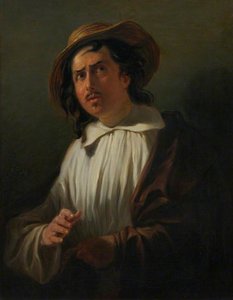 William Henry Murray (1790–1852), Actor and Manager of Theatre Royal, Edinburgh, as 'Paul Pry' (Crombie Sketchbook, fo.4)1843 · Scottish National Portrait Gallery
31
 An Officer of the 18th Regiment of (Light) Dragoons (Hussars), c.18151840
32
 Sir Walter Scott Dictating to His Daughter, Anne, in the Armoury at Abbotsford1844 · The National Trust For Scotland
33
 Highland Gillie and His Pony1850 · The Stirling Smith Art Gallery - Museum
34
 Frederick William Robert Stewart (1805–1872), Viscount Castlereagh, Later 4th Marquess of Londonderry, Wearing Hunting Costume1823 · National Trust
35
 Fair Maid of Perth
36
 The Ballad of Old Robin Gray1826
37
 The Battle of Bannockburn1850 · Royal Scottish Academy of Art - Architecture
38
 Bude harbour, DevonNational Maritime Museum
39
 Fair Maid of PerthUniversity of Edinburgh Fine Art Collection
40
 Field of Waterloo
41
 Christmas Eve
42
 The Battle of Cape St Vincent, 14 February 1797National Maritime Museum
43
 Mr Mackay of the Edinburgh Theatre as Baillie Nicol JarvieAbbotsford House
44
 James Russell, the ActorAbbotsford House
45
 The Bashkirs1814 · Hermitage Museum
46
 The Murder of David Rizzio1833 · Scottish National Gallery
47
 The Orphan1838 · Royal Collection
48
 Frontier Guards (Circassian Prince on Horseback Selling Two Boys)1814 · Hermitage Museum
De vier onderwerpen die het meest voorkomen in deze originelen, elk met zijn mooiste voorbeeld.
De 8 musea met de meeste schilderijen op deze pagina.
| Museum | Stad | Werken van William Allan | Schilderijen uit deze lijst |
|---|---|---|---|
 Scottish National Portrait Gallery |
Edinburgh | 8 | James Hogg (1770–1835), Poet (The Ettrick Shepherd) (The Ettrick Shepherd's House Heating or The Celebration of his Birthday), Matthew Hardie (1755–1826), Violin Maker, William Blackwood (1776–1834), Publisher |
 Scottish National Gallery |
Edinburgh | 7 | The Slave Market, Constantinople, Compositional Sketch for 'Death of the Regent Moray', Study for 'The Murder of David Rizzio' |
 Royal Scottish Academy of Art - Architecture |
Edinburgh | 3 | Self Portrait, The Stirrup Cup, The Battle of Bannockburn |
 Abbotsford House |
Malvern | 3 | Sir Walter Scott in His Study with His Dog 'Maida', Mr Mackay of the Edinburgh Theatre as Baillie Nicol Jarvie, James Russell, the Actor |
 National Maritime Museum |
Londen | 2 | Bude harbour, Devon, The Battle of Cape St Vincent, 14 February 1797 |
 Hermitage Museum |
Sint-Petersburg | 2 | The Bashkirs, Frontier Guards (Circassian Prince on Horseback Selling Two Boys) |
 The Company of Merchants of The City of Edinburgh |
Edinburgh | 1 | John Robertson |
 Leeds General Infirmary |
Leeds | 1 | William Hey (1736–1819) |
Kies een decennium om het origineel te zien dat dit tijdperk definieert.
The scene unfolds in Tartar Robbers Dividing Spoil, a work painted by William Allan around 1817. Within the shadows of a cavernous space, the tension of a sudden encounter hangs heavy in the air. The composition centers on the interaction between two men, their presence illuminated against the dark, textured stone of their surroundings. Every brushstroke captures a moment of high drama, frozen in time as the figures negotiate their…
This large-scale oil painting, created in 1824, presents a crowded and dynamic street scene reminiscent of a public disturbance or uprising. The composition is defined by a diagonal thrust, driven by a central group of people and a horse, which creates a sense of instability and movement. Within this chaotic scene, numerous figures are engaged in various actions; some are seen falling, others are gesturing, and many are observing the…
The painting titled The Slave Market, Constantinople is a work by the artist William Allan. This specific piece was created about 1838. The canvas measures 129 x 198 cm.


The Slave Market, Constantinople (1838), Scottish National Gallery, Edinburgh. The Signing of the National Covenant in Greyfriars Kirkyard, Edinburgh (1838) en Tartar Robbers Dividing Spoil (1817) volgen.
56 jaar oud: The Slave Market, Constantinople dateert uit 1838, en William Allan werd geboren in 1782.
The Slave Market, Constantinople, The Signing of the National Covenant in Greyfriars Kirkyard, Edinburgh, Tartar Robbers Dividing Spoil, Compositional Sketch for 'Death of the Regent Moray', James Hogg (1770–1835), Poet (The Ettrick Shepherd) (The Ettrick Shepherd's House Heating or The Celebration of his Birthday), Joseph Mallord William Turner, Self Portrait, Study for 'The Murder of David Rizzio', The Murder of David Rizzio en John Robertson. De bovenstaande ranglijst vermeldt het jaar en het museum van elk werk.
Onze catalogus bevat 56 werken van William Allan, daterend van 1803 tot 1850.
Voornamelijk in Scottish National Portrait Gallery (Edinburgh), Scottish National Gallery (Edinburgh) en Royal Scottish Academy of Art - Architecture (Edinburgh). De bovenstaande museumtabel bevat een volledig overzicht.
In 1830s: 16 van de 48 werken op deze pagina werden toen gemaakt, waaronder The Slave Market, Constantinople.
Op deze pagina is het vroegste John Robertson (1803) en het laatste Highland Gillie and His Pony (1850).
Men (5), Historical scene (4) en People (3), verspreid over de 48 werken op deze pagina.
Oil On Canvas, voor 7 van de 48 werken op deze pagina.
Romanticism, te oordelen aan de originelen op deze pagina.
James Hogg (1770–1835), Poet (The Ettrick Shepherd) (The Ettrick Shepherd's House Heating or The Celebration of his Birthday), Matthew Hardie (1755–1826), Violin Maker en William Blackwood (1776–1834), Publisher: het Scottish National Portrait Gallery, Edinburgh herbergt 8 van de werken op deze pagina.
Sir William Allan (1782-1850) staat te boek als een spilfiguur in de Schotse kunst van de 19e eeuw, een meester van de historische schilderkunst die met meesterlijke hand een nauwgezette realisme verbond met een evocatieve dramatiek. Geboren in een vooraanstaande koopmansfamilie in Edinburgh, was zijn artistieke pad grotendeels zelfgekozen, gevoed door een vroege blootstelling aan de opkomende kunstwereld en later begeleid door het mentorschap van Sir Henry Raeburn, een leidende figuur van de Schotse Verlichting. Het werk van Allan overstijgt de loutere portretkunst; het is een levendig tapijt geweven met draden van de Schotse cultuur, Russische intriges en de romantische geest van zijn tijdperk. Zijn nalatenschap reikt veel verder dan individuele schilderijen; hij vormde de identiteit van de National Gallery of Scotland en beïende generaties kunstenaars die hem opvolgden.
De vormende jaren van Allan waren doordrenkt van de tradities van de Edinburghse artistieke kringen. Hoewel zijn formele opleiding beperkt was, absorbeerde hij invloeden van John Graham aan de Trustees’ Academy, naast de technieken van David Wilkie en Alexander George Fraser. Deze vroege blootstelling installeerde een diep respect voor detail en compositie – kenmerken die zijn eigenzinnige stijl zouden definiëren. Cruciaal was dat Raeburn Allans talent herkende en hem begeleiding bood, waardoor hij leerde niet alleen de gelijkenis vast te leggen, maar ook het karakter en de emotie. Deze verbinding met de Schotse Verlichting vormde Allans artistische visie diepgaand, waarbij de nadruk lag op observatie, intellectuele nieuwsgierigheid en een verlangen om de wereld met nauwkeurigheid en nuance weer te geven.
Een beslissend moment in Allans carrière was zijn besluit om in 1805 naar Rusland te reizen. Gedreven door een fascinatie voor oosterse culturen en een verlangen naar artistieke inspiratie, begon hij aan een langdurig verblijf dat een diepe impact zou hebben op zijn oeuvre. Allan doopte zichzelf onder in het dagelijks leven van Kozakken, Circassiërs en Tataren, waarbij hij hun gebruiken, kleding en sociale interacties minutieus documenteerde. Hij was niet slechts aan het schetsen; hij ging actief de dialoente aan met deze gemeenschappen, won hun vertrouwen en kreeg toegang tot scènes die zelden door westerse kunstenaars werden aanschouwd. Deze meeslepende ervaring resulteerde in een reeks schilderijen die ongekende inzichten boden in de Russische samenleving – een onderwerp dat destijds grotendeels onontgonnen was in de Europese kunst.
Zijn meest gevierde werken uit deze periode omvatten “The Circassian Captives”, een aangrijpend beeld van een groep vrouwen die op hun lot wachten, en “Russian Peasants Keeping Their Holiday”, dat de levendige energie van een landelijke viering vangt. Deze schilderijen zijn niet alleen opmerkelijk om hun technische vaardigheid, maar ook om hun empathische weergave van gemarginaliseerde gemeenschappen. Allans benadering was revolutionair; hij streefde ernaar deze culturen met respect en begrip te representeren, voorbij de stereotiepe afbeeldingen die vaak in eerdere werken te vinden waren.
De artistieke stijl van Allan wordt gekenmerende door een opmerkelijke versmelting van realisme en romantiek. Hij bezat het uitzonderlijke vermogen om texturen weer te geven – van de ruwe wol van Kozakkenkleding tot het glinsterende oppervlak van Circassische juwelen – met een verbazingwekkend detailniveau. Zijn composities zijn vaak dynamisch, waarbij hij dramatische lichtinval en zorgvuldig geplaatste figuren gebruikt om een gevoel van beweging en narratief te creëren. Kleur speelt een cruciale rol in zijn werk; het wordt niet louter voor decoratieve effecten ingezet, maar om stemming en atmosfeer over te brengen.
Sleutelwerken zoals “Portrait of John Renny” illustreren zijn vaardigheid in het vangen van de gelijkenis en persoonlijkheid van zijn onderwerpen. Het zelfportret, geschilderd later in zijn leven, onthult een beschouwelijke blik en een subtiel bewustzijn van zijn eigen veroudering. “The Ballad of Old Robin Gray”, een spookachtige weergave van een oudere man die zich zijn verleden herinnert, toont Allans vermogen om emotie op te roepen via gebaren en expressie. Deze schilderijen, samen met andere werken in de Scottish National Gallery, getuigen van een opmerkelijke evolutie in zijn stijl – van de vroege invloeden van John Opie naar een meer volwassen en genuanceerde benadering.
De impact van Sir William Allan op de Schotse kunst reikt veel verder dan zijn individuele prestaties. Hij speelde een vitale rol bij de oprichting van de Scottish National Portrait Gallery, waarbij hij een significante bijdrage leverde aan de collectie en de identiteit ervan vormgaf als bewaarplaats van het Schotse artistieke erfgoed. Zijn werk hielp de status van de Schotse schilderkunst binnen de bredere Europese kunstwereld te verheffen, waarmee hij de heersende opvattingen over wat "serieuze" kunst inhield, uitdaagde.
De nalatenschap van Allan weerspiegelt zich ook in het werk van latere generaties Schotse kunstenaars. Hij toonde het belang aan van het bestuderen van lokale cultuur en tradities, wat een meer genuanceerde en authentieke representatie van Schotland op het canvas aanmoedigde. Zijn toewijding aan detail, zijn vermogen om emotie te vangen en zijn bereidheid om onconventionele onderwerpen te verkennen, blijven kunstenaars tot op de dag van vandaag inspireren. De blijvende aantrekkingskracht van Allans schilderijen ligt niet alleen in hun technische briljantie, maar ook in hun diepgaande inzichten in de menselijke conditie en het rijke tapijt van het Schotse en Russische leven.

