Portret van William Henry Margetson

De 55 bekendste schilderijen van William Henry Margetson, een selectie uit de galerie

Bijgewerkt in november 2026 · gerangschikt op basis van onze populariteitsscore (zoekopdrachten, bezoeken en bestellingen per kunstwerk) · 55 werken van William Henry Margetson in onze catalogus

Kortom

Van alle originele werken die William Henry Margetson heeft nagelaten, is At The Cottage Door de bekendste. Direct daarna volgen The Seashore en The Morning Walk (1900). Onze catalogus bevat 55 werken van William Henry Margetson; de galerie heeft de 55 meest bewonderde werken ter wereld bewaard, elk voorzien van de datum, het museum en het verhaal erachter.

1861 – 1940, Denmark Hill Romanticism Meeste werken: Art Gallery of New South Wales

De top 10 schilderijen van William Henry Margetson: de selectie van de galerie

1
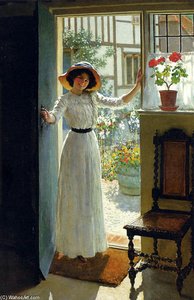
At The Cottage Door door William Henry Margetson

At The Cottage Door

Oil On Canvas

A woman stands at the threshold of a cottage, her hands resting upon the window frame. She is positioned in profile, looking out from the interior toward an unseen point beyond the glass. The scene is framed by the architectural elements of the doorway and the windowsill, which are crowded with various botanical elements. Potted plants and ceramic vases occupy the immediate foreground and the ledge, creating a layered depth…

2
The Seashore door William Henry Margetson

The Seashore

Oil On Canvas

A woman stands where the wet sand meets the tide. The light is diffused, filtered through an overcast sky that refuses to break. She is a vertical presence against the long, horizontal bands of the sea and the heavens. Her dress flows in soft lines, mimicking the movement of the receding water. The palette is quiet, composed of muted blues, greys, and beige. There is a stillness here, a sense…

3
The Morning Walk (1900) door William Henry Margetson

The Morning Walk

1900 · Watercolor

In this delicate watercolor, we find ourselves observing a private moment from the turn of the century. A young woman moves along a sunlit, cobblestone path, her presence marked by the soft peach and pink of her dress. She walks toward us, framed by a canopy of trees that filter the morning light into a dappled pattern upon the ground. There is a rhythmic quality to the composition, found in…

4
The Angel appearing to the Shepherds (1906) door William Henry Margetson

The Angel appearing to the Shepherds

1906 · Oil On Canvas

In this 1906 oil on canvas, we find ourselves in the quiet, shadowed stillness of a nocturnal landscape. The scene captures a moment of profound spiritual interruption: the Annunciation to the Shepherds. A luminous celestial being descends from the upper left, its presence breaking the deep, midnight blues of the expansive sky. This figure, draped in robes of brilliant, glowing white, acts as the primary source of light, casting a…

5
Marsh Marigolds (1924) door William Henry Margetson

Marsh Marigolds

1924 · Oil On Canvas

The air feels heavy with the scent of damp earth and spring growth as a young woman pauses within a sun-dappled grove. She leans gently against the rough, textured bark of a tree, her presence a soft anchor amidst the vertical lines of rising saplings and ancient trunks. Sunlight filters through the canopy above, casting a diffused, golden glow that dances across the forest floor in shifting patterns of light…

6
The good samaritan door William Henry Margetson

The good samaritan

Oil

In this intimate composition, we find ourselves witnessing a quiet act of mercy. A man lies prone upon the earth, his head resting heavily in the lap of a companion. The scene is one of profound vulnerability and care. A figure in a blue dress sits beside him, providing a sense of stability to the fallen man, while another, clad in a blue robe and a white hat, kneels in…

7
Flowers Of The Field door William Henry Margetson

Flowers Of The Field

Oil

The work reflects a transition in artistic sensibility, where the precision of academic tradition meets a softer, more modern approach to light and color. The subject embodies a specific ideal of feminine beauty, characterized by a quiet dignity and a seamless connection to the landscape. This piece captures a sense of spiritual yearning through its simple, pastoral subject matter. It avoids the heavy drama of grand history painting, opting instead…

8
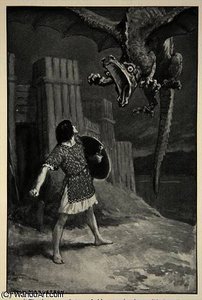
The Brazen Serpent door William Henry Margetson

The Brazen Serpent

Oil

The sun hangs heavy over a landscape of sand. A man stands at the center, his arms raised toward the sky in a gesture of urgent prayer or perhaps a desperate sermon. Around him, a crowd has gathered. Men and women lean in, their faces turned toward the speaker, caught in a moment of intense listening. The air feels thick with the weight of their shared attention. Near the edge…

9
Knox on his deathbed door William Henry Margetson

Knox on his deathbed

Oil

Knox on his deathbed is a work by the British painter and illustrator William Henry Margetson. Born in 1861 in Denmark Hill, United Kingdom, Margetson established a presence in the London art scene through his contributions to various galleries and exhibitions. His practice spanned both oil and watercolor, often focusing on the intersection of academic tradition and the evolving aesthetic sensibilities of the late Victorian era.

De selectie van William Henry Margetson gaat verder, van 11 tot 55

De onderwerpen die de aandacht van William Henry Margetson troffen

De vier onderwerpen die het meest voorkomen in deze originelen, elk met zijn mooiste voorbeeld.

De musea waar de originele werken van William Henry Margetson worden bewaard

Het museum met de meeste schilderijen op deze pagina.

Museum Stad Werken van William Henry Margetson Schilderijen uit deze lijst
Art Gallery of New South Wales, SydneyArt Gallery of New South Wales Sydney 1 The sea hath its pearls

William Henry Margetson decennium voor decennium: het origineel dat elk tijdperk definieert

Werken per decennium

Kies een decennium om het origineel te zien dat dit tijdperk definieert.

Vragen van verzamelaars over de schilderijen van William Henry Margetson

Waar is William Henry Margetson het meest bekend om?Onthul het antwoord

At The Cottage Door. The Seashore en The Morning Walk (1900) volgen.

Wat zijn de tien beroemdste schilderijen van William Henry Margetson?Onthul het antwoord

At The Cottage Door, The Seashore, The Morning Walk, The Angel appearing to the Shepherds, Marsh Marigolds, The good samaritan, Flowers Of The Field, The Brazen Serpent, Knox on his deathbed en The Sea Hath Its Pearls. De bovenstaande ranglijst vermeldt het jaar en het museum van elk werk.

Hoeveel schilderijen heeft William Henry Margetson nagelaten?Onthul het antwoord

Onze catalogus bevat 55 werken van William Henry Margetson, daterend van 1897 tot 1924.

In welke musea hangen de meesterwerken van William Henry Margetson?Onthul het antwoord

Voornamelijk in Art Gallery of New South Wales (Sydney). De bovenstaande museumtabel bevat een volledig overzicht.

In welke jaren schilderde William Henry Margetson de beroemdste werken?Onthul het antwoord

In 1900s: 2 van de 55 werken op deze pagina werden toen gemaakt, waaronder The Morning Walk.

Wat zijn de eerste en de laatste beroemde originelen van William Henry Margetson?Onthul het antwoord

Op deze pagina is het vroegste The sea hath its pearls (1897) en het laatste Marsh Marigolds (1924).

Welke onderwerpen koos William Henry Margetson het vaakst?Onthul het antwoord

Woman (8), Victorian era (5) en Flowers (3), verspreid over de 55 werken op deze pagina.

Welke techniek gebruikte William Henry Margetson het meest?Onthul het antwoord

Oil On Canvas, voor 4 van de 55 werken op deze pagina.

Bij welke kunststroming behoort William Henry Margetson?Onthul het antwoord

Romanticism en Post-impressionism, te oordelen aan de originelen op deze pagina.

William Henry Margetson: leven en werk

A Life Dedicated to Aesthetic Beauty: William Henry Margetson

William Henry Margetson, born in Camberwell, Surrey, in December 1861, was a painter whose career unfolded across the shifting tides of Victorian and early 20th-century British art. He wasn’t a revolutionary figure shattering conventions, but rather a dedicated craftsman who beautifully captured an era's ideals of feminine beauty and spiritual yearning. His journey began with formal training at Dulwich College, followed by studies at the prestigious Royal College of Art and the Royal Academy Schools – a path typical for aspiring artists of his time, yet one he navigated with distinct talent and sensitivity. Margetson first exhibited at the Royal Academy in 1885, marking the beginning of a consistent presence in London’s art scene over the following decades, showcasing work not only at the RA but also at the Royal Society of British Artists, the Royal Institute of Oil Painters, and the Grosvenor Gallery. This early success was cemented by winning the Armitage Medal for his studies at the Academy, a testament to his foundational skills.

From Victorian Academicism to Post-Impressionist Whispers

Initially, Margetson’s style firmly rooted itself in the academic tradition of Victorian painting. He excelled in portraiture, and it was through these depictions of women that he first garnered recognition. However, what distinguished him wasn't merely technical proficiency but a focus on capturing an *aesthetic* ideal – his subjects were often portrayed with modern hairstyles and fashionable hats, reflecting contemporary society while simultaneously embodying timeless grace. As the 19th century waned, Margetson’s artistic sensibilities began to evolve. He didn’t abandon realism entirely, but he allowed himself to be influenced by the burgeoning Post-Impressionist movement and the Pre-Raphaelites, particularly Lawrence Alma-Tadema. This shift manifested in a looser brushstroke, a more nuanced use of color, and an increasing interest in symbolic imagery. While never fully embracing radical experimentation, Margetson skillfully integrated these new influences into his existing style, creating works that bridged tradition and modernity.

The Zenith of His Career: ‘The Sea Hath Its Pearls’

‘The Sea Hath its Pearls’, exhibited at the Royal Academy in 1897, stands as Margetson's most celebrated achievement. Now residing in the Art Gallery of New South Wales, Australia, this classically decorative painting encapsulates his artistic maturity. The work is a masterful blend of Victorian elegance and symbolic depth, depicting a scene imbued with romanticism and subtle allegory. It’s not simply a beautiful image; it invites contemplation on themes of beauty, loss, and the hidden treasures within life's depths. This success wasn’t an isolated incident. Margetson also ventured into religious and allegorical subjects, demonstrating his versatility and intellectual curiosity. His ability to imbue these works with emotional resonance further solidified his reputation as a painter capable of more than just superficial beauty.

Beyond the Canvas: Illustration and Personal Life

Margetson’s talents extended beyond oil and watercolor painting; he also worked as an illustrator, contributing to various publications. This foray into illustration likely honed his skills in narrative composition and attention to detail – qualities evident in his paintings. His personal life was equally enriching. He married Helen Hatton, a fellow artist whom he met during a collaborative illustration project. They established a home first in London before relocating to the picturesque villages of Blewbury and Wallingford, Oxfordshire, where they continued their artistic pursuits. Margetson’s dedication to his craft remained unwavering throughout his life, culminating in a prolific career that spanned several decades. He passed away in Wallingford in 1940 at the age of 78, leaving behind a legacy of beautiful paintings and evocative illustrations.

A Lasting Impression: Historical Significance

While not a household name today, William Henry Margetson occupies an important niche within British art history. He represents a transitional figure – one who skillfully navigated the changing aesthetic landscape of his time. His work provides valuable insight into Victorian ideals of beauty, the influence of emerging artistic movements, and the enduring appeal of classical themes. The portrait of Alfred Tennyson he painted now held in the National Portrait Gallery is another testament to his skill and recognition within the art world. Margetson’s paintings continue to captivate viewers with their delicate beauty, emotional depth, and technical mastery, ensuring that his legacy as a dedicated artist endures.