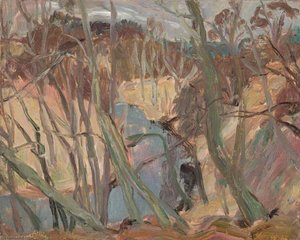
Portret van William Dobell

Schilderijen van William Dobell: De 100 bekendste, door de ogen van een galerie

Bijgewerkt in oktober 2026 · gerangschikt op basis van onze populariteitsscore (zoekopdrachten, bezoeken en bestellingen per kunstwerk) · 238 werken van William Dobell in onze catalogus

Kortom

Volgens de visie van de galerie is het beroemdste schilderij van William Dobell Still Life with Chagall Print (1933), waarvan het origineel in het Royal Scottish Academy of Art - Architecture in Edinburgh hangt. Florence (1924) en Bathers (1925) maken het trio compleet dat elk oog herkent. Van de 238 werken van William Dobell in onze catalogus presenteert de galerie hieronder de 100 bekendste werken, elk een origineel met de jaartal, het museum en wat het uniek maakt.

1899 – 1970, Cooks Hill, New South Wales Cubist landscape Meeste werken: Royal Scottish Academy of Art - Architecture

De top 10 schilderijen van William Dobell in de galerie

1
Still Life with Chagall Print (1933) door William Dobell

Still Life with Chagall Print

1933 · Acrylic On Canvas · Royal Scottish Academy of Art - Architecture, Edinburgh

A Haunting Still Life: "Still Life with Chagall Print" by Sir William Gillies This evocative artwork, created in 1933, presents a compelling still life imbued with an atmosphere of quiet melancholy and introspection. Dominated by a palette of dark blues and yellows, the composition features a vibrant yet slightly unsettling arrangement of flowers spilling from a vase alongside a striking figure – an elderly man cloaked and hatted, his face…

2
Florence (1924) door William Dobell

Florence

1924 · Acrylic On Canvas · Royal Scottish Academy of Art - Architecture, Edinburgh

William George Gillies' "Florence," painted in 1924, isn’t merely a depiction of an Italian city; it’s a vibrant distillation of its spirit – a testament to the enduring beauty and bustling life of one of Europe’s most historically significant urban centers. This captivating canvas transports us directly to the heart of Tuscany, offering a glimpse into a world brimming with energy, commerce, and artistic resonance. The painting immediately draws the…

3
Bathers (1925) door William Dobell

Bathers

1925 · Oil On Canvas · Royal Scottish Academy of Art - Architecture, Edinburgh

Sir William George Gillies’ “Bathers” is not merely a depiction of figures enjoying a riverside respite; it's an immersion into the very heart of a fleeting summer afternoon. Painted in 1925, this work transcends simple representation, capturing a mood—a languid sense of contentment and quiet observation—that resonates deeply with the viewer. The scene unfolds within a subtly rendered forest setting, dominated by the cool, reflective surface of the River Seine.…

4
Young Boy with a Teapot (1922) door William Dobell

Young Boy with a Teapot

1922 · Oil On Canvas · Royal Scottish Academy of Art - Architecture, Edinburgh

William George Gillies’ “Young Boy with a Teapot” is not merely a depiction of a child; it's a carefully constructed tableau of domesticity, imbued with a poignant sense of stillness and observation. Painted in 1922, during a period of significant artistic experimentation in Scotland – a time marked by the echoes of Cubism and the burgeoning influence of Paul Klee – this work stands as a testament to Gillies’ ability…

5
View to the Pentlands from near Temple door William Dobell

View to the Pentlands from near Temple

Acrylic On Canvas · Royal Scottish Academy of Art - Architecture, Edinburgh

William George Gillies (1898–1973), a pivotal figure in Scottish Colourist painting, bequeathed to us not merely landscapes but profound meditations on beauty and perception. His masterpiece, “View to the Pentlands from near Temple,” transcends mere representation; it’s an immersive experience of light, colour, and atmosphere—a testament to Gillies' unwavering dedication to capturing the essence of his surroundings.

10
Still Life with Two Lemons (1921) door William Dobell

Still Life with Two Lemons

The morning light settles softly across a kitchen table, catching the waxy skin of two lemons that command the center of the scene. These citrus fruits sit as the heart of the composition, their bright presence anchoring a collection of everyday objects. Nearby, apples rest in a casual arrangement, one drifting toward the left edge while another finds its place on the right. The scene feels lived-in and immediate, as…

Schilderijen van William Dobell, gerangschikt van 11 tot 100

11Duddingston Kirk and Arthur's Seat (1935) door William DobellDuddingston Kirk and Arthur's Seat1935 · Royal Scottish Academy of Art - Architecture 12N Stillevit met een zwarte kruik (1933) door William DobellN Stillevit met een zwarte kruik1933 · Royal Scottish Academy of Art - Architecture 13Landscape with Rainbow door William DobellLandscape with RainbowRoyal Scottish Academy of Art - Architecture 14Flowers in a Blue and White Vase (1934) door William DobellFlowers in a Blue and White Vase1934 · Royal Scottish Academy of Art - Architecture 15Abstract Composition (1935) door William DobellAbstract Composition1935 · Royal Scottish Academy of Art - Architecture 16Shore Scene, West Highlands (1937) door William DobellShore Scene, West Highlands1937 · Royal Scottish Academy of Art - Architecture 17Cottages with Green Fence (1944) door William DobellCottages with Green Fence1944 · Royal Scottish Academy of Art - Architecture 18Comrie Church (1929) door William DobellComrie Church1929 · Royal Scottish Academy of Art - Architecture 19The Red House, Durisdeer (1934) door William DobellThe Red House, Durisdeer1934 · Royal Scottish Academy of Art - Architecture 20Still Life with Blue Background (1945) door William DobellStill Life with Blue Background1945 · Royal Scottish Academy of Art - Architecture 21H. Harvey Wood (1922) door William DobellH. Harvey Wood1922 · Royal Scottish Academy of Art - Architecture 22Ascending (1936) door William DobellAscending1936 · Royal Scottish Academy of Art - Architecture 23The Harbour (1937) door William DobellThe Harbour1937 24Still Life with Scattered Fruit and Grasses (1945) door William DobellStill Life with Scattered Fruit and Grasses1945 · Royal Scottish Academy of Art - Architecture 25Untitled (cut down section of an oil painting used as a mirror backing) (1930) door William DobellUntitled (cut down section of an oil painting used as a mirror backing)1930 · Royal Scottish Academy of Art - Architecture 26My Mother, 1916 (1916) door William DobellMy Mother, 19161916 · Royal Scottish Academy of Art - Architecture 27Autumn, Durisdeer (1934) door William DobellAutumn, Durisdeer1934 · Royal Scottish Academy of Art - Architecture 28The sleeping Greek (1936) door William DobellThe sleeping Greek1936 · Art Gallery of New South Wales 29Laide, Ross shire (1937) door William DobellLaide, Ross shire1937 · Royal Scottish Academy of Art - Architecture 30The Origin of the Milky Way (after Jacopo Tintoretto) (1924) door William DobellThe Origin of the Milky Way (after Jacopo Tintoretto)1924 · Royal Scottish Academy of Art - Architecture 31Gateway, Italy (1924) door William DobellGateway, Italy1924 · Royal Scottish Academy of Art - Architecture 32Temple, Backs of Houses (1945) door William DobellTemple, Backs of Houses1945 · Royal Scottish Academy of Art - Architecture 33Marjory Porter (3) (1935) door William DobellMarjory Porter (3)1935 · Royal Scottish Academy of Art - Architecture 34Red Roofs (1923) door William DobellRed Roofs1923 · Royal Scottish Academy of Art - Architecture 35Head and Shoulders of a Bearded Man (1923) door William DobellHead and Shoulders of a Bearded Man1923 · Royal Scottish Academy of Art - Architecture 36The Bass Rock from Seacliff (1929) door William DobellThe Bass Rock from Seacliff1929 · Royal Scottish Academy of Art - Architecture 37Trees and Reflections (1930) door William DobellTrees and Reflections1930 · Royal Scottish Academy of Art - Architecture 38Marjory Porter (2) (1935) door William DobellMarjory Porter (2)1935 · Royal Scottish Academy of Art - Architecture 39Emma (1921) door William DobellEmma1921 · Royal Scottish Academy of Art - Architecture 40Fishing Boats, Anstruther Harbour (1945) door William DobellFishing Boats, Anstruther Harbour1945 41Life Study (college diploma work) (1922) door William DobellLife Study (college diploma work)1922 · Royal Scottish Academy of Art - Architecture 42Flags and Bunting (1935) door William DobellFlags and Bunting1935 · Royal Scottish Academy of Art - Architecture 43Spinningdale (1939) door William DobellSpinningdale1939 · Royal Scottish Academy of Art - Architecture 44Nungate Bridge, Haddington (1921) door William DobellNungate Bridge, Haddington1921 · Royal Scottish Academy of Art - Architecture 45Duddingston (1929) door William DobellDuddingston1929 · Royal Scottish Academy of Art - Architecture 46Sunshine, Cramond (1921) door William DobellSunshine, Cramond1921 47Trees and Coppice (1928) door William DobellTrees and Coppice1928 48East Lothian Upland (1923) door William DobellEast Lothian Upland1923 · Royal Scottish Academy of Art - Architecture 49Emma and Janet (1925) door William DobellEmma and Janet1925 · Royal Scottish Academy of Art - Architecture 50The boy at the basin (1932) door William DobellThe boy at the basin1932 · Art Gallery of New South Wales 51Nude (1931) door William DobellNude1931 · Art Gallery of New South Wales 52Emma (1931) door William DobellEmma1931 53Border Landscape (1930) door William DobellBorder Landscape1930 54Sisters Emma and Janet (1932) door William DobellSisters Emma and Janet1932 55St Monans, East Neuk of Fife (sketch) (1932) door William DobellSt Monans, East Neuk of Fife (sketch)1932 56Restalrig Village, Edinburgh (1930) door William DobellRestalrig Village, Edinburgh1930 · Royal Scottish Academy of Art - Architecture 57Two Pots, Saucer and Fruit (1933) door William DobellTwo Pots, Saucer and Fruit1933 · Royal Scottish Academy of Art - Architecture 58Near Durisdeer (1932) door William DobellNear Durisdeer1932 59Gardenstown (1932) door William DobellGardenstown1932 · Royal Scottish Academy of Art - Architecture 60Street scene, Pimlico (1937) door William DobellStreet scene, Pimlico1937 · Art Gallery of New South Wales 61Poppies in a Yellow Vase (1934) door William DobellPoppies in a Yellow Vase1934 62Harvest Field (1936) door William DobellHarvest Field1936 63Rocks and Water, Morar (1934) door William DobellRocks and Water, Morar1934 · Royal Scottish Academy of Art - Architecture 64Woods at Humbie, East Lothian (1936) door William DobellWoods at Humbie, East Lothian1936 65Sir William MacTaggart (1903–1981), Artist (1935) door William DobellSir William MacTaggart (1903–1981), Artist1935 66Landscape, Longniddry (1939) door William DobellLandscape, Longniddry1939 · Royal Scottish Academy of Art - Architecture 67Hawksnest Farm (1940) door William DobellHawksnest Farm1940 68Still Life, Flowers and Figures (1943) door William DobellStill Life, Flowers and Figures1943 69Studio Table (1940) door William DobellStudio Table1940 70Temple Village (1940) door William DobellTemple Village1940 71Temple, Winter Street (1940) door William DobellTemple, Winter Street1940 72Rainy Day, Pittenweem (1940) door William DobellRainy Day, Pittenweem1940 73Gattonside (1950) door William DobellGattonside1950 · Royal Scottish Academy of Art - Architecture 74Temple (1940) door William DobellTemple1940 75Poppies and Cretonne Cloth (1940) door William DobellPoppies and Cretonne Cloth1940 76Still Life, Breton Pot (1942) door William DobellStill Life, Breton Pot1942 77Early Morning, Temple (1942) door William DobellEarly Morning, Temple1942 78The Farm Place, Summer (1940) door William DobellThe Farm Place, Summer1940 79Still Life, Pointed Lace (1947) door William DobellStill Life, Pointed Lace1947 80The River and Beech Trees, Temple Woods (1947) door William DobellThe River and Beech Trees, Temple Woods1947 81Spring Evening (1948) door William DobellSpring Evening1948 82Eilean Donan Castle, Loch Duich (1947) door William DobellEilean Donan Castle, Loch Duich1947 83Midlothian Village (1944) door William DobellMidlothian Village1944 84Loch Duich, Kintail (1947) door William DobellLoch Duich, Kintail1947 85Summer (1945) door William DobellSummer1945 86Dusk at Letterfearn (1947) door William DobellDusk at Letterfearn1947 87Winter, Carrington (1947) door William DobellWinter, Carrington1947 88Anstruther Harbour (1945) door William DobellAnstruther Harbour1945 89Still Life with Orange Jug, Flowers and a Yellow Cloth door William DobellStill Life with Orange Jug, Flowers and a Yellow ClothRoyal Scottish Academy of Art - Architecture 90The Tulip Vase (1944) door William DobellThe Tulip Vase1944 91Brown and Grey Landscape, Pentland Hills (1948) door William DobellBrown and Grey Landscape, Pentland Hills1948 · Royal Scottish Academy of Art - Architecture 92The South Esk in Arniston Grounds (1948) door William DobellThe South Esk in Arniston Grounds1948 93Letterfearn (1947) door William DobellLetterfearn1947 94Still Life, Pot with Evergreen Leaves (1948) door William DobellStill Life, Pot with Evergreen Leaves1948 95Village scene, Mount Hagen (1953) door William DobellVillage scene, Mount Hagen1953 · Art Gallery of New South Wales 96Highland Landscape (1949) door William DobellHighland Landscape1949 97The Green Dish (1950) door William DobellThe Green Dish1950 98Still Life (1950) door William DobellStill Life1950 99Woodland Landscape, Blue Tree (1950) door William DobellWoodland Landscape, Blue Tree1950 · Royal Scottish Academy of Art - Architecture 100Eildon (1949) door William DobellEildon1949 · Arts Council Collection

De beroemde schilderijen van William Dobell, periode voor periode

De onderwerpen die de aandacht van William Dobell troffen

De vier onderwerpen die het meest voorkomen in deze originelen, elk met zijn mooiste voorbeeld.

De musea waar de originele werken van William Dobell worden bewaard

De 3 musea met de meeste schilderijen op deze pagina.

Museum Stad Werken van William Dobell Schilderijen uit deze lijst
Royal Scottish Academy of Art - Architecture, EdinburghRoyal Scottish Academy of Art - Architecture Edinburgh 132 Still Life with Chagall Print, Florence, Bathers
Art Gallery of New South Wales, SydneyArt Gallery of New South Wales Sydney 6 Mrs South Kensington, The sleeping Greek, The boy at the basin
Arts Council Collection, LondenArts Council Collection Londen 2 Eildon

William Dobell, één iconisch schilderij per decennium

Werken per decennium

Kies een decennium om het origineel te zien dat dit tijdperk definieert.

Schilderijen van William Dobell: de galerie geeft antwoord

Welk schilderij van William Dobell is het beroemdste van allemaal?Onthul het antwoord

Still Life with Chagall Print (1933), Royal Scottish Academy of Art - Architecture, Edinburgh. Florence (1924) en Bathers (1925) volgen.

Hoe oud was William Dobell bij de voltooiing van Still Life with Chagall Print?Onthul het antwoord

34 jaar oud: Still Life with Chagall Print dateert uit 1933, en William Dobell werd geboren in 1899.

Wat zijn de top 10 schilderijen van William Dobell?Onthul het antwoord

Still Life with Chagall Print, Florence, Bathers, Young Boy with a Teapot, View to the Pentlands from near Temple, Mediterranean Landscape with Overcast Sky, Mrs South Kensington, Sir William George Gillies (1898–1973), Artist, Self Portrait, Still Life in Grey and Brown en Still Life with Two Lemons. De bovenstaande ranglijst vermeldt het jaar en het museum van elk werk.

Hoeveel werken heeft William Dobell gemaakt?Onthul het antwoord

Onze catalogus bevat 238 werken van William Dobell, daterend van 1916 tot 1953.

Waar hangen de beroemdste originele werken van William Dobell?Onthul het antwoord

Voornamelijk in Royal Scottish Academy of Art - Architecture (Edinburgh), Art Gallery of New South Wales (Sydney) en Arts Council Collection (Londen). De bovenstaande museumtabel bevat een volledig overzicht.

Wanneer creëerde William Dobell de beroemdste schilderijen?Onthul het antwoord

In 1930s: 37 van de 100 werken op deze pagina werden toen gemaakt, waaronder Still Life with Chagall Print.

Wat zijn de vroegste en laatste beroemde werken van William Dobell?Onthul het antwoord

Op deze pagina is het vroegste My Mother, 1916 (1916) en het laatste Village scene, Mount Hagen (1953).

Welke onderwerpen keerde William Dobell het vaakst naar terug?Onthul het antwoord

Scottish art (8), Tranquility (8) en Gillies (7), verspreid over de 100 werken op deze pagina.

In welk medium werkte William Dobell het meest?Onthul het antwoord

Oil On Canvas, voor 26 van de 100 werken op deze pagina.

Bij welke stroming wordt William Dobell gerekend?Onthul het antwoord

Cubist landscape, te oordelen aan de originelen op deze pagina.

Welke originelen van William Dobell zijn in de collectie van het Royal Scottish Academy of Art - Architecture?Onthul het antwoord

Still Life with Chagall Print, Florence en Bathers: het Royal Scottish Academy of Art - Architecture, Edinburgh herbergt 51 van de werken op deze pagina.

William Dobell: de kunstenaar

Early Life and Education

Sir William George Gillies, geboren in Haddington in East Lothian, Schotland, in 1898, was een kunstenaar wiens leven en werk diep verweven waren met de landschappen en tradities van zijn geboortegemeenschap. Zijn artistieke reis begon niet direct op het doek; hij startte zijn opleiding aan de Edinburgh College of Art, maar deze werd onderbroken door dienstplicht in de Royal Engineers tijdens de Eerste Wereldoorlog. Deze ervaring, die hem vroegtijdig blootstelde aan de realiteit van conflict en verlies, zou een blijvende invloed hebben op zijn artistieke visie.

Na de oorlog keerde Gillies terug om zijn studie af te maken aan het Edinburgh College of Art. Daar werd hij niet alleen een getalenteerd kunstenaar, maar ook een toegewijde leraar, die meer dan veertig jaar lang de School for Drawing and Painting leidde. Zijn betrokkenheid bij het onderwijs was een essentieel onderdeel van zijn leven en droeg bij aan de ontwikkeling van vele toekomstige kunstenaars.

Artistic Development and Influences

Gillies’ artistieke reis begon met een fascinatie voor Cubisme, een beweging die hij ontdekte na het studeren onder André Lhote in Parijs (1923) en een bezoek aan Italië in 1924. Deze periode was cruciaal voor zijn ontwikkeling, waarbij hij de principes van geometrische fragmentatie en perspectiefonderzoek leerde toepassen. Zijn vroege werken, zoals “Two Pots, Saucer and Fruit” (1933), getuigen hiervan; ze vertonen een invloed van Cézanne, met zijn zorgvuldige composities en het gebruik van kleur om volume en diepte te suggereren, in combinatie met de understatement van kunstenaars als Braque en Picasso.

Een fundamentele verandering in Gillies’ artistieke benadering kwam in 1934 tot stand door de ontmoeting met de werk van Paul Klee. Klee’s gebruik van kleur, zijn speelse composities en het vermogen om emotie te overbrengen via eenvoudige vormen inspireerden Gillies om een meer expressieve en intuïtieve benadering van de kleur te ontwikkelen. Hij begon elementen uit de folklore en traditie van Schotland op te nemen in zijn werk, waardoor zijn stijl zich onderscheidde van de rigide principes van Cubisme.

The 1922 Group and Collaborative Spirit

In 1922 richtte Gillies samen met andere kunstenaars, waaronder William Crozier, William Geissler en William MacTaggart, de “1922 Group” op. Deze groep was meer dan alleen een artistieke vereniging; het was een platform voor jonge Schotse kunstenaars om hun werk te presenteren aan het publiek via tentoonstellingen in de New Gallery in Edinburgh. De 1922 Group bevorderde een gevoel van gemeenschap en innovatie binnen de Schotse kunstscene, waardoor een vruchtbare omgeving ontstond voor experimenteren en uitwisselen van ideeën.

De groep speelde een cruciale rol bij het stimuleren van de ontwikkeling van nieuwe talenten en het creëren van een platform voor hun werk. De tentoonstellingen waren niet alleen een manier om kunst te presenteren, maar ook om kunstenaars met elkaar in contact te brengen en hen te inspireren.

Themes and Subject Matter

Gillies’ oeuvre is voornamelijk gekenmerkt door zijn liefde voor de Schotse landschappen. Hij schilderde de Lothian, Fife en Border regio's met een intense gevoeligheid, vastleggend niet alleen de fysieke kenmerken van het terrein, maar ook de sfeer en de emoties die hij ermee associeerde. Zijn landschappen zijn vaak doordrenkt van licht en kleur, en ze vertonen een diepe verbinding met de natuur.

Naast landschappen was Gillies ook gefascineerd door stillevenschilderingen. Deze werken, vaak gekenmerkt door de aanwezigheid van keramiek gemaakt door zijn jongere zus, Emma Smith Gillies – wiens vroege dood hem diep heeft getroffen – waren een bron van zowel schoonheid als verdriet. De stillevenschilderingen werden vaak gebruikt om emotionele reflectie te bieden en de complexiteit van het leven te onderzoeken.

Major Achievements and Recognition

Sir William George Gillies werd in 1970 ridder, een erkenning voor zijn bijdrage aan de kunst in Schotland. In 1957 ontving hij de CBE (Commander of the Order of the British Empire) voor zijn diensten aan de kunst. Na zijn pensionering van het Edinburgh College of Art bleef Gillies actief als kunstenaar en werd hij benoemd tot hoofd van de school in 1961, een positie die hij tot 1966 bekleedde. Tijdens deze periode werden belangrijke ontwikkelingen doorgevoerd, waaronder de bouw van een nieuwe architectuurfaculteit.

Zijn werk is te vinden in musea en collecties in heel Schotland, waaronder Aberdeen, Dundee, Edinburgh, Glasgow, en in nationale galerijen in Londen, Ottawa en Peru. De retrospectieve tentoonstelling die de Scottish Arts Council hem gaf trok meer dan 30.000 bezoekers, wat een bewijs is van zijn invloed en populariteit.

Historical Significance and Legacy

Sir William George Gillies wordt beschouwd als een van de meest prominente Schotse kunstenaars van de 20e eeuw. Zijn werk vertegenwoordigt een unieke synthese van moderne invloeden en traditionele Schotse esthetiek. Hij was een belangrijke figuur in de Edinburgh School, een beweging die zich kenmerkte door het gebruik van kleur en licht om emotie te overbrengen. Gillies’ nalatenschap strekt zich verder uit dan zijn eigen kunst; hij heeft generaties van kunstenaars geïnspireerd en de richting van Schotse kunst beïnvloed.

Hij stierf vredig in zijn bed op 15 april 1973, maar zijn werk blijft een bron van inspiratie en bewondering. Gillies’ artistieke visie, gekenmerkt door zijn liefde voor Schotland, zijn expressieve kleurgebruik en zijn vermogen om emotie te overbrengen, zal nog lang voortleven in de geschiedenis van de kunst.