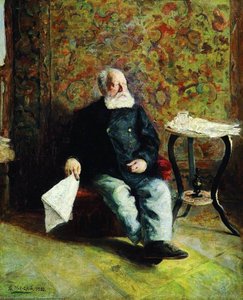
Portret van Vladimir Egorovic Makovskij

De 100 bekendste schilderijen van Vladimir Egorovic Makovskij, een selectie uit de galerie

Bijgewerkt in november 2026 · gerangschikt op basis van onze populariteitsscore (zoekopdrachten, bezoeken en bestellingen per kunstwerk) · 141 werken van Vladimir Egorovic Makovskij in onze catalogus

Kortom

Van alle originele werken die Vladimir Egorovic Makovskij heeft nagelaten, is I will not! (1892) de bekendste. Direct daarna volgen Verdict (1882) en Goodbye, Papa (1894). Onze catalogus bevat 141 werken van Vladimir Egorovic Makovskij; de galerie heeft de 100 meest bewonderde werken ter wereld bewaard, elk voorzien van de datum, het museum en het verhaal erachter.

1846 – 1920, Moskou Realism Meeste werken: Yekaterinburg Museum of Fine Arts

De top 10 schilderijen van Vladimir Egorovic Makovskij: de selectie van de galerie

1
I will not! (1892) door Vladimir Egorovic Makovskij

I will not!

1892 · Oil

The scene unfolds within the oil painting titled "I will not!", a work that captures a fleeting moment of human interaction. This piece is the creation of Vladimir Makovsky, an artist who brought the realities of his era to the canvas. He lived from 1846 until 1920, leaving behind a body of work that reflects the shifting social landscapes of his time. Born in Moscow, Russia, Makovsky grew up immersed…

2
Verdict (1882) door Vladimir Egorovic Makovskij

Verdict

1882 · Oil On Canvas

The oil painting depicts a group of figures gathered in a room characterized by heavy wooden furniture and architectural lines. A large, dark wooden table occupies the foreground, its surface reflecting a diffused light that illuminates the scene from an unseen source. At the center of the arrangement, a woman holds an infant. She wears garments of blue and white, which contrast against the darker, muted tones of the surrounding…

3
Goodbye, Papa (1894) door Vladimir Egorovic Makovskij

Goodbye, Papa

1894 · Oil On Canvas

In this 1894 oil on canvas, a young woman and an older man are positioned in a close, physical connection. The woman wears a white dress and a veil that covers her head and shoulders. She holds the hand of the man, who is dressed in a dark suit. Their bodies are oriented toward one another, creating a central focus of contact amidst a quiet setting. To the left, a…

4
Mother and daughter (1886) door Vladimir Egorovic Makovskij

Mother and daughter

1886 · Oil

In this 1886 oil painting, two figures occupy the immediate foreground of a wide landscape. A woman and a young girl stand facing one another, positioned in a way that suggests a private conversation. The woman is dressed in a dark skirt paired with a lighter-colored blouse, while the girl wears a dress made of the same dark fabric as the woman's skirt. Their clothing is characteristic of traditional peasant…

5
From the rain (1887) door Vladimir Egorovic Makovskij

From the rain

1887 · Oil On Canvas

The scene before us is titled From the rain, a work that emerges from the brush of the Russian painter Vladimir Makovsky. Created in 1887, this oil on canvas captures a specific, fleeting moment of life. The artist, born in Moscow, Russia, brings a sense of lived reality to this composition, grounding the viewer in a particular era of his homeland.

6
Before explaining the (Date) (1900) door Vladimir Egorovic Makovskij

Before explaining the (Date)

1900 · Oil On Canvas

The air feels heavy with the scent of damp earth and decaying leaves. Sunlight filters through a dense canopy of intertwining branches, casting long, soft shadows across a forest floor carpeted in moss and fallen foliage. In this quiet, wooded clearing, two figures are caught in a private exchange. A man in a military uniform stands poised, his presence commanding yet still, facing a woman whose long dress flows around…

7
Study to ''January 9, 1905 on Vasilyevsky island'' (1907) door Vladimir Egorovic Makovskij

Study to ''January 9, 1905 on Vasilyevsky island''

1907 · Oil

The canvas presents a study titled Study to ''January 9, 1905 on Vasilyevsky island'', a work that captures a specific, heavy moment in time. Created about 1907, the painting emerges from the hand of Vladimir Makovsky. He approaches the scene with the practiced eye of a man who understands the weight of a single, frozen instant. The brushwork holds a quiet tension, as if the air itself is waiting for…

8
Two mothers. Native mother and stepmother. (1906) door Vladimir Egorovic Makovskij

Two mothers. Native mother and stepmother.

1906 · Oil On Canvas

In this oil painting from 1905-1906, a quiet domestic breakfast is suddenly fractured by an unexpected arrival. The scene unfolds around a dining table draped in a white tablecloth, set with the familiar items of a morning meal. The stillness of the room is broken by the presence of a woman who has just entered, her appearance marking her as a stranger to this well-to-do household. She wears a dark…

9
Grandma's Instruction (1869) door Vladimir Egorovic Makovskij

Grandma's Instruction

1869 · Oil On Canvas · Yekaterinburg Museum of Fine Arts, Jekaterinburg

In this quiet genre painting, titled Grandma's Instruction, we encounter a private moment of domesticity captured by the Russian artist Vladimir Makovsky. Created in 1869, the work reflects the early period of a career that would eventually define much of the realist movement in Russia. Makovsky was a man of many roles—a painter, a teacher, and an art collector—whose life was deeply embedded in the artistic traditions of Moscow.

10
Lover of of antiquity (1869) door Vladimir Egorovic Makovskij

Lover of of antiquity

1869 · Watercolor

The artwork titled Lover of of antiquity was created by the Russian painter Vladimir Makovsky. This piece dates to about 1869, a year marking the conclusion of the artist's formal studies at the Moscow School of Painting, Sculpture, and Architecture. The work emerged during a period when Makovsky was establishing his presence within the Russian art scene, specifically through his involvement with the Association of Travelling Art Exhibitions.

De selectie van Vladimir Egorovic Makovskij gaat verder, van 11 tot 100

11Literary reading (1866) door Vladimir Egorovic MakovskijLiterary reading1866 12Buddies (1878) door Vladimir Egorovic MakovskijBuddies1878 13Study of the Head of an Old Man (1883) door Vladimir Egorovic MakovskijStudy of the Head of an Old Man1883 · Cleveland Museum of Art 14Maid with children (1883) door Vladimir Egorovic MakovskijMaid with children1883 · Yekaterinburg Museum of Fine Arts 15Ukrainian girl (1882) door Vladimir Egorovic MakovskijUkrainian girl1882 16The Peddler (1880) door Vladimir Egorovic MakovskijThe Peddler1880 · Metropolitan Museum of Art 17The secret (1884) door Vladimir Egorovic MakovskijThe secret1884 18Two pilgrims (1885) door Vladimir Egorovic MakovskijTwo pilgrims1885 19A letter (1883) door Vladimir Egorovic MakovskijA letter1883 20The Prisoner (1882) door Vladimir Egorovic MakovskijThe Prisoner1882 21A portrait of E. I. Makovsky (1880) door Vladimir Egorovic MakovskijA portrait of E. I. Makovsky1880 22In the hall (1884) door Vladimir Egorovic MakovskijIn the hall1884 23Date (1883) door Vladimir Egorovic MakovskijDate1883 24Portrait of I. E. Tsvetkov (1890) door Vladimir Egorovic MakovskijPortrait of I. E. Tsvetkov1890 25A portrait of E. S. Sorokin (1891) door Vladimir Egorovic MakovskijA portrait of E. S. Sorokin1891 26Dilettante (1896) door Vladimir Egorovic MakovskijDilettante1896 · Zimmerli Art Museum at Rutgers University 27Painter's family (1893) door Vladimir Egorovic MakovskijPainter's family1893 · National Art Museum of Azerbaijan 28Jesus Christ (1894) door Vladimir Egorovic MakovskijJesus Christ1894 29An optimist and a pessimist (1893) door Vladimir Egorovic MakovskijAn optimist and a pessimist1893 30Arrival of a School Mistress in the Countryside (1897) door Vladimir Egorovic MakovskijArrival of a School Mistress in the Countryside1897 31In the birch forest. (1905) door Vladimir Egorovic MakovskijIn the birch forest.1905 · Nationaal Museum in Warschau 32Ukrainian peasant girl (1902) door Vladimir Egorovic MakovskijUkrainian peasant girl1902 33A conversation. (1910) door Vladimir Egorovic MakovskijA conversation.1910 · Nationaal Museum in Warschau 34Portrait of a boy (1908) door Vladimir Egorovic MakovskijPortrait of a boy1908 35Violinist (1908) door Vladimir Egorovic MakovskijViolinist1908 36At the sexton (1915) door Vladimir Egorovic MakovskijAt the sexton1915 · Yekaterinburg Museum of Fine Arts 37At the kitchen (1913) door Vladimir Egorovic MakovskijAt the kitchen1913 38At the Boulevard (1887) door Vladimir Egorovic MakovskijAt the Boulevard1887 39Guitar player (1879) door Vladimir Egorovic MakovskijGuitar player1879 40Declaration of Love (1891) door Vladimir Egorovic MakovskijDeclaration of Love1891 41A boy selling brew (1861) door Vladimir Egorovic MakovskijA boy selling brew1861 42A deacon (1871) door Vladimir Egorovic MakovskijA deacon1871 43Knuckles (1870) door Vladimir Egorovic MakovskijKnuckles1870 44A gypsy lady (1875) door Vladimir Egorovic MakovskijA gypsy lady1875 45Waiting (1875) door Vladimir Egorovic MakovskijWaiting1875 46Dinner (Farmer's Market in Moscow) (1875) door Vladimir Egorovic MakovskijDinner (Farmer's Market in Moscow)1875 47A Private Conversation (1878) door Vladimir Egorovic MakovskijA Private Conversation1878 48Making Jam (1876) door Vladimir Egorovic MakovskijMaking Jam1876 49Making Jam (1876) door Vladimir Egorovic MakovskijMaking Jam1876 50Visiting a poor people (1874) door Vladimir Egorovic MakovskijVisiting a poor people1874 51The Meal (1875) door Vladimir Egorovic MakovskijThe Meal1875 52Fans of nightingales (1873) door Vladimir Egorovic MakovskijFans of nightingales1873 53Congratulations (1878) door Vladimir Egorovic MakovskijCongratulations1878 54A girl with geese (1875) door Vladimir Egorovic MakovskijA girl with geese1875 · Nizhniy Tagil State Museum of Fine Arts 55Brew seller (1879) door Vladimir Egorovic MakovskijBrew seller1879 56Fishing (1884) door Vladimir Egorovic MakovskijFishing1884 57Moscow types (1879) door Vladimir Egorovic MakovskijMoscow types1879 58Peasant boys (1880) door Vladimir Egorovic MakovskijPeasant boys1880 59Reprimand (1883) door Vladimir Egorovic MakovskijReprimand1883 60Two ukrainians (1882) door Vladimir Egorovic MakovskijTwo ukrainians1882 61Organ grinder (1879) door Vladimir Egorovic MakovskijOrgan grinder1879 62Fair (1882) door Vladimir Egorovic MakovskijFair1882 63At the village school (1883) door Vladimir Egorovic MakovskijAt the village school1883 64Old man with a pipe (1881) door Vladimir Egorovic MakovskijOld man with a pipe1881 65Politicians (1884) door Vladimir Egorovic MakovskijPoliticians1884 66The Collapse of a Bank (study) (1880) door Vladimir Egorovic MakovskijThe Collapse of a Bank (study)1880 67At Noon (1879) door Vladimir Egorovic MakovskijAt Noon1879 68The Condemned (1879) door Vladimir Egorovic MakovskijThe Condemned1879 69The Collapse of a Bank (1881) door Vladimir Egorovic MakovskijThe Collapse of a Bank1881 70In Search of Medicine (1884) door Vladimir Egorovic MakovskijIn Search of Medicine1884 71In a Country School (1883) door Vladimir Egorovic MakovskijIn a Country School1883 72The Village Children (1880) door Vladimir Egorovic MakovskijThe Village Children1880 73Midday Sun (1881) door Vladimir Egorovic MakovskijMidday Sun1881 74Sergey Korovin (1892) door Vladimir Egorovic MakovskijSergey Korovin1892 · Nationaal Museum in Warschau 75Old couple (1889) door Vladimir Egorovic MakovskijOld couple1889 · Nikanor Onatsky Regional Art Museum in Sumy 76Crimean seashore (1889) door Vladimir Egorovic MakovskijCrimean seashore1889 77Wandering fiddler (1886) door Vladimir Egorovic MakovskijWandering fiddler1886 78Over the chips (1892) door Vladimir Egorovic MakovskijOver the chips1892 79The first coat (1892) door Vladimir Egorovic MakovskijThe first coat1892 80His First Suit (1892) door Vladimir Egorovic MakovskijHis First Suit1892 81Prayer service at the farm in Ukraine (1886) door Vladimir Egorovic MakovskijPrayer service at the farm in Ukraine1886 82Miracle at Cana (1887) door Vladimir Egorovic MakovskijMiracle at Cana1887 83Easter Te Deum (1888) door Vladimir Egorovic MakovskijEaster Te Deum1888 84Easter Mass (1888) door Vladimir Egorovic MakovskijEaster Mass1888 85The Doss House (1889) door Vladimir Egorovic MakovskijThe Doss House1889 86Hunters at Rest (1887) door Vladimir Egorovic MakovskijHunters at Rest1887 87Fisherwomen (1886) door Vladimir Egorovic MakovskijFisherwomen1886 88Don't Go! (1892) door Vladimir Egorovic MakovskijDon't Go!1892 89Morning tea (1891) door Vladimir Egorovic MakovskijMorning tea1891 90Portrait of Alexei Ivanovitch Strelkovsky (1889) door Vladimir Egorovic MakovskijPortrait of Alexei Ivanovitch Strelkovsky1889 91Peasant children (1890) door Vladimir Egorovic MakovskijPeasant children1890 92Grandmother and granddaughter (1895) door Vladimir Egorovic MakovskijGrandmother and granddaughter1895 93Summer (1896) door Vladimir Egorovic MakovskijSummer1896 94Summer (1896) door Vladimir Egorovic MakovskijSummer1896 95Summer (1896) door Vladimir Egorovic MakovskijSummer1896 96Summer (1896) door Vladimir Egorovic MakovskijSummer1896 97At Volga (1897) door Vladimir Egorovic MakovskijAt Volga1897 98Two sisters (1893) door Vladimir Egorovic MakovskijTwo sisters1893 99At the porter's room (1893) door Vladimir Egorovic MakovskijAt the porter's room1893 100To crown (Farewell) (1894) door Vladimir Egorovic MakovskijTo crown (Farewell)1894

De beroemde schilderijen van Vladimir Egorovic Makovskij, periode voor periode

De onderwerpen die de aandacht van Vladimir Egorovic Makovskij troffen

De vier onderwerpen die het meest voorkomen in deze originelen, elk met zijn mooiste voorbeeld.

De musea waar de originele werken van Vladimir Egorovic Makovskij worden bewaard

De 8 musea met de meeste schilderijen op deze pagina.

Museum Stad Werken van Vladimir Egorovic Makovskij Schilderijen uit deze lijst
Yekaterinburg Museum of Fine Arts, JekaterinburgYekaterinburg Museum of Fine Arts Jekaterinburg 3 Grandma's Instruction, Maid with children, At the sexton
Nationaal Museum in Warschau, WarschauNationaal Museum in Warschau Warschau 3 In the birch forest., A conversation., Sergey Korovin
Cleveland Museum of Art, ClevelandCleveland Museum of Art Cleveland 1 Study of the Head of an Old Man
Metropolitan Museum of Art, New YorkMetropolitan Museum of Art New York 1 The Peddler
Zimmerli Art Museum at Rutgers University, New BrunswickZimmerli Art Museum at Rutgers University New Brunswick 1 Dilettante
National Art Museum of Azerbaijan, BakuNational Art Museum of Azerbaijan Baku 1 Painter's family
Nizhniy Tagil State Museum of Fine Arts, Nizhny TagilNizhniy Tagil State Museum of Fine Arts Nizhny Tagil 1 A girl with geese
Nikanor Onatsky Regional Art Museum in Sumy, SumyNikanor Onatsky Regional Art Museum in Sumy Sumy 1 Old couple

Vladimir Egorovic Makovskij decennium voor decennium: het origineel dat elk tijdperk definieert

Werken per decennium

Kies een decennium om het origineel te zien dat dit tijdperk definieert.

Vragen van verzamelaars over de schilderijen van Vladimir Egorovic Makovskij

Waar is Vladimir Egorovic Makovskij het meest bekend om?Onthul het antwoord

I will not! (1892). Verdict (1882) en Goodbye, Papa (1894) volgen.

Hoe oud was Vladimir Egorovic Makovskij toen I will not! werd gemaakt?Onthul het antwoord

46 jaar oud: I will not! dateert uit 1892, en Vladimir Egorovic Makovskij werd geboren in 1846.

Wat zijn de tien beroemdste schilderijen van Vladimir Egorovic Makovskij?Onthul het antwoord

I will not!, Verdict, Goodbye, Papa, Mother and daughter, From the rain, Before explaining the (Date), Study to ''January 9, 1905 on Vasilyevsky island'', Two mothers. Native mother and stepmother., Grandma's Instruction en Lover of of antiquity. De bovenstaande ranglijst vermeldt het jaar en het museum van elk werk.

Hoeveel schilderijen heeft Vladimir Egorovic Makovskij nagelaten?Onthul het antwoord

Onze catalogus bevat 141 werken van Vladimir Egorovic Makovskij, daterend van 1861 tot 1915.

In welke musea hangen de meesterwerken van Vladimir Egorovic Makovskij?Onthul het antwoord

Voornamelijk in Yekaterinburg Museum of Fine Arts (Jekaterinburg), Nationaal Museum in Warschau (Warschau) en Cleveland Museum of Art (Cleveland). De bovenstaande museumtabel bevat een volledig overzicht.

In welke jaren schilderde Vladimir Egorovic Makovskij de beroemdste werken?Onthul het antwoord

In 1880s: 40 van de 100 werken op deze pagina werden toen gemaakt, waaronder Verdict.

Wat zijn de eerste en de laatste beroemde originelen van Vladimir Egorovic Makovskij?Onthul het antwoord

Op deze pagina is het vroegste A boy selling brew (1861) en het laatste At the sexton (1915).

Welke onderwerpen koos Vladimir Egorovic Makovskij het vaakst?Onthul het antwoord

Man (16), Woman (13) en Children (11), verspreid over de 100 werken op deze pagina.

Welke techniek gebruikte Vladimir Egorovic Makovskij het meest?Onthul het antwoord

Oil On Canvas, voor 29 van de 100 werken op deze pagina.

Bij welke kunststroming behoort Vladimir Egorovic Makovskij?Onthul het antwoord

Realism, te oordelen aan de originelen op deze pagina.

Welke werken van Vladimir Egorovic Makovskij hangen in het Yekaterinburg Museum of Fine Arts?Onthul het antwoord

Grandma's Instruction, Maid with children en At the sexton: het Yekaterinburg Museum of Fine Arts, Jekaterinburg herbergt 3 van de werken op deze pagina.

Vladimir Egorovic Makovskij: leven en werk

Een Erfenis van Waarheid: Het Leven en de Visie van Vladimir Yegorovich Makovsky

Vladimir Yegorovich Makovsky (1846-1920) staat als een spilfiguur in de geschiedenis van de Russische realistische schilderkunst en fungeerde als een diepzinnige stem voor de Peredvizhniki-beweging. Geboren in een familie waar kunst niet slechts een beroep maar een manier van leven was, waren zijn vroege jaren in Moskou doordrenkt van creatieve traditie. Als zoon van Yegor Ivanovich Makovsky, een gerenommeerd verzamelaar en oprichter van de Moskoven Kunstschool, werd Vladimir opgevoed in een omgeving waarin artistieke uitmuntendheid en sociale verantwoordelijkheid voorop stonden. Samen met zijn broers, Nikolai en Konstantin, maakte hij deel uit van een indrukwekkende artistieke dynastie die het landschap van de Russische schilderkunst fundamenteel zou hervormen door afstand te nemen van het academisch idealisme ten gunste van een eerlijke, ongepolijste weergave van de werkelijkheid.

Zijn formele reis begon aan de prestigieuze Moskoven School voor Schilderkunst, Beeldhouwkunst en Architectuur, waar zijn technische meesterschap werd gesmeed. Na zijn afstuderen in 1869 zocht Makovsky niet naar het holle comfort van de keizerlijke academies; in plaats daarvan sloot hij zich aan bij de Vereniging van Reizende Kunstexposities. Deze beslissing was transformatief, omdat het hem in het hart bracht van een beweging die gewijd was aan het brengen van kunst naar het volk en het gebruik van het canvas als een spiegel voor de maatschappelijke strijd. Zijn werk werd gekenmerkt door een ongekende gave om rustiek humor te verweven met diepe, vaak aangrijpende sociale observaties. Door zijn ogen wordt de kijker meegenomen naar de intieme hoekjes van het 19e-eeuwse Rusland, waar men getuige is van zowel de stille waardigheid van de boerenstand als de subtiele ironie van het stadsleven.

De Kunst van Observatie: Thema's en Techniek

Makovsky’s oeuvre is een meesterklasse in genreschilderkunst, waarbij elke penseelstreek dient om de menselijke conditie te verlichten. Hij bezat een uniek talent voor het vastleggen van vluchtige momenten—een gedeelde blik, een kortstondig rustmoment tijdens het werk, of de stille spanning van een sociale ontmoeting. In werken zoals “De Druivensapverkoper” en “Het Fruit Inmaken” maakt hij gebruik van een delicaat evenwicht tussen licht en textuur om de atmosfeer van het landleven op te roepen, waarbij hij zijn scènes doordrenkt met een milde ironie die voorkomt dat ze louter sentimenteel worden. Zijn techniek stelde hem in staat om te navigeren tussen de brede, expressieve streken die nodig zijn voor atmosferische landschappen en het minutieuze detail dat vereist is voor psychologische portretkunst.

Naast de charme van zijn luchtigere scènes was Makovsky een moedige chroniqueur van sociale ongelijkheid. Hij gebruikte zijn kunst als een krachtig middel voor maatschappijkritiek, waarbij hij de kijker confronteerde met de ongemakkelijke realiteiten van zijn tijd. Zijn schilderijen verkenden vaak thema's zoals:

  • Sociale Onrechtvaardigheid: De confrontatie met de ontberingen van de lagere klassen en de groeiende kloof tussen sociale lagen.
  • Menselijke Verbinding: Het vastleggen van de rauwe intimiteit van emotie in werken zoals “Verklaring van Liefde.”
  • Het Verloop van de Tijd: Het documenteren van de veranderende seizoensritmes van het Russische leven, zoals te zien in het evocatieve “Aan de Boulevard.”
  • Psychologische Diepgang: Het gebruik van zelfportretten en karakterstudies om de innerlijke wereld van zijn onderwerpen te verkennen.

Historisch Belang en Blijvende Invloed

Het historische gewicht van de bijdrage van Vladimir Makovsky kan niet worden overschat. Als vooraanstaand lid van de Wanderers hielp hij het monopolie van de academische kunst te doorbreken, waarmee hij de weg vrijmaakte voor een democratischere en sociaal betrokken vorm van expressie. Zijn vermogen om het alledaagse met het monumentale te verweven, stelde hem in staat een visuele taal te creëren die zowel de intellectuelen als het gewone volk aansprak. Zelfs in zijn meest persoonlijke werken, zoals zijn Zelfportret, voel je de druk van de grotere wereld op het individu, een reflectie van de turbulente historische verschuivingen die Rusland tijdens zijn leven doormaakte.

Vandaag de dag leeft Makovsky’s nalatenschap voort door de blijvende kracht van zijn beelden. Hij blijft een meester van de "eerlijke" blik, die ons eraan herinnert dat kunst op haar krachtigst is wanneer zij weigert weg te kijken van de complexiteit van het leven. Zijn werken worden nog steeds bestudeerd en bewonderd, niet alleen om hun technische briljantie, maar ook om hun diepe empathie en hun vermogen om de ziel van een verdwenen tijdperk te vangen.