Portret van Vittore Carpaccio

De 100 bekendste schilderijen van Vittore Carpaccio, een selectie uit de galerie

Bijgewerkt in november 2026 · gerangschikt op basis van onze populariteitsscore (zoekopdrachten, bezoeken en bestellingen per kunstwerk) · 201 werken van Vittore Carpaccio in onze catalogus

Kortom

Van alle originele werken die Vittore Carpaccio heeft nagelaten, is Christ met de Symbolen van het Laatste Avondmaal Omringd door Engelen (1510) het bekendst, in de collectie van het Metropolitan Museum of Art, New York. Direct daarna volgen The Ten Thousand Martyrs on the Mount Ararat (1515) en Meeting of the Betrothed Couple (detail) (1495). Onze catalogus bevat 201 werken van Vittore Carpaccio; de galerie heeft de 100 meest bewonderde werken ter wereld bewaard, elk voorzien van de datum, het museum en het verhaal erachter.

1465 – 1526, Venetië Venetiaanse renaissance Meeste werken: Gallerie dell'Accademia di Venezia

De top 10 schilderijen van Vittore Carpaccio: de selectie van de galerie

1
Christ met de Symbolen van het Laatste Avondmaal Omringd door Engelen (1510) door Vittore Carpaccio

Christ met de Symbolen van het Laatste Avondmaal Omringd door Engelen

1510 · Olieverf op paneel · Metropolitan Museum of Art, New York

Vittore Carpaccio’s ‘Christ met de Symbolen van het Laatste Avondmaal en omgeven door engelen’, een meesterwerk uit 1510, is meer dan slechts een religieuze afbeelding; het is een diepgaand visueel verhaal dat de kwetsbaarheid, offerslag en hoop van het christendom belichaamt. Deze schilderij, geboren in de bruisende artistieke sfeer van Venetië, biedt een fascinerend venster op de overgang van de middeleeuwse kunst naar de expressieve en naturalistische esthetiek van de…

2
The Ten Thousand Martyrs on the Mount Ararat (1515) door Vittore Carpaccio

The Ten Thousand Martyrs on the Mount Ararat

1515 · Oil On Panel · Gallerie dell'Accademia di Venezia, Venetië

To stand before this monumental canvas is to be enveloped by a wave of profound spiritual energy. Vittore Carpaccio’s depiction, The Ten Thousand Martyrs on the Mount Ararat, is not merely a painting; it is an overwhelming testament to faith, endurance, and the ultimate promise of resurrection. The sheer scale of the work—a dramatic expanse measuring 307 by 205 centimeters—demands attention, drawing the viewer into its complex narrative heart. It…

3
Meeting of the Betrothed Couple (detail) (1495) door Vittore Carpaccio

Meeting of the Betrothed Couple (detail)

1495 · Oil · Gallerie dell'Accademia di Venezia, Venetië

Vittore Carpaccio's “Meeting of the Betrothed Couple” is not merely a depiction of a historical event; it’s a meticulously crafted window into the vibrant, complex world of 15th-century Venice. This particular detail, focusing on the central figures amidst a throng of nobility and civic officials, offers an intimate invitation to explore the artist's unique approach to narrative painting – a style that eschewed the prevailing humanist trends of his time…

4
The Lion of St Mark (detail) (1516) door Vittore Carpaccio

The Lion of St Mark (detail)

1516 · Tempera · Doge's Palace, Venetië

In this detail from 1516, a winged lion occupies the foreground, its physical presence defined by a heavy, stone-like texture. The creature is positioned with its hind legs submerged in water while its forelegs rest upon dry land. Its wings are spread wide across the upper portion of the frame. In its paws, the lion holds an open book. The pages contain Latin text that reads "PAX TIBI MARCE EVANGELISTA…

5
The Lion of St Mark (detail) (1516) door Vittore Carpaccio

The Lion of St Mark (detail)

1516 · Tempera On Panel · Doge's Palace, Venetië

In the heart of the Palazzo Ducale, where the echoes of history still resonate through the marble halls of Venice, resides one of the most profound symbols of a vanished republic. Vittore Carpaccio’s "The Lion of St Mark," completed in 1516, is far more than a mere depiction of a mythical creature; it is a breathtaking window into the soul of the Venetian Renaissance. To gaze upon this work is…

6
Lamentation of Christ (1510) door Vittore Carpaccio

Lamentation of Christ

1510 · Oil

In the heavy stillness that follows the Crucifixion, Vittore Carpaccio’s Lamentation of Christ captures a moment of profound theological and human tragedy. Painted around 1510, the scene unfolds with a somber atmosphere, inviting a slow, meditative gaze. At the center of this spiritual drama, the figure of Jesus hangs from the cross, his body a silent witness to sacrifice. The composition is meticulously detailed, creating a stage where the divine…

7
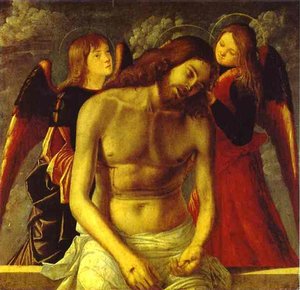
The Dead Christ (1520) door Vittore Carpaccio

The Dead Christ

1520 · Oil On Canvas · Staatliche Museen zu Berlin, Berlijn

The body of Jesus lies upon a cold stone slab, a pale weight amidst the shadows of a rocky landscape. Around him, the air is heavy with the silence of the departed. Figures gather, their faces etched with the quiet geometry of grief. Some stand close to the lifeless limbs, while others linger in the periphery, caught in a moment of profound stillness. A single tree rises nearby, its branches…

8
St George and the Dragon (detail) (1502) door Vittore Carpaccio

St George and the Dragon (detail)

1502 · Tempera On Panel · Scuola di San Giorgio degli Schiavoni, Venice

In the heart of Venice, within the hallowed halls of the Scuola di San Giorgio degli Schiavoni, lies a fragment of a much larger epic. The detail from Vittore Carpaccio’s St George and the Dragon serves as a breathtaking window into the height of the Italian Renaissance. Painted in 1502, this tempera on wood panel is not merely a depiction of a myth, but a visceral experience of movement and…

9
St George and the Dragon (1516) door Vittore Carpaccio

St George and the Dragon

1516 · Tempera On Panel · San Giorgio Maggiore, Venetië

In the heart of the Venetian Renaissance, where the shimmering reflections of the canals met the burgeoning spirit of humanism, Vittore Carpaccio captured a moment of eternal struggle. St George and the Dragon is not merely a depiction of a legendary battle; it is a breathtaking narrative tapestry that weaves together the chivalric ideals of the sixteenth century with a profound spiritual allegory. As the viewer’s eye meets the canvas,…

10
Meeting of the Betrothed Couple (detail) (1495) door Vittore Carpaccio

Meeting of the Betrothed Couple (detail)

1495 · Acrylic On Canvas · Gallerie dell'Accademia di Venezia, Venetië

Vittore Carpaccio’s “Meeting of the Betrothed Couple,” a meticulously rendered detail from his monumental cycle depicting scenes from Dante Alighieri's *Divine Comedy*, offers a captivating glimpse into the vibrant, complex world of 15th-century Venice. Far more than a simple illustration, this panel—a fragment of a larger narrative—is a masterclass in observation and storytelling, revealing Carpaccio’s unique approach to Renaissance painting. It’s a scene brimming with social nuance, legal formality, and…

De selectie van Vittore Carpaccio gaat verder, van 11 tot 100

11Martyrdom of the Pilgrims and the Funeral of St Ursula (detail) (1493) door Vittore CarpaccioMartyrdom of the Pilgrims and the Funeral of St Ursula (detail)1493 · Gallerie dell'Accademia di Venezia 12The Healing of the Madman (detail) (1496) door Vittore CarpaccioThe Healing of the Madman (detail)1496 · Gallerie dell'Accademia di Venezia 13Portrait of a Knight (1510) door Vittore CarpaccioPortrait of a Knight1510 · Thyssen-Bornemisza Museum 14The Miracle of the Relic of the True Cross on the Rialto Bridge (1494) door Vittore CarpaccioThe Miracle of the Relic of the True Cross on the Rialto Bridge1494 · Gallerie dell'Accademia di Venezia 15The Healing of the Madman (detail) (1496) door Vittore CarpaccioThe Healing of the Madman (detail)1496 · Gallerie dell'Accademia di Venezia 16The Arrival of the Pilgrims in Cologne (1490) door Vittore CarpaccioThe Arrival of the Pilgrims in Cologne1490 · Gallerie dell'Accademia di Venezia 17St Stephen is Consecrated Deacon (detail) door Vittore CarpaccioSt Stephen is Consecrated Deacon (detail)Staatliche Museen zu Berlin 18Saint Peter Martyr (1505) door Vittore CarpaccioSaint Peter Martyr1505 · Philbrook Museum of Art 19The Ambassadors Return to the English Court (detail) (1495) door Vittore CarpaccioThe Ambassadors Return to the English Court (detail)1495 · Gallerie dell'Accademia di Venezia 20The Dream of St Ursula (1495) door Vittore CarpaccioThe Dream of St Ursula1495 · Gallerie dell'Accademia di Venezia 21The Meditation on the Passion (1510) door Vittore CarpaccioThe Meditation on the Passion1510 · Metropolitan Museum of Art 22Portrait of a lady (1495) door Vittore CarpaccioPortrait of a lady1495 · Museum of Fine Arts 23Vision of St. Augustine (1507) door Vittore CarpaccioVision of St. Augustine1507 24Departure of the Pilgrims (detail) (1495) door Vittore CarpaccioDeparture of the Pilgrims (detail)1495 · Gallerie dell'Accademia di Venezia 25Martyrdom of the Pilgrims and the Funeral of St Ursula (detail) (1493) door Vittore CarpaccioMartyrdom of the Pilgrims and the Funeral of St Ursula (detail)1493 · Gallerie dell'Accademia di Venezia 26St Catherine of Alexandria and St Veneranda (1500) door Vittore CarpaccioSt Catherine of Alexandria and St Veneranda1500 · Castelvecchio Museum 27Madonna and Child with two Saints (1490) door Vittore CarpaccioMadonna and Child with two Saints1490 · Gemäldegalerie 28The Lion of St Mark door Vittore CarpaccioThe Lion of St Mark 29Portrait of a Man (1510) door Vittore CarpaccioPortrait of a Man1510 · Museum of Fine Arts 30Madonna and Child Enthroned with Saints and Donor (1507) door Vittore CarpaccioMadonna and Child Enthroned with Saints and Donor1507 · Walters Art Museum 31A Gondolier (1517) door Vittore CarpaccioA Gondolier1517 · Isabella Stewart Gardner Museum 32St George and the Dragon (1516) door Vittore CarpaccioSt George and the Dragon1516 33The Baptism of the Selenites (detail) (1507) door Vittore CarpaccioThe Baptism of the Selenites (detail)1507 · Scuola di San Giorgio degli Schiavoni 34Salvator Mundi (1520) door Vittore CarpaccioSalvator Mundi1520 35Two Court Ladies door Vittore CarpaccioTwo Court Ladies 36The Marriage of the Virgin (1504) door Vittore CarpaccioThe Marriage of the Virgin1504 · Pinacoteca di Brera 37A Bishop Saint Blessing (1514) door Vittore CarpaccioA Bishop Saint Blessing1514 · Philbrook Museum of Art 38Mary with the Child and Saints Catherine and Jerome (1508) door Vittore CarpaccioMary with the Child and Saints Catherine and Jerome1508 · Staatliche Kunsthalle Karlsruhe 39Crucifixion and Apotheosis of the Ten Thousand Martyrs (1515) door Vittore CarpaccioCrucifixion and Apotheosis of the Ten Thousand Martyrs1515 · Gallerie dell'Accademia di Venezia 40Disputation of St Stephen (detail) (1514) door Vittore CarpaccioDisputation of St Stephen (detail)1514 · Pinacoteca di Brera 41Apotheosis of St Ursula (1491) door Vittore CarpaccioApotheosis of St Ursula1491 · Gallerie dell'Accademia di Venezia 42The Lion of St Mark (detail) (1516) door Vittore CarpaccioThe Lion of St Mark (detail)1516 · Doge's Palace 43The Ambassadors Depart (detail) (1495) door Vittore CarpaccioThe Ambassadors Depart (detail)1495 · Gallerie dell'Accademia di Venezia 44The Healing of the Madman (1496) door Vittore CarpaccioThe Healing of the Madman1496 · Gallerie dell'Accademia di Venezia 45Death of the Virgin by Carpaccio (1508) door Vittore CarpaccioDeath of the Virgin by Carpaccio1508 · Pinacoteca Nazionale 46The Ambassadors Return to the English Court (detail) (1495) door Vittore CarpaccioThe Ambassadors Return to the English Court (detail)1495 · Gallerie dell'Accademia di Venezia 47Disputation of St Stephen (detail) (1514) door Vittore CarpaccioDisputation of St Stephen (detail)1514 · Pinacoteca di Brera 48Arrival of the English Ambassadors (detail) (13) (1495) door Vittore CarpaccioArrival of the English Ambassadors (detail) (13)1495 · Gallerie dell'Accademia di Venezia 49Arrival of the English Ambassadors (detail) (1495) door Vittore CarpaccioArrival of the English Ambassadors (detail)1495 · Gallerie dell'Accademia di Venezia 50Presentation of Jesus in the Temple (detail) (1510) door Vittore CarpaccioPresentation of Jesus in the Temple (detail)1510 · Gallerie dell'Accademia di Venezia 51Arrival of the English Ambassadors (detail) (9) (1495) door Vittore CarpaccioArrival of the English Ambassadors (detail) (9)1495 · Gallerie dell'Accademia di Venezia 52Funeral of St Jerome (1502) door Vittore CarpaccioFuneral of St Jerome1502 · Scuola di San Giorgio degli Schiavoni 53Portrait of a lady (1485) door Vittore CarpaccioPortrait of a lady1485 54The Departure of the English Ambassadors (1498) door Vittore CarpaccioThe Departure of the English Ambassadors1498 55Glorification of St. Ursula and her Companions (1491) door Vittore CarpaccioGlorification of St. Ursula and her Companions1491 56the ambassadors depart - 280x253 - (1494) door Vittore Carpacciothe ambassadors depart - 280x253 -1494 57Hunting on the Lagoon (1490) door Vittore CarpaccioHunting on the Lagoon1490 58Meeting of the Betrothed Couple (detail) (1495) door Vittore CarpaccioMeeting of the Betrothed Couple (detail)1495 · Gallerie dell'Accademia di Venezia 59Agony in the Garden (1502) door Vittore CarpaccioAgony in the Garden1502 · Scuola di San Giorgio degli Schiavoni 60The Crucifixion and the Glorification the Ten Thousand Martyrs on Mount Ararat (1515) door Vittore CarpaccioThe Crucifixion and the Glorification the Ten Thousand Martyrs on Mount Ararat1515 61Portrait of a Venetian Nobleman (1510) door Vittore CarpaccioPortrait of a Venetian Nobleman1510 62The Baptism of the Selenites (1502) door Vittore CarpaccioThe Baptism of the Selenites1502 63The Triumph of St. George (1507) door Vittore CarpaccioThe Triumph of St. George1507 64Young Knight in a Landscape (1510) door Vittore CarpaccioYoung Knight in a Landscape1510 65Holy Conversation (detail) (1505) door Vittore CarpaccioHoly Conversation (detail)1505 · Musée du Petit Palais 66Baptism of the Selenites (detail) (1502) door Vittore CarpaccioBaptism of the Selenites (detail)1502 · Scuola di San Giorgio degli Schiavoni 67St. George Killing the Dragon (1507) door Vittore CarpaccioSt. George Killing the Dragon1507 68St. George Baptising the Gentile (1507) door Vittore CarpaccioSt. George Baptising the Gentile1507 69The Glory of St. Vidal (1514) door Vittore CarpaccioThe Glory of St. Vidal1514 70The Annunciation (1504) door Vittore CarpaccioThe Annunciation1504 · Ca' d'Oro 71The Dead Christ Supported by Angels. (1502) door Vittore CarpaccioThe Dead Christ Supported by Angels.1502 72Presentation in the Temple (1510) door Vittore CarpaccioPresentation in the Temple1510 73St. Stephen is Consecrated Deacon (1514) door Vittore CarpaccioSt. Stephen is Consecrated Deacon1514 74Salvator Mundi (1520) door Vittore CarpaccioSalvator Mundi1520 75The Annunciation (1504) door Vittore CarpaccioThe Annunciation1504 76Saint John the Baptist (1505) door Vittore CarpaccioSaint John the Baptist1505 · Philbrook Museum of Art 77Dream of St.Ursula (1495) door Vittore CarpaccioDream of St.Ursula1495 78St Jerome and the Lion (1502) door Vittore CarpaccioSt Jerome and the Lion1502 · Scuola di San Giorgio degli Schiavoni 79Vision of St Augustin (1502) door Vittore CarpaccioVision of St Augustin1502 · Scuola di San Giorgio degli Schiavoni 80The Stoning of St Stephen (1520) door Vittore CarpaccioThe Stoning of St Stephen1520 · Staatsgalerie 81Debate of St. Stephen (1514) door Vittore CarpaccioDebate of St. Stephen1514 82Portrait of a Woman door Vittore CarpaccioPortrait of a WomanRijksmuseum 83St George and the Dragon (detail) (1502) door Vittore CarpaccioSt George and the Dragon (detail)1502 · Scuola di San Giorgio degli Schiavoni 84Apotheosis of St Ursula (detail) (1491) door Vittore CarpaccioApotheosis of St Ursula (detail)1491 · Gallerie dell'Accademia di Venezia 85St. Stephen Preaching (1514) door Vittore CarpaccioSt. Stephen Preaching1514 86The Birth of the Virgin (1508) door Vittore CarpaccioThe Birth of the Virgin1508 87The Virgin Reading to the Infant Christ/The Virgin Adoring the Infant Christ with Saint John\n\nThe Virgin Reading to the Infant Christ (recto) (1490) door Vittore CarpaccioThe Virgin Reading to the Infant Christ/The Virgin Adoring the Infant Christ with Saint John\n\nThe Virgin Reading to the Infant Christ (recto)1490 · Courtauld Gallery 88Birth of the Virgin (1504) door Vittore CarpaccioBirth of the Virgin1504 · Accademia Carrara 89The Ten Thousand Martyrs on the Mount Ararat (detail) (1515) door Vittore CarpaccioThe Ten Thousand Martyrs on the Mount Ararat (detail)1515 · Gallerie dell'Accademia di Venezia 90Two Venetian Ladies (1510) door Vittore CarpaccioTwo Venetian Ladies1510 · Museo Correr 91Allegorical Figure of a Woman in a Landscape Holding a Spear and a Cornucopia door Vittore CarpaccioAllegorical Figure of a Woman in a Landscape Holding a Spear and a Cornucopia 92Madonna and Child door Vittore CarpaccioMadonna and ChildCollection Bemberg 93Resurrection of Christ door Vittore CarpaccioResurrection of ChristGemäldegalerie 94Coronation of Mary door Vittore CarpaccioCoronation of MaryGemäldegalerie 95Arrival of the English Ambassadors (detail - ) door Vittore CarpaccioArrival of the English Ambassadors (detail - ) 96The Madonna Reading door Vittore CarpaccioThe Madonna Reading 97Sacra Conversazione door Vittore CarpaccioSacra Conversazione 98Annunciation door Vittore CarpaccioAnnunciation 99the ambassadors depart door Vittore Carpacciothe ambassadors depart 100The Ambassadors Return to the English Court (detail) door Vittore CarpaccioThe Ambassadors Return to the English Court (detail)

De beroemde schilderijen van Vittore Carpaccio, periode voor periode

De onderwerpen die de aandacht van Vittore Carpaccio troffen

De vier onderwerpen die het meest voorkomen in deze originelen, elk met zijn mooiste voorbeeld.

De musea waar de originele werken van Vittore Carpaccio worden bewaard

De 8 musea met de meeste schilderijen op deze pagina.

Museum Stad Werken van Vittore Carpaccio Schilderijen uit deze lijst
Gallerie dell'Accademia di Venezia, VenetiëGallerie dell'Accademia di Venezia Venetië 36 The Ten Thousand Martyrs on the Mount Ararat, Meeting of the Betrothed Couple (detail), Meeting of the Betrothed Couple (detail)
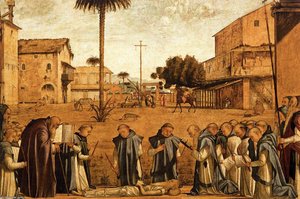
Scuola di San Giorgio degli Schiavoni, VeniceScuola di San Giorgio degli Schiavoni Venice 17 St George and the Dragon (detail), The Baptism of the Selenites (detail), Funeral of St Jerome
Pinacoteca di Brera, MilaanPinacoteca di Brera Milaan 6 The Marriage of the Virgin, Disputation of St Stephen (detail), Disputation of St Stephen (detail)
Doge's Palace, VenetiëDoge's Palace Venetië 4 The Lion of St Mark (detail), The Lion of St Mark (detail), The Lion of St Mark (detail)
Gemäldegalerie, BerlijnGemäldegalerie Berlijn 4 Madonna and Child with two Saints, Resurrection of Christ, Coronation of Mary
Philbrook Museum of Art, TulsaPhilbrook Museum of Art Tulsa 3 Saint Peter Martyr, A Bishop Saint Blessing, Saint John the Baptist
Metropolitan Museum of Art, New YorkMetropolitan Museum of Art New York 3 Christ met de Symbolen van het Laatste Avondmaal Omringd door Engelen, The Meditation on the Passion
Staatliche Museen zu Berlin, BerlijnStaatliche Museen zu Berlin Berlijn 3 The Dead Christ, St Stephen is Consecrated Deacon (detail)

Vittore Carpaccio decennium voor decennium: het origineel dat elk tijdperk definieert

Werken per decennium

Kies een decennium om het origineel te zien dat dit tijdperk definieert.

Vragen van verzamelaars over de schilderijen van Vittore Carpaccio

Waar is Vittore Carpaccio het meest bekend om?Onthul het antwoord

Christ met de Symbolen van het Laatste Avondmaal Omringd door Engelen (1510), Metropolitan Museum of Art, New York. The Ten Thousand Martyrs on the Mount Ararat (1515) en Meeting of the Betrothed Couple (detail) (1495) volgen.

Hoe oud was Vittore Carpaccio toen Christ met de Symbolen van het Laatste Avondmaal Omringd door Engelen werd gemaakt?Onthul het antwoord

45 jaar oud: Christ met de Symbolen van het Laatste Avondmaal Omringd door Engelen dateert uit 1510, en Vittore Carpaccio werd geboren in 1465.

Wat zijn de tien beroemdste schilderijen van Vittore Carpaccio?Onthul het antwoord

Christ met de Symbolen van het Laatste Avondmaal Omringd door Engelen, The Ten Thousand Martyrs on the Mount Ararat, Meeting of the Betrothed Couple (detail), The Lion of St Mark (detail), The Lion of St Mark (detail), Lamentation of Christ, The Dead Christ, St George and the Dragon (detail), St George and the Dragon en Meeting of the Betrothed Couple (detail). De bovenstaande ranglijst vermeldt het jaar en het museum van elk werk.

Hoeveel schilderijen heeft Vittore Carpaccio nagelaten?Onthul het antwoord

Onze catalogus bevat 201 werken van Vittore Carpaccio, daterend van 1485 tot 1520.

In welke musea hangen de meesterwerken van Vittore Carpaccio?Onthul het antwoord

Voornamelijk in Gallerie dell'Accademia di Venezia (Venetië), Scuola di San Giorgio degli Schiavoni (Venice) en Pinacoteca di Brera (Milaan). De bovenstaande museumtabel bevat een volledig overzicht.

In welke jaren schilderde Vittore Carpaccio de beroemdste werken?Onthul het antwoord

In 1490s: 28 van de 100 werken op deze pagina werden toen gemaakt, waaronder Meeting of the Betrothed Couple (detail).

Wat zijn de eerste en de laatste beroemde originelen van Vittore Carpaccio?Onthul het antwoord

Op deze pagina is het vroegste Portrait of a lady (1485) en het laatste The Dead Christ (1520).

Welke onderwerpen koos Vittore Carpaccio het vaakst?Onthul het antwoord

Narrative painting (13), Venetian school (12) en Man (10), verspreid over de 100 werken op deze pagina.

Welke techniek gebruikte Vittore Carpaccio het meest?Onthul het antwoord

Oil On Canvas, voor 19 van de 100 werken op deze pagina.

Bij welke kunststroming behoort Vittore Carpaccio?Onthul het antwoord

Venetiaanse renaissance, te oordelen aan de originelen op deze pagina.

Welke werken van Vittore Carpaccio hangen in het Gallerie dell'Accademia di Venezia?Onthul het antwoord

The Ten Thousand Martyrs on the Mount Ararat, Meeting of the Betrothed Couple (detail) en Meeting of the Betrothed Couple (detail): het Gallerie dell'Accademia di Venezia, Venetië herbergt 24 van de werken op deze pagina.

Vittore Carpaccio: leven en werk

Vroege Leven en Artistieke Vorming

Vittore Carpaccio werd rond 1465 geboren in Venetië, een stad die werd gedefinieerd door haar maritieme handel en haar unieke, atmosferische licht. Als jonge kunstenaar binnen de Venetiaanse school zocht hij de begeleiding van Gentile Bellini. Dit meesterschap vormde een cruciale periode in zijn leven; het legde de basis voor zijn technische benadering en bood het noodzakelijke fundament voor zijn toekomstige succes als schilder.

De opleiding die Carpaccio onder Bellini genoot, stelde hem in staat om een vaste hand te ontwikkelen en een scherp oog te krijgen voor de specifieke details van het Venetiaanse leven. Hij leerde navigeren door de complexiteit van compositie en kleur, elementen die essentieel waren voor de artistieke stromingen van die tijd. Deze vroege vorming hielp hem om een vaste voet aan de grond te krijgen in het competitieve artistieke landschap van de Republiek, waarmee hij het toneel bereidde voor een carrière gewijd aan het vastleggen van zowel heilige verhalen als de dagelijkse realiteit van zijn geboortestad.

Artistieke Stijl en Invloeden

De benadering van Vittore Carpaccio ten aanzien van de schilderkunst bleef opvallend conservatief, zelfs terwijl de wereld om hem heen voortdurend in beweging was. Terwijl veel van zijn tijdgenoten de meeslepende humanistische trends omarmden die de Italiaanse renaissancekunst herdefinieerden, keek hij vaak in een geheel andere richting. Zijn werk ademt een gevoel van fantasie uit en grijpt regelmatig terug naar de geest van de middeleeuwse romantiek, in plaats van de pastorale idealen die door de volgende generatie schilders werden geprefereerd. Deze voorkeur verleende zijn scènes een unieke atmosfeer, een sfeer die zich duidelijk onderscheidde van de evoluerende smaken op het Venetiaanse vasteland.

Zijn visuele taal werd gevormd door een specifieke versmelting van invloeden. Hij putte zwaar uit de stijl van Antonello da Messina en de minutieuze tradities van de vroeg-Nederlandse kunst. Deze combinatie stelde hem in staat om een meesterschap over het perspectief te ontwikkelen en een precisie in architecturale details te bereiken die hem onderscheidde van andere kunstenaars uit zijn tijd. Hij had de gave om zijn onderwerpen te plaatsen in zeer specifieke, gestructureerde omgevingen, waarbij hij licht en schaduw gebruikte om een gevoel van diepte te creëren dat zowel tastbaar als buitenaards aanvoelde.

Deze aandacht voor detail is bijzonder evident in zijn grootschalige narratieve werken, waarin hij complexe verhalen verweefde in het weefsel van de setting zelf. Zijn vermogen om de texturen van kleding en de exacte geometrie van een gebouw weer te geven, hielp bij het creëren van een realisme dat zijn meer verbeeldingsrijke verhalen ondersteunde. Door zich te concentreren op deze nauwkeurige elementen, bouwde hij een wereld op die geleefd aanvoelde, zelfs wanneer de thematiek neigde naar het legendarische of het heilige.

Meesterwerken en Narratieve Cycli

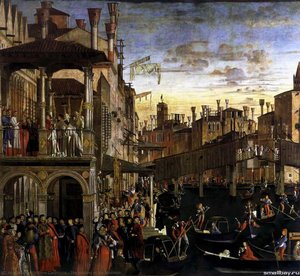
Vittore Carpaccio vond zijn meest krachtige expressie in het grootschalige vertellen van verhalen. Zijn meest ambitieuze onderneming was de cyclus van negen schilderijen die bekendstaat als De Legende van Sint-Ursula, een project dat hij in 1490 tot leven wekte. Deze werken boden hem de mogelijkheid om complexe werelden te creëren, waarbij de toeschouwer diep wordt meegezogen in de fijnmazige details van het leven van de heilige. Daarnaast bezat hij het zeldzame talent om de ware ziel van zijn geboortestad te vangen. In Het Wonder van het Relikwie van het Kruis bij de Ponte di Rialto portretteerde hij Venetië op het toppunt van haar macht, waarbij hij het stedelijke landschap gebruikte om zijn religieuze verhalen te verankeren in een herkenbare, tastbare realiteit.

Zijn veelzijdigheid als kunstenaar blijkt uit de diversiteit van zijn opdrachten. Hij schilderde het Portret van Doge Leonardo Loredan, een werk dat zijn prominente status binnen de Venetiaanse Renaissance onderstreept. Ook zijn vermogen om drama te vatten is meesterlijk in werken zoals Sint-Joris en de Draak, een tempera op houten paneel die momenteel wordt bewaard in de Scuola di San Giorgio degli Schiavoni in Venetië. Dit schilderij vangt een intense spanning door de compositie en de dynamische interactie tussen de figuren.

Enkele van zijn meest iconische werken zijn:

  • De Legende van Sint-Ursula (begonnen in 1490)
  • Het Wonder van het Relikwie van het Kruis bij de Ponte di Rialto
  • Sint-Joris en de Draak
  • Portret van Doge Leonardo Loredan

Loopbaan en Belangrijke Opdrachten

De meest productieve jaren van Vittore Carpaccio vonden plaats tussen 1490 en 1519. Gedurende deze periode werd hij een constante aanwezigheid in het religieuze leven van Venetië, waarbij hij diverse kerkelijke opdrachten ontving die hem de ruimte boden om complexe narratieven te verkennen. Zijn werk leek vaak door de straten van de stad te dwalen, waarbij hij de geest van de Republiek vastlegde in grootschalige, stedelijke scènes. Een treffend voorbeeld hiervan is Het Wonder van het Relikwie van het Kruis bij de Ponte di Rialto, een meesterwerk dat Venetië toont op het hoogtepunt van haar burgerlijke trots.

Naarmate zijn carrière vorderde, begon de aard van zijn mecenaat te veranderen. Waar zijn vroege jaren werden gekenmerkt door grootschalige religieuze cycli en publieke werken, verschoof zijn oeuvre na 1510 naar de private sfeer. Hij begon voornamelijk te werken voor individuele Venetiaanse opdrachtgevers, waarbij hij stukken creëerde die de persoonlijke smaak van de groeiende klasse van kooplieden in de stad weerspiegelden. Deze transitie markeerde een beweging van het monumentale, publieke verhalen vertellen uit zijn jeugd naar meer intieme ontmoetingen met zijn verzamelaars.

Zijn religieuze productie bleef gedurende het eerste decennium van de zestiende eeuw constant. Enkele opmerkelijke opdrachten uit deze periode zijn:

  • Sint-Thomas Aquinustroning (1507)
  • De Presentatie van Christus in de Tempel (1510)

Nalatenschap en Historische Betekenis

Vittore Carpaccio neemt een bijzondere plaats in onder de vroege meesters van de Venetiaanse Renaissance, een tijdperk dat de Italiaanse kunst fundamenteel zou transformeren. Terwijl zijn tijdgenoten zich steeds meer richting nieuwe humanistische stromingen bewogen, bleef Carpaccio vaak verankerd in een meer traditionele manier van kijken. Tegen 1510 begonnen degenen die naast hem leefden en werkten zijn stijl als te conservatief te beschouwen. Hij volgde de wankele stromingen van zijn tijd niet, maar gaf de voorkeur aan een methode die met een bewonderende blik terugkeek naar de gedetailleerde, narratieve tradities uit het verleden.

Deze standvastigheid betekende dat zijn naam soms in de schaduw is komen te staan van iconische figuren zoals Giovanni Bellini of Giorgione. Waar anderen kozen voor een geheel nieuwe visuele taal, bleef Carpaccio zijn werelden opbouwen door middel van uiterst precieze architecturale details en een onmiskenbare fascinatie voor het exotische. Zijn oeuvre fungeert nog steeds als een venster op een specifiek moment in Venetië; hij legde de burgerlijke trots van de stad en de verbinding met het Levant vast door een lens die voor zijn tijdgenoten steeds ouderwetsiger leek te worden. Bij zijn dood in 1526 liet hij een oeuvre na dat getuigt van een unieke, zij het enigszins koppige, toewijding aan zijn ambacht.

Onder zijn meest betekenisvolle werken behoren:

  • De Legende van Sint Ursula
  • Het Wonder van het Reliek van het Ware Kruis bij de Ponte di Rialto
  • Sint Joris en de Draak