Portret van Salvator Rosa

Schilderijen van Salvator Rosa: De 100 bekendste, door de ogen van een galerie

Bijgewerkt in november 2026 · gerangschikt op basis van onze populariteitsscore (zoekopdrachten, bezoeken en bestellingen per kunstwerk) · 274 werken van Salvator Rosa in onze catalogus

Kortom

Volgens de visie van de galerie is het beroemdste schilderij van Salvator Rosa The Baptism of the Eunuch (1660), waarvan het origineel in het Chrysler Museum of Art in Norfolk hangt. Pythagoras Emerging from the Underworld (1662) en Landscape with St Jerome (1670) maken het trio compleet dat elk oog herkent. Van de 274 werken van Salvator Rosa in onze catalogus presenteert de galerie hieronder de 100 bekendste werken, elk een origineel met de jaartal, het museum en wat het uniek maakt.

1615 – 1673, Napels Baroque style Meeste werken: Bayerische Staatsgemäldesammlungen

De top 10 schilderijen van Salvator Rosa in de galerie

1
The Baptism of the Eunuch (1660) door Salvator Rosa

The Baptism of the Eunuch

1660 · Oil On Canvas · Chrysler Museum of Art, Norfolk

In "The Baptism of the Eunuch" by Salvator Rosa, a profound moment of spiritual transformation unfolds within a rugged landscape. Created in 1660, the scene captures the precise instant of a man's rebirth through water. A figure, dressed in a white robe, receives the sacrament from another person. This act of baptism occurs amidst a natural setting where rocks rise from the earth, grounding the sacred event in a physical,…

2
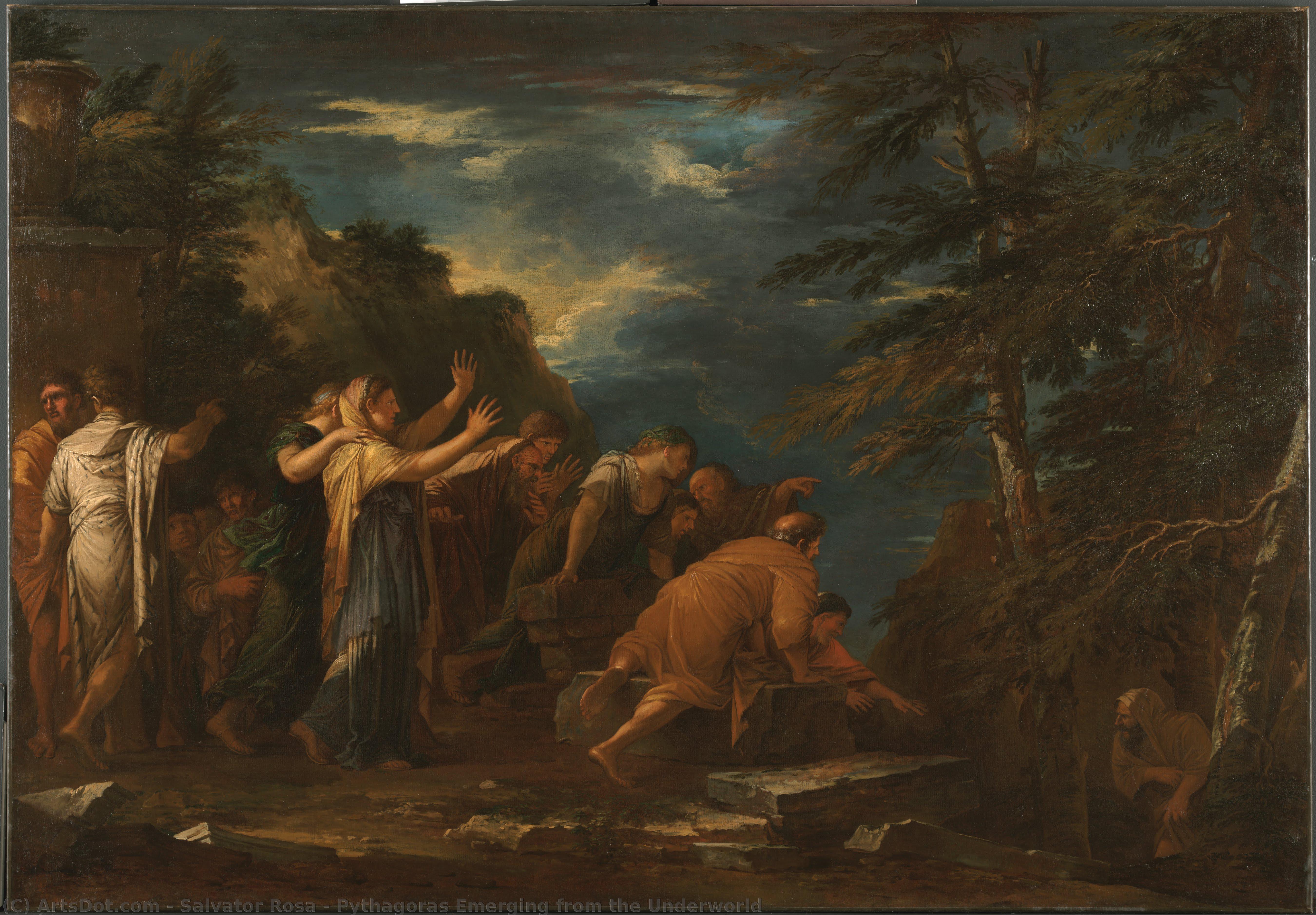
Pythagoras Emerging from the Underworld (1662) door Salvator Rosa

Pythagoras Emerging from the Underworld

1662 · Olieverf op canvas · Kimbell Art Museum, Fort Worth

Pythagoras Emerging from the Underworld: A Baroque Vision of Philosophy and Myth Salvator Rosa’s “Pythagoras Emerging from the Underworld,” painted in 1662, stands as a testament to the baroque artistic spirit—a dramatic fusion of philosophical contemplation and mythological narrative. Executed with masterful brushstrokes and imbued with an atmosphere of profound solemnity, this monumental canvas captures a pivotal moment recounted by Plato: Pythagoras’s descent into Hades and his encounter with Homer…

3
Landscape with St Jerome (1670) door Salvator Rosa

Landscape with St Jerome

1670 · Oil On Canvas · Musée Condé, Chantilly

A rugged, mountainous gorge dominates the vertical composition, creating a sense of isolation through deep, narrow canyons. The landscape is defined by jagged, irregular rock faces and the skeletal, tangled branches of overhanging trees. Earthy tones of ochre, deep brown, and muted green establish a somber atmosphere, while a luminous patch of sky at the top center provides a sharp contrast to the shadows below. Within this untamed environment, a…

4
Head of a Man with a Turban (1652) door Salvator Rosa

Head of a Man with a Turban

1652 · Oil On Canvas · Birmingham Museum and Art Gallery, Birmingham

A single light source strikes the left side of a weathered face, carving it out of a heavy, ink-black void. The man’s gaze is steady, meeting the viewer with a quiet, stoic intensity. He wears a voluminous turban, its cream and ochre folds catching the light, revealing the coarse texture of the cloth. Deep shadows swallow the right side of his head, merging his beard and the nape of his…

5
Tobias and the Angel (1662) door Salvator Rosa

Tobias and the Angel

1662 · Oil On Canvas · Musée Condé, Chantilly

The canvas holds a vertical tension, a sudden movement between the heavens and the earth. A celestial figure descends, cutting through a darkness that feels heavy and thick. This is the moment of intervention, where the divine enters the realm of the mortal. Light does not merely illuminate; it strikes. It catches the curve of a reaching hand and the pale skin of a kneeling figure, leaving the rest of…

6
Return of Astrea (1642) door Salvator Rosa

Return of Astrea

1642 · Oil On Canvas · Kunsthistorisches Museum, Wenen

A heavy, weathered stone structure anchors the left side of the canvas, its crumbling edges catching the light. Beside it, a gnarled tree leans into the frame, its dark branches reaching like fingers toward a vast, cloud-filled sky. In the lower foreground, rustic figures move through the shadows of the ruins. A man in white and blue stands amidst the earthy tones of ochre and sienna. Above this earthly realm,…

7
Daniel in the Lion's Den (1662) door Salvator Rosa

Daniel in the Lion's Den

1662 · Oil On Canvas · Musée Condé, Chantilly

Salvator Rosa painted Daniel in the Lion's Den as a profound exercise in religious art. This oil on canvas work emerged after 1662, a period when the artist sought to expand his reputation beyond the rugged landscapes for which he was known. The composition belongs to a larger, cohesive cycle of five thematically linked Biblical stories. These paintings were executed for Carlo de' Rossi, intended to decorate a private chapel…

8
Crucifixion of Polyclitus (1650) door Salvator Rosa

Crucifixion of Polyclitus

1650 · Oil · Nationaal Museum in Warschau, Warschau

In this dramatic Baroque oil painting, we find ourselves witnessing a moment of profound martyrdom. The composition is built upon a restless diagonal, pulling the eye from a crowded, agitated group of figures in the lower left toward the central figure of Polyclitus, suspended upon the cross in the upper right. The landscape is not a place of peace; it is a rugged, mountainous terrain of craggy rocks and turbulent…

9
Jesus carrying the cross (1667) door Salvator Rosa

Jesus carrying the cross

1667 · Oil · Musée Condé, Chantilly

A heavy, wooden cross dominates the composition, its diagonal thrust cutting through a turbulent scene of physical and spiritual struggle. Christ is caught in a moment of intense exertion, his body strained under the burden of the timber. Around him, a crowd of onlookers and tormentors creates a sense of claustrophobic chaos. The arrangement of figures is agitated, driving the eye across the canvas in a series of sharp, conflicting…

10
Witches at their Incantations (1646) door Salvator Rosa

Witches at their Incantations

1646 · Oil On Canvas · National Gallery, Londen

The shadows deepen as we encounter Witches at their Incantations, a work that pulls the viewer into a dark, nocturnal ritual. Painted by Salvator Rosa about 1646, the scene captures a gathering of figures caught in the midst of a witches' sabbath. This macabre assembly unfolds beneath a heavy, cloud-covered sky, where the line between the human and the monstrous begins to blur. It is a moment of profound unrest,…

Schilderijen van Salvator Rosa, gerangschikt van 11 tot 100

11Group of Warriors (1644) door Salvator RosaGroup of Warriors1644 · Bayerische Staatsgemäldesammlungen 12Self-Portrait as Philosopher of Silence (1641) door Salvator RosaSelf-Portrait as Philosopher of Silence1641 · National Gallery 13Landscape with Bather (1660) door Salvator RosaLandscape with Bather1660 · Yale University Art Gallery 14Saint John the Baptist Baptizing Christ in the Jordan (1655) door Salvator RosaSaint John the Baptist Baptizing Christ in the Jordan1655 · Kelvingrove Art Gallery and Museum 15Jeremie pulled from the cistern (1622) door Salvator RosaJeremie pulled from the cistern1622 · Musée Condé 16Armed Robbers in Rocky Countryside (1644) door Salvator RosaArmed Robbers in Rocky Countryside1644 · Bayerische Staatsgemäldesammlungen 17Jonah Preaching to the People of Niniveh (1645) door Salvator RosaJonah Preaching to the People of Niniveh1645 · Statens Museum for Kunst 18Prometheus on the Rock (1644) door Salvator RosaPrometheus on the Rock1644 · Bayerische Staatsgemäldesammlungen 19Mountain Landscape (1644) door Salvator RosaMountain Landscape1644 · Bayerische Staatsgemäldesammlungen 20Landscape with Saint Anthony Abbot and Saint Paul the Hermit (1662) door Salvator RosaLandscape with Saint Anthony Abbot and Saint Paul the Hermit1662 · Scottish National Gallery 21Study for 'Il Genio di Rosa' door Salvator RosaStudy for 'Il Genio di Rosa' 22Astraea Leaves The Earth (1665) door Salvator RosaAstraea Leaves The Earth1665 · Kunsthistorisches Museum 23An Evangelist (1635) door Salvator RosaAn Evangelist1635 · Israël Museum 24The War People of Gideon (1644) door Salvator RosaThe War People of Gideon1644 · Bayerische Staatsgemäldesammlungen 25Allegory of Study (1647) door Salvator RosaAllegory of Study1647 · John and Mable Ringling Museum of Art 26Scenes of Witchcraft: Night (1640) door Salvator RosaScenes of Witchcraft: Night1640 · Cleveland Museum of Art 27Scenes of Witchcraft: Evening (1640) door Salvator RosaScenes of Witchcraft: Evening1640 · Cleveland Museum of Art 28Scenes of Witchcraft: Day (1640) door Salvator RosaScenes of Witchcraft: Day1640 · Cleveland Museum of Art 29Scenes of Witchcraft: Morning (1640) door Salvator RosaScenes of Witchcraft: Morning1640 · Cleveland Museum of Art 30A Philosopher (1643) door Salvator RosaA Philosopher1643 · Kedleston Hall 31The Founding of Thebes (1645) door Salvator RosaThe Founding of Thebes1645 · Statens Museum for Kunst 32The Martyrdom of Saint Januarius and his Fellows (1650) door Salvator RosaThe Martyrdom of Saint Januarius and his Fellows1650 · Städel Museum 33Head of a Philosopher, called 'Democritus' (1659) door Salvator RosaHead of a Philosopher, called 'Democritus'1659 34Bandits robbing Travellers (1656) door Salvator RosaBandits robbing Travellers1656 · Knole House 35Anchorites Tempted by Demons (1660) door Salvator RosaAnchorites Tempted by Demons1660 · Galleria Nazionale d'Arte Antica 36Three Marys at the Tomb (1665) door Salvator RosaThree Marys at the Tomb1665 · John and Mable Ringling Museum of Art 37Christ expelling the Money Changers from the Temple (1664) door Salvator RosaChrist expelling the Money Changers from the Temple1664 · Attingham Park 38The Angel Leaving the House of Tobias (1662) door Salvator RosaThe Angel Leaving the House of Tobias1662 39Cavalieri in Marcia (1673) door Salvator RosaCavalieri in Marcia1673 40Self-Portrait (1650) door Salvator RosaSelf-Portrait1650 · Detroit Institute of Arts 41Saint Simon the Apostle (1673) door Salvator RosaSaint Simon the Apostle1673 · Georgia Museum of Art 42Landscape with Armed Men (1640) door Salvator RosaLandscape with Armed Men1640 · Los Angeles County Museum of Art 43St. Francis in Ecstasy door Salvator RosaSt. Francis in EcstasyThe Phillips Collection 44Fall of the Giants door Salvator RosaFall of the Giants 45Saint Humphrey (Onuphrius) (1660) door Salvator RosaSaint Humphrey (Onuphrius)1660 · Minneapolis Institute of Art 46Landscape with an "Arco Naturale" (1651) door Salvator RosaLandscape with an "Arco Naturale"1651 · Statens Museum for Kunst 47Odysseus and Nausicaa (1655) door Salvator RosaOdysseus and Nausicaa1655 · Los Angeles County Museum of Art 48Sleeping Warrior (1644) door Salvator RosaSleeping Warrior1644 · Bayerische Staatsgemäldesammlungen 49Ceres and Phytalus (1662) door Salvator RosaCeres and Phytalus1662 · Los Angeles County Museum of Art 50Witches at their Incantations door Salvator RosaWitches at their Incantations 51A Cavalry Battle (1652) door Salvator RosaA Cavalry Battle1652 · Auckland Art Gallery Toi o Tāmaki 52Desolate Landscape with Two Figures (1662) door Salvator RosaDesolate Landscape with Two Figures1662 · Scottish National Gallery 53Landscape with Mercury and the Dishonest Woodman (1652) door Salvator RosaLandscape with Mercury and the Dishonest Woodman1652 · National Gallery 54Landscape with Warriors (1644) door Salvator RosaLandscape with Warriors1644 · Bayerische Staatsgemäldesammlungen 55Landscape with Armed Men (1640) door Salvator RosaLandscape with Armed Men1640 · Los Angeles County Museum of Art 56Glaucus and Scylla (1661) door Salvator RosaGlaucus and Scylla1661 · Los Angeles County Museum of Art 57The Raising of Lazarus door Salvator RosaThe Raising of LazarusMusée Condé 58Still Life (1673) door Salvator RosaStill Life1673 · Bayerische Staatsgemäldesammlungen 59Youth with An Effigy of Diana of Ephesus (1657) door Salvator RosaYouth with An Effigy of Diana of Ephesus1657 · Royal Collection 60River Landscape with Apollo and the Cumean Sibyl (1655) door Salvator RosaRiver Landscape with Apollo and the Cumean Sibyl1655 · Wallace Collection 61Rocky Landscape with a Huntsman and Warriors (1670) door Salvator RosaRocky Landscape with a Huntsman and Warriors1670 · Louvre 62The Finding of Moses (1650) door Salvator RosaThe Finding of Moses1650 · Kimbell Art Museum 63Bandits on a Rocky Coast (1656) door Salvator RosaBandits on a Rocky Coast1656 · Metropolitan Museum of Art 64Standing Warror with Shield (1657) door Salvator RosaStanding Warror with Shield1657 · Los Angeles County Museum of Art 65Saint John the Baptist Revealing Christ to the Disciples (1655) door Salvator RosaSaint John the Baptist Revealing Christ to the Disciples1655 · Kelvingrove Art Gallery and Museum 66Pythagoras and the Fisherman (1662) door Salvator RosaPythagoras and the Fisherman1662 · Staatliche Museen zu Berlin 67Rocky Landscape (1644) door Salvator RosaRocky Landscape1644 · Bayerische Staatsgemäldesammlungen 68A Pass with Travellers attacked by Bandits (1627) door Salvator RosaA Pass with Travellers attacked by Bandits1627 · Knole House 69Bay in a Calm Sea (1644) door Salvator RosaBay in a Calm Sea1644 · Bayerische Staatsgemäldesammlungen 70Sea Storm (1644) door Salvator RosaSea Storm1644 · Bayerische Staatsgemäldesammlungen 71Sea Bay with Rocky Coast (1644) door Salvator RosaSea Bay with Rocky Coast1644 · Bayerische Staatsgemäldesammlungen 72Landscape with Riders (1644) door Salvator RosaLandscape with Riders1644 · Bayerische Staatsgemäldesammlungen 73Sea Storm (1644) door Salvator RosaSea Storm1644 · Bayerische Staatsgemäldesammlungen 74Mountain Landscape (1644) door Salvator RosaMountain Landscape1644 · Bayerische Staatsgemäldesammlungen 75Rocky Coast at a Bay (1644) door Salvator RosaRocky Coast at a Bay1644 · Bayerische Staatsgemäldesammlungen 76Bay by Turbulent Sea (1644) door Salvator RosaBay by Turbulent Sea1644 · Bayerische Staatsgemäldesammlungen 77Seastorm (1644) door Salvator RosaSeastorm1644 · Bayerische Staatsgemäldesammlungen 78Wild rocky landscape (1644) door Salvator RosaWild rocky landscape1644 · Bayerische Staatsgemäldesammlungen 79Sea bay with castle ruins (1644) door Salvator RosaSea bay with castle ruins1644 · Bayerische Staatsgemäldesammlungen 80Coastal Landscape with Castle (1644) door Salvator RosaCoastal Landscape with Castle1644 · Bayerische Staatsgemäldesammlungen 81Lucrezia as Poetry (1641) door Salvator RosaLucrezia as Poetry1641 · Wadsworth Atheneum Museum of Art 82Evening Landscape (1640) door Salvator RosaEvening Landscape1640 83Harbour with Ruins (1640) door Salvator RosaHarbour with Ruins1640 · Szépművészeti Múzeum 84St John Preaching (1660) door Salvator RosaSt John Preaching1660 · York Art Gallery 85Rocky Landscape with Figures (1660) door Salvator RosaRocky Landscape with Figures1660 86The Finding of Moses (1660) door Salvator RosaThe Finding of Moses1660 · Detroit Institute of Arts 87The Return of the Prodigal Son (1660) door Salvator RosaThe Return of the Prodigal Son1660 · National Gallery of Canada 88A Seaport (1651) door Salvator RosaA Seaport1651 · Statens Museum for Kunst 89Southern Harbour (1651) door Salvator RosaSouthern Harbour1651 · Statens Museum for Kunst 90Rocky landscape with figures (1651) door Salvator RosaRocky landscape with figures1651 91Landscape with figures (1651) door Salvator RosaLandscape with figures1651 92Landscape with Tower and Boat (1660) door Salvator RosaLandscape with Tower and Boat1660 · Musée Condé 93Christ resurrected door Salvator RosaChrist resurrectedMusée Condé 94the Witches' Sabbath (1654) door Salvator Rosathe Witches' Sabbath1654 · Museum of Fine Arts, Houston 95Glaucus and Scylla (1661) door Salvator RosaGlaucus and Scylla1661 · Art Gallery of South Australia 96Diogenes Throwing Away His Drinking Cup. (1651) door Salvator RosaDiogenes Throwing Away His Drinking Cup.1651 · Statens Museum for Kunst 97Wooded Landscape (1650) door Salvator RosaWooded Landscape1650 98Portrait of the Artist's Wife Lucrezia (1657) door Salvator RosaPortrait of the Artist's Wife Lucrezia1657 · Galleria Nazionale d’Arte Antica 99Diogenes Casting away his Cup (1650) door Salvator RosaDiogenes Casting away his Cup1650 · Museum of Fine Arts, Houston 100Landscape with a Wide River, Waterfall and Three Figures (1665) door Salvator RosaLandscape with a Wide River, Waterfall and Three Figures1665 · John and Mable Ringling Museum of Art

De beroemde schilderijen van Salvator Rosa, periode voor periode

De onderwerpen die de aandacht van Salvator Rosa troffen

De vier onderwerpen die het meest voorkomen in deze originelen, elk met zijn mooiste voorbeeld.

De musea waar de originele werken van Salvator Rosa worden bewaard

De 8 musea met de meeste schilderijen op deze pagina.

Museum Stad Werken van Salvator Rosa Schilderijen uit deze lijst
Bayerische Staatsgemäldesammlungen, MünchenBayerische Staatsgemäldesammlungen München 21 Group of Warriors, Armed Robbers in Rocky Countryside, Prometheus on the Rock
Musée Condé, ChantillyMusée Condé Chantilly 9 Landscape with St Jerome, Tobias and the Angel, Daniel in the Lion's Den
Statens Museum for Kunst, KopenhagenStatens Museum for Kunst Kopenhagen 10 Jonah Preaching to the People of Niniveh, The Founding of Thebes, Landscape with an "Arco Naturale"
Los Angeles County Museum of Art, Los AngelesLos Angeles County Museum of Art Los Angeles 7 Landscape with Armed Men, Odysseus and Nausicaa, Ceres and Phytalus
Cleveland Museum of Art, ClevelandCleveland Museum of Art Cleveland 5 Scenes of Witchcraft: Night, Scenes of Witchcraft: Evening, Scenes of Witchcraft: Day
National Gallery, LondenNational Gallery Londen 7 Witches at their Incantations, Self-Portrait as Philosopher of Silence, Landscape with Mercury and the Dishonest Woodman
John and Mable Ringling Museum of Art, SarasotaJohn and Mable Ringling Museum of Art Sarasota 4 Allegory of Study, Three Marys at the Tomb, Landscape with a Wide River, Waterfall and Three Figures
Kunsthistorisches Museum, WenenKunsthistorisches Museum Wenen 4 Return of Astrea, Astraea Leaves The Earth

Salvator Rosa, één iconisch schilderij per decennium

Werken per decennium

Kies een decennium om het origineel te zien dat dit tijdperk definieert.

Schilderijen van Salvator Rosa: de galerie geeft antwoord

Welk schilderij van Salvator Rosa is het beroemdste van allemaal?Onthul het antwoord

The Baptism of the Eunuch (1660), Chrysler Museum of Art, Norfolk. Pythagoras Emerging from the Underworld (1662) en Landscape with St Jerome (1670) volgen.

Hoe oud was Salvator Rosa bij de voltooiing van The Baptism of the Eunuch?Onthul het antwoord

45 jaar oud: The Baptism of the Eunuch dateert uit 1660, en Salvator Rosa werd geboren in 1615.

Wat zijn de top 10 schilderijen van Salvator Rosa?Onthul het antwoord

The Baptism of the Eunuch, Pythagoras Emerging from the Underworld, Landscape with St Jerome, Head of a Man with a Turban, Tobias and the Angel, Return of Astrea, Daniel in the Lion's Den, Crucifixion of Polyclitus, Jesus carrying the cross en Witches at their Incantations. De bovenstaande ranglijst vermeldt het jaar en het museum van elk werk.

Hoeveel werken heeft Salvator Rosa gemaakt?Onthul het antwoord

Onze catalogus bevat 274 werken van Salvator Rosa, daterend van 1627 tot 1673.

Waar hangen de beroemdste originele werken van Salvator Rosa?Onthul het antwoord

Voornamelijk in Bayerische Staatsgemäldesammlungen (München), Musée Condé (Chantilly) en Statens Museum for Kunst (Kopenhagen). De bovenstaande museumtabel bevat een volledig overzicht.

Wanneer creëerde Salvator Rosa de beroemdste schilderijen?Onthul het antwoord

In 1640s: 36 van de 100 werken op deze pagina werden toen gemaakt, waaronder Return of Astrea.

Wat zijn de vroegste en laatste beroemde werken van Salvator Rosa?Onthul het antwoord

Op deze pagina is het vroegste A Pass with Travellers attacked by Bandits (1627) en het laatste Cavalieri in Marcia (1673).

Welke onderwerpen keerde Salvator Rosa het vaakst naar terug?Onthul het antwoord

Sky (25), People (25) en Figures (18), verspreid over de 100 werken op deze pagina.

In welk medium werkte Salvator Rosa het meest?Onthul het antwoord

Oil On Canvas, voor 50 van de 100 werken op deze pagina.

Bij welke stroming wordt Salvator Rosa gerekend?Onthul het antwoord

Baroque style, te oordelen aan de originelen op deze pagina.

Welke originelen van Salvator Rosa zijn in de collectie van het Bayerische Staatsgemäldesammlungen?Onthul het antwoord

Group of Warriors, Armed Robbers in Rocky Countryside en Prometheus on the Rock: het Bayerische Staatsgemäldesammlungen, München herbergt 21 van de werken op deze pagina.

Salvator Rosa: de kunstenaar

Het Vroege Leven, Familie en Opleiding

In de buitenwijken van Napels, meer specifiek in Arenella, treedt Salvator Rosa de wereld binnen. De exacte datum van zijn geboorte blijft een punt van historisch debat, waarbij men uitgaat van ofwel 20 juni of 21 juli 1615. Hij wordt geboren in een familie met uiteenlopende afkomst; zijn moeder, Giulia Greca Rosa, behoort tot een van de Griekse families van Sicilië, terwijl zijn vader, Vito Antonio de Rosa, werkzaam is als landmeter. De schaduw van de Vesuvius werpt een dreigende aanwezigheid over zijn vroege jaren, een geologische kracht die uiteindelijk zijn visuele taal diepgaand zal vormen.

Conflict bepaalt zijn pad naar een roeping. Zijn vader, die streeft naar een stabieler en traditioneler leven voor zijn zoon, heeft de intentie dat Salvator Rosa de priesterstand in zal gaan of een carrière als advocaat zal nastreven. Het klooster van de Somaschi-paters is de bestemming die voor hem is voorbereid. De interesses van de jongen trekken echter in een heel andere richting. Hij keert zich af van het religieuze leven om in het geheim de kunsten te verkennen. Onder de stille begeleiding van zijn oom aan moederszijde, Paolo Greco, begint hij de fundamenten van zijn ambacht te beheersen. Deze clandestiene opleiding zet zich voort wanneer hij de weg vindt naar de begeleiding van Francesco Fracanzano, waarbij hij de technische basis absorbeert die hem er later toe in staat zal stellen om de gevestigde esthetische normen van het Baroktijdperk uit te dagen.

Artistieke carrière in Napels, Rome en Florence

De loopbaan van Salvator Rosa beweegt mee op de politieke en sociale getijden van het 17e-eeuwse Italië. In 1635 verlaat hij zijn geboortestad Napels om naar Rome te trekken, het onbetwiste artistieke epicentrum van die tijd. Hoewel hij in 1637 terugkeert naar Napels, wordt zijn aanwezigheid in de stad steeds turbulenter. Tegen 1648 wordt de kunstenaar gedwongen Napels volledig te ontvluchten, nadat hij betrokken is geraakt bij een mislukte opstand tegen de Spaanse heersers. Deze periode van rebellie vormt een definitieve breuk met zijn vroege jaren.

Zijn daaropvolgende reis voert hem naar Florence. Deze tweede periode in de stad biedt een heel andere vorm van betrokkenheid. Buiten het atelier om verdiept Rosa zich volledig in het intellectuele en zintuiglijke leven van de Florentijnse kringen. Hij brengt zijn uren door met het spelen van muziek, het schrijven van poëzie en het bestuderen van de stoïcijnse filosofie. Dit veelzijdige bestaan voedt de diepgang van zijn latere oeuvre, aangezien zijn interesse in het geschreven woord en het filosofisch denken steeds meer versmelt met zijn visuele praktijk.

Techniek en Stijl

De penseelvoering van Salvator Rosa verwerpt de gepolijste oppervlakken en geïdealiseerde vormen die zo kenmerkend waren voor het grootste deel van de Barok. In plaats daarvan omarmt hij een onorthodoxe en extravagante stijl, waarbij hij de voorkeur geeft aan het rauwe en het ongetemde. Hij beheerst het chiaroscuro tot in de puntjes, waarbij hij het dramatische samenspel van licht en schaduw gebruikt om zowel vorm als stemming te boetseren. Deze techniek doet meer dan alleen contouren definiëren; het creëert een diepe spanning over het gehele canvas. Zijn landschappen zijn geen idyllische toevluchtsoorden voor contemplatie, maar worden gekenmerkt door een wilde en ruige ongetemdheid. Onstuimige luchten en grillig, rotsachtig terrein domineren zijn composities, wat getuigt van een diepe fascinatie voor de volatiele kracht van de natuur.

Zijn onderwerpen wijken vaak af van de gangbare religieuze scènes die zijn tijdgenoten schilderden. Hij kiest veelvuldig voor obscure en esoterische thema's, ontleend aan de Bijbel, de mythologie en de levens van filosofen. Deze intellectuele strengheid transformeert het landschap van een louter decoratief decor tot een centrale, actieve deelnemer aan het narratief. In zijn handen wordt de omgeving een podium voor morele en filosofische reflectie. Hij stelt de menselijke figuur vaak af als een marginaal wezen, nietig en nietig gemaakt door de immense en vaak vijandige schaal van de natuurlijke wereld.

Belangrijke Werken en Meesterwerken

Het canvas wordt bij Salvator Rosa vaak een arena voor intense psychologische introspectie. In het werk uit 1641, Self-Portrait as Philosopher of Silence, dat zich in de National Gallery in Londen bevindt, confronteert de kunstenaar de toeschouwer door een lens van verstilling. Dit stuk fungeert als een meditatie over wijsheid, waarbij een donkere, contemplatieve sfeer wordt ingezet om zijn identiteit te vestigen. In een vergelijkbare streving versterkt zijn Self-Portrait as a Philosopher uit 1645, eveneens in de National Gallery in Londen, dit persona van de denkende man; hij beweegt zich hierbij weg van loutere representatie naar een expressie van intellectuele strengheid.

De natuur is in de handen van Salvator Rosa zelden een vredig decor; het is een ontembare, turbulente kracht. Rond 1640 ontstond Ruins in a Rocky Landscape, een werk dat nu te vinden is in het Cleveland Museum of Art, waarin klassieke ruïnes en iriserend licht worden gebruikt om een wereld in constante verandering te suggereren. Deze ruwheid strekt zich uit tot zijn mythologische en allegorische composities. Het meesterwerk Pythagoras Emerging from the Underworld uit 1662, gevestigd in het Kimbell Art Museum in Fort Worth, hanteert een dramatische landschapscompositie om de kloof tussen het fysieke en het metafysische te overbruggen. In dezelfde geest hanteert het werk Democrito E Protagora uit 1664 in het Hermitage Museum in Sint-Petersburg een filosofische allegorie, ingebed in een stormachtig landschap.

Zelfs religieuze verhalen ondergaan een transformatie onder zijn penseel. The Baptism of the Eunuch, geschilderd in 1660 en opgenomen in de collectie van het Chrysler Museum of Art in Norfolk, doordrenkt de Bijbelse scène met een hoogst dramatisch karakter. Zijn vermogen om door deze uiteenlopende thema's te navigeren—van het mythologische tot het heilige—is wat zijn artistieke oeuvre zo uniek maakt.

  • Self-Portrait as Philosopher of Silence (1641)
  • Pythagoras Emerging from the Underworld (1662)
  • Democrito E Protagora (1664)
  • The Baptism of the Eunuch (1660)
  • Ruins in a Rocky Landscape (circa 1640)

Nalatenschap en Invloed

De impact van Salvator Rosa resoneert diep door de evolutie van de barokke kunst. Zijn breuk met de geïdealiseerde, geordende landschappen van zijn tijdgenoten creëert een artistieke frictie die de koers van de 17e-eeuwse schilderkunst fundamenteel verandert. Deze invloed beweegt zich door de decennia heen en reikt tot in het oeuvre van latere meesters zoals Luca Giordano. Hij schilderde immers niet louter decoratieve scenerieën; hij construeerde een visuele taal van turbulentie die nog lang na zijn dood bleef voortbestaan.

Zijn geromantiseerde landschappen en historiestukken oefenen een krachtige aanwezigheid uit, die de 17e eeuw overstijgt en tot diep in de vroege 19e eeuw nagalmt. Deze werken fungeren als prototypes voor het romantische landschap, waarbij de "pittoreske" klassieke vergezichten werden ingeruild voor iets dat veel vluchtiger en onvoorspelbaarder was. In plaats van kalme, pastorale toevluchtsoorden, presenteert hij een wilde en vaak vijandige natuur. Deze verschuiving in perspectief anticipeert op de emotionele intensiteit die later de kern zou vormen van de Romantiek.

De erfenis van zijn visie is terug te vinden in de spanning tussen de menselijke figuur en de ongetemde wildernis. Door het landschap te positioneren als een primair onderwerp, in plaats van slechts een achtergrond voor religieuze of mythologische verhalen, herdefinieerde hij de hiërarchie van de genres. Zijn ruige, rotsachtige terreinen en stormachtige luchten boden een blauwdruk voor een esthetiek van het sublieme, waarin de natuur een kracht is van ontzag en introspectie, in plaats van een gecontroleerde tuin.

Waar zijn zijn werken vandaag de dag te bewonderen

De fysieke overblijfselen van de rusteloze carrière van Salvator Rosa zijn verspreid over de grote kunsthoofsteden van Europa en de Amerika's. In Sint-Petersburg bewaart het Hermitage Museum zijn vroege precisie in het werk uit 1640, Portrait of a Man. Verspreid over het continent behoudt het Louvre in Parijs zijn aanwezigheid door middel van zijn Heroic Battle uit 1652. Deze werken verankeren zijn nalatenschap in de grote institutionele collecties van de 17e eeuw.

De filosofische en mythologische preoccupaties van de kunstenaar vinden eveneens hun weg naar gespecialiseerde collecties. De National Gallery in Londen herbergt zijn Self-Portrait as a Philosopher uit 1645, een werk dat zijn intense betrokkenheid bij het intellectuele denken vastlegt. In Fort Worth huisvest het Kimbell Art Museum Pythagoras Emerging from the Underworld, een compositie uit 1662 die zijn vermogen benadrukt om mythe met een dramatisch landschap te versmelten. Ondertussen bevat het Metropolitan Museum of Art in New York zijn Bandits on a Rocky Coast uit 1556, een stuk dat de ruige, ongetemde natuur weerspiegelt die hij zo koesterde.