Portret van Paul Sandby

De 79 bekendste schilderijen van Paul Sandby, een selectie uit de galerie

Bijgewerkt in november 2026 · gerangschikt op basis van onze populariteitsscore (zoekopdrachten, bezoeken en bestellingen per kunstwerk) · 79 werken van Paul Sandby in onze catalogus

Kortom

Van alle originele werken die Paul Sandby heeft nagelaten, is Man standing in a landscape de bekendste. Direct daarna volgen Horse Fair on Bruntsfield Links, Edinburgh (1750) en London Cries: A Muffin Man (1759). Onze catalogus bevat 79 werken van Paul Sandby; de galerie heeft de 79 meest bewonderde werken ter wereld bewaard, elk voorzien van de datum, het museum en het verhaal erachter.

1798 – 1863, Nottingham Romanticism Meeste werken: Yale Center for British Art

De top 10 schilderijen van Paul Sandby: de selectie van de galerie

1
Man standing in a landscape door Paul Sandby

Man standing in a landscape

Charcoal

Paul Sandby presents a quiet study in Man standing in a landscape. The work captures a gentleman in period clothing, frozen in a three-quarter pose. He looks toward the left, his figure occupying much of the vertical space against a simplified rural scene. The man remains the central focus, a solitary presence amidst the soft suggestions of buildings and structures on the horizon.

2
Horse Fair on Bruntsfield Links, Edinburgh (1750) door Paul Sandby

Horse Fair on Bruntsfield Links, Edinburgh

1750 · Watercolor · Scottish National Gallery, Edinburgh

Paul Sandby: The Father of Modern Landscape Painting Paul Sandby RA stands as a pivotal figure in the history of British landscape painting, recognized not merely for his artistic skill but for establishing a new aesthetic tradition that profoundly impacted subsequent generations. Born in Nottingham to Thomas Sandby, a textile worker, Paul’s early life was marked by self-education and an innate fascination with observation—qualities that would prove instrumental in shaping…

3
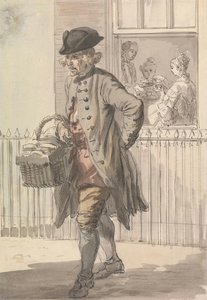
London Cries: A Muffin Man (1759) door Paul Sandby

London Cries: A Muffin Man

1759 · Drawing · Yale Center for British Art, New Haven

This evocative drawing, titled "London Cries: A Muffin Man," transports the modern viewer directly into the bustling, atmospheric heart of 18th-century London. The scene is rendered with a captivating immediacy that speaks volumes about daily commerce and human interaction. At the center moves the muffin man, his basket laden with tempting goods, embodying a moment of everyday ritual. His figure, complete with a distinctive hat and mustache, anchors the composition,…

4
Windsor Castle from the Great Park door Paul Sandby

Windsor Castle from the Great Park

Watercolor

This watercolor on paper, titled Windsor Castle from the Great Park, offers a quiet glimpse into the English landscape through the eyes of Paul Sandby. The work captures the castle as it sits within its surrounding parkland, viewed through a screen of foreground foliage. It is a piece that reflects the artist's deep connection to the terrain, specifically the areas around Windsor where he spent significant time sketching and observing…

5
Miss Marsden - back view door Paul Sandby

Miss Marsden - back view

Chalk

Miss Marsden - back view by Paul Sandby presents a focused portrait study of a woman viewed from behind. The subject is captured in period attire, emphasizing the silhouette and structural details of 19th-century fashion. Her clothing consists of a fitted bodice and a long skirt finished with a ruffled hem.

6
The Laterna Magica (1760) door Paul Sandby

The Laterna Magica

1760 · Watercolor · British Museum, Londen

Paul Sandby’s “The Laterna Magica,” painted in 1760, isn't merely a depiction of a room; it’s a meticulously crafted illusion, a vibrant snapshot of a world fascinated by the burgeoning technology of optical projection. More than just a charming scene of gentlemen observing a theatrical display, this watercolor offers a profound glimpse into the intellectual and social currents of 18th-century England – a period grappling with scientific advancement, artistic convention,…

7
London Cries: A Man with a Bottle (1759) door Paul Sandby

London Cries: A Man with a Bottle

1759 · Acrylic On Canvas · Yale Center for British Art, New Haven

Paul Sandby's "London Cries: A Man with a Bottle," painted in 1759, isn’t merely a depiction of a street scene; it’s a vibrant, almost theatrical window into the bustling heart of eighteenth-century London. This watercolor, now meticulously reproduced as a hand-painted artwork by WahooArt, captures a moment of everyday commerce and perhaps, a touch of wry observation, offering a glimpse into the lives of ordinary people within the grand tapestry…

8
The Meteor of August 18, 1783, as seen from the East Angle of the North Terrace, Windsor Castle (1783) door Paul Sandby

The Meteor of August 18, 1783, as seen from the East Angle of the North Terrace, Windsor Castle

1783 · Watercolor · Yale Center for British Art, New Haven

Paul Sandby's watercolor, “The Meteor of August 18, 1783,” isn’t merely a depiction of a fleeting astronomical event; it’s a window into the collective wonder and scientific curiosity of late 18th-century England. Painted from the East Angle of the North Terrace at Windsor Castle, the scene captures a pivotal moment – the transit of a meteor across the night sky – as observed by a small group of onlookers. The…

De selectie van Paul Sandby gaat verder, van 11 tot 79

11Study of a coachman door Paul SandbyStudy of a coachmanNational Portrait Gallery of Sweden 12Thomas Sandby and His Family door Paul SandbyThomas Sandby and His Family 13A Group of Four Children, with Dogs door Paul SandbyA Group of Four Children, with Dogs 14The Bayswater Road, Paddington door Paul SandbyThe Bayswater Road, Paddington 15Sketch of an elegant lady door Paul SandbySketch of an elegant lady 16Two Coaches with Passengers door Paul SandbyTwo Coaches with Passengers 17View of the Powder Magazine in Hyde Park door Paul SandbyView of the Powder Magazine in Hyde Park 18A riverside landscape door Paul SandbyA riverside landscape 19Back of the Public House near Bayswater door Paul SandbyBack of the Public House near Bayswater 20Windsor Park door Paul SandbyWindsor Park 21A Sleeping Woman; Study of a Head door Paul SandbyA Sleeping Woman; Study of a Head 22Travelers Entering a Town door Paul SandbyTravelers Entering a Town 23Ross Castle, Killarney, with villagers on a ferryboat door Paul SandbyRoss Castle, Killarney, with villagers on a ferryboat 24Windsor Great Park door Paul SandbyWindsor Great Park 25St. George's Gate, Canterbury door Paul SandbySt. George's Gate, Canterbury 26Rochester, Kent door Paul SandbyRochester, Kent 27Views of Windsor Castle door Paul SandbyViews of Windsor Castle 28The Iron Forge between Dolgelli and Barmouth 1 door Paul SandbyThe Iron Forge between Dolgelli and Barmouth 1 29The Light Steps, Hastings door Paul SandbyThe Light Steps, Hastings 30An Italianate landscape with women washing clothes door Paul SandbyAn Italianate landscape with women washing clothes 31The Cemetery Gate of St Augustine's Monastery Canterbury door Paul SandbyThe Cemetery Gate of St Augustine's Monastery Canterbury 32The Encampment in St James's Park door Paul SandbyThe Encampment in St James's Park 33A Boy Crawling on the Floor door Paul SandbyA Boy Crawling on the Floor 34A mother and child seated in a garden door Paul SandbyA mother and child seated in a garden 35A wooded river landscape with figures and cattle, a castle beyond door Paul SandbyA wooded river landscape with figures and cattle, a castle beyond 36The North Terrace of Windsor Castle looking west door Paul SandbyThe North Terrace of Windsor Castle looking west 37Naval post with three soldiers door Paul SandbyNaval post with three soldiers 38Part of the Banqueting Hall of the Royal Palace at Eltham door Paul SandbyPart of the Banqueting Hall of the Royal Palace at Eltham 39Man driving a donkey, and man leading a cart door Paul SandbyMan driving a donkey, and man leading a cart 40Woolwich from the Conduit Hill, the Thames estuary beyond door Paul SandbyWoolwich from the Conduit Hill, the Thames estuary beyond 41Young lady writing at a table door Paul SandbyYoung lady writing at a table 42A rural landscape door Paul SandbyA rural landscape 43A cottage by a river with figures in the foreground door Paul SandbyA cottage by a river with figures in the foreground 44The garden front of Old Somerset House, London door Paul SandbyThe garden front of Old Somerset House, London 45Henry VIII Gateway, Windsor Castle door Paul SandbyHenry VIII Gateway, Windsor Castle 46Young boy on a see-saw door Paul SandbyYoung boy on a see-saw 47Children on a see-saw door Paul SandbyChildren on a see-saw 48Young man, seated, holding a riding crop door Paul SandbyYoung man, seated, holding a riding crop 49Two of the artist's children with their nurse, seated in a garden door Paul SandbyTwo of the artist's children with their nurse, seated in a garden 50The Iron Forge between Dolgelli and Barmouth door Paul SandbyThe Iron Forge between Dolgelli and Barmouth 51View from a London terrace door Paul SandbyView from a London terrace 52Windsor Castle: The Round Tower, Royal Court and Devil (1767) door Paul SandbyWindsor Castle: The Round Tower, Royal Court and Devil1767 · National Gallery of Victoria 53Buildwas door Paul SandbyBuildwas 54View down a valley towards distant buildings, trees in the foreground door Paul SandbyView down a valley towards distant buildings, trees in the foreground 55Derwent Waster door Paul SandbyDerwent Waster 56Edinburgh Castle door Paul SandbyEdinburgh Castle 57View of Tonbridge door Paul SandbyView of Tonbridge 58View of Rackett Lodge, Wandsworth, London door Paul SandbyView of Rackett Lodge, Wandsworth, London 59Study of a donkey door Paul SandbyStudy of a donkey 60Old Windsor Green door Paul SandbyOld Windsor Green 61Middleham Castle, Yorkshire door Paul SandbyMiddleham Castle, Yorkshire 62An extensive river landscape with travellers door Paul SandbyAn extensive river landscape with travellers 63A horse and cart leaving a harbour door Paul SandbyA horse and cart leaving a harbour 64Woolwich from the Conduit Hill, the Thames beyond door Paul SandbyWoolwich from the Conduit Hill, the Thames beyond 65Cows in a Park door Paul SandbyCows in a Park 66Study of a Tree door Paul SandbyStudy of a Tree 67Trees and house seen from a meadow - Bishopgate door Paul SandbyTrees and house seen from a meadow - Bishopgate 68A shepherd driving his flock before a Scottish castle door Paul SandbyA shepherd driving his flock before a Scottish castle 69South East View of Windsor Castle From the Park door Paul SandbySouth East View of Windsor Castle From the Park 70A horse door Paul SandbyA horse 71An old grey horse tethered to a tree, a boy resting nearby door Paul SandbyAn old grey horse tethered to a tree, a boy resting nearby 72Foresters In Windsor Great Park door Paul SandbyForesters In Windsor Great Park 73View Of Windsor Castle And Part Of The Town From The Spital Hill door Paul SandbyView Of Windsor Castle And Part Of The Town From The Spital Hill 74An extensive wooded river landscape with an amorous couple making music under a tree door Paul SandbyAn extensive wooded river landscape with an amorous couple making music under a tree 75Sanby paul the spread eagle tavern millbank door Paul SandbySanby paul the spread eagle tavern millbank 76Llangollen, Denbighshire door Paul SandbyLlangollen, Denbighshire 77Part of the Old Bridge at Shrewsbury with two arches of the new one door Paul SandbyPart of the Old Bridge at Shrewsbury with two arches of the new one 78Cow­Girl in the Windsor Great Park door Paul SandbyCow­Girl in the Windsor Great Park 79A Man and a Saddled Horse door Paul SandbyA Man and a Saddled HorseYale Center for British Art

De onderwerpen die de aandacht van Paul Sandby troffen

De vier onderwerpen die het meest voorkomen in deze originelen, elk met zijn mooiste voorbeeld.

De musea waar de originele werken van Paul Sandby worden bewaard

De 5 musea met de meeste schilderijen op deze pagina.

Museum Stad Werken van Paul Sandby Schilderijen uit deze lijst
Yale Center for British Art, New HavenYale Center for British Art New Haven 4 London Cries: A Muffin Man, London Cries: A Man with a Bottle, The Meteor of August 18, 1783, as seen from the East Angle of the North Terrace, Windsor Castle
Scottish National Gallery, EdinburghScottish National Gallery Edinburgh 1 Horse Fair on Bruntsfield Links, Edinburgh
British Museum, LondenBritish Museum Londen 1 The Laterna Magica
National Portrait Gallery of Sweden, SträngnäsNational Portrait Gallery of Sweden Strängnäs 1 Study of a coachman
National Gallery of Victoria, MelbourneNational Gallery of Victoria Melbourne 1 Windsor Castle: The Round Tower, Royal Court and Devil

Vragen van verzamelaars over de schilderijen van Paul Sandby

Waar is Paul Sandby het meest bekend om?Onthul het antwoord

Man standing in a landscape. Horse Fair on Bruntsfield Links, Edinburgh (1750) en London Cries: A Muffin Man (1759) volgen.

Wat zijn de tien beroemdste schilderijen van Paul Sandby?Onthul het antwoord

Man standing in a landscape, Horse Fair on Bruntsfield Links, Edinburgh, London Cries: A Muffin Man, Windsor Castle from the Great Park, Miss Marsden - back view, The Laterna Magica, London Cries: A Man with a Bottle, The Meteor of August 18, 1783, as seen from the East Angle of the North Terrace, Windsor Castle, Boy with a whip en Study of a woman pointing. De bovenstaande ranglijst vermeldt het jaar en het museum van elk werk.

Hoeveel schilderijen heeft Paul Sandby nagelaten?Onthul het antwoord

Onze catalogus bevat 79 werken van Paul Sandby.

In welke musea hangen de meesterwerken van Paul Sandby?Onthul het antwoord

Voornamelijk in Yale Center for British Art (New Haven), Scottish National Gallery (Edinburgh) en British Museum (Londen). De bovenstaande museumtabel bevat een volledig overzicht.

Welke onderwerpen koos Paul Sandby het vaakst?Onthul het antwoord

Buildings (16), Landscape (10) en Gardens and parks (10), verspreid over de 79 werken op deze pagina.

Welke techniek gebruikte Paul Sandby het meest?Onthul het antwoord

Watercolor, voor 4 van de 79 werken op deze pagina.

Bij welke kunststroming behoort Paul Sandby?Onthul het antwoord

Romanticism en Neoclassicism, te oordelen aan de originelen op deze pagina.

Welke werken van Paul Sandby hangen in het Yale Center for British Art?Onthul het antwoord

London Cries: A Muffin Man, London Cries: A Man with a Bottle en The Meteor of August 18, 1783, as seen from the East Angle of the North Terrace, Windsor Castle: het Yale Center for British Art, New Haven herbergt 4 van de werken op deze pagina.

Paul Sandby: leven en werk

Paul Sandby RA: De Vader van Moderne Landschapschilderkunst

Paul Sandby (1731 – 7 november 1809) staat als een onmiskenbare figuur in de geschiedenis van de Britse landschapschilderkunst, erkend niet alleen vanwege zijn artistieke vaardigheid, maar ook omdat hij een nieuwe esthetische traditie vestigde die generaties daarna diepgaand beïnvloedde. Geboren in Nottingham aan Thomas Sandby, een textielarbeider, was Paul’s vroege leven gekenmerkt door zelfstudie en een innige fascinatie voor observatie – kwaliteiten die cruciaal bleken te zijn voor het vormgeven van zijn buitengewone carrière als zowel cartograaf als kunstenaar. Anders dan veel kunstenaars van zijn tijd, die zich formeel lieten trainen, perfectioneerde Sandby zijn vak onafhankelijk, zichzelf onderdompelend in de natuurlijke wereld en nauwkeurig het mooie ervan vastleggend met aquarel.
  • Vroege levensjaren & Training: De vroege jaren van Paul leerden hem een diepe waardering voor detail en nauwkeurigheid – vaardigheden die later naadloos overgingen in zijn cartografische inspanningen. Zijn broer Thomas, ook een tekenaar, moedigde deze artistieke neiging aan, stimuleerde experimenteren en bevorderde een collaboratieve geest.
  • Militair dienst & De Schotse Landschapsverkenning: Sandby’s betrokkenheid bij het militaire tekenafdeling in de Tower of London leidde hem naar een rol die hem blootstelde aan de grandeur van Schotland tijdens de Jacobitenoopstand. Deze opdracht stelde hem in staat topografische kaarten en schetsen van Schotse hooglandlandschappen te maken – een project dat zijn reputatie als visueel vastlegger van geschiedenis verstevigde en hem tot een van de toonaangevende landschapskunstenaars van zijn tijd maakte.
  • Samenwerking & Artistieke Stijl: Sandby’s partnerschap met Thomas was cruciaal voor zijn artistieke ontwikkeling. Samen vestigden ze een academie in Nottingham, waar aspirant-kunstenaars zich aangetrokken voelden om te leren van hun expertise. Hun kenmerkende stijl – gekenmerkt door levendige kleurenwas en een meesterlijke weergave van atmosferische perspectief – werd onmiddellijk herkenbaar en diepgaand invloedrijk.
  • Koninklijke Patronage & Architectonische Bijdragen: Sandby’s band met George III verhoogde zijn status binnen de artistieke gemeenschap, waardoor hij posities kreeg bij het militaire academie in Woolwich en Windsor Great Park. Zijn architecturale ontwerpen, waaronder Cumberland Lodge, toonden zijn veelzijdigheid en verstevigden zijn erfenis als een visionair bouwer die kunst en natuur wilde verenigen.
  • Erfgoed & Invloed: Sandby’s nauwkeurige observaties van Schotland – vastgelegd in iconische aquarel zoals “The Light Steps” en “West View of the City of Edinburgh” – maakten hem tot een pionier van de romantische landschapschilderkunst. Zijn werk pleitte voor de expressieve kracht van kleur en licht, waardoor kunstenaars in heel Groot-Brittannië en daarbuiten geïnspireerd werden om een nieuwe esthetische gevoeligheid te omarmen die visuele schoonheid waardeerde naast intellectuele nauwkeurigheid.
Sandby’s aquarel is gevierd vanwege zijn ongekende realisme – een getuigenis van zijn toewijding aan het vastleggen van de subtiliteiten van natuurlijk licht en textuur. Hij gebruikte vaardig technieken zoals glazuurtechniek en scumbling om adembenemende effecten te creëren van licht en schaduw, waardoor afbeeldingen werden gecreëerd die niet alleen visuele pracht, maar ook een tastbare sfeer overbrengen. Zijn nauwkeurige aandacht voor detail strekte zich uit verder dan alleen representatie; hij streefde ernaar de geest van de plaats vast te leggen – de essentie van het Schotse Hoogland en het Engelse platteland – waardoor landschappen werden getransformeerd tot voertuigen voor emoties en intellectuele contemplatie. Zijn bijdrage aan de Royal Academy was bijzonder opmerkelijk, waarbij het een centrum werd voor artistische innovatie en een traditie van academisch engagement met kunst bevorderde. Sandby’s lezingen over architectuur versterkten verder zijn reputatie als een intellectueel leider die de fusie van kunst en wetenschap promootte – een overtuiging die zijn hele leven gericht was op schoonheid en waarheid.

De invloedrijke rol van Paul Sandby

Sandby's werk markeerde een verschuiving in landschapschilderkunst, waarbij de nadruk lag op het vastleggen van de emotionele impact van de natuurlijke wereld. Zijn gebruik van levendige kleuren en atmosferische perspectieven creëerde een gevoel van diepte en realisme dat voorheen zelden was gezien. Hij werd beschouwd als een pionier van de romantische beweging, die de schoonheid en het drama van de natuur wilde vastleggen. Sandby's invloed strekte zich uit over verschillende gebieden van de kunst. Hij was een belangrijke figuur in de ontwikkeling van aquatint, een printtechniek waarmee hij zijn landschappen kon reproduceren met een ongekende nauwkeurigheid en detail. Zijn werk inspireerde andere kunstenaars om nieuwe technieken te ontwikkelen en hun eigen visie op de natuur vast te leggen. Sandby's nalatenschap leeft voort in het werk van latere romantische schilders, die zijn stijlprincipes overnamen en zijn toewijding aan het portretteren van de natuur met onverbogen eerlijkheid. Hij wordt beschouwd als "de vader van moderne landschapschilderkunst", een titel die rechtmatig is toegekend voor zijn baanbrekende rol in het vormgeven van de Britse kunstcultuur en het vestigen van een visuele taal die tot op vandaag resoneert met het publiek.