Portret van Nicolai Abraham Abildgaard

De 100 bekendste schilderijen van Nicolai Abraham Abildgaard, een selectie uit de galerie

Bijgewerkt in oktober 2026 · gerangschikt op basis van onze populariteitsscore (zoekopdrachten, bezoeken en bestellingen per kunstwerk) · 106 werken van Nicolai Abraham Abildgaard in onze catalogus

Kortom

Van alle originele werken die Nicolai Abraham Abildgaard heeft nagelaten, is The Greek Poet Sappho and the Girl from Mytilene (1809) het bekendst, in de collectie van het Statens Museum for Kunst, Kopenhagen. Direct daarna volgen Cupid Playing the Lyre. (1782) en Christian V Presents Danish Law 1683 (1784). Onze catalogus bevat 106 werken van Nicolai Abraham Abildgaard; de galerie heeft de 100 meest bewonderde werken ter wereld bewaard, elk voorzien van de datum, het museum en het verhaal erachter.

1743 – 1809, Kopenhagen Neoclassicism Meeste werken: Statens Museum for Kunst

De top 10 schilderijen van Nicolai Abraham Abildgaard: de selectie van de galerie

1
The Greek Poet Sappho and the Girl from Mytilene (1809) door Nicolai Abraham Abildgaard

The Greek Poet Sappho and the Girl from Mytilene

1809 · Acrylic On Canvas · Statens Museum for Kunst, Kopenhagen

Nicolai Abildgaard’s Sappho and Mytilene: A Vision of Romantic Idealism The painting “The Greek Poet Sappho and the Girl from Mytilene,” created by Nicolai Abraham Abildgaard in 1809, stands as a cornerstone of Danish neoclassical art and embodies the fervent spirit of Romantic idealism. More than just a depiction of two figures, it’s an exploration of beauty, longing, and the sublime—themes central to the artistic sensibilities of the era. Housed…

2
Cupid Playing the Lyre. (1782) door Nicolai Abraham Abildgaard

Cupid Playing the Lyre.

1782 · Oil On Canvas · Thorvaldsen Museum, Kopenhagen

In the quiet stillness of a mythological moment, Cupid Playing the Lyre. emerges from the shadows. This oil on canvas work, created by Nicolai Abildgaard around 1782, captures a solitary figure caught in a private, celestial act. The scene centers on a youthful, winged Cupid, whose presence brings a sense of soft grace to the composition. He leans toward a lyre that rests upon a stone pedestal, his delicate form…

3
Christian V Presents Danish Law 1683 (1784) door Nicolai Abraham Abildgaard

Christian V Presents Danish Law 1683

1784 · Oil On Canvas · Statens Museum for Kunst, Kopenhagen

Christian V Presents Danish Law 1683 is an oil painting by Nicolai Abildgaard. Created in 1784, this work functions as a history scene depicting a specific real event. The subject matter focuses on a Danish king presenting a body of law, capturing a moment of official legal or political significance. The scene is rendered in a documentary style that emphasizes the gravity of the proceedings.

4
Julia and Fulvia (1803) door Nicolai Abraham Abildgaard

Julia and Fulvia

1803 · Oil On Canvas · Statens Museum for Kunst, Kopenhagen

The oil on canvas painting titled Julia and Fulvia was executed by the artist Nicolai Abildgaard. This work depicts a literary scene or figure, focusing on the physical interaction between two female subjects. The composition centers on the tension between these figures within a classical setting.

6
Frederik II Builds Kronborg Castle at Elsinore (1782) door Nicolai Abraham Abildgaard

Frederik II Builds Kronborg Castle at Elsinore

1782 · Oil On Canvas · Statens Museum for Kunst, Kopenhagen

In this significant work of Danish history, Frederik II Builds Kronborg Castle at Elsinore, the artist Nicolai Abildgaard captures a moment of profound national construction. The painting centers on Frederick II of Denmark, depicted during the foundational stages of the Kronborg Castle at Elsinore. It is a scene that looks back at the 18th century through a lens of historical narrative, focusing on the architectural ambitions of the Danish monarchy.

7
Kulturens herredømme (1796) door Nicolai Abraham Abildgaard

Kulturens herredømme

1796 · Oil · Statens Museum for Kunst, Kopenhagen

The oil painting titled Kulturens herredømme, known in English as The supremacy of culture, was executed by the artist Nicolai Abildgaard. This work is identified by the accession number KMS1836. The composition features a monochromatic, black-and-white palette that emphasizes the play of light and shadow across the figures.

8
Christian VII Uniting the Ducal with the Royal Part of Holstein in 1767 (1790) door Nicolai Abraham Abildgaard

Christian VII Uniting the Ducal with the Royal Part of Holstein in 1767

1790 · Oil On Canvas · Statens Museum for Kunst, Kopenhagen

The composition centers on a seated male figure, identified as King Christian VII, positioned on the right side of the canvas. He is dressed in white and gold regalia, wearing a crown and holding a scepter. To his left, two female figures are positioned; one faces the viewer directly, while the other is seen in profile, gesturing toward the king. Above the central group, a dark eagle flies through a…

9
Magnus Stenbock Surrenders the Fortress of Tønningen to Frederik IV in 1714 (1785) door Nicolai Abraham Abildgaard

Magnus Stenbock Surrenders the Fortress of Tønningen to Frederik IV in 1714

1785 · Oil On Canvas · Statens Museum for Kunst, Kopenhagen

In the grand tapestry of European history, few moments capture the gravity of shifting power quite like the scene depicted in Nicolai Abraham Abildgaard’s 1785 masterpiece, Magnus Stenbock Surrenders the Fortress of Tønningen to Frederik IV in 1714. This evocative oil painting serves as a window into a pivotal era of military diplomacy and sovereign command. The composition is masterfully orchestrated, drawing the viewer into a crowded, dynamic tableau where…

10
The robber's housekeeper comforts the young girl by telling the myth of Amor and Psyche. Motif from Apulejus, The Golden Donkey (1808) door Nicolai Abraham Abildgaard

The robber's housekeeper comforts the young girl by telling the myth of Amor and Psyche. Motif from Apulejus, The Golden Donkey

1808 · Oil On Canvas · Statens Museum for Kunst, Kopenhagen

The robber's housekeeper comforts the young girl by telling the myth of Amor and Psyche. Motif from Apulejus, The Golden Donkey is an oil on canvas work created about 1808. This piece captures a quiet, narrative moment between two figures, framed by the presence of a donkey in the shadows. The scene draws its inspiration from the literary motifs found in Apuleius's writings.

De selectie van Nicolai Abraham Abildgaard gaat verder, van 11 tot 100

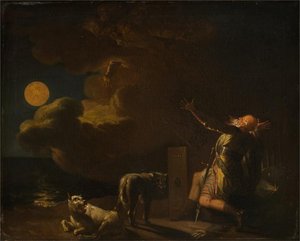
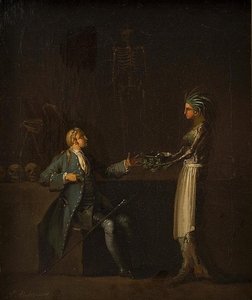
11Apollo charging the Parcae to visit Ceres, who has fled from the Earth (1809) door Nicolai Abraham AbildgaardApollo charging the Parcae to visit Ceres, who has fled from the Earth1809 · Statens Museum for Kunst 12Christian III Succouring Denmark (1780) door Nicolai Abraham AbildgaardChristian III Succouring Denmark1780 · Statens Museum for Kunst 13Christian III Succouring Denmark (1780) door Nicolai Abraham AbildgaardChristian III Succouring Denmark1780 · Statens Museum for Kunst 14The Construction of Copenhagen´s Dock in the Reign of Christian VI (1786) door Nicolai Abraham AbildgaardThe Construction of Copenhagen´s Dock in the Reign of Christian VI1786 · Statens Museum for Kunst 15The Prayers of the Potuans at the Feast of the Unfathomable God (1785) door Nicolai Abraham AbildgaardThe Prayers of the Potuans at the Feast of the Unfathomable God1785 · Statens Museum for Kunst 16A farewell scene (1783) door Nicolai Abraham AbildgaardA farewell scene1783 · Nivaagaards Malerisamling 17Rome as Ruler of the World (1784) door Nicolai Abraham AbildgaardRome as Ruler of the World1784 · Statens Museum for Kunst 18The Triumph of a Potuan, whose Reform Proposal has been Approved (1785) door Nicolai Abraham AbildgaardThe Triumph of a Potuan, whose Reform Proposal has been Approved1785 · Statens Museum for Kunst 19Absolute Monarchy Assigned to Frederik III in 1660 (1783) door Nicolai Abraham AbildgaardAbsolute Monarchy Assigned to Frederik III in 16601783 · Statens Museum for Kunst 20The Establishment of Schools (1781) door Nicolai Abraham AbildgaardThe Establishment of Schools1781 · Statens Museum for Kunst 21Asiatic Trade (1782) door Nicolai Abraham AbildgaardAsiatic Trade1782 · Statens Museum for Kunst 22Niels Klim thinks he hears the Deacon when he is awakened by a Bull (1785) door Nicolai Abraham AbildgaardNiels Klim thinks he hears the Deacon when he is awakened by a Bull1785 · Statens Museum for Kunst 23Standardization of Weights and Measures in 1683 (1784) door Nicolai Abraham AbildgaardStandardization of Weights and Measures in 16831784 · Statens Museum for Kunst 24The Foundation of the Royal Library (1783) door Nicolai Abraham AbildgaardThe Foundation of the Royal Library1783 · Statens Museum for Kunst 25Richard III wakes up from his nightmare in his tent in Bosworth (1785) door Nicolai Abraham AbildgaardRichard III wakes up from his nightmare in his tent in Bosworth1785 · Statens Museum for Kunst 26Alexander's messenger at the Persian philosopher (1785) door Nicolai Abraham AbildgaardAlexander's messenger at the Persian philosopher1785 27Alexander the Great and an officer visit Diogenes. (1785) door Nicolai Abraham AbildgaardAlexander the Great and an officer visit Diogenes.1785 28The Prince Royal Frederik awakens the sleeping Fama with the help of Clio. Study. (1783) door Nicolai Abraham AbildgaardThe Prince Royal Frederik awakens the sleeping Fama with the help of Clio. Study.1783 · The Museum of National History at Frederiksborg Castle 29Richard III Before the Battle of Bosworth (1780) door Nicolai Abraham AbildgaardRichard III Before the Battle of Bosworth1780 · Randers Kunstmuseum 30The Archangel Michael and Satan Disputing about the Body of Moses (1785) door Nicolai Abraham AbildgaardThe Archangel Michael and Satan Disputing about the Body of Moses1785 · ARoS Aarhus Kunstmuseum 31Niels Klim Receives the Homage of the Quamites. (1787) door Nicolai Abraham AbildgaardNiels Klim Receives the Homage of the Quamites.1787 · Statens Museum for Kunst 32King Priam Pleading with Achilles for the Corpse of Hector (1794) door Nicolai Abraham AbildgaardKing Priam Pleading with Achilles for the Corpse of Hector1794 · Statens Museum for Kunst 33The Foundation of the Copenhagen Fire Insurance (1786) door Nicolai Abraham AbildgaardThe Foundation of the Copenhagen Fire Insurance1786 · Statens Museum for Kunst 34Mercury by the Seashore (1794) door Nicolai Abraham AbildgaardMercury by the Seashore1794 · Statens Museum for Kunst 35Richard III (1787) door Nicolai Abraham AbildgaardRichard III1787 36Achilles and the Centaur Cheiron (1796) door Nicolai Abraham AbildgaardAchilles and the Centaur Cheiron1796 · Statens Museum for Kunst 37Thetis Immersing her Infant Son Achilles in the River Styx to Make him Invulnerable (1796) door Nicolai Abraham AbildgaardThetis Immersing her Infant Son Achilles in the River Styx to Make him Invulnerable1796 · Statens Museum for Kunst 38The Death of Achilles (1796) door Nicolai Abraham AbildgaardThe Death of Achilles1796 · Statens Museum for Kunst 39Philosophy. Allegorical figure. (1800) door Nicolai Abraham AbildgaardPhilosophy. Allegorical figure.1800 · Statens Museum for Kunst 40The Slave Davus and the Maid Mysis. From Terence´s Andria. (1804) door Nicolai Abraham AbildgaardThe Slave Davus and the Maid Mysis. From Terence´s Andria.1804 · Statens Museum for Kunst 41Christian I Raising the Province of Holstein to the State of a Duchy in 1460 (1778) door Nicolai Abraham AbildgaardChristian I Raising the Province of Holstein to the State of a Duchy in 14601778 · Statens Museum for Kunst 42Jurisprudence. Allegorical Figure (1800) door Nicolai Abraham AbildgaardJurisprudence. Allegorical Figure1800 · Statens Museum for Kunst 43Achilles and the Daughters of Lycomedes (1796) door Nicolai Abraham AbildgaardAchilles and the Daughters of Lycomedes1796 · Statens Museum for Kunst 44Theology. Allegorical figure (1800) door Nicolai Abraham AbildgaardTheology. Allegorical figure1800 · Statens Museum for Kunst 45Simo and his former slave Sosia. From Terence´s Andria. (1803) door Nicolai Abraham AbildgaardSimo and his former slave Sosia. From Terence´s Andria.1803 · Statens Museum for Kunst 46Julia and Fulvia (1800) door Nicolai Abraham AbildgaardJulia and Fulvia1800 · National Museum of Art, Architecture and Design 47Portrait of the artist's son Marcus Aurelius Abildgaard. (1797) door Nicolai Abraham AbildgaardPortrait of the artist's son Marcus Aurelius Abildgaard.1797 48Fingal gives his weapons to Oscar. (1796) door Nicolai Abraham AbildgaardFingal gives his weapons to Oscar.1796 · Kunsten Museum of Modern Art Aalborg 49Allegory of Philosophy (1800) door Nicolai Abraham AbildgaardAllegory of Philosophy1800 50Allegory of Protestantism (1809) door Nicolai Abraham AbildgaardAllegory of Protestantism1809 · Ribe Kunstmuseum 51The Catholic Worldview, Allegory (1809) door Nicolai Abraham AbildgaardThe Catholic Worldview, Allegory1809 · Ribe Kunstmuseum 52The Oath of Fealty in 1660 (1806) door Nicolai Abraham AbildgaardThe Oath of Fealty in 16601806 · Statens Museum for Kunst 53Odysseus Takes Counsel with Teiresias. From Homer´s Odyssey (1809) door Nicolai Abraham AbildgaardOdysseus Takes Counsel with Teiresias. From Homer´s Odyssey1809 · Statens Museum for Kunst 54Fotis sees her Lover Lucius Transformed into an Ass. Motif from Apeleius' The Golden Ass (1809) door Nicolai Abraham AbildgaardFotis sees her Lover Lucius Transformed into an Ass. Motif from Apeleius' The Golden Ass1809 · Statens Museum for Kunst 55Tarquin and the Sibyl (1809) door Nicolai Abraham AbildgaardTarquin and the Sibyl1809 · Statens Museum for Kunst 56Hierarchy at its Peak at the time of the Crusades (1784) door Nicolai Abraham AbildgaardHierarchy at its Peak at the time of the Crusades1784 · Statens Museum for Kunst 57The Revival of Learning, the Invention of Printing and Gunpowder and the Discovery of America (1784) door Nicolai Abraham AbildgaardThe Revival of Learning, the Invention of Printing and Gunpowder and the Discovery of America1784 · Statens Museum for Kunst 58Papirius and his Mother (1809) door Nicolai Abraham AbildgaardPapirius and his Mother1809 · Statens Museum for Kunst 59Alexander the Great and Diogenes. (1809) door Nicolai Abraham AbildgaardAlexander the Great and Diogenes.1809 · Kunsten Museum of Modern Art Aalborg 60Fotis sees her Lover Lucius Transformed into an Ass. Motif from Apeleius' The Golden Ass (1809) door Nicolai Abraham AbildgaardFotis sees her Lover Lucius Transformed into an Ass. Motif from Apeleius' The Golden Ass1809 · Statens Museum for Kunst 61Tibullus Lamenting outside the Door of his Beloved (1808) door Nicolai Abraham AbildgaardTibullus Lamenting outside the Door of his Beloved1808 · Statens Museum for Kunst 62Christian IV Aboard his Flagship "The Trinity" (1782) door Nicolai Abraham AbildgaardChristian IV Aboard his Flagship "The Trinity"1782 · Statens Museum for Kunst 63Two Young Men Confessing to Alexander the Great their Conspiracy against Him (1800) door Nicolai Abraham AbildgaardTwo Young Men Confessing to Alexander the Great their Conspiracy against Him1800 · Statens Museum for Kunst 64Niels Klim Attends the Sentencing of the Deceased Potuan Prince. (1785) door Nicolai Abraham AbildgaardNiels Klim Attends the Sentencing of the Deceased Potuan Prince.1785 · Statens Museum for Kunst 65The Abolition of Adscription in 1788 (1790) door Nicolai Abraham AbildgaardThe Abolition of Adscription in 17881790 · Statens Museum for Kunst 66Frederik V as Patron of Science and Arts (1787) door Nicolai Abraham AbildgaardFrederik V as Patron of Science and Arts1787 · Statens Museum for Kunst 67The Midwife Taking Leave of the Girl from Andros (from Terence's Andria ) (1801) door Nicolai Abraham AbildgaardThe Midwife Taking Leave of the Girl from Andros (from Terence's Andria )1801 · Statens Museum for Kunst 68Nature Untamed (1784) door Nicolai Abraham AbildgaardNature Untamed1784 · Statens Museum for Kunst 69Hamlet Delivering a Letter Written by Himself to the Queen of Scotland (1776) door Nicolai Abraham AbildgaardHamlet Delivering a Letter Written by Himself to the Queen of Scotland1776 · Statens Museum for Kunst 70From Ludvig Holbergs´s The Journey of Niels Klim to The World Underground (1785) door Nicolai Abraham AbildgaardFrom Ludvig Holbergs´s The Journey of Niels Klim to The World Underground1785 · Statens Museum for Kunst 71Frederik II Builds Kronberg Castle at Elsinore (1781) door Nicolai Abraham AbildgaardFrederik II Builds Kronberg Castle at Elsinore1781 · Statens Museum for Kunst 72The Dying Messalina and Her Mother (1797) door Nicolai Abraham AbildgaardThe Dying Messalina and Her Mother1797 · Statens Museum for Kunst 73The Greek Poet Anacreon and Bathyll (1808) door Nicolai Abraham AbildgaardThe Greek Poet Anacreon and Bathyll1808 · Statens Museum for Kunst 74Christian I Elevates Holstein to a Duchy in 1474 (1778) door Nicolai Abraham AbildgaardChristian I Elevates Holstein to a Duchy in 14741778 · Statens Museum for Kunst 75Socrates in Prison (1784) door Nicolai Abraham AbildgaardSocrates in Prison1784 · Ny Carlsberg Glyptotek 76Niels Klim in Potu (1785) door Nicolai Abraham AbildgaardNiels Klim in Potu1785 · Statens Museum for Kunst 77Allegory on the Right of Citizenship (1790) door Nicolai Abraham AbildgaardAllegory on the Right of Citizenship1790 · Statens Museum for Kunst 78Fingal Sees the Ghosts of his Forefathers by Moonlight (1782) door Nicolai Abraham AbildgaardFingal Sees the Ghosts of his Forefathers by Moonlight1782 · Statens Museum for Kunst 79Male Figure after Michelangelo's 'Last Judgement' in the Sistine Chapel (1774) door Nicolai Abraham AbildgaardMale Figure after Michelangelo's 'Last Judgement' in the Sistine Chapel1774 · Statens Museum for Kunst 80Ismene and Antogone Plead with Theseus (1799) door Nicolai Abraham AbildgaardIsmene and Antogone Plead with Theseus1799 · Statens Museum for Kunst 81Hamlet and His Mother (1778) door Nicolai Abraham AbildgaardHamlet and His Mother1778 · Statens Museum for Kunst 82Richard III terrified by nightmarish visions. Shakespeare, Act 5, Scene 9 door Nicolai Abraham AbildgaardRichard III terrified by nightmarish visions. Shakespeare, Act 5, Scene 9Nivaagaards Malerisamling 83Amor and Psyche embracing each other door Nicolai Abraham AbildgaardAmor and Psyche embracing each otherNivaagaards Malerisamling 84Two Roman warriors watching a seated man embracing a child door Nicolai Abraham AbildgaardTwo Roman warriors watching a seated man embracing a child 85Scenes from 'Niels Klim's Subterranean Journey' door Nicolai Abraham AbildgaardScenes from 'Niels Klim's Subterranean Journey'Hamburger Kunsthalle 86Audhumla door Nicolai Abraham AbildgaardAudhumlaStatens Museum for Kunst 87The Doctor's Wife Reveals Her Husband's Intention of Anatomising Niels Klim (1787) door Nicolai Abraham AbildgaardThe Doctor's Wife Reveals Her Husband's Intention of Anatomising Niels Klim1787 · Statens Museum for Kunst 88The Finding of the Infant Moses door Nicolai Abraham AbildgaardThe Finding of the Infant MosesStatens Museum for Kunst 89Adam and Eve (1780) door Nicolai Abraham AbildgaardAdam and Eve1780 · Nationalmuseum 90Catullus, and Lesbia Seeking Comfort in his Arms for the Death of her Sparrow (1809) door Nicolai Abraham AbildgaardCatullus, and Lesbia Seeking Comfort in his Arms for the Death of her Sparrow1809 · Nivaagaards Malerisamling 91A view of Schie Church in Sweden door Nicolai Abraham AbildgaardA view of Schie Church in SwedenSorø Art Museum 92Adrastos Slays Himself on Atys' Tomb door Nicolai Abraham AbildgaardAdrastos Slays Himself on Atys' TombARoS Aarhus Kunstmuseum 93Lover Pamfilus in conversation with his forslagne serve Davus door Nicolai Abraham AbildgaardLover Pamfilus in conversation with his forslagne serve DavusStatens Museum for Kunst 94Portrait of Nicolai Abraham Abildgaard door Nicolai Abraham AbildgaardPortrait of Nicolai Abraham Abildgaard 95Ossian's swansong door Nicolai Abraham AbildgaardOssian's swansongStatens Museum for Kunst 96Hamlet Shows His Mother the Ghost of His Father door Nicolai Abraham AbildgaardHamlet Shows His Mother the Ghost of His Father 97Fingal Sees the Ghosts of His Ancestors in the Moonlight door Nicolai Abraham AbildgaardFingal Sees the Ghosts of His Ancestors in the Moonlight 98Jupiter Weighing the Fate of Man door Nicolai Abraham AbildgaardJupiter Weighing the Fate of ManRibe Kunstmuseum 99Sitting male nude with the face partly covered by his raised arms door Nicolai Abraham AbildgaardSitting male nude with the face partly covered by his raised arms 100The Wounded Philoctetes (1775) door Nicolai Abraham AbildgaardThe Wounded Philoctetes1775 · Nationaal Museum van Denemarken

De beroemde schilderijen van Nicolai Abraham Abildgaard, periode voor periode

De onderwerpen die de aandacht van Nicolai Abraham Abildgaard troffen

De vier onderwerpen die het meest voorkomen in deze originelen, elk met zijn mooiste voorbeeld.

De musea waar de originele werken van Nicolai Abraham Abildgaard worden bewaard

De 8 musea met de meeste schilderijen op deze pagina.

Museum Stad Werken van Nicolai Abraham Abildgaard Schilderijen uit deze lijst
Statens Museum for Kunst, KopenhagenStatens Museum for Kunst Kopenhagen 70 The Greek Poet Sappho and the Girl from Mytilene, Christian V Presents Danish Law 1683, Julia and Fulvia
Nivaagaards Malerisamling, NibeNivaagaards Malerisamling Nibe 4 A farewell scene, Richard III terrified by nightmarish visions. Shakespeare, Act 5, Scene 9, Amor and Psyche embracing each other
Ribe Kunstmuseum, EsbjergRibe Kunstmuseum Esbjerg 3 Allegory of Protestantism, The Catholic Worldview, Allegory, Jupiter Weighing the Fate of Man
ARoS Aarhus Kunstmuseum, AarhusARoS Aarhus Kunstmuseum Aarhus 2 The Archangel Michael and Satan Disputing about the Body of Moses, Adrastos Slays Himself on Atys' Tomb
Kunsten Museum of Modern Art Aalborg, AalborgKunsten Museum of Modern Art Aalborg Aalborg 2 Fingal gives his weapons to Oscar., Alexander the Great and Diogenes.
The Museum of National History at Frederiksborg Castle, HillerødThe Museum of National History at Frederiksborg Castle Hillerød 2 The Prince Royal Frederik awakens the sleeping Fama with the help of Clio. Study.
Nationalmuseum, StockholmNationalmuseum Stockholm 2 Adam and Eve
Sorø Art Museum, SorøSorø Art Museum Sorø 2 A view of Schie Church in Sweden

Nicolai Abraham Abildgaard decennium voor decennium: het origineel dat elk tijdperk definieert

Werken per decennium

Kies een decennium om het origineel te zien dat dit tijdperk definieert.

Vragen van verzamelaars over de schilderijen van Nicolai Abraham Abildgaard

Waar is Nicolai Abraham Abildgaard het meest bekend om?Onthul het antwoord

The Greek Poet Sappho and the Girl from Mytilene (1809), Statens Museum for Kunst, Kopenhagen. Cupid Playing the Lyre. (1782) en Christian V Presents Danish Law 1683 (1784) volgen.

Hoe oud was Nicolai Abraham Abildgaard toen The Greek Poet Sappho and the Girl from Mytilene werd gemaakt?Onthul het antwoord

66 jaar oud: The Greek Poet Sappho and the Girl from Mytilene dateert uit 1809, en Nicolai Abraham Abildgaard werd geboren in 1743.

Wat zijn de tien beroemdste schilderijen van Nicolai Abraham Abildgaard?Onthul het antwoord

The Greek Poet Sappho and the Girl from Mytilene, Cupid Playing the Lyre., Christian V Presents Danish Law 1683, Julia and Fulvia, The Potuans are Surprised to see Niels Klim Genuflect in front of the Wise Prince., Frederik II Builds Kronborg Castle at Elsinore, Kulturens herredømme, Christian VII Uniting the Ducal with the Royal Part of Holstein in 1767, Magnus Stenbock Surrenders the Fortress of Tønningen to Frederik IV in 1714 en The robber's housekeeper comforts the young girl by telling the myth of Amor and Psyche. Motif from Apulejus, The Golden Donkey. De bovenstaande ranglijst vermeldt het jaar en het museum van elk werk.

Hoeveel schilderijen heeft Nicolai Abraham Abildgaard nagelaten?Onthul het antwoord

Onze catalogus bevat 106 werken van Nicolai Abraham Abildgaard, daterend van 1774 tot 1809.

In welke musea hangen de meesterwerken van Nicolai Abraham Abildgaard?Onthul het antwoord

Voornamelijk in Statens Museum for Kunst (Kopenhagen), Nivaagaards Malerisamling (Nibe) en Ribe Kunstmuseum (Esbjerg). De bovenstaande museumtabel bevat een volledig overzicht.

In welke jaren schilderde Nicolai Abraham Abildgaard de beroemdste werken?Onthul het antwoord

In 1780s: 40 van de 100 werken op deze pagina werden toen gemaakt, waaronder Cupid Playing the Lyre..

Wat zijn de eerste en de laatste beroemde originelen van Nicolai Abraham Abildgaard?Onthul het antwoord

Op deze pagina is het vroegste Male Figure after Michelangelo's 'Last Judgement' in the Sistine Chapel (1774) en het laatste The Greek Poet Sappho and the Girl from Mytilene (1809).

Welke onderwerpen koos Nicolai Abraham Abildgaard het vaakst?Onthul het antwoord

Man (35), Woman (33) en Drapery (20), verspreid over de 100 werken op deze pagina.

Welke techniek gebruikte Nicolai Abraham Abildgaard het meest?Onthul het antwoord

Oil On Canvas, voor 53 van de 100 werken op deze pagina.

Bij welke kunststroming behoort Nicolai Abraham Abildgaard?Onthul het antwoord

Neoclassicism, te oordelen aan de originelen op deze pagina.

Welke werken van Nicolai Abraham Abildgaard hangen in het Statens Museum for Kunst?Onthul het antwoord

The Greek Poet Sappho and the Girl from Mytilene, Christian V Presents Danish Law 1683 en Julia and Fulvia: het Statens Museum for Kunst, Kopenhagen herbergt 70 van de werken op deze pagina.

Nicolai Abraham Abildgaard: leven en werk

Early Life and Artistic Foundations

Nicolai Abraham Abildgaard, geboren in Kopenhagen op september 11e, 1743, kwam voort uit een familie die diep geworteld was in de kunst en wetenschap. Zijn vader, Søren Abildgaard, was een gerespecteerde antiquarische tekenaar, waardoor hij zijn zoon vroeg een waardering ontwikkelde voor klassieke vormen en minutieuze observatie. Deze familiale invloed bleek fundamenteel te zijn omdat Abildgaard zijn artistieke reis begon, aanvankelijk onder begeleiding van een lokale schilderleraar voordat hij formeel toegeschreven werd aan het Nieuwe Koninklijke Dansse Academie voor Kunst in 1764. Zijn talent kwam snel naar boven; vanaf 1764 tot 1767 verdiende hij consequent prijzen en medailles die zijn groeiende bekwaamheid erkenden. Deze vroege successen kwamen samen met een reisbeurs die hij vijf jaar later eindelijk kon gebruiken – een belangrijke kans die zijn artistieke ontwikkeling vorm gaf, hoewel het vijf jaar duurde voordat hij deze daadwerkelijk kon benutten. Tijdens deze vroegste jaren aan de Academie profiteerde hij van de begeleiding van Johan Edvard Mandelberg en Johannes Wiedewelt, terwijl hij tegelijkertijd zijn eigen unieke pad volgde. Hij werd getraind door een schilderleraar voor hij zich bij het Nieuwe Koninklijke Dansse Academie voor Kunst in 1764 aangaf waar hij studeerde onder de begeleiding van Johan Edvard Mandelberg en Johannes Wiedewelt. Hij won een reeks medailles aan de Academie voor zijn briljantie vanaf 1764 tot 1767 waardoor hij steeds weer werd bekroond met erkenning voor zijn groeiende talent. Deze vroege successen kwamen samen met een reisbeurs die hij vijf jaar later eindelijk kon gebruiken – een belangrijke kans die zijn artistieke ontwikkeling vorm gaf, hoewel het vijf jaar duurde voordat hij deze daadwerkelijk kon benutten. Tijdens deze vroegste jaren aan de Academie profiteerde hij van de begeleiding van Johan Edvard Mandelberg en Johannes Wiedewelt terwijl hij tegelijkertijd zijn eigen unieke pad volgde. Hij ontwikkelde een diepe waardering voor literatuur, waarbij hij inspiratie haalde uit het werk van Shakespeare, Homer en Ossian – verhalen die hij later op zijn doeken doorvoerden met lagen van betekenis en emotionele resonans.

De Romeinse Ontwaking: Een Verschuiving in Perspectief

In 1772 reisde Nicolai Abildgaard eindelijk naar zijn lange gekende droom uit naar Rome. Deze vijfjarige séjour bleek transformatief, waarbij hij een cruciale keerpunt markteerde in zijn artistieke evolutie. Omringd door het hart van de klassieke oudheid besteedde hij zich volledig aan het bestuderen niet alleen beeldhouwkunst maar ook architectuur, decoratie en de prachtige fresco's die Palazzo Farnese versierden. Een bezoek aan Napels in 1776 met kunstenaar Jens Juel breidde zijn horizonen verder uit. Rome was niet alleen een plaats voor technische studie; het was een intellectuele ontwaking. Abildgaard duikte in geschiedenisschilderkunst, zoekend naar beheersing van zijn complexiteit en narratieve kracht. Hij haalde inspiratie op bij de meesters – Annibale Carracci, Rafael, Titian en Michelangelo – waarbij hij hun compositiesstrategieën, dramatische lichtgebruik en diepgaande kennis van anatomie absorbeerde. Een bezoek aan Napels in 1776 met kunstenaar Jens Juel breidde zijn horizonen verder uit. Rome was niet alleen een plaats voor technische studie; het was een intellectuele ontwaking. Abildgaard duikte in geschiedenisschilderkunst, zoekend naar beheersing van zijn complexiteit en narratieve kracht. Hij haalde inspiratie op bij de meesters – Annibale Carracci, Rafael, Titian en Michelangelo – waarbij hij hun compositiesstrategieën, dramatische lichtgebruik en diepgaande kennis van anatomie absorbeerde. Een bezoek aan Napels in 1776 met kunstenaar Jens Juel breidde zijn horizonen verder uit. Rome was niet alleen een plaats voor technische studie; het was een intellectuele ontwaking. Abildgaard duikte in geschiedenisschilderkunst, zoekend naar beheersing van zijn complexiteit en narratieve kracht. Hij haalde inspiratie op bij de meesters – Annibale Carracci, Rafael, Titian en Michelangelo – waarbij hij hun compositiesstrategieën, dramatische lichtgebruik en diepgaande kennis van anatomie absorbeerde. Een bezoek aan Napels in 1776 met kunstenaar Jens Juel breidde zijn horizonen verder uit. Rome was niet alleen een plaats voor technische studie; het was een intellectuele ontwaking. Abildgaard duikte in geschiedenisschilderkunst, zoekend naar beheersing van zijn complexiteit en narratieve kracht. Hij haalde inspiratie op bij de meesters – Annibale Carracci, Rafael, Titian en Michelangelo – waarbij hij hun compositiesstrategieën, dramatische lichtgebruik en diepgaande kennis van anatomie absorbeerde. Een bezoek aan Napels in 1776 met kunstenaar Jens Juel breidde zijn horizonen verder uit. Rome was niet alleen een plaats voor technische studie; het was een intellectuele ontwaking. Abildgaard duikte in geschiedenisschilderkunst, zoekend naar beheersing van zijn complexiteit en narratieve kracht. Hij haalde inspiratie op bij de meesters – Annibale Carracci, Rafael, Titian en Michelangelo – waarbij hij hun compositiesstrategieën, dramatische lichtgebruik en diepgaande kennis van anatomie absorbeerde. Een bezoek aan Napels in 1776 met kunstenaar Jens Juel breidde zijn horizonen verder uit. Rome was niet alleen een plaats voor technische studie; het was een intellectuele ontwaking. Abildgaard duikte in geschiedenisschilderkunst, zoekend naar beheersing van zijn complexiteit en narratieve kracht. Hij haalde inspiratie op bij de meesters – Annibale Carracci, Rafael, Titian en Michelangelo – waarbij hij hun compositiesstrategieën, dramatische lichtgebruik en diepgaande kennis van anatomie absorbeerde. Een bezoek aan Napels in 1776 met kunstenaar Jens Juel breidde zijn horizonen verder uit. Rome was niet alleen een plaats voor technische studie; het was een intellectuele ontwaking. Abildgaard duikte in geschiedenisschilderkunst, zoekend naar beheersing van zijn complexiteit en narratieve kracht. Hij haalde inspiratie op bij de meesters – Annibale Carracci, Rafael, Titian en Michelangelo – waarbij hij hun compositiesstrategieën, dramatische lichtgebruik en diepgaande kennis van anatomie absorbeerde. Een bezoek aan Napels in 1776 met kunstenaar Jens Juel breidde zijn horizonen verder uit. Rome was niet alleen een plaats voor technische studie; het was een intellectuele ontwaking. Abildgaard duikte in geschiedenisschilderkunst, zoekend naar beheersing van zijn complexiteit en narratieve kracht. Hij haalde inspiratie op bij de meesters – Annibale Carracci, Rafael, Titian en Michelangelo – waarbij hij hun compositiesstrategieën, dramatische lichtgebruik en diepgaande kennis van anatomie absorbeerde. Een bezoek aan Napels in 1776 met kunstenaar Jens Juel breidde zijn horizonen verder uit. Rome was niet alleen een plaats voor technische studie; het was een intellectuele ontwaking. Abildgaard duikte in geschiedenisschilderkunst, zoekend naar beheersing van zijn complexiteit en narratieve kracht. Hij haalde inspiratie op bij de meesters – Annibale Carracci, Rafael, Titian en Michelangelo – waarbij hij hun compositiesstrategieën, dramatische lichtgebruik en diepgaande kennis van anatomie absorbeerde. Een bezoek aan Napels in 1776 met kunstenaar Jens Juel breidde zijn horizonen verder uit. Rome was niet alleen een plaats voor technische studie; het was een intellectuele ontwaking. Abildgaard duikte in geschiedenisschilderkunst, zoekend naar beheersing van zijn complexiteit en narratieve kracht. Hij haalde inspiratie op bij de meesters – Annibale Carracci, Rafael, Titian en Michelangelo – waarbij hij hun compositiesstrategieën, dramatische lichtgebruik en diepgaande kennis van anatomie absorbeerde. Een bezoek aan Napels in 1776 met kunstenaar Jens Juel breidde zijn horizonen verder uit. Rome was niet alleen een plaats voor technische studie; het was een intellectuele ontwaking. Abildgaard duikte in geschiedenisschilderkunst, zoekend naar beheersing van zijn complexiteit en narratieve kracht. Hij haalde inspiratie op bij de meesters – Annibale Carracci, Rafael, Titian en Michelangelo – waarbij hij hun compositiesstrategieën, dramatische lichtgebruik en diepga