Portrait of Max Slevogt

The 100 Most Famous Max Slevogt Paintings, Each One of a Kind

Updated oktober 2026 · ranked by our popularity score (searches, visits and orders for each work) · 102 works by Max Slevogt in our catalogue

In short

The Quarry at Albersweiler (1912) is the Max Slevogt painting that draws the most eyes. After it, the eye goes to The Singer Francisco d'Andrade as Don Giovanni in Mozart's Opera (1912) and Frau Voll mit Tochter (1895). Among the 102 works of Max Slevogt in our catalog, these 100 are the most famous, each a unique original presented with its year, its museum and the reason it endures.

1868 – 1932, Landshut Impressionism Most works: Bayerische Staatsgemäldesammlungen

Top 10 paintings by Max Slevogt, through the gallery's eye

1
The Quarry at Albersweiler (1912) by Max Slevogt

The Quarry at Albersweiler

1912

A Glimpse into Industrial Transformation: Max Slevogt’s *The Quarry at Albersweiler* (1912) Max Slevogt's *The Quarry at Albersweiler*, painted in 1912, is more than just a landscape; it’s a compelling visual document of a changing world. Measuring 72 x 101 cm and executed with oil on canvas, the painting captures a pivotal moment where human industry begins to dramatically reshape the natural environment. While seemingly serene at first glance, a…

2
The Singer Francisco d'Andrade as Don Giovanni in Mozart's Opera (1912) by Max Slevogt

The Singer Francisco d'Andrade as Don Giovanni in Mozart's Opera

1912 · Oil On Canvas · Alte Nationalgalerie, Berlijn

The canvas captures a moment of profound tension from Mozart's opera, specifically the graveyard scene where Don Giovanni invites the statue of the Commendatore to supper. Francisco d'Andrade, marking his thirtieth year on stage, is rendered with a sense of disembodied, floating quality. He is draped in a voluminous white cloak that flows toward the right, creating a stark contrast against a dark, moody background of muted blues and blacks.…

3
Frau Voll mit Tochter (1895) by Max Slevogt

Frau Voll mit Tochter

1895 · Oil · Alte Nationalgalerie, Berlijn

Two figures emerge from a heavy, indistinct darkness. On the left, a woman gazes outward with a weary, solemn expression, her face etched with subtle shadows and fine lines. Her hair is pulled back tightly, a stark contrast to the soft, pale skin of her features. Beside her, a younger girl leans her head toward the older woman, her expression pensive and tired. A single patch of bright blue fabric…

4
Prince Regent Luitpold in the Ermine Cloak (1908) by Max Slevogt

Prince Regent Luitpold in the Ermine Cloak

1908 · Oil On Canvas · Bayerische Staatsgemäldesammlungen, München

In this 1908 oil on canvas, an elderly man, identified as Prince Regent Luitpold, is positioned against a dark, undifferentiated background. The subject is rendered in a vertical composition, standing slightly off-center. He wears a heavy blue mantle, which is lined with white ermine fur. The lighting originates from the upper left, casting illumination across the subject's face, the white fabric of his shirt, and the folds of the blue…

6
Theater Curtain (1931) by Max Slevogt

Theater Curtain

1931 · Painting · Bayerische Staatsgemäldesammlungen, München

The composition presents a formal, pyramidal arrangement of a multi-generational family, captured in a moment of staged stillness. Subjects are organized into two distinct rows: a seated group in the foreground and a standing assembly in the background. The scene is rendered in monochromatic sepia and warm reddish-brown tones, suggesting the chemical aging of a vintage photographic process. Soft, directional lighting defines the contours of facial features and the heavy…

7
Lady Adventure (1894) by Max Slevogt

Lady Adventure

1894 · Oil On Canvas · Städel Museum, Frankfurt

The oil on canvas presents a close-up view of two figures locked in a physical encounter. A figure clad in silver-toned metallic armor is intertwined with a nude female form. The composition follows a diagonal axis, creating a sense of movement through the interlocking limbs. Dark, moody tones of deep black and murky green dominate the background, which remains largely obscured by shadow. High-contrast lighting, or chiaroscuro, catches the edges…

9
Sailboats on the Alster River in the Evening (1905) by Max Slevogt

Sailboats on the Alster River in the Evening

1905 · Oil On Canvas

In the gentle transition from day to dusk, Max Slevogt’s Sailboats on the Alster River in the Evening captures a moment of profound serenity and communal joy. This 1905 masterpiece serves as a window into a bygone era of leisure, where the rhythmic movement of sailboats across the water mirrors the quiet pulse of life along the riverbanks. As the evening light begins to soften, Slevogt masterfully orchestrates a scene…

Max Slevogt's famous paintings, numbers 11 to 100

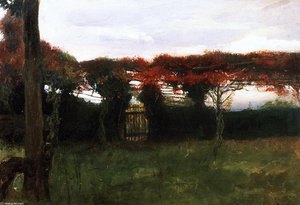
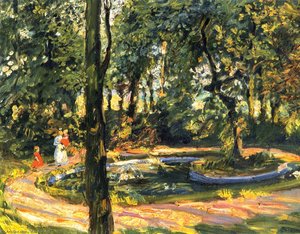
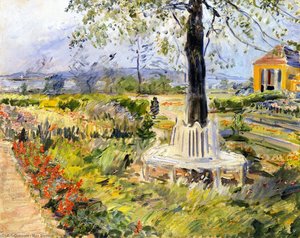
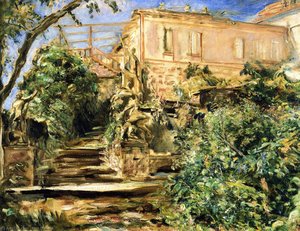
11Danae (1895) by Max SlevogtDanae1895 · Lenbachhaus 12Luise Papenhagen (1897) by Max SlevogtLuise Papenhagen1897 · Lenbachhaus 13Portrait of the Art historian Karl Voll (1898) by Max SlevogtPortrait of the Art historian Karl Voll1898 · Bayerische Staatsgemäldesammlungen 14Parrot Man (1901) by Max SlevogtParrot Man1901 · Niedersächsisches Landesmuseum 15Hour of Celebration (1900) by Max SlevogtHour of Celebration1900 · Bayerische Staatsgemäldesammlungen 16Faun and a girl (1900) by Max SlevogtFaun and a girl1900 · Nationaal Museum Warschau 17Grape harvest. (1900) by Max SlevogtGrape harvest.1900 · Nationaal Museum Warschau 18Portrait of the Poet Michael Georg Conrad (1909) by Max SlevogtPortrait of the Poet Michael Georg Conrad1909 · Bayerische Staatsgemäldesammlungen 19Prince Regent Luitpold, Profile Portrait (1909) by Max SlevogtPrince Regent Luitpold, Profile Portrait1909 · Bayerische Staatsgemäldesammlungen 20Bathing Boys (1911) by Max SlevogtBathing Boys1911 21Supper on the Terrace of the Badenburg in the Nymphenburg Palace Park (1908) by Max SlevogtSupper on the Terrace of the Badenburg in the Nymphenburg Palace Park1908 22A Self-Portrait in the Garden at Godramstein (1910) by Max SlevogtA Self-Portrait in the Garden at Godramstein1910 · Worcester Art Museum 23Don Juan's encounter with the stony guest (1906) by Max SlevogtDon Juan's encounter with the stony guest1906 · Alte Nationalgalerie 24Self-Portrait with Black Hat (1913) by Max SlevogtSelf-Portrait with Black Hat1913 · Lenbachhaus 25Nina and Wolfgang Slevogt (1917) by Max SlevogtNina and Wolfgang Slevogt1917 · Lenbachhaus 26Miss Eva Steinbarth (1915) by Max SlevogtMiss Eva Steinbarth1915 27Sudanese women (1914) by Max SlevogtSudanese women1914 · Staatliche Kunstsammlungen Dresden 28Don Quichote und Sancho Pansa (1917) by Max SlevogtDon Quichote und Sancho Pansa1917 29Pirates (1914) by Max SlevogtPirates1914 · Staatliche Kunstsammlungen Dresden 30Sardanapalus (1922) by Max SlevogtSardanapalus1922 31Portrait of a dancer Antonia Mercé called "La Argentina". (1926) by Max SlevogtPortrait of a dancer Antonia Mercé called "La Argentina".1926 · National Museum in Szczecin 32Self-Portrait (1929) by Max SlevogtSelf-Portrait1929 · Bayerische Staatsgemäldesammlungen 33The Libyan Desert (1914) by Max SlevogtThe Libyan Desert1914 34Early Autumn in the Palatinate - Vineyards near Neukastel (1927) by Max SlevogtEarly Autumn in the Palatinate - Vineyards near Neukastel1927 35Sailing into Syracuse Harbor (1914) by Max SlevogtSailing into Syracuse Harbor1914 · Bayerische Staatsgemäldesammlungen 36Palatinate Landscape - View of the Madenburg (1924) by Max SlevogtPalatinate Landscape - View of the Madenburg1924 · Kunstmuseum Bonn 37Flower Still Life (Bouquet in Glass) (1896) by Max SlevogtFlower Still Life (Bouquet in Glass)1896 · Bayerische Staatsgemäldesammlungen 38Red Arbor with Dog (1897) by Max SlevogtRed Arbor with Dog1897 39Red Arbor with Thundercounds (1893) by Max SlevogtRed Arbor with Thundercounds1893 40Man on a Forest Path (1904) by Max SlevogtMan on a Forest Path1904 · Westfälisches Landesmuseum 41Female Nude from the Back (1905) by Max SlevogtFemale Nude from the Back1905 · Museum Kunstpalast 42Port (Bridge) (1905) by Max SlevogtPort (Bridge)1905 · National Gallery Prague 43The Dancer Marietta di Rigardo (1904) by Max SlevogtThe Dancer Marietta di Rigardo1904 44Under an Arbour (1901) by Max SlevogtUnder an Arbour1901 45Study of Some Uniform Pieces (1909) by Max SlevogtStudy of Some Uniform Pieces1909 · Bayerische Staatsgemäldesammlungen 46Prince Regent Luitpold in the Prayer Chair under Canopy in Candlelight (1909) by Max SlevogtPrince Regent Luitpold in the Prayer Chair under Canopy in Candlelight1909 · Bayerische Staatsgemäldesammlungen 47Prince Regent Luitpold Kneeling at the Altar with Retinue (1909) by Max SlevogtPrince Regent Luitpold Kneeling at the Altar with Retinue1909 · Bayerische Staatsgemäldesammlungen 48Church Scene with the Preacher on the Pulpit (1908) by Max SlevogtChurch Scene with the Preacher on the Pulpit1908 · Bayerische Staatsgemäldesammlungen 49Slaughtered Pig (1906) by Max SlevogtSlaughtered Pig1906 · Staatliche Kunsthalle Karlsruhe 50Fruit Still Life (1911) by Max SlevogtFruit Still Life1911 · Staatliche Kunsthalle Karlsruhe 51Landscape with a view of Landau (1909) by Max SlevogtLandscape with a view of Landau1909 · Nationaal Museum Warschau 52Self - portrait by Max SlevogtSelf - portraitPomeranian State Museum 53still life roses in vase by Max Slevogtstill life roses in vase 54forest - road by Max Slevogtforest - road 55Portrait of Carl Steinbart (1910) by Max SlevogtPortrait of Carl Steinbart1910 56Herbstwald (1906) by Max SlevogtHerbstwald1906 57Children by the Pond - The Garden in Godramstein (1909) by Max SlevogtChildren by the Pond - The Garden in Godramstein1909 58Dame im weissen Reitkleid zu Pferde (1910) by Max SlevogtDame im weissen Reitkleid zu Pferde1910 59Entrance into the Harbor of Syracuse (1914) by Max SlevogtEntrance into the Harbor of Syracuse1914 · Bayerische Staatsgemäldesammlungen 60Sandstorm in the Libyan Desert (1914) by Max SlevogtSandstorm in the Libyan Desert1914 · Staatliche Kunstsammlungen Dresden 61Flower Garden I in Neu Cladow (1912) by Max SlevogtFlower Garden I in Neu Cladow1912 · Westfälisches Landesmuseum 62Unter den Linden (1913) by Max SlevogtUnter den Linden1913 63Tiger in the Jungle (1917) by Max SlevogtTiger in the Jungle1917 64The Nile at Aswan (1914) by Max SlevogtThe Nile at Aswan1914 · Staatliche Kunstsammlungen Dresden 65View from Godramstein toward Frankweiler (1913) by Max SlevogtView from Godramstein toward Frankweiler1913 66Grape Arbor at Neukastel (1917) by Max SlevogtGrape Arbor at Neukastel1917 67Sunny Garden Corner (1921) by Max SlevogtSunny Garden Corner1921 · Bayerische Staatsgemäldesammlungen 68Blossoming Lilac (1921) by Max SlevogtBlossoming Lilac1921 · Städel Museum 69Harness Racetrack in Ruhleben (1920) by Max SlevogtHarness Racetrack in Ruhleben1920 · Lenbachhaus 70Woodland Hawthorn with Small Cart (1918) by Max SlevogtWoodland Hawthorn with Small Cart1918 · Museum der bildenden Künste 71Terrace in Neukastel (1925) by Max SlevogtTerrace in Neukastel1925 · Bayerische Staatsgemäldesammlungen 72Still Life with Fruit (1925) by Max SlevogtStill Life with Fruit1925 · Bayerische Staatsgemäldesammlungen 73View from Naukastel, Late Autumn with Snow (1923) by Max SlevogtView from Naukastel, Late Autumn with Snow1923 74Neukastel, View toward Leinsweiler (1925) by Max SlevogtNeukastel, View toward Leinsweiler1925 75Neukastel - View of the Madenburg (1924) by Max SlevogtNeukastel - View of the Madenburg1924 · Museum Kunstpalast 76The Family Doctor János Plesch (1928) by Max SlevogtThe Family Doctor János Plesch1928 77Still life with Melon (1931) by Max SlevogtStill life with Melon1931 · Westfälisches Landesmuseum 78Summer House Garden (1912) by Max SlevogtSummer House Garden1912 79Cherry Harvest, View from Heukastel toward the South (1926) by Max SlevogtCherry Harvest, View from Heukastel toward the South1926 · Wallraf-Richartz-Museum 80Garden in Neu-Cladow (1912) by Max SlevogtGarden in Neu-Cladow1912 81Palatinate Landscape (1923) by Max SlevogtPalatinate Landscape1923 82The Garden at Neukastel with the LIbrary (1930) by Max SlevogtThe Garden at Neukastel with the LIbrary1930 83Country House in Godramstein - Entrance to the Villa (1909) by Max SlevogtCountry House in Godramstein - Entrance to the Villa1909 84The Country House in Godramstein (West Side) (1911) by Max SlevogtThe Country House in Godramstein (West Side)1911 85Het Palatiaanse Landschap (1921) by Max SlevogtHet Palatiaanse Landschap1921 · Staatliche Kunsthalle 86Garden Steps in Neukastel (1916) by Max SlevogtGarden Steps in Neukastel1916 87Moonlit NIght at Neukastel - View of the Madenburg by Moonlight (1917) by Max SlevogtMoonlit NIght at Neukastel - View of the Madenburg by Moonlight1917 88Landschap bij Godramstein - Wolken Passeren (1910) by Max SlevogtLandschap bij Godramstein - Wolken Passeren1910 · Museum der bildenden Künste 89Park Landscape in the Palatinate (1909) by Max SlevogtPark Landscape in the Palatinate1909 90Portrait of Ansorge by Max SlevogtPortrait of Ansorge 91Forest Path by Max SlevogtForest Path 92two women by Max Slevogttwo women 93Title Page by Max SlevogtTitle Page 94The Prodigal Son by Max SlevogtThe Prodigal Son 95The dancer Marietta di Rigardo by Max SlevogtThe dancer Marietta di RigardoStaatliche Kunstsammlungen Dresden 96Slevogt family in the garden of Godramstein by Max SlevogtSlevogt family in the garden of Godramstein 97Grape Harvest at Neukastel (1916) by Max SlevogtGrape Harvest at Neukastel1916 · Museum Folkwang 98Harness Racing (1907) by Max SlevogtHarness Racing1907 99Spring in the Palatinate (1910) by Max SlevogtSpring in the Palatinate1910 100Negro Boy Mursi (1914) by Max SlevogtNegro Boy Mursi1914 · Staatliche Kunstsammlungen Dresden

Max Slevogt's famous paintings, period by period

The subjects that held Max Slevogt's eye

The four subjects that come back most often in these originals, each with its finest example.

The museums that keep Max Slevogt's originals

The 8 museums that hold the most of the paintings on this page.

Museum City Works by Max Slevogt Paintings from this list
Bayerische Staatsgemäldesammlungen, MünchenBayerische Staatsgemäldesammlungen München 18 Prince Regent Luitpold in the Ermine Cloak, Theater Curtain, Angela von Tschudi
Staatliche Kunstsammlungen Dresden, DresdenStaatliche Kunstsammlungen Dresden Dresden 6 Sudanese women, Pirates, Sandstorm in the Libyan Desert
Lenbachhaus, MünchenLenbachhaus München 5 Danae, Luise Papenhagen, Self-Portrait with Black Hat
Alte Nationalgalerie, BerlijnAlte Nationalgalerie Berlijn 4 The Singer Francisco d'Andrade as Don Giovanni in Mozart's Opera, Frau Voll mit Tochter, Requiem for the St. Georgsknights
Nationaal Museum Warschau, WarschauNationaal Museum Warschau Warschau 3 Faun and a girl, Grape harvest., Landscape with a view of Landau
Westfälisches Landesmuseum, MünsterWestfälisches Landesmuseum Münster 3 Man on a Forest Path, Flower Garden I in Neu Cladow, Still life with Melon
Städel Museum, FrankfurtStädel Museum Frankfurt 2 Lady Adventure, Blossoming Lilac
Museum Kunstpalast, DüsseldorfMuseum Kunstpalast Düsseldorf 2 Female Nude from the Back, Neukastel - View of the Madenburg

Max Slevogt across the decades: one unique original for each

Works per decade

Pick a decade to see the original that defines it.

Max Slevogt's paintings: questions for the gallery

What is the single most famous work of Max Slevogt?Reveal the answer

The Quarry at Albersweiler (1912). The Singer Francisco d'Andrade as Don Giovanni in Mozart's Opera (1912) and Frau Voll mit Tochter (1895) come next.

At what age did Max Slevogt create The Quarry at Albersweiler?Reveal the answer

44 years old: The Quarry at Albersweiler dates from 1912, and Max Slevogt was born in 1868.

Which ten paintings by Max Slevogt are the most famous?Reveal the answer

The Quarry at Albersweiler, The Singer Francisco d'Andrade as Don Giovanni in Mozart's Opera, Frau Voll mit Tochter, Prince Regent Luitpold in the Ermine Cloak, Requiem for the St. Georgsknights, Theater Curtain, Lady Adventure, Angela von Tschudi, Sailboats on the Alster River in the Evening and Scheherazade (Telling the Stories from 1001 Nights to the Caliph). The ranking above gives each one's year and museum.

How many works by Max Slevogt are known?Reveal the answer

Our catalog holds 102 works by Max Slevogt, dated from 1893 to 1931.

Where can the most famous Max Slevogt originals be seen?Reveal the answer

Mostly in Bayerische Staatsgemäldesammlungen (München), Staatliche Kunstsammlungen Dresden (Dresden) and Lenbachhaus (München). The museum table above lists them all.

During which period did Max Slevogt create the best-known paintings?Reveal the answer

In 1910s: 33 of the 100 works on this page were made then, The Quarry at Albersweiler among them.

Which famous Max Slevogt painting is the earliest, and which the latest?Reveal the answer

On this page, the earliest is Red Arbor with Thundercounds (1893) and the latest Theater Curtain (1931).

What subjects did Max Slevogt favour?Reveal the answer

Landscape (11), People (6) and Gardens and parks (5), across the 100 works on this page.

What materials did Max Slevogt paint with most?Reveal the answer

Oil On Canvas, for 15 of the 100 works on this page.

Which movement does the work of Max Slevogt belong to?Reveal the answer

Impressionism, judging by the originals on this page.

What Max Slevogt originals can I see at the Bayerische Staatsgemäldesammlungen?Reveal the answer

Prince Regent Luitpold in the Ermine Cloak, Theater Curtain and Angela von Tschudi: the Bayerische Staatsgemäldesammlungen, München holds 18 of the works on this page.

Where can I order a hand-painted Max Slevogt reproduction?Reveal the answer

Yes, as a reproduction: the original stays in its museum, but any painting on this page can be painted by hand for you, made to order one at a time, from the painting's own page.

Max Slevogt: a portrait of the artist

De Lichtvolle Erfenis van Max Slevogt

Max Slevogt staat te boek als een hoeksteen van de Duitse impressionistische schilderkunst, gewaardeerd om zijn meesterlijke landschapsafbeeldingen en zijn vermogen om de vluchtige schoonheid van de natuur met een opmerkelijke gevoeligheid vast te leggen. Geboren in Landshut, Beieren, in 1868, begon hij aan een artistieke reis die hem zou doen transformeren van donkere, academische tonale schetsen naar levendige doeken vol licht en kleur—een stilistische verschuiving die symbool stond voor de bredere beweging die de Europese kunst rond de eeuwwisseling hervormde. Zijn vormende jaren bracht hij door met het verfijnen van zijn vaardigheden aan de Münchense Academie, waar hij aanvankelijke experimenteerde met donkere paletten en technieken die beïnvloed waren door de toenmalige academische stijl.

Een cruciaal bezoek aan Parijs in 1889 ontketende echter een diepgaande transformatie binnen zijn artistieke ziel. Blootgesteld aan de revolutionaire ideeën van meesters zoals Édouard Manet, werd Slevogts visie voortgestuwd naar een gewaagdere benadering die prioriteit gaf aan directe observatie van de natuurlijke wereld. Deze ontmoeting met de Franse avant-garde blies leven in zijn penseelvoering en moedigde hem aan om plein air schilderen te omarmen en de vergankelijke dans van het licht op het landschap op te zoeken. Zijn werk begon te pulseren met een atmosferische vitaliteit, waarbij hij zich losmaakte van rigide ateliercomposities ten gunste van een meer spontane en zintuiglijke omgang met de werkelijkheid.

Een Meesterschap van Licht en Landschap

Hoewel het vruchtbare oeuvre van Slevogt diverse genres besloeg, waaronder illustratie, portretkunst en genreschilderkunst, domineerden landschappen consequent zijn prachtige werk. Hij verwierf bijzondere bekendheid door zijn evocatieve portrettering van de Beierse alpenregio's, in het bijzonder Neukastel, dat zijn levenslange thuis werd en diende als een blijvende bron van inspiratie. Zijn doeken worden gevierd om hun vermogen om de subtiele nuances van licht en schaduw te vangen, waarbij hij een minutieuze aandacht voor textuur en kleur toont die hem onderscheidt van veel van zijn tijdgenoten.

De technische evolutie van de kunstenaar wordt gekenmerkt door enkele kernaspecten:

  • Dynamische Penseelvoering: Een overgang van gecontroleerde, academische streken naar meer vloeiende, energieke applicaties van verf.
  • Chromatische Briljantie: Een toenemend vertrouwen op een levendig palet om de warmte van het zonlicht en de koelte van de schemering over te brengen.
  • Atmosferische Diepte: Het gebruik van zachte randen en lichtdiffusie om het gevoel van vocht, mist en lucht binnen een scène te recreëren.

Buiten de serene schoonheid van zijn landschappen bezat Slevogt een opmerkelijk vermogen om het gewicht van de menselijke geschiedenis vast te leggen. Zijn latere werken weerspiegelen een diepere, somberdere betrokkenheid bij de wereld, inclusief evocatieve afbeeldingen van Egypte en de gruwelijke verschrikkingen van de Eerste Wereldoorlog. Dit vermogen om te schakelen tussen het idyllische en het diepzinnige getuigt van de emotionele reikwijdte die zijn grootheid definieert.

Culturele Invloed en Historisch Belang

Naast zijn individuele artistieke prestaties verstevigde Slevogts betrokkenheid bij culturele instellingen zijn positie binnen het intellectuele landschap van het Weimar-Duitsland. Als prominent lid van de Berlijnse Secessie en de Preussische Academie van Kunsten bevond hij zich in het hart van de belangrijkste esthetische debatten van die tijd. Hij omarmde de avant-gardistische geest terwijl hij een standvastige toewijding behield aan traditionele artistieke principes, waardoor hij de kloof tussen klassieke training en moderne innovatie kon overbruggen.

Zijn veelzijdigheid strekte zich zelfs uit tot de podiumkunsten; zo ontwierp hij opmerkelijk genoeg het decor voor Mozarts Don Giovanni, waarmee hij zijn vermogen toonde om zijn schilderkunstige visie te vertalen naar de theatrale ruimte. Door zijn werk in tijdschriften zoals Simplicissimus en zijn blijvende invloed op het Duitse impressionisme, liet Max Slevogt een onuitwisbare stempel achter op de kunstgeschiedenis. Hij blijft een gevierde figuur wiens werk voortdurend resoneert bij iedereen die wordt geraakt door het samenspel van licht, kleur en de eeuwige geest van de natuur.

All 102 works by Max Slevogt →