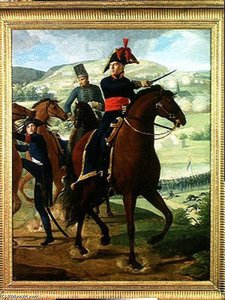
Portret van Louis Hersent

De 37 bekendste schilderijen van Louis Hersent, een selectie uit de galerie

Bijgewerkt in oktober 2026 · gerangschikt op basis van onze populariteitsscore (zoekopdrachten, bezoeken en bestellingen per kunstwerk) · 37 werken van Louis Hersent in onze catalogus

Kortom

Van alle originele werken die Louis Hersent heeft nagelaten, is Sophie Crouzet (1801) het bekendst, in de collectie van het Cleveland Museum of Art, Cleveland. Direct daarna volgen Henri-Charles-Ferdinand of Artois Duke of Bordeaux and his Sister Louise-Marie-Therese of (1820) en Portrait of Madame Le Doyen (1825). Onze catalogus bevat 37 werken van Louis Hersent; de galerie heeft de 37 meest bewonderde werken ter wereld bewaard, elk voorzien van de datum, het museum en het verhaal erachter.

1777 – 1860, Parijs Neoclassicism Meeste werken: Musée Carnavalet

De top 10 schilderijen van Louis Hersent: de selectie van de galerie

De selectie van Louis Hersent gaat verder, van 11 tot 37

De onderwerpen die de aandacht van Louis Hersent troffen

De vier onderwerpen die het meest voorkomen in deze originelen, elk met zijn mooiste voorbeeld.

De musea waar de originele werken van Louis Hersent worden bewaard

De 8 musea met de meeste schilderijen op deze pagina.

Museum Stad Werken van Louis Hersent Schilderijen uit deze lijst
Musée Carnavalet, ParijsMusée Carnavalet Parijs 3 Portrait of Madame Arachequesne, Portrait of Romain de Bourge, General Louis Marie Turreau De Garambouville At The Gravieres Affair
Opera House, VersaillesOpera House Versailles 3 Louise-Adélaïde Desnos, Queen Maria Amalia Of The French, Delphine De Girardin
Cleveland Museum of Art, ClevelandCleveland Museum of Art Cleveland 1 Sophie Crouzet
Musée de la Vie Romantique, ParisMusée de la Vie Romantique Paris 1 Portrait of Madame Le Doyen
Château de Versailles, VersaillesChâteau de Versailles Versailles 1 Portrait of Sophie Gay
Museum of the French Revolution, VizilleMuseum of the French Revolution Vizille 1 The Battle Of Landschut, 21st April
Musée Condé, ChantillyMusée Condé Chantilly 1 Marie-amelie De Bourbon -
Nationalmuseum, StockholmNationalmuseum Stockholm 1 Fénélon Returns A Stolen Cow To A Peasant

Louis Hersent decennium voor decennium: het origineel dat elk tijdperk definieert

Werken per decennium

Kies een decennium om het origineel te zien dat dit tijdperk definieert.

Vragen van verzamelaars over de schilderijen van Louis Hersent

Waar is Louis Hersent het meest bekend om?Onthul het antwoord

Sophie Crouzet (1801), Cleveland Museum of Art, Cleveland. Henri-Charles-Ferdinand of Artois Duke of Bordeaux and his Sister Louise-Marie-Therese of (1820) en Portrait of Madame Le Doyen (1825) volgen.

Hoe oud was Louis Hersent toen Sophie Crouzet werd gemaakt?Onthul het antwoord

24 jaar oud: Sophie Crouzet dateert uit 1801, en Louis Hersent werd geboren in 1777.

Wat zijn de tien beroemdste schilderijen van Louis Hersent?Onthul het antwoord

Sophie Crouzet, Henri-Charles-Ferdinand of Artois Duke of Bordeaux and his Sister Louise-Marie-Therese of, Portrait of Madame Le Doyen, Portrait of Madame Arachequesne, Portrait of Sophie Gay, Portrait of Madame Demetz in a red sofa, Religieux de l'hospice du mont Saint Gothard, Portrait of Sophie Legrand, comtesse Walsh de Serrant, and her children, Self-portrait en Louise-Adélaïde Desnos. De bovenstaande ranglijst vermeldt het jaar en het museum van elk werk.

Hoeveel schilderijen heeft Louis Hersent nagelaten?Onthul het antwoord

Onze catalogus bevat 37 werken van Louis Hersent, daterend van 1801 tot 1854.

In welke musea hangen de meesterwerken van Louis Hersent?Onthul het antwoord

Voornamelijk in Musée Carnavalet (Parijs), Opera House (Versailles) en Cleveland Museum of Art (Cleveland). De bovenstaande museumtabel bevat een volledig overzicht.

In welke jaren schilderde Louis Hersent de beroemdste werken?Onthul het antwoord

In 1820s: 5 van de 37 werken op deze pagina werden toen gemaakt, waaronder Henri-Charles-Ferdinand of Artois Duke of Bordeaux and his Sister Louise-Marie-Therese of.

Wat zijn de eerste en de laatste beroemde originelen van Louis Hersent?Onthul het antwoord

Op deze pagina is het vroegste Sophie Crouzet (1801) en het laatste Self-portrait (1854).

Welke onderwerpen koos Louis Hersent het vaakst?Onthul het antwoord

Portraiture (4), Royalty (3) en Neoclassical style (2), verspreid over de 37 werken op deze pagina.

Bij welke kunststroming behoort Louis Hersent?Onthul het antwoord

Neoclassicism, te oordelen aan de originelen op deze pagina.

Welke werken van Louis Hersent hangen in het Musée Carnavalet?Onthul het antwoord

Portrait of Madame Arachequesne, Portrait of Romain de Bourge en General Louis Marie Turreau De Garambouville At The Gravieres Affair: het Musée Carnavalet, Parijs herbergt 3 van de werken op deze pagina.

Louis Hersent: leven en werk

A Legacy in Portraiture: The Life and Art of Louis Hersent

Louis Hersent, a name resonating with the elegance of the French Restoration era, was more than just a painter; he was a chronicler of his time. Born in Paris in 1777, Hersent’s artistic journey unfolded against a backdrop of revolutionary upheaval and imperial grandeur, ultimately solidifying his place as a master of Neoclassical portraiture and historical painting. His canvases offer not merely likenesses but insightful glimpses into the personalities and societal currents of early 19th-century France. From an early age, Hersent demonstrated a keen aptitude for art, leading him to the studio of Jacques-Louis David – a pivotal moment that would indelibly shape his aesthetic sensibilities. David, the preeminent Neoclassical painter and official artist of Napoleon Bonaparte, instilled in Hersent a rigorous approach to draftsmanship, composition, and form. This foundational training emphasized clarity, balance, and a restrained palette—hallmarks that would define Hersent’s mature style. Winning the prestigious Prix de Rome in 1797 further cemented his commitment to classical ideals, providing him with invaluable exposure to the artistic heritage of Italy.

The Embrace of Neoclassicism and Artistic Development

Hersent's work embodies the core tenets of Neoclassicism: a reverence for antiquity, an emphasis on order and reason, and a commitment to technical precision. However, while deeply rooted in this tradition, Hersent wasn’t merely imitative. He infused his paintings with a subtle psychological depth, capturing not just the outward appearance but also the inner character of his subjects. His portraits are characterized by dignified poses, meticulous attention to detail—particularly in fabrics and textures—and a restrained emotionality that speaks volumes. He excelled at portraying members of the French aristocracy and military leaders, figures who sought to project an image of stability and authority in the wake of revolutionary turmoil. Paintings like The Duc D'Orléans, Duke Of Chartres And Nemours, exemplify this approach, presenting a commanding figure radiating both power and refinement. Hersent’s skill in draftsmanship—a cornerstone of David’s teachings—allowed him to render figures with remarkable accuracy and anatomical correctness. This dedication to realism was tempered by an understanding of ideal proportions and harmonious composition, resulting in canvases that possessed both visual beauty and intellectual resonance.

Winning Recognition: The Prix de Rome and Artistic Influence

The awarding of the Prix de Rome in 1797 represented a monumental achievement for Hersent—a validation of his artistic talent and a gateway to further scholarly pursuits. This prestigious scholarship enabled him to spend several years studying in Florence, immersing himself in the artistic traditions of antiquity and honing his skills under the tutelage of Alessandro Falconetti, another influential Neoclassical painter. The Florentine experience profoundly impacted Hersent’s aesthetic sensibilities, fostering a deeper appreciation for classical ideals and refining his technique. He returned to Paris with renewed confidence and ambition, establishing himself as a respected artist and teacher—a role he continued to fulfill throughout his life. His influence extended beyond his own students; he championed the principles of Neoclassicism within the Parisian art world, shaping the tastes and sensibilities of an entire generation.

Notable Achievements: Portraits of Distinction

Hersent’s artistic reputation soared during the Restoration period, fueled by commissions from prominent patrons—including members of the royal family—and by his unwavering dedication to excellence. He produced a prolific oeuvre encompassing portraits of monarchs, nobles, military officers, and intellectuals—each canvas imbued with meticulous detail and psychological insight. Among his most celebrated works are depictions of Louise Élisabeth Vigée Le Brun, capturing her regal beauty and conveying her inner strength; and portraits of Henri Charles Ferdinand, Duke Of Weimar, showcasing his aristocratic demeanor and intellectual curiosity. These paintings stand as enduring symbols of the elegance and sophistication of the French court—testaments to Hersent’s artistic mastery and his ability to capture the essence of human character.

A Family Committed to Art: Marriage and Legacy

Hersent married Louise Marie Jeanne Hersent-Mauduit in 1821, forging a partnership rooted in shared passions for art and scholarship. Together, they cultivated an environment that nurtured artistic creativity—Louise herself was a talented painter specializing in portraits and history painting. Their daughter, Marie Virginie Boquet, followed in her parents’ footsteps, becoming a porcelain painter and demonstrating a remarkable artistic aptitude. This familial devotion to the arts underscores Hersent's broader contribution to French cultural heritage—a legacy that extends beyond his individual achievements into the realm of artistic education and familial tradition. Louis Hersent passed away peacefully in 1860, leaving behind an impressive body of work that continues to captivate audiences today. His paintings remain invaluable sources of insight into the social and intellectual landscape of the early 19th century—a testament to his enduring artistic legacy.