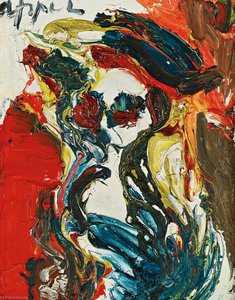
Karel Appel: een portret van de kunstenaar
A Life Painted in Bold Strokes: The World of Karel Appel
Christiaan Karel Appel, known affectionately as ‘Kik’ from childhood, burst onto the post-war art scene like a vibrant explosion of color and energy. Born in Amsterdam in 1921, his early life was steeped in the everyday rhythms of working-class Holland – his father a barber, his lineage tracing back to French Huguenots through his mother. This grounding, however, would soon be superseded by an irrepressible artistic drive that defied convention and ultimately reshaped the landscape of European art. A pivotal moment arrived at age fourteen with his first painting, a still life of fruit, followed shortly after by a paint set and easel gifted by his uncle Karel Chevalier, who also provided early instruction. These gifts weren’t merely tools; they were keys unlocking a world where imagination reigned supreme. The shadow of the Second World War loomed large over Appel’s formative years. Studying at the Rijksakademie van Beeldende Kunsten in Amsterdam during the German occupation proved challenging, yet it was there he forged lifelong bonds with fellow artists Corneille and Constant, friendships that would prove crucial to his artistic evolution. Facing opposition from his parents regarding his chosen path and fearing forced labor under Nazi rule, Appel bravely left home, choosing a life dedicated to art over conformity.
The CoBrA Revolution: Spontaneity and the Childlike Vision
Appel’s artistic journey truly ignited with the formation of the CoBrA group in 1948 – an acronym derived from Copenhagen, Brussels, and Amsterdam, representing the movement's core cities. Alongside Corneille, Constant, Jan Nieuwenhuys, and Christian Dotremont, Appel spearheaded a radical departure from established artistic norms. CoBrA wasn’t merely a style; it was a philosophy rooted in spontaneity, experimentation, and a profound embrace of the untamed creativity found in children's art and primitive cultures. Influenced by masters like Pablo Picasso and Henri Matisse, as well as the raw energy of Jean Dubuffet, Appel rejected rigid formalism in favor of intuitive expression. He began sculpting in 1947, utilizing assemblage techniques – constructing works from found materials painted in a bold palette of white, red, yellow, blue, and black. This period saw him involved with the Experimentele Groep, further solidifying his commitment to artistic innovation. The controversial fresco "Questioning Children" (1949), commissioned for Amsterdam City Hall, exemplified CoBrA’s provocative spirit but also sparked public outcry, ultimately leading to its being covered up – a testament to the movement’s challenging nature. Appel drew inspiration from Danish and Nordic mythology, weaving these ancient narratives into his increasingly abstract compositions.
Early Influences and Artistic Development
Appel’s artistic sensibilities were profoundly shaped by his upbringing in Amsterdam's working-class district. His father’s profession instilled a sense of practicality alongside an appreciation for craftsmanship, while his maternal heritage connected him to Huguenot traditions emphasizing intellectual curiosity and independent thought. The gift of a paint set from his uncle Karel Chevalier at the age of fourteen proved transformative, sparking his initial foray into painting with a still life of fruit – a deliberate choice reflecting Appel’s fascination with everyday subjects and rejecting academic conventions. His formative years coincided with the pervasive influence of Surrealism and Cubism, particularly Picasso's expressive use of color and form. However, Appel swiftly distanced himself from these styles, prioritizing an approach that prioritized spontaneous gesture and unfiltered emotion—a cornerstone of his distinctive artistic vision. He honed his sculptural skills through experimentation with assemblage techniques, repurposing discarded materials into evocative artworks that challenged traditional notions of beauty and materiality.
International Recognition and Artistic Expansion
Appel’s relocation to Paris in 1950 marked a pivotal moment in his career, providing him with access to a vibrant artistic milieu and fostering connections with influential figures like Jean Dubuffet and Michel Tapié. This period witnessed a surge of international exhibitions showcasing his groundbreaking work—including “Child and Beast II” at the Museum of Modern Art in 1955—solidifying his reputation as a pioneer of Abstract Expressionism and establishing him as one of the foremost artists of his generation. Appel’s murals continued to evolve throughout the decade, reflecting his ongoing engagement with themes of childhood innocence and social critique. His artistic explorations extended beyond painting and sculpture, encompassing printmaking and design projects that demonstrated his versatility and commitment to pushing creative boundaries.
Legacy and Enduring Influence
Karel Appel left an indelible mark on European art history, establishing the Karel Appel Foundation to safeguard his oeuvre and champion public awareness of his artistic legacy. His unwavering belief in spontaneity and childlike imagination—expressed through bold colors and unconventional materials—continues to inspire contemporary artists who seek to challenge conventions and embrace experimentation. Appel’s work stands as a testament to the transformative power of art to convey emotion, provoke thought, and celebrate the beauty found in unexpected places—a lasting contribution to the artistic landscape of the 20th century.