Portret van Franz Defregger

De 88 beroemdste schilderijen van Franz Defregger, elk uniek

Bijgewerkt in november 2026 · gerangschikt op basis van onze populariteitsscore (zoekopdrachten, bezoeken en bestellingen per kunstwerk) · 92 werken van Franz Defregger in onze catalogus

Kortom

Going to School is het schilderij van Franz Defregger dat de meeste aandacht trekt. Daarna gaat de blik naar Tyrolean Farmer (1860) en Zither Player and Two Girls (1860). Van de 92 werken van Franz Defregger in onze catalogus zijn dit de 88 bekendste, elk een uniek origineel gepresenteerd met het jaar, het museum en de reden waarom het blijft voortbestaan.

1835 – 1921, Iselsberg-Stronach Realism Meeste werken: Bayerische Staatsgemäldesammlungen

Top 10 schilderijen van Franz Defregger, door de ogen van de galerie

1
Going to School door Franz Defregger

Going to School

In Going to School, Franz Defregger captures a lively moment of daily life as a group of nine children makes their way up a hill. The children are dressed for their lessons, some carrying books tucked under their arms. Their movement toward the schoolhouse suggests the start of a busy day.

2
Tyrolean Farmer (1860) door Franz Defregger

Tyrolean Farmer

1860 · Oil On Board

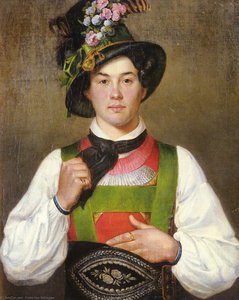
In "Tyrolean Farmer" by Franz Defregger, the world narrows to a single, weathered face. This close-up bust portrait centers an elderly man against a dark, indistinct background that offers no distraction from his presence. He wears a wide-brimmed hat, a silhouette that frames a thick, white beard. The subject, likely a Tyrolean farmer, stares forward from an eye-level perspective. This direct gaze establishes an immediate, quiet emotional connection between the…

3
Zither Player and Two Girls (1860) door Franz Defregger

Zither Player and Two Girls

1860 · Oil

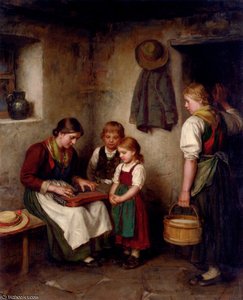
In the painting Zither Player and Two Girls by Franz Defregger, a quiet, domestic scene unfolds within a rustic interior. The composition is centered around three human figures and a dog, arranged in a triangular formation that directs the eye toward the central subject. A man sits on a bench, focused on playing a zither. He is accompanied by two young women dressed in traditional Tyrolean folk attire. In the…

4
Reclining female nude (1860) door Franz Defregger

Reclining female nude

1860 · Oil

In "Reclining female nude" by Franz Defregger, the composition centers on a single figure. The body is positioned diagonally across the frame, leaning against a draped structure. This arrangement creates a sense of quiet repose. The subject rests in a state of stillness, framed by the heavy, vertical folds of fabric that contrast with the organic lines of the anatomy. The perspective is a close-up, eye-level view that draws the…

5
Girl reading (1860) door Franz Defregger

Girl reading

1860 · Oil On Canvas

In "Girl reading" by Franz Defregger, the composition settles into a close-up, medium shot. The subject is captured from the chest up, positioned slightly off-center against a void of deep blacks. This darkness pushes the figure forward, creating a sense of intimacy and quietude. The grayscale palette strips away the distraction of color, leaving only the essential interplay of light and shadow. It is a study of stillness.

6
Portr. of a man with decorations (1860) door Franz Defregger

Portr. of a man with decorations

1860 · Oil

The oil portrait titled Portr. of a man with decorations is a work by the Austrian artist Franz Defregger. Created about 1860, this piece captures an elderly man in a moment of quietude. The subject is rendered with a focus on the weight of years and the presence of his distinction.

7
Liesal girl (half- length ) (1860) door Franz Defregger

Liesal girl (half- length )

1860 · Oil

The artwork titled Liesal girl (half- length ) is a painting by the Austrian artist Franz Defregger. This specific piece was created about 1860. The composition focuses on a single human figure, presented in a half-length format that centers the subject within the frame.

8
Portrait of a young girl (1860) door Franz Defregger

Portrait of a young girl

1860 · Oil On Canvas

Franz Defregger’s Portrait of a young girl, created about 1860, presents a centered, bust-length study of a single subject. The girl is positioned against a dark, indistinct background that pushes her figure toward the viewer. She possesses wavy, dark hair and gazes directly at the observer, establishing an intimate connection through her steady, frontal orientation. This directness is framed by the soft focus and classical realism that define the work's…

9
Peasants in front of the house (1860) door Franz Defregger

Peasants in front of the house

1860 · Oil On Canvas

The scene known as Peasants in front of the house emerges from the brush of Franz Defregger, an artist whose life was deeply rooted in the rugged landscapes of his homeland. Born in Iselsberg-Stronach, Austria, Defregger carries the spirit of the Tyrolean countryside into his work. This particular piece dates to about 1860, a period when the artist was beginning to find his voice amidst the realities of rural existence.…

10
Peasant-scene ( Talk over the marriage ) (1860) door Franz Defregger

Peasant-scene ( Talk over the marriage )

1860 · Oil On Canvas · Deutsches Museum, Berlijn

In Peasant-scene ( Talk over the marriage ), Franz Defregger centers the gravity of the room upon a single wooden table. Six peasants gather in a tight semi-circle, their bodies leaning inward to form a closed ring of intimacy. This arrangement traps the viewer within the rustic interior, making the social interaction feel immediate and private. The figures are locked in a serious discussion, perhaps negotiating the terms of a…

De beroemde schilderijen van Franz Defregger, nummer 11 tot 88

11The Blacksmith (1850) door Franz DefreggerThe Blacksmith1850 · Minneapolis Institute of Art 12the bath of a child (1868) door Franz Defreggerthe bath of a child1868 13The Last Muster (Oil Sketch) (1872) door Franz DefreggerThe Last Muster (Oil Sketch)1872 · Bayerische Staatsgemäldesammlungen 14Tyrolean Home Guard returning from the war of 1809. (1876) door Franz DefreggerTyrolean Home Guard returning from the war of 1809.1876 · Alte Nationalgalerie 15The Visit (1875) door Franz DefreggerThe Visit1875 · Bayerische Staatsgemäldesammlungen 16The Last Contingent (1874) door Franz DefreggerThe Last Contingent1874 17Children with a bird + cage. (1874) door Franz DefreggerChildren with a bird + cage.1874 18Family scene in front of the house (1872) door Franz DefreggerFamily scene in front of the house1872 19Die Kraftprobe (1878) door Franz DefreggerDie Kraftprobe1878 20The Storming of the Roter Turm in the Sendling Bauernschlacht 1705 (1881) door Franz DefreggerThe Storming of the Roter Turm in the Sendling Bauernschlacht 17051881 · Lenbachhaus 21The Storming of the Roter Turm in München by the Oberländer Peasants on Christmas Morning 1705 (1881) door Franz DefreggerThe Storming of the Roter Turm in München by the Oberländer Peasants on Christmas Morning 17051881 · Bayerische Staatsgemäldesammlungen 22Female Portrait in Black (1885) door Franz DefreggerFemale Portrait in Black1885 23Young Peasant Girl (1885) door Franz DefreggerYoung Peasant Girl1885 24Peasant Girl (1885) door Franz DefreggerPeasant Girl1885 25Portrait of a Peasant Girl (1885) door Franz DefreggerPortrait of a Peasant Girl1885 26Tyrolean Woman with Hat (1885) door Franz DefreggerTyrolean Woman with Hat1885 27Man with Beard (1879) door Franz DefreggerMan with Beard1879 28Tyrolean Peasant Woman with Hat (1885) door Franz DefreggerTyrolean Peasant Woman with Hat1885 29The Salon Tyrolean (1882) door Franz DefreggerThe Salon Tyrolean1882 30merry society of young peasants in an inn (1882) door Franz Defreggermerry society of young peasants in an inn1882 31portrait of a girl (1885) door Franz Defreggerportrait of a girl1885 32The young Mother (1884) door Franz DefreggerThe young Mother1884 33Young Girl (1890) door Franz DefreggerYoung Girl1890 34Portrait of a Young Girl (1888) door Franz DefreggerPortrait of a Young Girl1888 35Assembly of Tyrolean Freedom Fighters (1886) door Franz DefreggerAssembly of Tyrolean Freedom Fighters1886 36Tyrolean Hunter (1887) door Franz DefreggerTyrolean Hunter1887 · Augustiner Museum 37portrait of an old man (1890) door Franz Defreggerportrait of an old man1890 38Young man with pipe (1892) door Franz DefreggerYoung man with pipe1892 39The War Council of Andreas Hofer in the Year 1809 (1897) door Franz DefreggerThe War Council of Andreas Hofer in the Year 18091897 · Bayerische Staatsgemäldesammlungen 40The Painter Franz von Lenbach (1895) door Franz DefreggerThe Painter Franz von Lenbach1895 · Lenbachhaus 41The Strength Test (1898) door Franz DefreggerThe Strength Test1898 42interior scene with peasants (1896) door Franz Defreggerinterior scene with peasants1896 43Scene in a country- inn (1899) door Franz DefreggerScene in a country- inn1899 44group of peasant people in a cottage (1899) door Franz Defreggergroup of peasant people in a cottage1899 45The sick dachshund (1903) door Franz DefreggerThe sick dachshund1903 46Girl Portrait with Headscarf (1907) door Franz DefreggerGirl Portrait with Headscarf1907 47Young peasant-girl (1913) door Franz DefreggerYoung peasant-girl1913 48Girl with rake + letter (1915) door Franz DefreggerGirl with rake + letter1915 49The Story Of St. Nicholas door Franz DefreggerThe Story Of St. Nicholas 50The Salon-Tyrolean (1882) door Franz DefreggerThe Salon-Tyrolean1882 · Alte Nationalgalerie 51The Burning Seppenhaus in Reith (1890) door Franz DefreggerThe Burning Seppenhaus in Reith1890 · Lenbachhaus 52Head of girl (1890) door Franz DefreggerHead of girl1890 · Regional Gallery in Liberec 53Bust Portrait of a Tyrolean Peasant door Franz DefreggerBust Portrait of a Tyrolean PeasantBayerische Staatsgemäldesammlungen 54Portrait of a girl door Franz DefreggerPortrait of a girl 55portrait of a peasant door Franz Defreggerportrait of a peasant 56Brand in Reith door Franz DefreggerBrand in Reith 57Schauspieler door Franz DefreggerSchauspieler 58Alte Strasse door Franz DefreggerAlte Strasse 59Erstürmung des Roten Turmes door Franz DefreggerErstürmung des Roten Turmes 60Portrait of the artist door Franz DefreggerPortrait of the artist 61Kindbildnis door Franz DefreggerKindbildnis 62Poacher in the Alpine dairy hut door Franz DefreggerPoacher in the Alpine dairy hut 63Difficult question door Franz DefreggerDifficult questionRegional Gallery in Liberec 64Portrait of a Man door Franz DefreggerPortrait of a ManBayerische Staatsgemäldesammlungen 65Nicolaus Gysis door Franz DefreggerNicolaus Gysis 66Portrait of a girl door Franz DefreggerPortrait of a girl 67Training of monkeys Affendresur door Franz DefreggerTraining of monkeys Affendresur 68Wallfahrer door Franz DefreggerWallfahrer 69Bauernbursch Mit Pfeife door Franz DefreggerBauernbursch Mit Pfeife 70A Pan door Franz DefreggerA Pan 71The Zither Player door Franz DefreggerThe Zither Player 72A tyrolean peasant door Franz DefreggerA tyrolean peasant 73The Last Contingent door Franz DefreggerThe Last ContingentBayerische Staatsgemäldesammlungen 74Hunter And Maid In The Kuchl At Happy Geplauder door Franz DefreggerHunter And Maid In The Kuchl At Happy Geplauder 75A Bavarian Peasant Girl - door Franz DefreggerA Bavarian Peasant Girl - 76Girl Portrait door Franz DefreggerGirl PortraitBayerische Staatsgemäldesammlungen 77A Bavarian Peasant Girl door Franz DefreggerA Bavarian Peasant Girl 78Defegger Franz von Jungen Bauern door Franz DefreggerDefegger Franz von Jungen Bauern 79Ein junges Mädchen (The Little Girl) door Franz DefreggerEin junges Mädchen (The Little Girl) 80Die marchenerzahlerin door Franz DefreggerDie marchenerzahlerin 81The music lesson door Franz DefreggerThe music lesson 82Mother's Pride door Franz DefreggerMother's Pride 83Die erste studienreise door Franz DefreggerDie erste studienreise 84Idle Hours in the Harem door Franz DefreggerIdle Hours in the Harem 85Abschied der jager door Franz DefreggerAbschied der jager 86Der zitherspieler Auf Der Alm door Franz DefreggerDer zitherspieler Auf Der Alm 87A young man in tyrolean costume door Franz DefreggerA young man in tyrolean costume 88The happy family door Franz DefreggerThe happy family

De beroemde schilderijen van Franz Defregger, periode voor periode

De onderwerpen die de aandacht van Franz Defregger troffen

De vier onderwerpen die het meest voorkomen in deze originelen, elk met zijn mooiste voorbeeld.

De musea waar de originele werken van Franz Defregger worden bewaard

De 7 musea met de meeste schilderijen op deze pagina.

Museum Stad Werken van Franz Defregger Schilderijen uit deze lijst
Bayerische Staatsgemäldesammlungen, MünchenBayerische Staatsgemäldesammlungen München 8 The Last Muster (Oil Sketch), The Visit, The Storming of the Roter Turm in München by the Oberländer Peasants on Christmas Morning 1705
Lenbachhaus, MünchenLenbachhaus München 3 The Storming of the Roter Turm in the Sendling Bauernschlacht 1705, The Painter Franz von Lenbach, The Burning Seppenhaus in Reith
Alte Nationalgalerie, BerlijnAlte Nationalgalerie Berlijn 2 Tyrolean Home Guard returning from the war of 1809., The Salon-Tyrolean
Regional Gallery in Liberec, LiberecRegional Gallery in Liberec Liberec 2 Head of girl, Difficult question
Deutsches Museum, BerlijnDeutsches Museum Berlijn 1 Peasant-scene ( Talk over the marriage )
Minneapolis Institute of Art, MinneapolisMinneapolis Institute of Art Minneapolis 1 The Blacksmith
Augustiner Museum, FreiburgAugustiner Museum Freiburg 1 Tyrolean Hunter

Franz Defregger door de decennia heen: elk een uniek origineel

Werken per decennium

Kies een decennium om het origineel te zien dat dit tijdperk definieert.

Schilderijen van Franz Defregger: vragen voor de galerie

Wat is het bekendste werk van Franz Defregger?Onthul het antwoord

Going to School. Tyrolean Farmer (1860) en Zither Player and Two Girls (1860) volgen.

Welke tien schilderijen van Franz Defregger zijn het meest bekend?Onthul het antwoord

Going to School, Tyrolean Farmer, Zither Player and Two Girls, Reclining female nude, Girl reading, Portr. of a man with decorations, Liesal girl (half- length ), Portrait of a young girl, Peasants in front of the house en Peasant-scene ( Talk over the marriage ). De bovenstaande ranglijst vermeldt het jaar en het museum van elk werk.

Hoeveel werken van Franz Defregger zijn er bekend?Onthul het antwoord

Onze catalogus bevat 92 werken van Franz Defregger, daterend van 1850 tot 1915.

Waar kunnen de beroemdste originelen van Franz Defregger worden bekeken?Onthul het antwoord

Voornamelijk in Bayerische Staatsgemäldesammlungen (München), Lenbachhaus (München) en Alte Nationalgalerie (Berlijn). De bovenstaande museumtabel bevat een volledig overzicht.

In welke periode creëerde Franz Defregger de bekendste schilderijen?Onthul het antwoord

In 1880s: 16 van de 88 werken op deze pagina werden toen gemaakt, waaronder The Storming of the Roter Turm in the Sendling Bauernschlacht 1705.

Welk beroemd schilderij van Franz Defregger is de vroegste, en welke de laatste?Onthul het antwoord

Op deze pagina is het vroegste The Blacksmith (1850) en het laatste Girl with rake + letter (1915).

Welke onderwerpen had Franz Defregger de voorkeur?Onthul het antwoord

Woman (24), Man (18) en Portrait (13), verspreid over de 88 werken op deze pagina.

Met welke materialen schilderde Franz Defregger het meest?Onthul het antwoord

Oil On Canvas, voor 28 van de 88 werken op deze pagina.

Bij welke stroming behoort het werk van Franz Defregger?Onthul het antwoord

Realism en Munich school, te oordelen aan de originelen op deze pagina.

Welke originele werken van Franz Defregger kan ik zien in het Bayerische Staatsgemäldesammlungen?Onthul het antwoord

The Last Muster (Oil Sketch), The Visit en The Storming of the Roter Turm in München by the Oberländer Peasants on Christmas Morning 1705: het Bayerische Staatsgemäldesammlungen, München herbergt 8 van de werken op deze pagina.

Franz Defregger: een portret van de kunstenaar

Early Life and Artistic Awakening in the Tyrolean Landscape

Franz von Defregger emerged from the rugged beauty of Tyrol, Austria, born on April 30, 1835, in the small hamlet of Strohn. His beginnings were deeply rooted in the realities of rural life; his parents, Michael and Maria Defregger, were farmers who instilled within him a profound connection to the land. However, his early years were marked by hardship—a devastating typhoid epidemic tragically claimed the lives of his mother and two sisters when he was still young, casting a long shadow over his childhood. Despite these sorrows, a spark of creativity ignited within him. He displayed an aptitude for music, finding solace and expression in playing the flugelhorn within local bands. Simultaneously, a natural talent for drawing and woodcarving began to blossom as he worked alongside his father on the farm. These early artistic endeavors were self-taught, born from keen observation and a desire to capture the world around him—the weathered faces of the farmers, the patterns of light through the forest canopy, the simple beauty of everyday life. The decision to pursue art professionally came after his father’s death in 1858, a pivotal moment that demanded courage and sacrifice. Defregger bravely sold the family farm, relinquishing financial security for the uncertain path of an artist—a testament to his unwavering passion and commitment.

Formal Training and the Embrace of Munich

Defregger's artistic journey led him initially to Innsbruck, where he apprenticed with the esteemed sculptor Michael Stolz, honing his skills in woodcarving. Stolz quickly recognized that Defregger’s true calling lay not in three-dimensional sculpture, but in painting—a realization that proved transformative for the young artist. Recognizing this shift, Stolz facilitated an introduction to the influential Karl von Piloty at the Academy of Fine Arts in Munich. This marked a pivotal moment, propelling Defregger into the heart of the burgeoning Munich School of art. From 1860 to 1861, he attended preparatory classes under Hermann Dyck, laying the foundational groundwork for his formal artistic education. A period of intensive study followed at the École des Beaux-Arts in Paris (1863-1865), where he encountered the Barbizon school—a movement characterized by its emphasis on plein air painting and a rejection of academic conventions. The Barbizon painters’ focus on capturing the essence of nature, their use of loose brushstrokes, and their celebration of rural life profoundly influenced Defregger's artistic sensibilities, shaping his later depictions of the Tyrolean countryside. He participated in the Salon des Refusés in 1863, a bold move that demonstrated his willingness to engage with avant-garde movements and challenge established artistic norms.

A Style Rooted in Tyrolean Life and Historical Narrative

Franz von Defregger’s style is instantly recognizable for its realistic depictions of Tyrolean peasant life and significant historical events. His paintings are imbued with a profound sense of sentimentality and nostalgia, resonating deeply with audiences of his time—and continuing to captivate viewers today. He became closely associated with the Munich School, renowned for its meticulous realism and narrative focus. The influence of the Barbizon school is evident in his landscape paintings, which capture the atmospheric beauty of the Tyrolean mountains and valleys with a remarkable sensitivity to light and color. However, Defregger’s true mastery lay in his ability to portray the lives and stories of ordinary people—farmers, storytellers, musicians—with dignity and empathy. Mother’s Pride (1872), for example, offers a touching glimpse into domestic life, while The Storyteller (1876) beautifully captures the warmth of family connection. He frequently returned to scenes from the Tyrolean national uprising of 1809—a period of intense struggle and resistance—particularly focusing on the heroic figure of Andreas Hofer, a symbol of Tyrolean independence. Andreas Hofer mit seinen Beratern in Innsbruck (1879) stands as a powerful depiction of this pivotal moment in Tyrolean history, showcasing Defregger’s ability to convey both historical significance and human emotion. Other notable works such as Beauty of the Tyrol (1880) and Der Zitherspieler (1876) further demonstrate his talent for celebrating the beauty of his homeland and capturing the essence of traditional Tyrolean culture.

Recognition, Legacy, and Enduring Appeal

Defregger’s exceptional talent did not go unnoticed. In 1878, he achieved a significant milestone by becoming a professor of history painting at the Munich Art Academy—a position he held until 1910, profoundly influencing generations of aspiring artists. During this time, he fostered a new generation of painters who embraced his approach to realism and narrative storytelling. He received numerous accolades throughout his career, including the Order of Merit of Bavaria (1883) and the Prussian Order of Merit for Science and the Arts—recognizing his contributions to German art and culture. His work was prominently displayed at the Century of German Art exhibition in Berlin (1906), further solidifying his national recognition. Beyond his artistic achievements, Defregger demonstrated a deep connection to his homeland by building both a private home in Munich (the Defregger House) and a residence in Bolzano (Villa Defregger). Streets were even named in his honor in Vienna, Bolzano, and Gries am Brenner—a lasting testament to the esteem in which he was held. Franz von Defregger passed away on January 2, 1921, in Munich at the age of 85, leaving behind a rich artistic legacy that continues to inspire and captivate audiences today. His works remain cherished for their realism, emotional depth, and enduring celebration of the Tyrolean spirit—a poignant reminder of a bygone era.

Notable Works

Here are some of Franz von Defregger’s most celebrated paintings:
  • Mother’s Pride (1872)
  • The Storyteller (1876)
  • A Tyrolean Peasant (circa 1870s)
  • Andreas Hofer mit seinen Beratern in Innsbruck (1879)
  • Beauty of the Tyrol (1880)
  • Der Zitherspieler (1876)