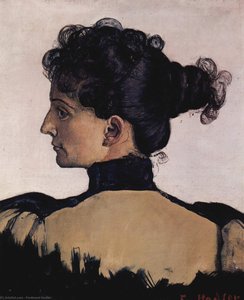
Portret van Ferdinand Hodler

Schilderijen van Ferdinand Hodler: De 100 bekendste, door de ogen van een galerie

Bijgewerkt in november 2026 · gerangschikt op basis van onze populariteitsscore (zoekopdrachten, bezoeken en bestellingen per kunstwerk) · 609 werken van Ferdinand Hodler in onze catalogus

Kortom

In het oog van de galerie is het beroemdste schilderij van Ferdinand Hodler Eiger, Monch and Jungfrau in Moonlight (1908). Woman in Ecstasy (1911) en Eiger, Monch and Jungfrau in Moonlight (1908) maken het trio compleet dat elk oog herkent. Van de 609 werken van Ferdinand Hodler in onze catalogus presenteert de galerie hieronder de 100 bekendste werken, elk een origineel met de jaartal, het museum en wat het uniek maakt.

1853 – 1918, Bern Symbolism, parallelism Meeste werken: Nationale Galerie van Bosnië en Herzegovina

De top 10 schilderijen van Ferdinand Hodler in de galerie

1
Eiger, Monch and Jungfrau in Moonlight (1908) door Ferdinand Hodler

Eiger, Monch and Jungfrau in Moonlight

1908 · Oil On Canvas

In the quietude of 1908, Ferdinand Hodler captured a nocturnal moment in his painting, Eiger, Monch and Jungfrau in Moonlight. The scene is dominated by three majestic mountains, arranged with a distinct sense of scale: the leftmost peak appears smaller, followed by a middle mountain with a slightly larger summit, while the rightmost peak stands as the largest of the trio. Above this rugged landscape, two airplanes traverse the sky—one…

2
Woman in Ecstasy (1911) door Ferdinand Hodler

Woman in Ecstasy

1911 · Oil On Canvas

To encounter Ferdinand Hodler’s Woman in Ecstasy is to step into a realm where the boundaries between the physical form and the ethereal spirit dissolve. Painted in 1911, this monumental canvas serves as a cornerstone of the Art Nouveau movement, capturing far more than a mere moment of movement; it embodies an entire era's yearning for beauty, transcendence, and liberation. The painting depicts a woman caught in the throes of…

3
Eiger, Monch and Jungfrau in Moonlight (1908) door Ferdinand Hodler

Eiger, Monch and Jungfrau in Moonlight

1908 · Oil On Canvas

In this 1908 oil on canvas, the landscape is dominated by three majestic mountain peaks: the Eiger, the Monch, and the Jungfrau. These summits are arranged in a rhythmic, ascending scale, with the leftmost peak appearing smaller, followed by a middle mountain with a slightly larger summit, and the rightmost peak standing as the largest of the trio. The scene is set during a moonlight night, characterized by a palette…

4
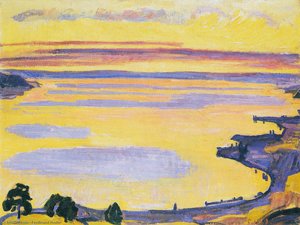
Sunset on Lake Geneva (1915) door Ferdinand Hodler

Sunset on Lake Geneva

1915 · Oil On Canvas · Kunsthaus Zürich, Zürich

The painting depicts a sunset over Lake Geneva. The sky above the water is rendered in shades of yellow, orange, and pink, creating a vibrant atmosphere. In the foreground, mountains are visible, providing depth to the landscape. A boat is positioned on the water, contributing to the serene scene.

5
Study of two figures (1897) door Ferdinand Hodler

Study of two figures

1897 · Acrylic On Paper · Nationale Galerie van Bosnië en Herzegovina, Sarajevo

Ferdinand Hodler’s “Study of Two Figures” is not a grand, dramatic statement; rather, it's an invitation to linger in the quiet intimacy of a shared moment. Painted in 1897, this graphite drawing on paper captures two women seated together, their postures suggesting a profound sense of contemplation and perhaps even melancholy. Hodler, a pivotal figure within Swiss Symbolism, wasn’t interested in literal representation but rather in conveying emotional atmosphere and…

6
Unity (1911) door Ferdinand Hodler

Unity

1911 · Painting

In the monumental mural Unity, created in 1911, Ferdinand Hodler presents a profound meditation on the collective human spirit. This expansive work, stretching across an impressive scale, transcends mere portraiture to become a rhythmic tapestry of existence. The composition is masterfully arranged in rows of figures that seem to pulse with a shared vitality; some individuals press toward the foreground with palpable presence, while others recede into the background, creating…

7
Lake Geneva in Chexbres (1904) door Ferdinand Hodler

Lake Geneva in Chexbres

1904 · Oil On Canvas

To gaze upon Ferdinand Hodler's Lake Geneva in Chexbres is to be invited into a moment suspended between the vastness of nature and the quiet contemplation of the human spirit. This magnificent oil on canvas, dating from 1904, captures more than just a picturesque vista; it encapsulates the very essence of the Swiss landscape filtered through the profound lens of an artistic master. The scene unfolds across a broad expanse…

8
Composition study (1887) door Ferdinand Hodler

Composition study

1887 · Oil On Canvas · Nationale Galerie van Bosnië en Herzegovina, Sarajevo

Ferdinand Hodler's "Composition Study," created in 1887, isn’t merely a sketch of three figures engaged in strenuous activity; it’s a profound meditation on the human condition, rendered with an arresting blend of anatomical precision and evocative symbolism. This work, now housed within the Tretyakov Gallery in Moscow, offers a rare glimpse into the artist's deeply personal vision – a world shaped by loss, contemplation, and a fascination with the ephemeral…

9
Self-portrait with stand (1879) door Ferdinand Hodler

Self-portrait with stand

1879 · Oil On Canvas · Kunst Museum Winterthur | Reinhart am Stadtgarten, Winterthur

To stand before Ferdinand Hodler’s Self-portrait with stand is to encounter a moment suspended between public presentation and private contemplation. This striking work, dating from 1879, captures the artist not merely as a likeness, but as a study in poised masculinity and burgeoning artistic self-awareness. The subject, impeccably dressed in a suit and tie, adopts a formal bearing, suggesting an occasion of importance or perhaps simply the necessary facade required…

10
The Wetterhorn (1912) door Ferdinand Hodler

The Wetterhorn

1912 · Oil On Canvas

To stand before Ferdinand Hodler’s The Wetterhorn is to be enveloped by the sublime majesty of the Swiss Alps, rendered through a lens of profound introspection. Painted in 1912, this oil on canvas masterpiece transcends mere topographical depiction; it is a meditation on permanence against the backdrop of fleeting human experience. The sheer scale of the snow-covered peak dominates the composition, its striking blue hue lending the entire scene an…

Schilderijen van Ferdinand Hodler, gerangschikt van 11 tot 100

11Hilly Landscape with Ravens, in the Bernese Oberland (1910) door Ferdinand HodlerHilly Landscape with Ravens, in the Bernese Oberland1910 12View of Lake Leman from Chexbres (1905) door Ferdinand HodlerView of Lake Leman from Chexbres1905 · Kunstmuseum Basel 13Stockhorn chain (blue sky) door Ferdinand HodlerStockhorn chain (blue sky) 14Woman on her deathbed door Ferdinand HodlerWoman on her deathbed 15Lake Geneva from Chexbres (1904) door Ferdinand HodlerLake Geneva from Chexbres1904 · Musée cantonal des Beaux-Arts 16Portrait of Fraulein Kyburz (1873) door Ferdinand HodlerPortrait of Fraulein Kyburz1873 · Rhode Island School of Design Museum of Art 17Portrait of a Spanish woman door Ferdinand HodlerPortrait of a Spanish woman 18Studies of self-portrait (1911) door Ferdinand HodlerStudies of self-portrait1911 19Portret van Berthe Hodler (1902) door Ferdinand HodlerPortret van Berthe Hodler1902 · Nationale Galerie van Bosnië en Herzegovina 20Landscape of the Swiss Alps (1918) door Ferdinand HodlerLandscape of the Swiss Alps1918 · Het Israël Museum 21The fall in Silvaplana (1907) door Ferdinand HodlerThe fall in Silvaplana1907 · Kunsthaus Zürich 22Thun with symmetric mirroring (1909) door Ferdinand HodlerThun with symmetric mirroring1909 · Musée d'Art et d'Histoire de Genève 23Jeanne Cerani-Charles door Ferdinand HodlerJeanne Cerani-Charles 24Day (Truth) door Ferdinand HodlerDay (Truth)Art Institute of Chicago 25From Le Grand Muveran Villars (1912) door Ferdinand HodlerFrom Le Grand Muveran Villars1912 · Von der Heydt Museum 26The cobbler by the window (1882) door Ferdinand HodlerThe cobbler by the window1882 27Forest Stream at Champery (1916) door Ferdinand HodlerForest Stream at Champery1916 28The shoemaker (1878) door Ferdinand HodlerThe shoemaker1878 29Modern Rütli (1878) door Ferdinand HodlerModern Rütli1878 · Gottfried Keller Foundation 30The Reaper (1878) door Ferdinand HodlerThe Reaper1878 31Gymnasts' Banquet (1877) door Ferdinand HodlerGymnasts' Banquet1877 · Kunsthaus Zürich 32The Miller, his Son and the Donkey (1888) door Ferdinand HodlerThe Miller, his Son and the Donkey1888 · Musée d'Art et d'Histoire de Genève 33The Disillusioned One (1892) door Ferdinand HodlerThe Disillusioned One1892 · Los Angeles County Museum of Art 34Study of the disappointed souls or Weary of life (1891) door Ferdinand HodlerStudy of the disappointed souls or Weary of life1891 35Overall study of the life of weary (1887) door Ferdinand HodlerOverall study of the life of weary1887 36Surprised by the Storm (1887) door Ferdinand HodlerSurprised by the Storm1887 37Night (1890) door Ferdinand HodlerNight1890 38Worship (1893) door Ferdinand HodlerWorship1893 39Childhood (1893) door Ferdinand HodlerChildhood1893 · Städel Museum 40Battle scenes (1896) door Ferdinand HodlerBattle scenes1896 41The Halberdier (1895) door Ferdinand HodlerThe Halberdier1895 · Dallas Museum of Art 42View into Infinity (1903) door Ferdinand HodlerView into Infinity1903 · Hamburger Kunsthalle 43The Adored Youth (1904) door Ferdinand HodlerThe Adored Youth1904 44Character study (1902) door Ferdinand HodlerCharacter study1902 45The Woodcutter (1910) door Ferdinand HodlerThe Woodcutter1910 · Von der Heydt Museum 46Character study (1906) door Ferdinand HodlerCharacter study1906 47Farewell participating female figure (1908) door Ferdinand HodlerFarewell participating female figure1908 48Pulling soldiers (1908) door Ferdinand HodlerPulling soldiers1908 49The working mower (1909) door Ferdinand HodlerThe working mower1909 50Pulling soldiers (1908) door Ferdinand HodlerPulling soldiers1908 51Woman in Ecstasy (1911) door Ferdinand HodlerWoman in Ecstasy1911 52Jeanne Günzburger (1912) door Ferdinand HodlerJeanne Günzburger1912 · Toledo Museum of Art 53Portrait of Emma Schmidt-Müller (1915) door Ferdinand HodlerPortrait of Emma Schmidt-Müller1915 54Josef Müller (1916) door Ferdinand HodlerJosef Müller1916 55Der Frühling (Fassung IV) (1912) door Ferdinand HodlerDer Frühling (Fassung IV)1912 56The Patient (1914) door Ferdinand HodlerThe Patient1914 · Kunstmuseum Basel 57Head of a Soldier (1917) door Ferdinand HodlerHead of a Soldier1917 · Art Institute of Chicago 58Valentine Godé-Darel one day before her death (1915) door Ferdinand HodlerValentine Godé-Darel one day before her death1915 · Kunstmuseum Basel 59Swearing from behind (1912) door Ferdinand HodlerSwearing from behind1912 60Two swearing (1912) door Ferdinand HodlerTwo swearing1912 61Study of self-portrait (1916) door Ferdinand HodlerStudy of self-portrait1916 62Standing draped figure (1913) door Ferdinand HodlerStanding draped figure1913 63Untitled (529) door Ferdinand HodlerUntitled (529) 64Lake Thun Landscape door Ferdinand HodlerLake Thun Landscape 65Female figure with garland (1895) door Ferdinand HodlerFemale figure with garland1895 · Nationale Galerie van Bosnië en Herzegovina 66Self portrait (1916) door Ferdinand HodlerSelf portrait1916 67Prayer in the Saint Pierre Cathedral in Geneva (1882) door Ferdinand HodlerPrayer in the Saint Pierre Cathedral in Geneva1882 · Kunstmuseum Winterthur 68Mother and Child door Ferdinand HodlerMother and Child 69Pulling soldiers (1908) door Ferdinand HodlerPulling soldiers1908 70Walking at the forest edge (1885) door Ferdinand HodlerWalking at the forest edge1885 71Lake Geneva on the evening in Chexbres (1895) door Ferdinand HodlerLake Geneva on the evening in Chexbres1895 72Lake Thun, Symmetric reflection (1905) door Ferdinand HodlerLake Thun, Symmetric reflection1905 73The river Aare in Solothurn (1915) door Ferdinand HodlerThe river Aare in Solothurn1915 74The Orator (1912) door Ferdinand HodlerThe Orator1912 75What are flowers saing (1893) door Ferdinand HodlerWhat are flowers saing1893 76Lake Geneva with Mont Blanc in the morning light (1918) door Ferdinand HodlerLake Geneva with Mont Blanc in the morning light1918 77The Lake Geneva from Chexbres (1898) door Ferdinand HodlerThe Lake Geneva from Chexbres1898 78Spring (1901) door Ferdinand HodlerSpring1901 79Transfiguration (1906) door Ferdinand HodlerTransfiguration1906 80Valentine Godé-Darel on her Deathbed (1915) door Ferdinand HodlerValentine Godé-Darel on her Deathbed1915 81Emotion (study) (1902) door Ferdinand HodlerEmotion (study)1902 82valentine gode darel sun door Ferdinand Hodlervalentine gode darel sun 83The road to Evordes door Ferdinand HodlerThe road to Evordes 84The Black Lutschina (1905) door Ferdinand HodlerThe Black Lutschina1905 85A morning in Interlaken (1875) door Ferdinand HodlerA morning in Interlaken1875 · Kunstmuseum Bern 86Dying cadet (1896) door Ferdinand HodlerDying cadet1896 87Thun, Stockhornkette (1910) door Ferdinand HodlerThun, Stockhornkette1910 88Thunersee with Niesen door Ferdinand HodlerThunersee with Niesen 89The road to a particular interest (1890) door Ferdinand HodlerThe road to a particular interest1890 · Kunst Museum Winterthur | Reinhart am Stadtgarten 90Portrait of Berthe Jacques, wife of the artist (1894) door Ferdinand HodlerPortrait of Berthe Jacques, wife of the artist1894 91Figure study (1901) door Ferdinand HodlerFigure study1901 · Nationale Galerie van Bosnië en Herzegovina 92Sensation (1901) door Ferdinand HodlerSensation1901 93Lake Silvaplana in Autumn (1907) door Ferdinand HodlerLake Silvaplana in Autumn1907 · Kunsthaus Zürich 94Dents du Midi in Clouds (1917) door Ferdinand HodlerDents du Midi in Clouds1917 95Grammont door Ferdinand HodlerGrammont 96Autumn Landscape near Solothurn door Ferdinand HodlerAutumn Landscape near Solothurn 97The reader 1 door Ferdinand HodlerThe reader 1Thyssen-Bornemisza Museum 98untitled (774) door Ferdinand Hodleruntitled (774) 99Prayer in the Cathedral of St. Pierre, Geneva (1882) door Ferdinand HodlerPrayer in the Cathedral of St. Pierre, Geneva1882 100At the foot of the Petit Saleve (1890) door Ferdinand HodlerAt the foot of the Petit Saleve1890

De beroemde schilderijen van Ferdinand Hodler, periode voor periode

De onderwerpen die de aandacht van Ferdinand Hodler troffen

De vier onderwerpen die het meest voorkomen in deze originelen, elk met zijn mooiste voorbeeld.

De musea waar de originele werken van Ferdinand Hodler worden bewaard

De 8 musea met de meeste schilderijen op deze pagina.

Museum Stad Werken van Ferdinand Hodler Schilderijen uit deze lijst
Nationale Galerie van Bosnië en Herzegovina, SarajevoNationale Galerie van Bosnië en Herzegovina Sarajevo 74 Study of two figures, Composition study, Portret van Berthe Hodler
Kunsthaus Zürich, ZürichKunsthaus Zürich Zürich 16 Sunset on Lake Geneva, The fall in Silvaplana, Gymnasts' Banquet
Kunstmuseum Basel, BazelKunstmuseum Basel Bazel 5 View of Lake Leman from Chexbres, The Patient, Valentine Godé-Darel one day before her death
Musée d'Art et d'Histoire de Genève, GenèveMusée d'Art et d'Histoire de Genève Genève 8 Thun with symmetric mirroring, The Miller, his Son and the Donkey
Art Institute of Chicago, ChicagoArt Institute of Chicago Chicago 3 Day (Truth), Head of a Soldier
Von der Heydt Museum, WuppertalVon der Heydt Museum Wuppertal 3 From Le Grand Muveran Villars, The Woodcutter
Kunst Museum Winterthur | Reinhart am Stadtgarten, WinterthurKunst Museum Winterthur | Reinhart am Stadtgarten Winterthur 2 Self-portrait with stand, The road to a particular interest
Städel Museum, FrankfurtStädel Museum Frankfurt 3 Childhood

Ferdinand Hodler, één iconisch schilderij per decennium

Werken per decennium

Kies een decennium om het origineel te zien dat dit tijdperk definieert.

Schilderijen van Ferdinand Hodler: de galerie geeft antwoord

Welk schilderij van Ferdinand Hodler is het beroemdste van allemaal?Onthul het antwoord

Eiger, Monch and Jungfrau in Moonlight (1908). Woman in Ecstasy (1911) en Eiger, Monch and Jungfrau in Moonlight (1908) volgen.

Hoe oud was Ferdinand Hodler bij de voltooiing van Eiger, Monch and Jungfrau in Moonlight?Onthul het antwoord

55 jaar oud: Eiger, Monch and Jungfrau in Moonlight dateert uit 1908, en Ferdinand Hodler werd geboren in 1853.

Wat zijn de top 10 schilderijen van Ferdinand Hodler?Onthul het antwoord

Eiger, Monch and Jungfrau in Moonlight, Woman in Ecstasy, Eiger, Monch and Jungfrau in Moonlight, Sunset on Lake Geneva, Study of two figures, Unity, Lake Geneva in Chexbres, Composition study, Self-portrait with stand en The Wetterhorn. De bovenstaande ranglijst vermeldt het jaar en het museum van elk werk.

Hoeveel werken heeft Ferdinand Hodler gemaakt?Onthul het antwoord

Onze catalogus bevat 609 werken van Ferdinand Hodler, daterend van 1873 tot 1918.

Waar hangen de beroemdste originele werken van Ferdinand Hodler?Onthul het antwoord

Voornamelijk in Nationale Galerie van Bosnië en Herzegovina (Sarajevo), Kunsthaus Zürich (Zürich) en Kunstmuseum Basel (Bazel). De bovenstaande museumtabel bevat een volledig overzicht.

Wanneer creëerde Ferdinand Hodler de beroemdste schilderijen?Onthul het antwoord

In 1910s: 29 van de 100 werken op deze pagina werden toen gemaakt, waaronder Woman in Ecstasy.

Wat zijn de vroegste en laatste beroemde werken van Ferdinand Hodler?Onthul het antwoord

Op deze pagina is het vroegste Portrait of Fraulein Kyburz (1873) en het laatste Landscape of the Swiss Alps (1918).

Welke onderwerpen keerde Ferdinand Hodler het vaakst naar terug?Onthul het antwoord

Landscape (28), Woman (17) en Man (15), verspreid over de 100 werken op deze pagina.

In welk medium werkte Ferdinand Hodler het meest?Onthul het antwoord

Oil On Canvas, voor 60 van de 100 werken op deze pagina.

Bij welke stroming wordt Ferdinand Hodler gerekend?Onthul het antwoord

Symbolism, parallelism en Art nouveau, te oordelen aan de originelen op deze pagina.

Welke originelen van Ferdinand Hodler zijn in de collectie van het Nationale Galerie van Bosnië en Herzegovina?Onthul het antwoord

Study of two figures, Composition study en Portret van Berthe Hodler: het Nationale Galerie van Bosnië en Herzegovina, Sarajevo herbergt 5 van de werken op deze pagina.

Ferdinand Hodler: de kunstenaar

De Architectuur van de Sterfelijkheid

Geboren in Bern, Zwitserland, in 1853, werden de vroege jaren van Ferdinand Hodler gekenmerkt door een stille, aanhoudende rouw. Nog voordat hij de adolescentie bereikte, liet de tuberculose die zijn vader en twee jongere broers uit het leven sloeg een leegte achter in zijn gezin. Deze vroege confrontatie met verlies werd een terugkerend motief in zijn werk, een schaduw die hem zou volgen van de bescheiden beginnende jaren van zijn leerlingtijd tot de hoogten van zijn professionele carrière. Hij begon zijn opleiding als decoratieschilder, waarbij hij zijn stiefvader hielp met commercieel signwerk; een praktische opleiding die hem een nauwkeurige beheersing van lijn en vorm bijbracht. Deze basis in vakmanschap bood de technische strengheid die later de steun zou vormen voor zijn complexere filosofische zoektochten.

Zijn verhuizing naar Genève in 1871 markeerde een breuk met de commerciële eisen van zijn jeugd. In de stad zocht hij een diepere betrokkenheid bij de kunst, door wetenschappelijke lezingen bij te wonen en de werken van meesters in het lokale museum te kopiëren. Het was hier dat hij begon weg te bewegen van het minutieuze realisme van zijn vroege landschappen en portretten. Hij was niet langer tevreden met het louter reproduceren van het decor van de Zwitserse Alpen of de gelijkenis van een model; hij streefde ernaar de onderliggende ritmes van het bestaan te vangen. Deze overgang van het objectieve naar het subjectieve zou hem uiteindelijk leiden tot de ontwikkeling van een geheel eigen visuele taal.

De Logica van het Parallelisme

Hodlers meest significante bijdrage aan de evolutie van de moderne schilderkunst was zijn theorie van het parallelisme. Dit was niet louter een compositietechniek, maar een manier om de wereld te zien als een reeks onderling verbonden, ritmische patronen. Hij observeerde hoe vormen in de natuur—de helling van een berg, de curve van een menselijk ledemaat, of de reflectie in het water—vaak in een gestructureerde, geometrische harmonie op elkaar spiegelden. Door figuren en landschapselementen in deze repetitieve, ritmische cadans te arrangeren, probeerde hij de structurele orde af te beelden waarvan hij geloofde dat deze de natuurlijke wereld regeerde. Deze benadering stelde hem in staat de kloof te overbruggen tussen de fysieke realiteit van een scène en de emotionele staat van de toeschouwer.

Zijn werk bevond zich vaak in het spanningsveld tussen het Symbolisme en een meer gestructureerd, modern gevoel. In werken zoals De Nacht, voltooid in 1890, verkende hij thema's als rust en sterfelijkheid door middel van liggende figuren, een onderwerp dat de heersende smaak van die tijd uitdaagde. Zijn vermogen om klassieke vorm te versmelten met een moderne, bijna structurele intensiteit is duidelijk zichtbaar in Waarheid II (1897). Hij vertrouwde niet op het chaotische penseelwerk van zijn tijdgenoten; in plaats daarvan gebruikte hij een weloverwogen, vaak gedempt palet van oker, bruin en groen om een gevoel van permanentie en gewicht te creëren. Zijn doeken waren geen loutere vensters naar een scène, maar georganiseerde omgevingen waarin de menselijke geest en het landschap door een gedeelde geometrie aan elkaar waren gebonden.

Een Leven in Landschappen

Het Zwitserse landschap bleef een constante aanwezigheid in zijn oeuvre, in het bijzonder de grootsheid van de Alpen. Hij beschouwde deze bergen niet slechts als topografische kenmerken, maar als spirituele entiteiten. Zijn afbeeldingen van de Eiger, Mönch en Jungfrau, of de uitzichten vanaf de Dents du Midi, weerspiegelen een verlangen om de schaal van de bergen te vertalen naar een taal van emotionele resonantie. Hij maakte vaak gebruik van een gelaagd proces, waarbij hij dunne wassingen van kleur aanbracht over dikkere impasto om een specifieke luminositeit te bereiken, vooral in zijn latere studies van het licht over het Meer van Genève. Deze werken getuigen van een meesterschap in atmosfeer, waarbij de nevelige, etherische kwaliteit van het Alpenlicht werd gevangen zonder de structurele integriteit van het terrein op te offeren.

Tegen de tijd van zijn dood in Genève in 1918 had Hodler zich gevestigd als een centrale figuur in de Zwitserse kunstgeschiedenis. Zijn invloed is zichtbaar in de ontwikkeling van het Expressionisme, aangezien zijn nadruk op subjectieve emotie en ritmische vorm een fundament bood voor hen die de traditionele representatie wilden overstijgen. Hij bleef een schilder van diepgaande psychologische gelaagdheid, die de instrumenten van zijn ambacht gebruikte om de fundamentele vragen van leven en dood onder ogen te komen. Zijn nalatenschap ligt in de manier waarop hij de kijker dwong om voorbij de oppervlakte van de wereld te kijken, om de stille, herhalende patronen te vinden die het geheel bij elkaar houden.