


1


Bijgewerkt in oktober 2026 · gerangschikt op basis van onze populariteitsscore (zoekopdrachten, bezoeken en bestellingen per kunstwerk) · 13 werken van Caleb Lewis in onze catalogus
Kortom
Persistent Echo is het schilderij van Caleb Lewis dat de meeste aandacht trekt; het origineel bevindt zich in het ARTXV Museum of Neurodivergent Art, London. Daarna gaat de blik naar Saunders Walk en Persistent Echo B. Van de 13 werken van Caleb Lewis in onze catalogus zijn dit de 13 bekendste, elk een uniek origineel gepresenteerd met het jaar, het museum en de reden waarom het blijft voortbestaan.




Het museum met de meeste schilderijen op deze pagina.
| Museum | Stad | Werken van Caleb Lewis | Schilderijen uit deze lijst |
|---|---|---|---|
 ARTXV Museum of Neurodivergent Art |
London | 13 | Persistent Echo, Saunders Walk, Persistent Echo B |
Persistent Echo, ARTXV Museum of Neurodivergent Art, London. Saunders Walk en Persistent Echo B volgen.
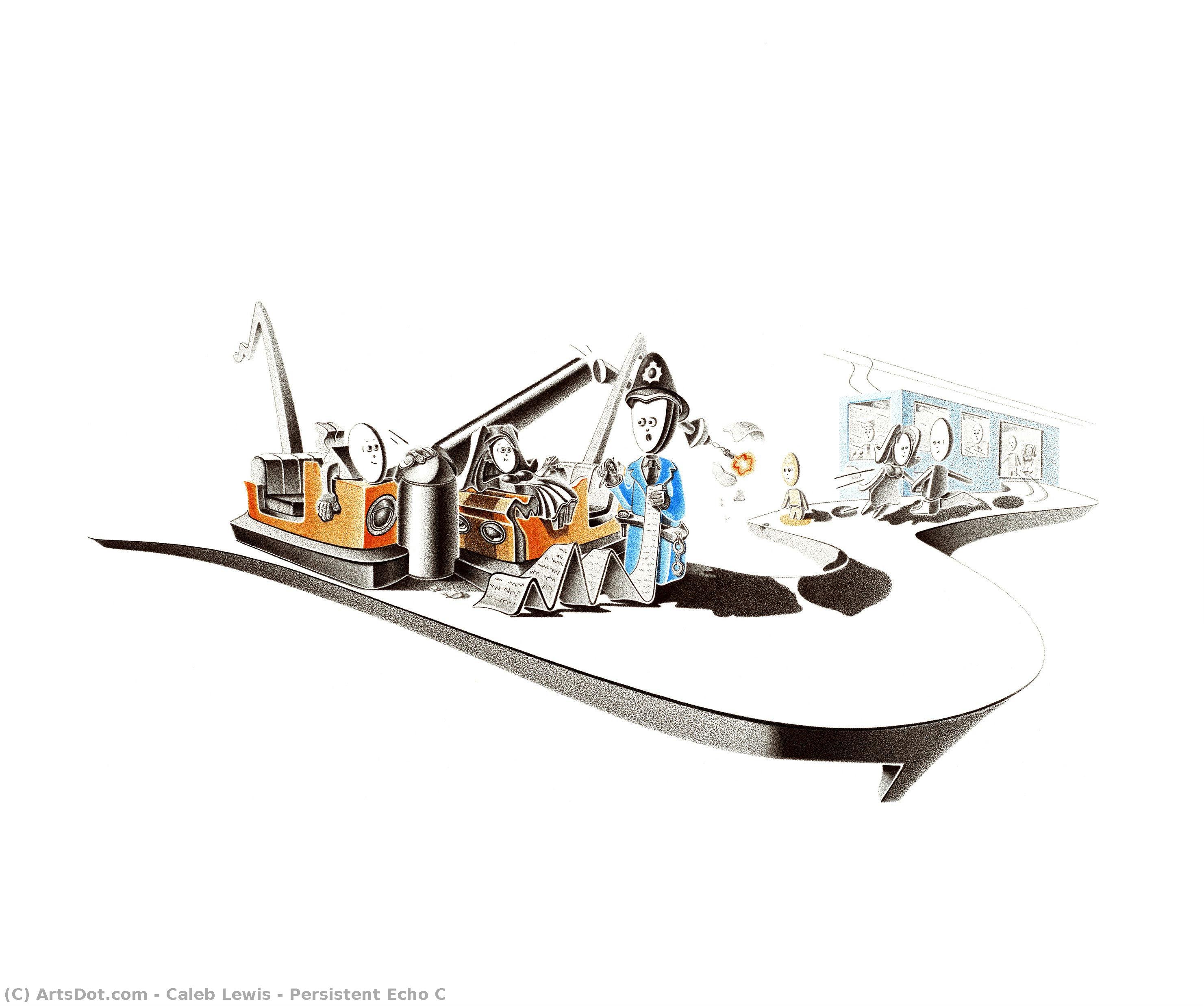
Persistent Echo, Saunders Walk, Persistent Echo B, Ignition, Persistent Echo C, Bridge, Hey! by Caleb Lewis, Persistent Echo A, No Man en Torpor. De bovenstaande ranglijst vermeldt het jaar en het museum van elk werk.
Onze catalogus bevat 13 werken van Caleb Lewis.
Voornamelijk in ARTXV Museum of Neurodivergent Art (London). De bovenstaande museumtabel bevat een volledig overzicht.
Surrealism, te oordelen aan de originelen op deze pagina.
Persistent Echo, Saunders Walk en Persistent Echo B: het ARTXV Museum of Neurodivergent Art, London herbergt 13 van de werken op deze pagina.
Born on 16 April 1978, Caleb Lewis grew up within the orbit of a father whose profession was as demanding as it was physically isolating. A diver by trade, his father spent significant time working on an oil rig near Dubai, a distance that shaped the early landscape of Lewis's life. These formative years were marked by a quiet observation of the world, a trait that would later inform his perspective as a playwright and game designer.
His formal path into the dramatic arts began at the Flinders University Drama Centre. It was here that he refined his understanding of structure and narrative, eventually earning a Bachelor of Creative Arts (Hons) in 2001. During this period of study, he came under the mentorship of a prominent Australian dramatist, an experience that helped ground his burgeoning interest in storytelling within the rigors of professional craft.
This period of training provided the technical foundation for a career defined by an interest in the complexities of human interaction. By the time he completed his studies, Lewis had moved from the structured environment of the classroom toward the experimental possibilities of the stage and digital media, carrying with him the discipline of his early academic and professional guidance.
Lewis’s professional trajectory is defined by a steady presence within the Australian theatrical landscape. His early career saw him established as a former resident with Melbourne's Red Stitch Actors Theatre and Griffin Theatre. It was during this formative period that his writing began to garner significant attention, including being shortlisted for the 2008 Philip Parsons Young Playwrights Award. His work often moves between the traditional boundaries of the stage and more experimental forms of storytelling.
His dramatic output has been marked by several notable achievements in playwriting. The play Dogfall first reached an audience in Adelaide, South Australia, in 2007. His ability to navigate complex narratives earned him the inaugural Richard Burton Award for New Plays for his work Clinchfield. This recognition highlighted a capacity for structural precision and thematic depth that would characterize much of his subsequent output.
Beyond the written word, Lewis has explored the intersection of performance and innovation. In 2013, he received the Ruby Award for Innovation for the multi-platform work If There Was A Colour Darker Than Black I’d Wear It. This project demonstrated an interest in how narrative can exist outside of a standard proscenium arch, utilizing interactive elements to engage his audience in ways that traditional scripts might not allow.
Lewis’s professional reach extends through significant commissions from major theatrical institutions, including the State Theatre Company of South Australia and Riverside in New South Wales. His work has also been shaped by collaborations with Bell Shakespeare and the Black Swan Theatre Company in Western Australia. These engagements reflect a career deeply embedded in the institutional fabric of Australian drama, moving between large-scale productions and specialized creative assignments.
Beyond the formal stage, his practice is defined by a commitment to community engagement and social dialogue. He has facilitated workshops designed to inspire creativity among young people and Indigenous Australian communities. This dedication to using art as a tool for connection is further seen in his long-standing partnership with the Hunter Institute of Mental Health. In regional South Australia, he applied this collaborative approach to a project with former offenders, working alongside them to develop a new work for the stage.
Lewis’s career has been defined by a restless movement between the written word and immersive environments. During a residency with the Griffin Theatre Company, he produced the play Nailed, a work that helped establish his presence in the Australian theatrical landscape. This period of development preceded the 2004 release of Songs for the Deaf, a collection of short plays that explored the nuances of human connection. His literary reach extended to the publication of Cathedral by Currency Press, a work that examined the intersections of faith and loss.
His interests often move beyond the traditional stage to engage with modern anxieties through multimedia. His project Six Million Hits examined the pressures of contemporary life, utilizing a multi-platform approach to reach his audience. This interest in experiential design led to a commission to create an interactive live experience for the World Expo in Dubai, demonstrating an ability to scale his storytelling for global, large-scale environments.
Lewis’s visual language is defined by a meticulous, almost rhythmic precision. He works primarily through stippling, a method where images are rendered exclusively in pen and ink through the application of countless small dots. This process is deeply personal, functioning as a way to dissipate nervous energy and find a sense of equilibrium. The concentration required to place each point allows for a quiet stillness, turning a repetitive motion into a means of managing internal noise. It is a practice of patience, where the act of creation provides a necessary antidote to the turbulence of life.
His aesthetic often shifts between the tactile and the digital. While his stippled works possess a physical, meditative quality, he also employs digital illustration to construct imagery that explores the complexities of the human condition. These works frequently grapple with the weight of memory, the nuances of identity, and the structures of community. By blending these different modes of expression, he creates a visual narrative that addresses fear and anxiety through a lens of psychological depth. The resulting images often possess a certain unsettling beauty, capturing fragments of experience that feel both specific and universal.

