Portret van Stanislas Lépine

Schilderijen van Stanislas Lépine: De 100 bekendste, door de ogen van een galerie

Bijgewerkt in november 2026 · gerangschikt op basis van onze populariteitsscore (zoekopdrachten, bezoeken en bestellingen per kunstwerk) · 123 werken van Stanislas Lépine in onze catalogus

Kortom

Volgens de visie van de galerie is het beroemdste schilderij van Stanislas Lépine Portrait of Stanisław Potocki (1782-1831). (1788), waarvan het origineel in het Nationaal Museum in Warschau in Warschau hangt. Pont de la Tournelle, Paris (1862) en The Tuileries Basin (1877) maken het trio compleet dat elk oog herkent. Van de 123 werken van Stanislas Lépine in onze catalogus presenteert de galerie hieronder de 100 bekendste werken, elk een origineel met de jaartal, het museum en wat het uniek maakt.

1835 – 1892, Caen Impressionism Meeste werken: Musée Carnavalet

De top 10 schilderijen van Stanislas Lépine in de galerie

1
Portrait of Stanisław Potocki (1782-1831). (1788) door Stanislas Lépine

Portrait of Stanisław Potocki (1782-1831).

1788 · Oil On Canvas · Nationaal Museum in Warschau, Warschau

A young child sits at the heart of this scene, draped in ornate, aristocratic attire that speaks of high status and ceremony. This small figure rides a sturdy brown horse, which is positioned atop a large, golden sled. The arrangement feels both dreamlike and deliberate, as if a moment of play has been frozen in a grand, symbolic gesture. Warm earth tones dominate the view, with deep browns, shimmering golds,…

2
Pont de la Tournelle, Paris (1862) door Stanislas Lépine

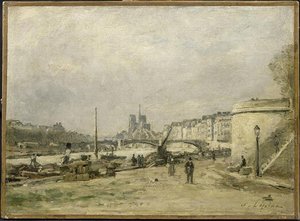
Pont de la Tournelle, Paris

1862 · Oil On Canvas · National Gallery of Art, Washington

The oil on canvas depicts a river scene in Paris, centered on the Pont de la Tournelle. The composition follows a horizontal emphasis, established by the expanse of the river and the line of the bridge. Verticality is provided by the architectural forms of the buildings lining the banks. In the foreground and midground, the water's surface reflects the structures above, creating a series of curved lines and light patterns.…

3
The Tuileries Basin (1877) door Stanislas Lépine

The Tuileries Basin

1877 · Sculpture

The work carries the weight of antiquity, appearing as a quiet observer of classical ideals. The composition relies on the interplay between the solid, heavy presence of the stone and the perceived lightness of the figure's upward gaze. There is a sense of weightlessness in the way the drapery falls, despite the material's inherent density. The neutral, seamless background strips away any sense of environment, forcing a direct encounter with…

4
The Rue de Norvins, Montmartre (1878) door Stanislas Lépine

The Rue de Norvins, Montmartre

1878 · Oil · Kelvingrove Art Gallery and Museum, Glasgow

In this 1878 oil painting, we find ourselves standing at the edge of a sloping street in Montmartre. The Rue de Norvins recedes into a soft, hazy distance, drawing the eye through a deep linear perspective toward a pale horizon. There is a stillness here, a sense of a morning caught in a moment of transition. A woman walks in the foreground, accompanied by a child and a small dog,…

5
Rue Mont-Cenis, Montmartre (1872) door Stanislas Lépine

Rue Mont-Cenis, Montmartre

1872 · Oil On Canvas · National Gallery of Ireland, Dublin

This oil on canvas depicts a narrow, cobblestone street within the Montmartre district of Paris. The composition relies on a strong linear perspective, where the buildings on either side of the road form a receding corridor that directs the eye toward the center of the background. The architecture is rendered in a palette of muted tones, specifically grey, beige, ochre, and soft browns. Above the rooftops, the sky appears as…

6
A Courtyard on the rue de la Fontenelle (1874) door Stanislas Lépine

A Courtyard on the rue de la Fontenelle

1874 · Oil · Norton Simon Museum, Pasadena

The scene is a vertically oriented view of a courtyard, framed by two tall, slender trees on the left and right edges. These trees form a natural archway that directs the eye toward the center of the composition. A solitary woman walks toward the viewer in the foreground, carrying a basket. In the distance, near a dark doorway, smaller and less distinct figures are visible. The ground is a pathway…

7
Country Road (1878) door Stanislas Lépine

Country Road

1878 · Oil On Canvas

In this 1878 oil on canvas, we find ourselves in a serene rural landscape that captures a fleeting instance of rest. Two young men are positioned on a grassy bank, their presence adding a human element to the winding dirt road that leads the eye through a field. A solitary tree rises in the midground, providing a vertical anchor to the composition. The scene is bathed in the soft, diffused…

8
Canal in Saint-Denis, Effect of Moonlight (1876) door Stanislas Lépine

Canal in Saint-Denis, Effect of Moonlight

1876 · Oil On Canvas

The composition centers on a horizontal view of a canal in Saint-Denis under moonlight. The water occupies the foreground and middle ground, acting as a reflective surface for the moon and the surrounding architecture. On the left, a row of buildings lines the canal edge, while trees appear on the right side of the frame. A bridge spans the water in the distance, creating a sense of depth through size…

9
QUAIS DE LA SEINE, PONT MARIE door Stanislas Lépine

QUAIS DE LA SEINE, PONT MARIE

Oil On Canvas

The Seine flows through the center of the frame, a grey ribbon cutting through the heart of Paris. Water moves toward the viewer, carrying the weight of an overcast sky in its ripples. The Pont Marie spans the current, its arches breaking the horizontal rhythm of the riverbanks. Buildings line the quays, their facades rendered in muted tones of beige and brown. A few figures move along the banks, small…

10
Prairies à Tournebouse door Stanislas Lépine

Prairies à Tournebouse

Oil On Canvas

The composition of Prairies à Tournebouse is organized horizontally, emphasizing the breadth of the terrain. In the foreground, tall grasses and wildflowers occupy the lower edge of the frame, rendered with visible, broken brushstrokes that suggest texture and movement. A river curves through the middle ground, its surface reflecting the cool blues of the sky. In the distance, a village is nestled among a cluster of trees, positioned near the…

Schilderijen van Stanislas Lépine, gerangschikt van 11 tot 100

11Caen: Customs (1860) door Stanislas LépineCaen: Customs1860 · Musée des Beaux-Arts de Tours 12Landscape with Farm Buildings (1863) door Stanislas LépineLandscape with Farm Buildings1863 · Scottish National Gallery 13Montmartre (1863) door Stanislas LépineMontmartre1863 · Scottish National Gallery 14The Pont de la Tournelle, Paris (1862) door Stanislas LépineThe Pont de la Tournelle, Paris1862 · National Gallery 15The Seine at Sèvres (1862) door Stanislas LépineThe Seine at Sèvres1862 16Entrance to the Port (1858) door Stanislas LépineEntrance to the Port1858 17Ships in Port (1860) door Stanislas LépineShips in Port1860 18The Saint Pierre Basin (1863) door Stanislas LépineThe Saint Pierre Basin1863 19Bridge in a French City (1870) door Stanislas LépineBridge in a French City1870 20The Seine à Bercy (1868) door Stanislas LépineThe Seine à Bercy1868 · National Gallery of Ireland 21Landscape with a Bridge (1871) door Stanislas LépineLandscape with a Bridge1871 · Hermitage Museum 22Nuns and Schoolgirls in the Tuileries Gardens, Paris (1871) door Stanislas LépineNuns and Schoolgirls in the Tuileries Gardens, Paris1871 · National Gallery 23Moonlit River (1868) door Stanislas LépineMoonlit River1868 24The Seine at la Garenne Saint-Denis (1870) door Stanislas LépineThe Seine at la Garenne Saint-Denis1870 25The Seine at Ile Saint-Denis (1870) door Stanislas LépineThe Seine at Ile Saint-Denis1870 26View of the Seine (1870) door Stanislas LépineView of the Seine1870 27Farmyard in Normandy (1868) door Stanislas LépineFarmyard in Normandy1868 28The Marne at Charenton, A Fisherman (1871) door Stanislas LépineThe Marne at Charenton, A Fisherman1871 29Harbor at Low Tide (1873) door Stanislas LépineHarbor at Low Tide1873 30The Seine at La Garenne Saint-Denis (1875) door Stanislas LépineThe Seine at La Garenne Saint-Denis1875 · Ashmolean Museum 31Yacht sur la Riviere (1874) door Stanislas LépineYacht sur la Riviere1874 · Russell-Cotes Art Gallery - Museum 32View on the Seine, Paris (1872) door Stanislas LépineView on the Seine, Paris1872 · Art Institute of Chicago 33View on the Outskirts of Caen (1872) door Stanislas LépineView on the Outskirts of Caen1872 · National Gallery of Art 34View of Brie-sur-Marne (1873) door Stanislas LépineView of Brie-sur-Marne1873 · Musée d'Orsay 35The Pont Neuf, Paris (1875) door Stanislas LépineThe Pont Neuf, Paris1875 · Norton Simon Museum 36The Canal Saint-Denis by Moonlight (1877) door Stanislas LépineThe Canal Saint-Denis by Moonlight1877 · Wallraf-Richartz-Museum 37Montmartre, the rue Cortot (1874) door Stanislas LépineMontmartre, the rue Cortot1874 38A Plow Horse in a Field (1874) door Stanislas LépineA Plow Horse in a Field1874 · National Gallery of Art 39Street in Montmartre, Snow Effect (1878) door Stanislas LépineStreet in Montmartre, Snow Effect1878 40Country Road (1876) door Stanislas LépineCountry Road1876 41The Pont des Arts, Paris (1875) door Stanislas LépineThe Pont des Arts, Paris1875 42Place de la Concord (1878) door Stanislas LépinePlace de la Concord1878 43The Pont de Bercy as seen from the Quai de La Gare (1875) door Stanislas LépineThe Pont de Bercy as seen from the Quai de La Gare1875 44The Seine at Ile Saint-Denis (1877) door Stanislas LépineThe Seine at Ile Saint-Denis1877 45The Pont National as Seen from Quai d'Ivry, Paris (1873) door Stanislas LépineThe Pont National as Seen from Quai d'Ivry, Paris1873 46Montmartre, the Rue Saint-Vincent (1873) door Stanislas LépineMontmartre, the Rue Saint-Vincent1873 47Paris, the Pont des Arts (1878) door Stanislas LépineParis, the Pont des Arts1878 48The Ourcq Canal, Towpath, Moonlight (1876) door Stanislas LépineThe Ourcq Canal, Towpath, Moonlight1876 49The Banks of the Marne (1880) door Stanislas LépineThe Banks of the Marne1880 · Musée des Beaux-Arts 50The Seine, at Passy (1880) door Stanislas LépineThe Seine, at Passy1880 · Musée Carnavalet 51Pont des Arts, View from Pont Royal (1884) door Stanislas LépinePont des Arts, View from Pont Royal1884 · Musée Carnavalet 52Saint-Michel Bridge (1880) door Stanislas LépineSaint-Michel Bridge1880 · Musée Carnavalet 53L'île de la Cité and l'île Saint-Louis, viewed from the Pont d'Austerlitz (1880) door Stanislas LépineL'île de la Cité and l'île Saint-Louis, viewed from the Pont d'Austerlitz1880 · Musée Carnavalet 54The Artesian Well of Grenelle, (place de Breteuil) (1880) door Stanislas LépineThe Artesian Well of Grenelle, (place de Breteuil)1880 · Musée Carnavalet 55Sunset on a River (1880) door Stanislas LépineSunset on a River1880 · Scottish National Gallery 56A Gateway behind Trees (1881) door Stanislas LépineA Gateway behind Trees1881 · National Gallery 57The Apple Market (1880) door Stanislas LépineThe Apple Market1880 · Art Institute of Chicago 58A Stream in France (1880) door Stanislas LépineA Stream in France1880 · Art Institute of Chicago 59The Courtyard (1880) door Stanislas LépineThe Courtyard1880 · Art Institute of Chicago 60View of the Louvre (1883) door Stanislas LépineView of the Louvre1883 · National Gallery of Art 61Canal Saint-Martin (1885) door Stanislas LépineCanal Saint-Martin1885 62The Estacade Bridge (1880) door Stanislas LépineThe Estacade Bridge1880 · Walters Art Museum 63The Pont de l'Estacade, Paris (1880) door Stanislas LépineThe Pont de l'Estacade, Paris1880 · Norton Simon Museum 64River Scene with Ducks (1879) door Stanislas LépineRiver Scene with Ducks1879 65The Seine at Ivry (1885) door Stanislas LépineThe Seine at Ivry1885 66Vue de la Butte, Montmartre (1892) door Stanislas LépineVue de la Butte, Montmartre1892 · City Art Gallery 67A Quarry at Caen (1892) door Stanislas LépineA Quarry at Caen1892 · Musée des Beaux-Arts de Caen 68Le quai aux fleurs (titre attribué) Le quai aux fleurs et le pont d'Arcole (autre titre) door Stanislas LépineLe quai aux fleurs (titre attribué) Le quai aux fleurs et le pont d'Arcole (autre titre) 69La Seine devant Saint Denis (titre attribué) Vue sur la Seine (ancien titre donné sans raison dans les anciens catalogues) door Stanislas LépineLa Seine devant Saint Denis (titre attribué) Vue sur la Seine (ancien titre donné sans raison dans les anciens catalogues) 70The Banks of the Saine at St. Cloud door Stanislas LépineThe Banks of the Saine at St. Cloud 71Farmyard in Normandy door Stanislas LépineFarmyard in Normandy 72CHALAND A QUAI door Stanislas LépineCHALAND A QUAI 73Chantiers navals à Caen door Stanislas LépineChantiers navals à Caen 74La Seine à Saint Ouen door Stanislas LépineLa Seine à Saint Ouen 75QUAI DE LA SEINE A PARIS door Stanislas LépineQUAI DE LA SEINE A PARIS 76MONTMARTRE, RUE SAINT VINCENT door Stanislas LépineMONTMARTRE, RUE SAINT VINCENT 77LE FILS DE L'ARTISTE door Stanislas LépineLE FILS DE L'ARTISTE 78Péniche sur la Seine door Stanislas LépinePéniche sur la SeinePréfecture de L'isère 79Bateaux sur le fleuve, clair de lune (titre attribué) door Stanislas LépineBateaux sur le fleuve, clair de lune (titre attribué) 80La Seine avec vue du Panthéon door Stanislas LépineLa Seine avec vue du Panthéon 81LE MARCHE AUX POMMES door Stanislas LépineLE MARCHE AUX POMMES 82LE PORT DE CAEN door Stanislas LépineLE PORT DE CAEN 83Les bords de la Seine door Stanislas LépineLes bords de la SeineLeeds Art Gallery 84Treescape door Stanislas LépineTreescapeThe Dick Institute 85The Shepherdess door Stanislas LépineThe ShepherdessAberdeen Art Gallery 86La forêt de Fontainebleau, France door Stanislas LépineLa forêt de Fontainebleau, FranceBowes Museum 87View of Paris door Stanislas LépineView of ParisRhode Island School of Design Museum of Art 88The coast of Normandy door Stanislas LépineThe coast of NormandyFitzwilliam Museum 89The Pont de l'Alma near Paris door Stanislas LépineThe Pont de l'Alma near ParisScottish National Gallery 90View of the Seine door Stanislas LépineView of the SeineMuseum voor Schone Kunsten Gent 91Landscape door Stanislas LépineLandscapeMcManus: Dundee's Art Galleries And Museums 92River Scene door Stanislas LépineRiver SceneTowneley Hall Art Gallery And Museum 93Montmartre door Stanislas LépineMontmartreNational Museum Cardiff 94Landscape with River door Stanislas LépineLandscape with RiverHarvard Art Museums 95Woman by a Stream door Stanislas LépineWoman by a Stream 96The Seine. The Trocadero and the Grenelle Bridge, seen from the javel wharf door Stanislas LépineThe Seine. The Trocadero and the Grenelle Bridge, seen from the javel wharf 97In the Luxembourg Garden door Stanislas LépineIn the Luxembourg Garden 98Les Champs-Elysées door Stanislas LépineLes Champs-Elysées 99FAUBOURG DE PARIS SOUS LA NEIGE door Stanislas LépineFAUBOURG DE PARIS SOUS LA NEIGE 100Les Bords de La Marne. Pêche à l'épervier à la boucle de Saint Maur door Stanislas LépineLes Bords de La Marne. Pêche à l'épervier à la boucle de Saint Maur

De beroemde schilderijen van Stanislas Lépine, periode voor periode

De onderwerpen die de aandacht van Stanislas Lépine troffen

De vier onderwerpen die het meest voorkomen in deze originelen, elk met zijn mooiste voorbeeld.

De musea waar de originele werken van Stanislas Lépine worden bewaard

De 8 musea met de meeste schilderijen op deze pagina.

Museum Stad Werken van Stanislas Lépine Schilderijen uit deze lijst
Musée Carnavalet, ParijsMusée Carnavalet Parijs 6 The Seine, at Passy, Pont des Arts, View from Pont Royal, Saint-Michel Bridge
National Gallery of Art, WashingtonNational Gallery of Art Washington 4 Pont de la Tournelle, Paris, View on the Outskirts of Caen, A Plow Horse in a Field
Scottish National Gallery, EdinburghScottish National Gallery Edinburgh 4 Landscape with Farm Buildings, Montmartre, Sunset on a River
Art Institute of Chicago, ChicagoArt Institute of Chicago Chicago 4 View on the Seine, Paris, The Apple Market, A Stream in France
Norton Simon Museum, PasadenaNorton Simon Museum Pasadena 3 A Courtyard on the rue de la Fontenelle, The Pont Neuf, Paris, The Pont de l'Estacade, Paris
National Gallery, LondenNational Gallery Londen 3 The Pont de la Tournelle, Paris, Nuns and Schoolgirls in the Tuileries Gardens, Paris, A Gateway behind Trees
National Gallery of Ireland, DublinNational Gallery of Ireland Dublin 2 Rue Mont-Cenis, Montmartre, The Seine à Bercy
Nationaal Museum in Warschau, WarschauNationaal Museum in Warschau Warschau 1 Portrait of Stanisław Potocki (1782-1831).

Stanislas Lépine, één iconisch schilderij per decennium

Werken per decennium

Kies een decennium om het origineel te zien dat dit tijdperk definieert.

Schilderijen van Stanislas Lépine: de galerie geeft antwoord

Welk schilderij van Stanislas Lépine is het beroemdste van allemaal?Onthul het antwoord

Portrait of Stanisław Potocki (1782-1831). (1788), Nationaal Museum in Warschau, Warschau. Pont de la Tournelle, Paris (1862) en The Tuileries Basin (1877) volgen.

Wat zijn de top 10 schilderijen van Stanislas Lépine?Onthul het antwoord

Portrait of Stanisław Potocki (1782-1831)., Pont de la Tournelle, Paris, The Tuileries Basin, The Rue de Norvins, Montmartre, Rue Mont-Cenis, Montmartre, A Courtyard on the rue de la Fontenelle, Country Road, Canal in Saint-Denis, Effect of Moonlight, QUAIS DE LA SEINE, PONT MARIE en Prairies à Tournebouse. De bovenstaande ranglijst vermeldt het jaar en het museum van elk werk.

Hoeveel werken heeft Stanislas Lépine gemaakt?Onthul het antwoord

Onze catalogus bevat 123 werken van Stanislas Lépine, daterend van 1858 tot 1892.

Waar hangen de beroemdste originele werken van Stanislas Lépine?Onthul het antwoord

Voornamelijk in Musée Carnavalet (Parijs), National Gallery of Art (Washington) en Scottish National Gallery (Edinburgh). De bovenstaande museumtabel bevat een volledig overzicht.

Wanneer creëerde Stanislas Lépine de beroemdste schilderijen?Onthul het antwoord

In 1870s: 34 van de 100 werken op deze pagina werden toen gemaakt, waaronder The Tuileries Basin.

Wat zijn de vroegste en laatste beroemde werken van Stanislas Lépine?Onthul het antwoord

Op deze pagina is het vroegste Entrance to the Port (1858) en het laatste Vue de la Butte, Montmartre (1892).

Welke onderwerpen keerde Stanislas Lépine het vaakst naar terug?Onthul het antwoord

Sky (47), Water (43) en River (41), verspreid over de 100 werken op deze pagina.

In welk medium werkte Stanislas Lépine het meest?Onthul het antwoord

Oil On Canvas, voor 59 van de 100 werken op deze pagina.

Bij welke stroming wordt Stanislas Lépine gerekend?Onthul het antwoord

Impressionism, te oordelen aan de originelen op deze pagina.

Welke originelen van Stanislas Lépine zijn in de collectie van het Musée Carnavalet?Onthul het antwoord

The Seine, at Passy, Pont des Arts, View from Pont Royal en Saint-Michel Bridge: het Musée Carnavalet, Parijs herbergt 5 van de werken op deze pagina.

Stanislas Lépine: de kunstenaar

A Quiet Observer of the Seine: The Life and Art of Stanislas Lépine

Stanislas Victor Edouard Lépine, geboren in Caen, Frankrijk in 1835, bevindt zich op een fascinerende, vaak understatement plaats binnen het verhaal van de Franse schilderkunst van de 19e eeuw. Hoewel hij niet typisch wordt geclassificeerd als een kernlid van de Impressionisten, diende zijn werk als een cruciale brug tussen de gevestigde tradities van de Barbizon school en de opkomende innovaties die de moderne kunst zouden definiëren. Lépine’s artistieke reis was één van stille toewijding, gekenmerkt door een diepe gevoeligheid voor licht, atmosfeer en de subtiele schoonheid van het Franse platteland en stedelijke landschappen – met name die langs de Seine, welke zijn blijvende muze werd. Zijn vroege aanleg in de kunst leidde hem naar formele opleiding, maar een ontmoeting met Camille Corot in Normandië in 1859 bleek werkelijk baanbrekend. Het volgende jaar trad Lépine formeel toe tot Corot’s atelier, waardoor een mentor-relatie werd ingegaan die zijn artistieke visie en techniek diepgaand vormde. Deze relatie instilled binnen hem een diepe waardering voor plein air painting – werken direct vanuit de natuur – en een toewijding aan het vastleggen van de vluchtige effecten van licht en atmosfeer.

The Painterly Embrace of Light and Atmosphere

Lépine’s schilderijen zijn onmiddellijk herkenbaar door hun rustige stemming, delicate luminositeit en vaak intieme schaal. Hij specialiseerde zich in landschappen, maar zijn onderwerpkeuzes gingen verder dan puur plattelandsgezichten en omvatten de evoluerende stedelijke omgeving van Parijs. Rivierzicht domineerden zijn oeuvre; de Seine, met zijn drukke activiteit, glinsterende reflecties en voortdurend veranderende licht, bood een onuitputtelijke bron van inspiratie. Parijse stadsgezichten en rustigere plattelandsomgevingen vonden ook hun plaats op zijn doeken, allemaal weergegeven met losse, atmosferische penseelstreken die de focus legden op het vastleggen van de *impressie* van een scène in plaats van gedetailleerde reproducties. Hij was niet geïnteresseerd in grote verhalen of dramatische composities; Lépine zocht juist naar een gevoel van sereniteit en realisme, uitnodigend kijkers in momenten van stilte en contemplatie. Zijn palet neigde naar gedempte tonen, bedreven ingezet om de subtiele nuances van licht en schaduw vast te leggen, waardoor een sfeer werd gecreëerd die zowel rustig als diep ontroerend is. Deze toewijding aan het vastleggen van atmosferische effecten plaatst hem in lijn met de Impressionisten, maar zijn benadering bleef toch distinct – meer ingetoomd en minder gericht op de radicale experimentatie met kleur en vorm die kenmerkend was voor veel van zijn tijdgenoten.

A Peripheral Figure in a Revolutionary Movement

In 1874 nam Lépine deel aan de eerste Impressionistische tentoonstelling gehouden in Nadar’s studio, waardoor hij zich tijdelijk aansloot bij een groep kunstenaars die de conventies van de kunstwereld uitdaagden. Echter, zijn artistieke temperament en stijlicheden plaatsten hem uiteindelijk enigszins los van de kernprincipes van het Impressionisme. Hoewel hij plein air painting omarmde en een interesse deelde in het vastleggen van vluchtige momenten, ontbrak zijn werk aan de schreeuwende experimentatie en subjectieve intensiteit die kenmerkend was voor kunstenaars als Monet of Renoir. Hij bleef meer verbonden met traditionele technieken en een meer naturalistische benadering van representatie. Deze onderscheiding leidde erin dat velen hem beschouwden als een voorschool van het Impressionisme – een overgangsfiguur die de weg vrijmaakte voor de opkomst van de beweging, in plaats van een actieve deelnemer binnen deze. Ondanks zijn aanwezigheid op die eerste tentoonstelling, signaleerde dit een bereidheid om met nieuwe ideeën in te gaan en gevestigde normen uit te dagen. Hij diende als een vitale schakel tussen de Barbizon school’s nadruk op directe waarneming en de Impressionisten’ streven naar het vastleggen van subjectieve ervaring.

Influences and Artistic Development

Lépine's artistic development was profoundly shaped by his relationship with Camille Corot, who instilled in him a deep appreciation for the subtleties of light and atmosphere, as well as the importance of working directly from nature. He also drew inspiration from Johan Barthold Jongkind, particularly his depictions of maritime scenes, which influenced Lépine’s own focus on river views and coastal landscapes. His early works often featured dark, somber tones, reflecting a more traditional approach to landscape painting. However, as he matured, his palette became lighter and brighter, and his brushwork looser and more expressive. He was particularly adept at capturing the fleeting effects of light, creating paintings that seemed to shimmer with an inner radiance. Lépine’s artistic style can be characterized as a synthesis of these influences – a quiet, contemplative approach rooted in tradition but infused with a sense of modern sensibility.

Recognition and Legacy

Doorheen zijn carrière exposeerde Lépine regelmatig op de Salon en andere prestigieuze venues, waardoor hij geleidelijk aan kritieke waardering verdiende voor zijn gevoelige weergaven van het Franse platteland en stedelijke leven. Zijn werk resonerde met publiek dat waarde vond in zijn rustige schoonheid en ingetutte elegantie. Een significante moment van erkenning kwam in 1889, toen hij een gouden medaille ontving op de Exposition Universelle voor zijn schilderij *Pont de l'Estacade*. Deze prestigieuze prijs bevestigde zijn positie binnen de kunstgemeenschap en bracht meer aandacht aan zijn werk. Vandaag de dag worden Lépine’s schilderijen bewaard in talrijke openbare en particuliere collecties wereldwijd, een getuigenis van hun blijvende aantrekkingskracht en historische betekenis. Hoewel hij vaak overschaduwd wordt door meer beroemde tijdgenoten, wordt hij steeds meer erkend als een meester van atmosferisch landschapsschilderen – een kunstenaar die de essentie van 19e-eeuws Frankrijk vastlegde met buitengewone gevoeligheid en vaardigheid. Zijn serene en contemplatieve scènes bieden een waardevolle blik op een vervlogen tijdperk, herinnerend aan de schoonheid die te vinden is in de alledaagse momenten van het leven. Hij overleed plotseling in Parijs op 28 september 1892, waardoor een erfenis van stille observatie en artistieke verfijning achterbleef.