The Industrial Sublime: The Artistic Vision of Robert Soden
Born in the historic town of Taunton, Somerset, in 1955, Robert Soden has emerged as a profound voice in British contemporary art, weaving together the rugged textures of industrial heritage with the delicate sensibilities of Romanticism. His artistic journey is one defined by a deep, meditative engagement with the spaces where human industry meets the natural world. Soden does not merely document structures; he captures the very soul of architectural transformation, exploring how memory and time etch themselves upon the steel and stone of our changing landscapes.
Soden’s formal mastery was forged in the prestigious halls of the Royal College of Art in London, where he studied from 1979 to 1982. It was during this formative period that he refined his command over watercolor and gouache, developing a technique characterized by meticulous observation and an ability to convey emotional resonance through subtle tonal shifts. His training instilled in him a humanist approach to visual representation, a philosophy that allows him to find beauty in the often-overlooked corners of the industrial North, treating a conveyor belt or a steel gantry with the same reverence one might accord a mountain range.
A Legacy Written in Steel and Sky
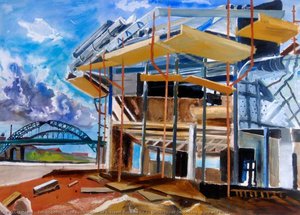
The heart of Soden’s oeuvre lies in his evocative documentation of the evolving landscapes of Sunderland and the wider North East of England. Perhaps his most significant achievement is the monumental 1992 work, Monkwearmouth Gantry. In this piece, Soden captures the imposing skeletal beauty of the industrial structure against a brooding, atmospheric sky. The painting serves as more than a mere record of engineering; it is a poignant meditation on the vulnerability of human progress and the inevitable cycle of decay and renewal. This work, held in the esteemed collection of the Victoria and Albert Museum, exemplifies his ability to distill complex industrial narratives into striking, singular visual compositions.
His fascination with the intersection of man-made structures and natural elements extends through a variety of notable subjects, including:
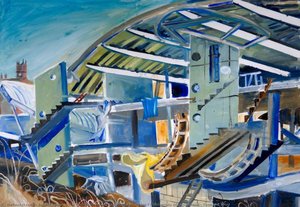
- St Peter's Campus, University of Sunderland: Where he explores the architectural dialogue within academic spaces.
- The Construction of Prospect Building No.2: A study in the raw, unfolding energy of urban development.
- Industrial Landscapes: Capturing the dark, cloudy atmospheres that define the heritage of the coal and shipping industries.
Influences and the Romantic Tradition
To understand Soden’s aesthetic is to recognize his deep roots in the 19th-century tradition of Romantic landscape painting. He draws significant inspiration from masters such as Hubert Robert and David Roberts, artists who were renowned for their ability to evoke the "sublime"—that overwhelming sense of awe and terror found in ruins and dramatic vistas. Soden adopts this classical lens to view the modern industrial era, finding a contemporary version of the sublime within the rusted iron and heavy machinery of the British landscape.
His work continues to resonate within prestigious institutions worldwide, ensuring his place in the lineage of artists who bridge the gap between historical reverence and contemporary observation. His paintings are held in several significant collections, including:
- The Science Museum, London
- Laing Art Gallery, Newcastle
- Sunderland Museum and Winter Garden
- National Coal Mining Museum, Wakefield
- London Transport Museum
Through his dedication to capturing the interplay of light, shadow, and structure, Robert Soden has created a visual archive that honors the industrial past while inviting us to contemplate our environmental future. His art remains a testament to the enduring power of the gaze to find grace within the grit of human endeavor.