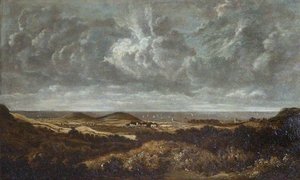
Portret van Robert Ladbrooke

De 17 bekendste schilderijen van Robert Ladbrooke, een selectie uit de galerie

Bijgewerkt in november 2026 · gerangschikt op basis van onze populariteitsscore (zoekopdrachten, bezoeken en bestellingen per kunstwerk) · 17 werken van Robert Ladbrooke in onze catalogus

Kortom

Van alle originele werken die Robert Ladbrooke heeft nagelaten, is The Mackerel Market on Yarmouth Beach, Norfolk (1810) de bekendste. Direct daarna volgen Landscape (1820) en Landscape with a Church (1840). Onze catalogus bevat 17 werken van Robert Ladbrooke; de galerie heeft de 17 meest bewonderde werken ter wereld bewaard, elk voorzien van de datum, het museum en het verhaal erachter.

1768 – 1842, Norwich Meeste werken: National Trust

De top 10 schilderijen van Robert Ladbrooke: de selectie van de galerie

De selectie van Robert Ladbrooke gaat verder, van 11 tot 17

De musea waar de originele werken van Robert Ladbrooke worden bewaard

De 7 musea met de meeste schilderijen op deze pagina.

Museum Stad Werken van Robert Ladbrooke Schilderijen uit deze lijst
National Trust, NorwichNational Trust Norwich 2 Beeston Regis from the 'Roman Camp', Man and Dog on a Path in a Wooded Landscape
The Stirling Smith Art Gallery - Museum, StirlingThe Stirling Smith Art Gallery - Museum Stirling 1 Landscape with a Church
Smithsonian American Art Museum, Washington, D.C.Smithsonian American Art Museum Washington, D.C. 1 Barnyard Scene
Norfolk Museums, NorwichNorfolk Museums Norwich 1 Yarmouth Harbour, Moonlight
Yale Center for British Art, New HavenYale Center for British Art New Haven 1 Wooded Landscape with Woman and Child Walking Down a Road
Towneley Hall Art Gallery - Museum, BurnleyTowneley Hall Art Gallery - Museum Burnley 1 The Old Farmstead
Wolverhampton Art Gallery, WolverhamptonWolverhampton Art Gallery Wolverhampton 1 An Oak Glade

Robert Ladbrooke decennium voor decennium: het origineel dat elk tijdperk definieert

Werken per decennium

Kies een decennium om het origineel te zien dat dit tijdperk definieert.

Vragen van verzamelaars over de schilderijen van Robert Ladbrooke

Waar is Robert Ladbrooke het meest bekend om?Onthul het antwoord

The Mackerel Market on Yarmouth Beach, Norfolk (1810). Landscape (1820) en Landscape with a Church (1840) volgen.

Hoe oud was Robert Ladbrooke toen The Mackerel Market on Yarmouth Beach, Norfolk werd gemaakt?Onthul het antwoord

42 jaar oud: The Mackerel Market on Yarmouth Beach, Norfolk dateert uit 1810, en Robert Ladbrooke werd geboren in 1768.

Wat zijn de tien beroemdste schilderijen van Robert Ladbrooke?Onthul het antwoord

The Mackerel Market on Yarmouth Beach, Norfolk, Landscape, Landscape with a Church, Landscape with Trees, Cattle, and Stream, Barnyard Scene, Wood Scene, Yarmouth Beach, Norfolk, Yarmouth Harbour, Moonlight, Wooded Landscape with Woman and Child Walking Down a Road en A View of Norwich Castle and Cathedral, Norfolk. De bovenstaande ranglijst vermeldt het jaar en het museum van elk werk.

Hoeveel schilderijen heeft Robert Ladbrooke nagelaten?Onthul het antwoord

Onze catalogus bevat 17 werken van Robert Ladbrooke, daterend van 1800 tot 1840.

In welke musea hangen de meesterwerken van Robert Ladbrooke?Onthul het antwoord

Voornamelijk in National Trust (Norwich), The Stirling Smith Art Gallery - Museum (Stirling) en Smithsonian American Art Museum (Washington, D.C.). De bovenstaande museumtabel bevat een volledig overzicht.

In welke jaren schilderde Robert Ladbrooke de beroemdste werken?Onthul het antwoord

In 1810s: 4 van de 17 werken op deze pagina werden toen gemaakt, waaronder The Mackerel Market on Yarmouth Beach, Norfolk.

Wat zijn de eerste en de laatste beroemde originelen van Robert Ladbrooke?Onthul het antwoord

Op deze pagina is het vroegste Landscape with Trees, Cattle, and Stream (1800) en het laatste Landscape with a Church (1840).

Welke werken van Robert Ladbrooke hangen in het National Trust?Onthul het antwoord

Beeston Regis from the 'Roman Camp' en Man and Dog on a Path in a Wooded Landscape: het National Trust, Norwich herbergt 2 van de werken op deze pagina.

Robert Ladbrooke: leven en werk

A Norfolk Visionary: The Life and Art of Robert Ladbrooke

Robert Ladbrooke, born in Norwich in 1768, stands as a pivotal figure in the development of British landscape painting, inextricably linked to the rise of the celebrated Norwich School. His story is one of humble beginnings blossoming into artistic leadership, a testament to dedication and a deep connection to his native Norfolk countryside. Apprenticed at a young age to an artist and printer named White, Ladbrooke’s early years instilled in him both technical skill and a practical understanding of image-making – foundations that would prove invaluable throughout his career. It was during this formative period that a crucial encounter occurred with John Crome, a fellow aspiring artist who shared Ladbrooke's passion and similar social standing. This meeting sparked not only a lifelong friendship but also an artistic partnership that would reshape the landscape of British art. The two young men lived together, dedicating their spare hours to sketching, copying masterworks, and nurturing their burgeoning talents. Their bond was further cemented when they married sisters, solidifying a personal and creative alliance that defined much of their artistic journeys.

Forging a New Path: The Norwich School and Artistic Development

The early 19th century witnessed a growing desire amongst artists to move beyond the dominance of London’s art institutions and cultivate regional identities. This spirit culminated in 1803 with the co-founding of the Norwich Society of Artists by Ladbrooke and Crome, an event that marked the true genesis of the Norwich School – England's first recognized art movement outside the capital. The school championed a direct engagement with nature, particularly the unique character of the Norfolk landscape. This wasn’t merely topographical representation; it was about capturing the essence of place, the subtle nuances of light and atmosphere, and the beauty inherent in everyday rural life. Initially, Ladbrooke practiced portraiture, but he soon gravitated towards landscapes, demonstrating a remarkable ability to portray atmospheric effects and evoke the mood of his subjects. His dedication earned him recognition, with regular exhibitions at both the Royal Academy and the British Institution. Though a brief secession from the Norwich Society in 1816, alongside Joseph Stannard and others, proved ultimately unsuccessful, it underscored a desire for artistic independence and a willingness to challenge established norms.

A Legacy in Landscape: Key Works and Artistic Style

Ladbrooke’s *oeuvre* is characterized by its unwavering focus on the rural areas of Norfolk – its churches, waterways, and expansive skies. While his reputation remained largely localized during his lifetime, his works are now recognized as significant contributions to British landscape art. Notable examples include his skillful aquatints, such as “A View of the Fellmongers on the River near Bishop’s Bridge” and “A View of Norwich Castle,” which showcase his mastery of light and atmosphere. However, it was his monumental project, “Views of the Churches of Norfolk,” that truly cemented his legacy. This ambitious undertaking, comprising over 650 lithographic plates published posthumously in five volumes (1843), stands as an invaluable visual record of Norfolk’s architectural heritage. Ladbrooke's style is defined by meticulous observation, a muted palette reflecting the distinctive quality of Norfolk light, and a profound sensitivity to mood and atmosphere. He drew inspiration from Dutch landscape painting traditions, evident in his careful attention to detail and atmospheric perspective.

A Family of Artists and Enduring Significance

Robert Ladbrooke’s influence extended far beyond his own artistic achievements, shaping the careers of his sons – Henry Ladbrooke and John Berney Ladbrooke – both accomplished artists who continued the Norwich School tradition. Henry gained acclaim for his evocative moonlight scenes, while John Berney excelled in depicting woodland landscapes. This familial continuation underscores the strength of the artistic environment fostered by Robert Ladbrooke. His role as a founder of the Norwich School holds immense historical significance. The school not only nurtured a sense of artistic community but also challenged the centralized authority of London-based art institutions, paving the way for regional artistic movements. Furthermore, “Views of the Churches of Norfolk” remains an invaluable historical document, offering insights into 19th-century architecture and rural life in East Anglia. Ladbrooke’s legacy is preserved through his works held in museums and private collections worldwide, ensuring that his contribution to British art continues to be appreciated by generations to come. He enjoyed a comfortable retirement thanks to the success of his teaching and artistic endeavors, passing away at his home on Scoles' Green, Norwich, on October 11, 1842 – marking the end of an era for the Norwich School, yet ensuring its enduring spirit lived on through his sons and the continued appreciation of his evocative landscapes.