Portret van Robert Brough

De 33 bekendste schilderijen van Robert Brough, een selectie uit de galerie

Bijgewerkt in november 2026 · gerangschikt op basis van onze populariteitsscore (zoekopdrachten, bezoeken en bestellingen per kunstwerk) · 44 werken van Robert Brough in onze catalogus

Kortom

Van alle originele werken die Robert Brough heeft nagelaten, is The Artist at Seventeen Years of Age (1889) de bekendste. Direct daarna volgen Monsignor Charles Tochetti (1897) en Sir James Murray (1850–1933) (1903). Onze catalogus bevat 44 werken van Robert Brough; de galerie heeft de 33 meest bewonderde werken ter wereld bewaard, elk voorzien van de datum, het museum en het verhaal erachter.

1872 – 1905, Invergordon Meeste werken: Edinburgh College of Art

De top 10 schilderijen van Robert Brough: de selectie van de galerie

1
The Artist at Seventeen Years of Age (1889) door Robert Brough

The Artist at Seventeen Years of Age

1889 · Oil On Canvas

In this 1889 oil on canvas, we find a young Robert Brough looking back at himself. It is a close-up, bust-length portrait that captures the artist at seventeen, a period of profound transition. The grayscale tones and muted palette lend the work a certain melancholy, as if we are witnessing a private thought caught in mid-air. There is a stillness here, a sense of a soul contemplating its own direction…

2
Monsignor Charles Tochetti (1897) door Robert Brough

Monsignor Charles Tochetti

1897 · Oil On Canvas

In this 1897 portrait, we find ourselves in a quiet, intimate encounter with Monsignor Charles Tochetti. The subject is presented in a close-up, three-quarter view, his presence filling the frame with a sense of settled dignity. There is a profound stillness here, a moment captured where the light catches the deep lines of a life lived with purpose. The background remains dark and indistinct, a deliberate choice that pushes the…

3
Sir James Murray (1850–1933) (1903) door Robert Brough

Sir James Murray (1850–1933)

1903 · Oil On Canvas

The portrait of Sir James Murray, executed in 1903, presents a formal study of the subject in a monochromatic palette. He is positioned slightly to the left of the center, facing forward with a direct gaze directed toward the viewer. The figure is dressed in a dark suit, which provides a solid, structured silhouette against the background. A doorway is visible behind him on the right, creating a receding plane…

4
Mrs Nicol of Roscobie (1905) door Robert Brough

Mrs Nicol of Roscobie

1905 · Oil On Canvas

A seated woman occupies the center of this 1897 oil on canvas, her gaze directed toward the viewer from a position of relaxed formality. She sits within an indistinct interior, the background rendered in soft, blended brushstrokes that lack sharp definition. The composition is anchored by the subject's upper body, while elements of her immediate surroundings provide subtle narrative cues:

5
John Hay (1871) door Robert Brough

John Hay

1871 · Oil On Canvas

In this intimate portrait titled John Hay, the artist Robert Brough turns his attention to the quiet dignity of an older man. The subject is presented with a heavy, prominent beard and mustache that frame a face marked by experience. It is a study of character, captured around about 1871. The sitter's presence is immediate, commanding the space with a sense of introspection and a certain weight of years.

6
Untitled (1892) door Robert Brough

Untitled

1892 · Oil

In this work, the artist explores the intersection of the physical and the psychological. The man's posture and the presence of the wooden tool suggest a narrative that remains just out of reach, leaving the observer to wonder about the purpose of his stance and the nature of his solitude. The composition avoids the clutter of a domestic setting, focusing entirely on the relationship between the body, the object, and…

7
Dolce pomum (1892) door Robert Brough

Dolce pomum

1892 · Oil

Painted in 1892, this work reflects the shifting artistic sensibilities of the late Victorian period. It moves away from the strict, formal portraiture of the past toward a more emotive and atmospheric approach. There is a subtle tension here between the structured dignity of traditional portraiture and the looser, more spontaneous brushwork influenced by contemporary movements. The painting does not merely document a likeness; it seeks to capture a mood,…

8
Mary Dallas Ross (c.1881–1936) (1892) door Robert Brough

Mary Dallas Ross (c.1881–1936)

1892 · Oil On Canvas

The portrait of Mary Dallas Ross (c.1881–1936) emerges from the canvas as a quiet encounter with a life caught in a moment of stillness. Painted by Robert Brough in 1892, this work captures the subject with a sense of poise that feels immediate, as if the viewer has just stepped into the room. The oil on canvas presents a study of character, where the artist's hand translates the presence of…

9
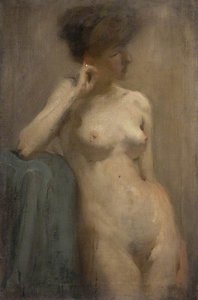
Female Nude with Brass Urn (1892) door Robert Brough

Female Nude with Brass Urn

1892 · Oil On Canvas · Edinburgh College of Art, Edinburgh

The gaze meets Female Nude with Brass Urn, a work that captures a singular, quiet moment in time. Painted by Robert Brough, this piece emerges from the canvas as an intimate study of form and light. The artist, Robert Brough, brings a sense of presence to the subject, freezing a fleeting instant of poise and determination within the frame. It is an oil on canvas that holds the viewer in…

10
View of Elgin, Moray (1894) door Robert Brough

View of Elgin, Moray

1894 · Oil

The painting presents a landscape centered on a river flowing through a terrain of green grass and scattered trees. Several boats rest upon the water's surface, their forms positioned at different intervals along the river. Near the water's edge, a single figure stands, oriented toward the river. The sky occupies the upper portion of the canvas, filled with a layer of clouds that creates a sense of depth. Along the…

De selectie van Robert Brough gaat verder, van 11 tot 33

De beroemde schilderijen van Robert Brough, periode voor periode

De onderwerpen die de aandacht van Robert Brough troffen

De vier onderwerpen die het meest voorkomen in deze originelen, elk met zijn mooiste voorbeeld.

De musea waar de originele werken van Robert Brough worden bewaard

De 7 musea met de meeste schilderijen op deze pagina.

Museum Stad Werken van Robert Brough Schilderijen uit deze lijst
Edinburgh College of Art, EdinburghEdinburgh College of Art Edinburgh 2 Female Nude with Brass Urn, Nude Study Female
University of Aberdeen, AmsterdamUniversity of Aberdeen Amsterdam 1 John Thomson
Scottish National Gallery, EdinburghScottish National Gallery Edinburgh 1 William Dallas Ross (d.1931)
West Lothian Council, LivingstonWest Lothian Council Livingston 1 John Adrian Louis (1860–1908), 7th Earl of Hopetoun and 1st Marquis of Linlithgow
Mintlaw Discovery Centre, PeterheadMintlaw Discovery Centre Peterhead 1 Reverend Dr James Stewart (1830–1917), Minister of Peterhead (1864–1917) (unfinished)
Dundee Art Gallery And Museum, DundeeDundee Art Gallery And Museum Dundee 1 Mary Dallas Ross
The Fleming Collection, LondenThe Fleming Collection Londen 1 Fieldworkers

Robert Brough decennium voor decennium: het origineel dat elk tijdperk definieert

Werken per decennium

Kies een decennium om het origineel te zien dat dit tijdperk definieert.

Vragen van verzamelaars over de schilderijen van Robert Brough

Waar is Robert Brough het meest bekend om?Onthul het antwoord

The Artist at Seventeen Years of Age (1889). Monsignor Charles Tochetti (1897) en Sir James Murray (1850–1933) (1903) volgen.

Hoe oud was Robert Brough toen The Artist at Seventeen Years of Age werd gemaakt?Onthul het antwoord

17 jaar oud: The Artist at Seventeen Years of Age dateert uit 1889, en Robert Brough werd geboren in 1872.

Wat zijn de tien beroemdste schilderijen van Robert Brough?Onthul het antwoord

The Artist at Seventeen Years of Age, Monsignor Charles Tochetti, Sir James Murray (1850–1933), Mrs Nicol of Roscobie, John Hay, Untitled, Dolce pomum, Mary Dallas Ross (c.1881–1936), Female Nude with Brass Urn en View of Elgin, Moray. De bovenstaande ranglijst vermeldt het jaar en het museum van elk werk.

Hoeveel schilderijen heeft Robert Brough nagelaten?Onthul het antwoord

Onze catalogus bevat 44 werken van Robert Brough, daterend van 1889 tot 1905.

In welke musea hangen de meesterwerken van Robert Brough?Onthul het antwoord

Voornamelijk in Edinburgh College of Art (Edinburgh), University of Aberdeen (Amsterdam) en Scottish National Gallery (Edinburgh). De bovenstaande museumtabel bevat een volledig overzicht.

In welke jaren schilderde Robert Brough de beroemdste werken?Onthul het antwoord

In 1890s: 17 van de 33 werken op deze pagina werden toen gemaakt, waaronder Monsignor Charles Tochetti.

Wat zijn de eerste en de laatste beroemde originelen van Robert Brough?Onthul het antwoord

Op deze pagina is het vroegste The Artist at Seventeen Years of Age (1889) en het laatste Mrs Nicol of Roscobie (1905).

Welke onderwerpen koos Robert Brough het vaakst?Onthul het antwoord

Man (14), Woman (14) en Chair (11), verspreid over de 33 werken op deze pagina.

Welke techniek gebruikte Robert Brough het meest?Onthul het antwoord

Oil On Canvas, voor 21 van de 33 werken op deze pagina.

Welke werken van Robert Brough hangen in het Edinburgh College of Art?Onthul het antwoord

Female Nude with Brass Urn en Nude Study Female: het Edinburgh College of Art, Edinburgh herbergt 2 van de werken op deze pagina.

Robert Brough: leven en werk

The Luminous Legacy of Robert Brough

In the annals of Scottish art history, few names evoke such a poignant sense of fleeting brilliance as Robert Brough. A painter whose life was tragically brief, spanning only from 1872 to 1905, Brough managed to capture the very essence of Victorian Aberdeen with a sensitivity that transcended the rigid academicism of his era. Born near Invergordon in the rugged beauty of Ross and Cromarty, he carried within him a vision that sought to bridge the gap between the venerable traditions of his homeland and the burgeoning modernism sweeping through Europe. His work remains a testament to a soul caught between the structured dignity of the past and the vibrant, emotive possibilities of the future.

Brough’s artistic journey was deeply rooted in the soil of Scottish tradition, yet it was never confined by it. His formal training at the Glasgow School of Art provided him with a formidable technical foundation, most notably through his studies under the influence of the legendary portraitist Henry Raeburn. From this encounter, Brough inherited a profound respect for the psychological depth of his subjects and a mastery of capturing authentic human emotion. However, where his predecessors might have sought a static perfection, Brough pursued something far more elusive: the atmospheric mood. He looked toward the Parisian avant-garde, absorbing the light-drenched lessons of Impressionism and the dreamlike enigmas of Symbolism, weaving these international influences into the fabric of his Scottish sensibilities.

A Symphony of Color and Emotion

As Brough established himself within the artistic circles of Aberdeen, his style underwent a remarkable evolution, moving away from mere representation toward a more expressive, visceral language. He became a master of color, utilizing a palette that could shift from somber, muted tones to sudden, breathtaking bursts of luminosity. His canvases were not merely depictions of people or scenes; they were vessels for feeling. In his portraits, one finds an intimate connection with the sitter, achieved through delicate brushstrokes and a sophisticated use of light that seems to pulse with life.

This mastery is perhaps most evident in his celebrated works, where the boundaries between reality and imagination begin to blur:

  • Dolly Crombie (1896): A stunning oil on canvas that exemplifies his ability to create intimacy. Through a careful arrangement of flowers and soft light, Brough captures a moment of quiet reflection, drawing the viewer into a private, serene world.
  • Fantaisie en Folie (1897): A piece that showcases his imaginative depth, where symbolism and composition invite the observer to ponder the deeper, perhaps more whimsical, meanings hidden within the domestic scene.
  • John Hay (1871): A poignant study of age and character, demonstrating his skill in using expressive realism to convey the dignity of the human experience.

Historical Significance and Enduring Spirit

Though his career was cut short by his untimely death at the age of thirty-two, Robert Brough left behind an oeuvre that continues to resonate with a singular, haunting beauty. He was an artist who refused to be stagnant, constantly experimenting with the interplay of light and shadow to express the inner complexities of his subjects. His ability to blend the formal requirements of portraiture with the emotive freedom of modern movement allowed him to document Victorian society not just as it appeared, but as it felt.

Today, Brough is remembered not merely as a regional painter, but as a visionary Scot who dared to infuse traditional subjects with a modern, luminous spirit. His works, held in prestigious collections such as Tate Britain, serve as vital links to a transformative period in art history. To look upon a Brough painting is to witness the struggle and the triumph of an artist striving to capture the ephemeral—the fleeting light, the passing emotion, and the enduring soul of a changing world.