A Life Forged in Beauty: The World of René Lalique
René Jules Lalique, a name synonymous with the ethereal beauty of Art Nouveau and the sleek elegance of Art Deco, was more than just a jeweller or glass designer—he was an innovator, a poet of materials, and a true artist who redefined luxury for his time. Born in Aÿ, France, on April 6th, 1860, Lalique’s journey began amidst the rolling hills of Champagne, a landscape that would forever imprint itself upon his artistic sensibility. Early summers spent with his maternal grandparents instilled within him a deep reverence for nature, a theme that would become utterly central to his creations. This idyllic upbringing was disrupted by a move to the Parisian suburbs, yet the memory of Aÿ remained potent, fueling his later naturalistic glasswork and imbuing it with an organic grace. The untimely death of his father propelled young René into apprenticeship with goldsmith Louis Aucoc, setting him on a path that would ultimately revolutionize both jewellery and glass artistry. He further honed his skills at the École des Arts Décoratifs in Paris and even ventured to London for studies at the Crystal Palace School of Art, absorbing diverse influences that shaped his unique aesthetic vision.From Jewellery to Glass: A Revolutionary Aesthetic
Lalique’s early career blossomed as a freelance designer for prominent French jewelry houses like Cartier and Boucheron during the 1880s. However, it was in 1890, with the opening of his own boutique in Paris' Opéra district, that Lalique truly began to forge his distinctive style. He swiftly became known for rejecting the prevailing opulent aesthetic, favoring instead a more organic and imaginative approach. He wasn’t interested merely in showcasing precious stones; he sought to elevate materials often considered secondary – horn, ivory, enamel, and crucially, glass – to equal status with diamonds and rubies. This was revolutionary. His jewelry became miniature sculptures, teeming with life: dragonflies with iridescent wings crafted from plique-à-jour enamel, orchids rendered in delicate gold filigree, peacocks displaying their plumage in vibrant gemstones. These weren’t simply adornments; they were wearable works of art, imbued with a sense of movement and naturalism rarely seen before. His designs resonated deeply with the spirit of Art Nouveau, embracing flowing lines, organic forms, and a celebration of the feminine form. He quickly garnered a devoted clientele, including celebrated actress Sarah Bernhardt, who commissioned numerous pieces that reflected her own dramatic persona. The use of materials like horn, ivory, enamel, and glass was not merely decorative; it was integral to his artistic vision, reflecting a desire to capture the essence of nature in miniature.The Allure of Glass: A New Artistic Horizon
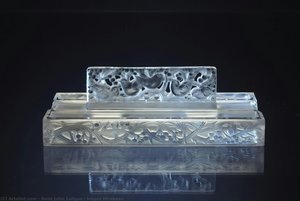
While Lalique’s jewelry established his reputation, it was his exploration of glass that cemented his legacy. His collaboration with perfumer François Coty in 1907 proved pivotal. Coty commissioned Lalique to design bottles for his perfumes, recognizing the potential to elevate fragrance presentation beyond simple functionality. This partnership marked a turning point, leading Lalique to dedicate himself increasingly to glassmaking. He acquired the Verrerie d'Alsace in 1921, allowing him to experiment with mass production techniques while maintaining artistic control. This wasn’t about creating cheap imitations; it was about making beauty accessible. The Art Deco era saw Lalique’s glasswork reach new heights of sophistication. He moved away from the flowing curves of Art Nouveau towards more geometric forms and streamlined designs, reflecting the modern spirit of the age. Vases, bowls, chandeliers, and even automobile hood ornaments—each piece bore the hallmark of his exquisite craftsmanship and innovative techniques like cire perdue (lost-wax casting) and frosted glass finishes. His work became synonymous with luxury and elegance, adorning the homes of discerning collectors worldwide, including Calouste Sarkis Gulbenkian, who amassed an impressive collection of over 140 Lalique pieces. The Verrerie d'Alsace was a crucial step in his career, allowing him to scale production while retaining artistic control and experimenting with new techniques.Influences and Techniques
Lalique’s work was profoundly influenced by several sources. His early exposure to nature during his childhood in Aÿ shaped his appreciation for organic forms and natural motifs. The Japanese aesthetic, particularly its emphasis on asymmetry and delicate craftsmanship, also played a significant role. Furthermore, Lalique drew inspiration from the Art Nouveau movement's fascination with flowing lines, floral patterns, and female figures. His technical mastery was equally remarkable. He pioneered techniques such as *plique-à-jour*, which allowed light to pass through colored glass, creating ethereal stained-glass effects; *cire perdue* (lost-wax casting), a method for producing intricate three-dimensional forms; and various enameling techniques that added vibrant colors and textures to his creations. He was a true innovator, constantly pushing the boundaries of what was possible with these materials. His ability to seamlessly blend artistic vision with technical expertise set him apart as one of the most influential artists of his time.A Lasting Legacy
René Lalique’s influence extends far beyond his own creations. He not only transformed the fields of jewelry and glass but also inspired generations of artists and designers. His daughter, Suzanne Lalique, continued the family artistic tradition as a painter and set designer for the Comédie-Française. His granddaughter, Marie Claude-Lalique, carried on the legacy of glassmaking until her death in 2003. The Maison Lalique continues to thrive today, upholding the standards of quality and artistry established by its founder. René Lalique passed away in Paris on May 1st or 5th, 1945, and was laid to rest in Père Lachaise Cemetery, a fitting final resting place for an artist whose work embodies both beauty and enduring spirit. His creations can be found in prestigious museums around the world, including the Musée d'Orsay, serving as a testament to his profound impact on art history. René Lalique wasn’t simply creating objects; he was crafting dreams, capturing the ephemeral beauty of nature, and leaving an indelible mark on the aesthetic landscape of the 20th century. His work remains a powerful reminder that true artistry lies in the ability to transform ordinary materials into extraordinary expressions of human creativity.Vraag en antwoord
Waar zijn de kunstwerken van René Lalique gegroepeerd per kunststroming te vinden?
De stromingen waarin René Lalique werkte, zijn te vinden op de Alle stromingen-pagina van de kunstenaar, waar de kunstwerken per stroming zijn gegroepeerd.
Kan ik de werken van René Lalique verkennen op basis van trefwoorden?
Om werken van René Lalique met een specifiek thema te vinden, kunt u de Op trefwoorden pagina van de kunstenaar gebruiken, waarop de kunstwerken per trefwoord zijn gegroepeerd.
Onder welke pseudoniemen of andere namen is René Lalique bekend?
René Lalique staat ook bekend onder de namen René Jules Lalique.