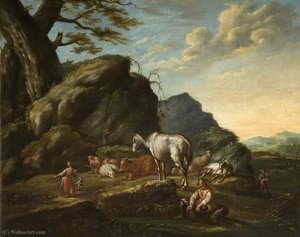
Goats and Flock of Sheep
Goats and Flock of Sheep is an oil painting by Philipp Peter Roos. The artist, who was also known by the moniker Rosa di Tivoli, produced this work about 1681. He was a German Baroque painter born in Sankt Goar, Germany.
Kortom
Van alle originele werken die Philipp Peter Roos heeft nagelaten, is Goats and Flock of Sheep (1681) het bekendst, in de collectie van het Bayerische Staatsgemäldesammlungen, München. Direct daarna volgen Piece of Livestock (1681) en Landscape with Cattle and Shepherd (1681). Onze catalogus bevat 93 werken van Philipp Peter Roos; de galerie heeft de 92 meest bewonderde werken ter wereld bewaard, elk voorzien van de datum, het museum en het verhaal erachter.
Goats and Flock of Sheep is an oil painting by Philipp Peter Roos. The artist, who was also known by the moniker Rosa di Tivoli, produced this work about 1681. He was a German Baroque painter born in Sankt Goar, Germany.
Piece of Livestock is an oil painting by Philipp Peter Roos, executed in 1681. The work originates from the Baroque period, a time when the artist was establishing his presence within the Italianate landscape tradition.
Landscape with Cattle and Shepherd is a work by the German Baroque painter Philipp Peter Roos. Created about 1681, the painting reflects the artist's specialized focus on pastoral scenes and animal subjects. Roos was a significant figure in the development of Italianate landscapes, often characterized by his intimate study of livestock and the natural environment.
In Piece of Livestock, Philipp Peter Roos organizes a pastoral scene through a close-up, ground-level perspective that establishes an immediate intimacy with the subjects. The composition is dominated by a large, seated cow positioned slightly to the right of the center. To the left, a smaller lamb or calf provides a sense of scale, while a woman interacts with a dog in the space behind the primary subject. This arrangement…
Resting Flock with Shepherds is an oil painting by the German Baroque artist Philipp Peter Roos. Created about 1681, this work captures a quiet moment within a rugged landscape. The composition focuses on a group of livestock and a shepherd, rendered with a sense of immediate presence that draws the viewer into the scene.
Resting Flock with Shepherds is an oil painting by Philipp Peter Roos. The canvas captures a heavy stillness among livestock and their guardian. This work was created about 1681. It presents a scene of animals and men gathered in a quiet, layered space under a turbulent sky.
In this Baroque-style oil painting, the mythological drama of the Liberation of Io unfolds with a sudden, heavy intensity. Created by Philipp Peter Roos about 1681, the scene captures a moment of profound tension between the divine and the mortal. A massive, powerful bull dominates the foreground, its muscular form rendered with a weight that feels almost tangible. This central figure looms over the landscape, its presence commanding the space…
This oil on canvas painting, dated 1681, presents a monochromatic scene rendered in various shades of gray. In the foreground, a young woman is positioned amidst a group of livestock, including sheep or goats. The composition is a medium shot, placing the human subject and the animals in the immediate front and middle ground. The terrain is undulating, forming rolling hills that recede into a background of hazy mountains and…
Returning Flock with Shepherds is an oil painting by Philipp Peter Roos. Created about 1681, the work captures a quiet moment of pastoral movement. The artist, a German Baroque painter, was born in Sankt Goar. He would later become known by the moniker Rosa di Tivoli.
The scene unfolds in Shepherd with Cow, Sheep and Goats in Italian Mountain Landscape, a work that captures a quiet moment of pastoral life. This painting, created about 1680, brings together a shepherd and his diverse herd amidst a rugged, mountainous setting. The figures and animals exist within a landscape that feels both immediate and deeply rooted in the natural world.
De vier onderwerpen die het meest voorkomen in deze originelen, elk met zijn mooiste voorbeeld.
De 8 musea met de meeste schilderijen op deze pagina.
| Museum | Stad | Werken van Philipp Peter Roos | Schilderijen uit deze lijst |
|---|---|---|---|
| München | 15 | Goats and Flock of Sheep, Piece of Livestock, Landscape with Cattle and Shepherd | |
| Kopenhagen | 5 | Cattle Piece, Landscape with a Bull, Sheep and Goats, A Shepherd with his Herd | |
| Buenos Aires | 4 | Landscape with shepherd and animals, Landscape with figures and animals, Shepherd and animals in a landscape | |
| Bratislava | 3 | Goat Herd with a Goatherd, Shepherd's Idyl in a Romantic Landscape with Ruins, Herd by an Ancient Well | |
| Praag | 3 | Ravine with a Stream, a Shepherd and His Herd, Horse and Goats Grazing, Shepherd with a Herd of Sheep and Goats | |
| Wenen | 3 | Herd with Sleeping Shepherds, Rider Meeting, Landscape with Flock of Sheep | |
| Sint-Petersburg | 3 | Landscape with a Grotto, Landscape with a Waterfall, Landscape with a Herd | |
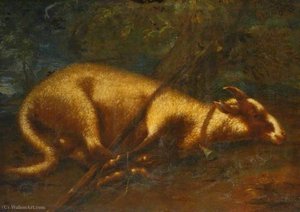
| Stockholm | 3 | Dead Hare, Landskap med hjord, A Goat Resting |
Kies een decennium om het origineel te zien dat dit tijdperk definieert.
This large-scale oil painting, dated 1669, presents a crowded, maximalist composition of diverse animal species. The arrangement is packed, with various animals overlapping to create a sense of density and movement. The color palette relies on deep, earthy tones, including rich browns, blacks, and dark ochres. These dark shades are interrupted by specific highlights of white and cream, alongside splashes of red from a rooster and parrots. The lighting follows…
Goats and Flock of Sheep is an oil painting by Philipp Peter Roos. The artist, who was also known by the moniker Rosa di Tivoli, produced this work about 1681. He was a German Baroque painter born in Sankt Goar, Germany.
A heavy, dark-colored cow anchors the center of this scene, its presence felt in the weight of its silhouette. To the left, two goats rest upon the ground, one a pale contrast of white and light tan against the shadows. A man sits nearby, leaning back in a moment of stillness, his gaze directed toward the animals or perhaps the viewer. The air in the enclosure feels thick and dim,…
In this work, titled Shepherd's Idyl in a Romantic Landscape with Ruins, the artist Philipp Peter Roos presents a quiet moment of rural existence. Created about 1700, the painting captures a shepherd tending to his flock amidst a landscape of rolling hills and weathered stone structures. There is a sense of stillness in the way the figures and animals occupy the space, suggesting a life governed by the rhythms of…
Goats and Flock of Sheep (1681), Bayerische Staatsgemäldesammlungen, München. Piece of Livestock (1681) en Landscape with Cattle and Shepherd (1681) volgen.
24 jaar oud: Goats and Flock of Sheep dateert uit 1681, en Philipp Peter Roos werd geboren in 1657.
Goats and Flock of Sheep, Piece of Livestock, Landscape with Cattle and Shepherd, Piece of Livestock, Resting Flock with Shepherds, Resting Flock with Shepherds, Liberation of Io, Piece of Cattle, Returning Flock with Shepherds en Shepherd with Cow, Sheep and Goats in Italian Mountain Landscape. De bovenstaande ranglijst vermeldt het jaar en het museum van elk werk.
Onze catalogus bevat 93 werken van Philipp Peter Roos, daterend van 1669 tot 1700.
Voornamelijk in Bayerische Staatsgemäldesammlungen (München), Statens Museum for Kunst (Kopenhagen) en National Museum of Fine Arts (Buenos Aires). De bovenstaande museumtabel bevat een volledig overzicht.
In 1680s: 21 van de 92 werken op deze pagina werden toen gemaakt, waaronder Goats and Flock of Sheep.
Op deze pagina is het vroegste Various animals gathered before Noah's Ark (1669) en het laatste Shepherd's Idyl in a Romantic Landscape with Ruins (1700).
Landscape (33), Animals (29) en Goats (19), verspreid over de 92 werken op deze pagina.
Oil On Canvas, voor 18 van de 92 werken op deze pagina.
Baroque, te oordelen aan de originelen op deze pagina.
Goats and Flock of Sheep, Piece of Livestock en Landscape with Cattle and Shepherd: het Bayerische Staatsgemäldesammlungen, München herbergt 15 van de werken op deze pagina.
In het gouden licht van de Italiaanse Barok roepen weinig namen de pastorale sereniteit van het platteland op zoals Philipp Peter Roos. Bekend in de geschiedenis onder zijn evocatieve bijnaam, Rosa di Tivoli, transformeerde deze in Duitsland geboren meester het landschapgenre door een diepe, bijna instinctieve verbondenheid met de natuurlijke wereld. Geboren in 1655 in de Rijnstreek—specifiek nabij Sankt Goar—was Roos vanaf zijn vroegste jaren voorbestemd voor het penseel. Hij was de zoon van Johann Heinrich Roos, een gerespecteerd landschapsschilder die de fundamentele lessen in tonale harmonie en compositorisch evenwicht bood die later de volwassen stijl van de kunstenaar zouden definiëren. Dit vroege meesterschap ging niet enkel over techniek; het was een onderdompeling in een manier van kijken naar de wereld door de lens van licht, schaduw en de stille waardigheid van de aarde.
De koers van Roos' leven veranderde drastisch in 1677, een moment dat werd ingegeven door de vrijgevigheid van Karel I, landgraaf van Hessen-Kassel. De landgraaf herkende het ontluikende talent van de jonge schilder en bood de financiële middelen om Roos op een transformerende reis naar Rome te laten vertrekken. Deze migratie van de Germaanse tradities naar het hart van de Italiaanse Barok stelde Roos in staat de levendige energie van de Romeinse kunst te absorberen. Het was hier dat hij mentorschap zocht bij de gevierde Giacinto Brandi, wiens invloed hielp bij het verfijnen van Roos' vermogen om klassieke structuur te versmelten met een meer spontane, atmosferische esthetiek. Deze periode in Rome was ook diep persoonlijk; het was in deze jaren dat Roos verliefd werd op Isabella Brandi, de dochter van zijn mentor. Hun verbintenis zou hem uiteindelijk naar Tivoli leiden, een verhuizing die zijn identiteit voor altijd zou verbinden met het landschap waar hij zo van hield.
Wat het oeuvre van Rosa di Tivoli werkelijk onderscheidt, is de ongeëvenaarde authenticiteit van zijn dierlijke onderwerpen. In tegenstelling tot veel van zijn tijdgenoten, die dieren slechts als decoratieve toevoegingen in een landschap gebruikten, behandelde Roos elk wezen—van de massieve stier tot de wendbare geit—met de eerbied van een portrettist. Zijn verblijfplaats in Tivoli was beroemd om een concept dat deed denken aan een levend atelier; hij onderhield een uitgestilde collectie van exotische en gedomesticeerde dieren, waardoor zijn omgeving effectief veranderde in een voortdurende studie van beweging, anatomie en temperament. Deze intieme nabijheid stelde hem in staat om de subtiele trilling van een oor of de spierkracht van een dier in spanning vast te leggen, wat zijn doeken een adembenemende vitaliteit gaf.
Zijn technische beheersing is evident in de manier waarop hij de complexiteit van de Barokke esthetiek navigeerde. Hoewel zijn composities vaak putten uit de serene, atmosferische kwaliteiten van de Gouden Eeuw, zijn ze doordrenkt met de dramatische intensiteit die kenmerkend is voor de Italiaanse school. Zijn werken kenmerken zich veelvuldig door:
Het historische belang van Philipp Peter Roos ligt in zijn vermogen om de kloof te overbruggen tussen de gestructureerde landschapstradities van Noord-Europa en het emotionele, door licht doordrongen drama van Italië. Hij kwam op een tijdperk dat de wetenschappelijke nieuwsgierigheid van die tijd de behoefte begon te maken aan nauwkeurigere observaties van de natuurlijke wereld, terwijl religieuze en mythologische thema's nog steeds het artistieke bewustzijn domineerden. In zijn schilderijen vindt men zowel het minutieuze detail van een naturalist als de poëtische ziel van een romanticus. Door de flora en fauna van het Romeinse platteland met zulke toewijding te documenteren, creëerde hij een visueel verslag dat evenzeer over de geest van de tijd gaat als over de onderwerpen zelf.
Hoewel hij in 1706 overleed en een nalatenschap achterliet die in de bodem van Tivoli zelf gegraveerd staat, bleef zijn invloed voortbestaan. Hij blijft een sleutelfiguur voor iedereen die de evolutie van de dierportretkunst en de ontwikkeling van het Italiaanse landschap bestudeert. Door zijn ogen zien we niet louter een verzameling vee; we zijn getuige van een diepgaande viering van het leven in zijn meest fundamentele, onverbloemde vormen. Zijn werk blijft resoneren als een testament tot de kracht van observatie en de blijvende schoonheid van het pastorale ideaal.