Een leven gewijd aan het Analytisch Realisme
Pavel Nikolajevitsj Filonov, geboren in Moskou in 1883, blijft een diep fascinerende en vaak raadselachtige figuur binnen het landschap van de Russische avant-garde. Zijn leven was niet louter een chroniek van artistieke creatie, maar een filosofische zoektoetst—een onvermoeibare drang om de essentie van de werkelijkheid te ontleden en te onthullen via zijn unieke methode van het Analytisch Realisme. In tegenstelling tot veel tijdgenoten die innovatie zochten in abstractie of geometrische vereenvoudiging, graafde Filonov dieper; hij geloofde dat elk object een "innerlijk leven" bezat, een verborgen ziel die wachtte om door middel van minutieuze analyse aan het licht te worden gebracht. Het ging hem niet simpelweg om *hoe* dingen eruitzagen, maar om *hoe* ze op hun meest fundamentele niveau bestonden—een concept dat zijn gehele artistieke traject zou definiëren. Zijn vroege jaren werden getekend door ontbering en verlies; als wees werd hij op jonge leeftijd naar de opkomende kunstscene van Sint-Petersburg getrokken, een stad die zowel zijn muze als zijn beproevingsveld zou worden. Hoewel hij aanvankelijk een formele opleiding volgde, vond hij de gevestigde normen van het Russisch realisme al snel verstikkend, terwijl hij verlangde naar een benadering die verder ging dan de loutere oppervlakte van de verschijning.De genesis van het Analytisch Realisme
Filonovs artistieke reis was diep verweven met de intellectuele stromingen van zijn tijd. De rigoureuze logica van Bertrand Russell, de epistemologische vragen van G.E. Moore en de taalfilosofie van Ludwig Wittgenstein vonden allemaal een diepe weerklank in zijn ontwikkelende principes. Hij experimenteerde uitgebreid en absorbeerde diverse invloeden, maar smeedde uiteindelijk zijn eigen pad, wat culmineerde in de formulering van het Analciteisch Realisme. Dit was geen plotselinge openbaring, maar een geleidelijke destillatie van ideeën; een moeizaam proces van het verfijnen van zijn visie totdat deze kristalliseerde in een coherente artistieke filosofie. Hij zette zich af tegen wat hij beschouwde als de oppervlakkigheid van het kubisme; hoewel hij de poging tot het afbreken van vormen erkende, vond hij dat het tekortschoot in het werkelijk vangen van de inherente energie en dynamiek van een object. Hij stelde dat elk wezen—bezield of onbezield—bestond uit fundamentele elementen: lijnen, oppervlakken, kleuren en vormen. Door deze componenten te analyseren, kon men het "innerlijke leven" of de "ziel" van het onderwerp onthullen. Dit omvatte een proces van deconstructie en reconstructie, waarbij objecten werden afgebroken tot hun bestanddelen en weer werden samengevoegd op een manier die hun onderliggende structuur en essentie overbracht. Zijn doeken werden levendige ecosystemen van gefragmenteerde vormen, krachtige lijnen en intense kleuren—een visuele representatie van dit analytische proces. Het ging niet om het afbeelden van de werkelijkheid zoals zij verscheen, maar zoals zij in de kern *was*.Kernwerken en artistieke stijl
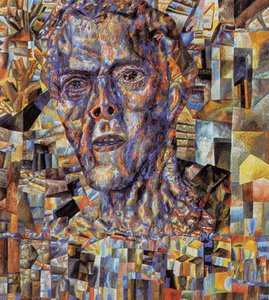
Filonovs artistieke oeuvre is, hoewel relatief klein qua aantal, opmerkelijk divers en consequent meeslepend. Vroege werken zoals St. Catherine (1910) tonen zijn ontluikende beheersing van kleur en compositie, terwijl ze al hinten naar de abstracte lens waarmee hij religieuze thema's spoedig zou bekijken. Man met een kruis (1913) verkent verder spirituele symboliek, verweven met zijn analytische benadering van vorm. Latere werken, zoals Gezichten (1940), zijn exemplarisch voor zijn volwassen stijl—abstracte composities die lijken op maskers of gefragmenteerde gelaatstrekken, uitgevoerd met een expressieve penseelvoering die beweging en emotionele diepgang overbrengt. Moeder (1916) springt eruit als een krachtig expressionistisch werk, doordrenkt van intimiteit en onrust, vol met levendige kleuren en symbolische lagen. Misschien wel een van zijn meest baanbrekende prestaties is Twee hoofden (1925), een meesterwerk van het Analytisch Realisme, gekenmerende door geometrische abstractie en complexe symboliek. Een bepalend kenmerk van Filonovs stijl is de dichte gelaagdheid van vormen—een techniek die hij gebruikte om diepte, complexiteit en een gevoel van pulserende energie in zijn composities te creëren. Hij bouwde zijn doeken op met meerdere lagen verf, waarbij hij minutieus complexe patronen creëerde die leken te vibreren van leven. Dit nauwgezette proces was niet louter technisch; het was essentieel om de verborgen energieën te onthullen die hij in alle dingen zag bestaan.Erfenis en blijvende invloed
Ondanks perioden van vergetelheid en onderdrukking tijdens het stalinistische tijdperk—een tijd waarin avant-gardistische kunst vaak met argwaan werd bekeken—worden de bijdragen van Pavel Filonov aan de kunstgeschiedenis tegenwoordig breed erkend. Hij wordt terecht beschouwd als een sleutelfiguur in de Russische avant-garde, een pionier die durfde uit te dagen wat de conventionele opvattingen over representatie waren. Zijn unieke artistieke visie en filosofische benadering blijven kunstenaars tot op de dag van vandaag inspireren en prikkelen om de grenzen tussen perceptie en realiteit te verkennen. Zijn werk is tentoongesteld in prestigieuze instellingen zoals de Trejakoev Galerij, wat ervoor zorgt dat zijn nalatenschap voortleeft als een getuigenis van de kracht van analytisch denken en het potentieel voor innovatieve artistieke expressie. Filonovs kunst is niet slechts iets om naar te kijken; het is een uitnodiging om de wereld opnieuw te zien—om voorbij de oppervlakte te kijken en af te dalen in de verborgen diepten van het bestaan.- Stroming: Analytisch Realisme
- Geboren: Moskou, Rusland (1883)
- Overleden: 1941
Vraag & Antwoord
Hoeveel kunstwerken van Pavel Filonov zijn beschikbaar om te bekijken?
U kunt 91 kunstwerken werken van Pavel Filonov bekijken op de Alle kunstwerken-pagina.
In welke stad en welk land is Pavel Filonov geboren?
Pavel Filonov werd geboren in Moskou, in Rusland.
Waar zijn de kunstwerken van Pavel Filonov gegroepeerd per techniek te vinden?
De werken van Pavel Filonov kunnen per medium worden bekeken op de Alle media pagina van de kunstenaar.