Portret van Narashige Koide

Schilderijen van Narashige Koide: De 7 bekendste, door de ogen van een galerie

Bijgewerkt in november 2026 · gerangschikt op basis van onze populariteitsscore (zoekopdrachten, bezoeken en bestellingen per kunstwerk) · 7 werken van Narashige Koide in onze catalogus

Kortom

Volgens de visie van de galerie is het beroemdste schilderij van Narashige Koide Vegetables on the Table (1927), waarvan het origineel in het Kitakyushu Municipal Museum of Art in Kitakyushu hangt. Self-Portrait with a Hat (1924) en Portrait of Mrs. N (1918) maken het trio compleet dat elk oog herkent. Van de 7 werken van Narashige Koide in onze catalogus presenteert de galerie hieronder de 7 bekendste werken, elk een origineel met de jaartal, het museum en wat het uniek maakt.

1887 – 1931, Osaka Meeste werken: Artizon Museum

De top 10 schilderijen van Narashige Koide in de galerie

1
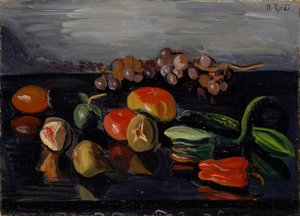
Vegetables on the Table (1927) door Narashige Koide

Vegetables on the Table

1927 · Oil · Kitakyushu Municipal Museum of Art, Kitakyushu

The table holds a collection of life, stripped to its essential shapes. Oranges and apples rest in the shadows, their skins catching a soft, directional light that defines their weight. Bananas stretch across the surface, their elongated curves cutting through the stillness. In the center, a vase of flowers acts as the composition's heart, anchoring the arrangement. Everything sits against a deep, atmospheric blue background, a void that pushes the…

2
Self-Portrait with a Hat (1924) door Narashige Koide

Self-Portrait with a Hat

1924 · Oil On Canvas · Artizon Museum, Tokio

To stand before Narashige Koide’s Self-Portrait with a Hat is to encounter not merely an image, but a profound turning point in the trajectory of modern Japanese art. Painted in 1924, this monumental work captures the artist at a critical juncture—a man shedding old habits and embracing a Westernized modernity while simultaneously grappling with the seismic shock of personal and societal upheaval. The very air around the figure seems charged…

3
Portrait of Mrs. N (1918) door Narashige Koide

Portrait of Mrs. N

1918 · Oil On Canvas · Aichi Prefectural Museum of Art, Nagoya

The oil on canvas titled Portrait of Mrs. N, known in Japanese as N婦人像, was created by Narashige Koide in 1918. The artist’s hand left a quiet mark in the upper left corner, where the inscription reads: N.Koide march 1918, oil. This specific marking anchors the work to a precise moment in the early twentieth century.

De onderwerpen die de aandacht van Narashige Koide troffen

De vier onderwerpen die het meest voorkomen in deze originelen, elk met zijn mooiste voorbeeld.

De musea waar de originele werken van Narashige Koide worden bewaard

De 4 musea met de meeste schilderijen op deze pagina.

Museum Stad Werken van Narashige Koide Schilderijen uit deze lijst
Artizon Museum, TokioArtizon Museum Tokio 2 Self-Portrait with a Hat, Reclining Nude
Aichi Prefectural Museum of Art, NagoyaAichi Prefectural Museum of Art Nagoya 2 Portrait of Mrs. N, Still Life with Vegetables
Kitakyushu Municipal Museum of Art, KitakyushuKitakyushu Municipal Museum of Art Kitakyushu 1 Vegetables on the Table
Ohara Museum of Art, KurashikiOhara Museum of Art Kurashiki 1 N's Family

Narashige Koide, één iconisch schilderij per decennium

Werken per decennium

Kies een decennium om het origineel te zien dat dit tijdperk definieert.

Schilderijen van Narashige Koide: de galerie geeft antwoord

Welk schilderij van Narashige Koide is het beroemdste van allemaal?Onthul het antwoord

Vegetables on the Table (1927), Kitakyushu Municipal Museum of Art, Kitakyushu. Self-Portrait with a Hat (1924) en Portrait of Mrs. N (1918) volgen.

Hoe oud was Narashige Koide bij de voltooiing van Vegetables on the Table?Onthul het antwoord

40 jaar oud: Vegetables on the Table dateert uit 1927, en Narashige Koide werd geboren in 1887.

Hoeveel werken heeft Narashige Koide gemaakt?Onthul het antwoord

Onze catalogus bevat 7 werken van Narashige Koide, daterend van 1918 tot 1931.

Waar hangen de beroemdste originele werken van Narashige Koide?Onthul het antwoord

Voornamelijk in Artizon Museum (Tokio), Aichi Prefectural Museum of Art (Nagoya) en Kitakyushu Municipal Museum of Art (Kitakyushu). De bovenstaande museumtabel bevat een volledig overzicht.

Wanneer creëerde Narashige Koide de beroemdste schilderijen?Onthul het antwoord

In 1920s: 3 van de 7 werken op deze pagina werden toen gemaakt, waaronder Vegetables on the Table.

Wat zijn de vroegste en laatste beroemde werken van Narashige Koide?Onthul het antwoord

Op deze pagina is het vroegste Portrait of Mrs. N (1918) en het laatste Reclining Nude (1931).

Welke onderwerpen keerde Narashige Koide het vaakst naar terug?Onthul het antwoord

Vegetables (2), Apples (2) en Oranges (2), verspreid over de 7 werken op deze pagina.

In welk medium werkte Narashige Koide het meest?Onthul het antwoord

Oil On Canvas, voor 3 van de 7 werken op deze pagina.

Welke originelen van Narashige Koide zijn in de collectie van het Artizon Museum?Onthul het antwoord

Self-Portrait with a Hat en Reclining Nude: het Artizon Museum, Tokio herbergt 2 van de werken op deze pagina.

Narashige Koide: de kunstenaar

A Pioneer of Modern Japanese Painting: The Life and Art of Narashige Koide

Narashige Koide, born in Osaka in 1887, emerged as a pivotal figure in the evolution of early 20th-century Japanese art. His brief but intensely productive career bridged the traditions of Nihonga – traditional Japanese painting – with the burgeoning influence of Western artistic styles, particularly in portraiture and the daring exploration of the nude form. Koide’s story is one of a restless innovator, constantly seeking to define a uniquely Japanese modernism, grappling with both aesthetic heritage and the allure of European avant-garde movements.

From his youth, an inclination towards art was evident, leading him to study Nihonga during his elementary and middle school years. However, Koide harbored a deep fascination with Western painting techniques, a desire that initially led to rejection from the Western Arts department of the Tokyo School of Fine Art in 1907. Accepted into the Nihonga program instead, he continued to pursue oil painting independently, recognizing its potential for expressing modern sensibilities. This duality – a grounding in Japanese artistic principles coupled with an ambition to master Western methods – would become a defining characteristic of his oeuvre.

The Rise of Hanshinkan Modernism and Early Success

After graduating from the Tokyo School of Fine Art in 1914, Koide returned to Osaka, immersing himself in the artistic ferment of the Kansai region. This period saw the emergence of what would become known as Hanshinkan Modernism – a movement characterized by its embrace of Western styles while retaining a distinctly Japanese aesthetic sensibility. Koide quickly became a leading voice within this burgeoning scene. His breakthrough came with “N’s Family” (1919), a yōga-style portrait that garnered significant attention and ultimately won the prestigious Chōgyū Prize at the Sixth Nikakai Exhibition. This work, now recognized as an Important Cultural Property of Japan, showcased Koide's ability to synthesize Western compositional techniques with Japanese themes and emotional depth.

The success of “N’s Family” propelled Koide into the spotlight, securing commissions and allowing him further artistic exploration. His subsequent works, such as "Boy with a Lamp" (1923), displayed a growing mastery of light and shadow, influenced by Impressionism and Post-Impressionism, yet imbued with a uniquely Japanese sensitivity to form and atmosphere. He wasn’t merely imitating Western styles; he was adapting them, filtering them through his own cultural lens.

Experimentation and the Pursuit of Form

Koide's artistic curiosity extended beyond traditional painting mediums. He experimented with various techniques, including painting on glass, demonstrating a willingness to push boundaries and challenge conventional norms. A trip to France from 1921-1922 further broadened his horizons, exposing him to the latest developments in European art. Upon his return, he established an atelier in Osaka in 1924, fostering a creative environment that attracted other artists and contributed to the vibrant artistic community of the region.

However, it was in his later years, particularly after moving to Ashiya in 1926, that Koide truly distinguished himself. He became renowned for his depictions of the female nude – a subject considered daringly modern for its time in Japan. Paintings like “Nude with White Cloth” (1929) and “Nude on a Bed” (1930) were not simply exercises in anatomical study; they were explorations of form, light, and emotion, imbued with a subtle sensuality that set them apart from their Western counterparts. He earned the nickname "Rafu no Narashige" – Narashige of the Nudes – reflecting his prominence in this genre.

Legacy and Lasting Influence

Tragically, Narashige Koide’s life was cut short by illness in 1931 at the age of just 43. Despite his relatively brief career, he left an indelible mark on Japanese art history. He played a crucial role in establishing Hanshinkan Modernism as a significant force and paved the way for future generations of artists to explore Western styles while remaining rooted in their own cultural heritage.

Koide’s work continues to resonate today, captivating viewers with its blend of technical skill, emotional depth, and innovative spirit. His paintings are held in prestigious collections such as the National Museum of Modern Art, Tokyo, and the Ohara Museum of Art, ensuring that his legacy will endure for years to come. He remains a testament to the power of artistic vision and the enduring quest to forge a uniquely modern Japanese aesthetic.

Notable Works