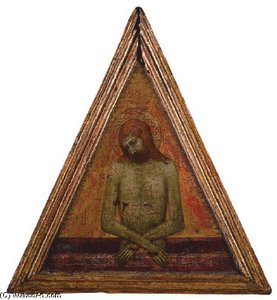
Portret van Naddo Ceccarelli

De 16 bekendste schilderijen van Naddo Ceccarelli, een selectie uit de galerie

Bijgewerkt in november 2026 · gerangschikt op basis van onze populariteitsscore (zoekopdrachten, bezoeken en bestellingen per kunstwerk) · 16 werken van Naddo Ceccarelli in onze catalogus

Kortom

Van alle originele werken die Naddo Ceccarelli heeft nagelaten, is Madonna and Child (1347) het bekendst, in de collectie van het Ashmolean Museum, Oxford. Direct daarna volgen Madonna and Child (1347) en Madonna and Child Flanked by Four Saints (1347). Onze catalogus bevat 16 werken van Naddo Ceccarelli; de galerie heeft de 16 meest bewonderde werken ter wereld bewaard, elk voorzien van de datum, het museum en het verhaal erachter.

1320 – 1347, Siena Meeste werken: Ashmolean Museum

De top 10 schilderijen van Naddo Ceccarelli: de selectie van de galerie

1
Madonna and Child (1347) door Naddo Ceccarelli

Madonna and Child

1347 · Tempera On Panel · Ashmolean Museum, Oxford

Madonna and Child is a religious panel painting by Naddo Ceccarelli, executed in 1347. The artist, born in Siena, Italy, in 1320, was a prominent figure in the Sienese school during the mid-14th century. This work is a representative example of the International Gothic style, characterized by its lyrical lines and decorative emphasis.

2
Madonna and Child (1347) door Naddo Ceccarelli

Madonna and Child

1347 · Tempera On Panel

The painting presents a vertical, centered composition of the Virgin Mary holding the Christ Child. The figures are positioned against a background of gold leaf, which creates a flat, non-directional light that emanates from the surface rather than a natural source. The Madonna is draped in a dark blue or black mantle, which contrasts with the pale pink tunic worn by the Child. Their faces are rendered in oval shapes…

3
Madonna and Child Flanked by Four Saints (1347) door Naddo Ceccarelli

Madonna and Child Flanked by Four Saints

1347 · Tempera On Panel · Chrysler Museum of Art, Norfolk

In the quiet intimacy of a private chapel or a refined domestic space, certain works of art possess the power to transcend time, acting as windows into a more spiritual era. Madonna and Child Flanked by Four Saints is precisely such a masterpiece. Created in 1347 by the Sienese master Naddo Ceccarelli, this delicate three-part altarpiece functions like a gilded Gothic dollhouse, inviting the viewer into a sacred, enclosed world.…

4
The Crucifixion door Naddo Ceccarelli

The Crucifixion

Tempera On Panel · Fitzwilliam Museum

Naddo Ceccarelli, a gifted pupil of the leading Sienese painter Simone Martini, executed The Crucifixion as a significant religious panel painting. This work belongs to the Sienese School and reflects the stylistic developments of the Late Gothic period. Ceccarelli’s training under Martini is evident in the execution of this piece, which emerged from a workshop tradition defined by both spiritual intensity and technical precision.

5
Saints Blaise, Catherine of Alexandria, and Lawrence door Naddo Ceccarelli

Saints Blaise, Catherine of Alexandria, and Lawrence

Tempera On Panel · Harvard Art Museums, Cambridge

In this religious panel, Naddo Ceccarelli presents Saints Blaise, Catherine of Alexandria, and Lawrence. The three figures emerge from a gold ground, standing in a silent row. They occupy a shallow space, their upright postures creating a rhythmic verticality. This Sienese work reflects the devotional focus of the mid-fourteenth century, a period when the artist was active between about 1330 and 1360.

6
Pietà with Saints door Naddo Ceccarelli

Pietà with Saints

Tempera On Panel

Pietà with Saints is a religious composition by Naddo Ceccarelli. The artist, born in Siena, Italy, in 1320, was a 14th-century Italian painter. This work likely served as an altarpiece, a sacred object intended for a place of worship. It captures a moment of profound stillness through its specific arrangement of figures.

De selectie van Naddo Ceccarelli gaat verder, van 11 tot 16

De onderwerpen die de aandacht van Naddo Ceccarelli troffen

De vier onderwerpen die het meest voorkomen in deze originelen, elk met zijn mooiste voorbeeld.

De musea waar de originele werken van Naddo Ceccarelli worden bewaard

De 5 musea met de meeste schilderijen op deze pagina.

Museum Stad Werken van Naddo Ceccarelli Schilderijen uit deze lijst
Ashmolean Museum, OxfordAshmolean Museum Oxford 1 Madonna and Child
Chrysler Museum of Art, NorfolkChrysler Museum of Art Norfolk 1 Madonna and Child Flanked by Four Saints
Fitzwilliam MuseumFitzwilliam Museum 1 The Crucifixion
Harvard Art Museums, CambridgeHarvard Art Museums Cambridge 1 Saints Blaise, Catherine of Alexandria, and Lawrence
Museum of Fine Arts, BostonMuseum of Fine Arts Boston 1 Crucified Christ with the Virgin and Saint John the Evangelist

Naddo Ceccarelli jaar voor jaar: de originelen die elk jaar definiëren

1347 is het jaar van elk gedateerd werk van Naddo Ceccarelli in deze selectie: hier zijn ze, gerangschikt op bekendheid.

Werken per jaar

Selecteer een jaar om de originele werken te bekijken.

Vragen van verzamelaars over de schilderijen van Naddo Ceccarelli

Waar is Naddo Ceccarelli het meest bekend om?Onthul het antwoord

Madonna and Child (1347), Ashmolean Museum, Oxford. Madonna and Child (1347) en Madonna and Child Flanked by Four Saints (1347) volgen.

Hoe oud was Naddo Ceccarelli toen Madonna and Child werd gemaakt?Onthul het antwoord

27 jaar oud: Madonna and Child dateert uit 1347, en Naddo Ceccarelli werd geboren in 1320.

Wat zijn de tien beroemdste schilderijen van Naddo Ceccarelli?Onthul het antwoord

Madonna and Child, Madonna and Child, Madonna and Child Flanked by Four Saints, The Crucifixion, Saints Blaise, Catherine of Alexandria, and Lawrence, Pietà with Saints, The Virgin Annunciate, Virgin And Child, The Virgin and Child en The Virgin Annunciate -. De bovenstaande ranglijst vermeldt het jaar en het museum van elk werk.

Hoeveel schilderijen heeft Naddo Ceccarelli nagelaten?Onthul het antwoord

Onze catalogus bevat 16 werken van Naddo Ceccarelli.

In welke musea hangen de meesterwerken van Naddo Ceccarelli?Onthul het antwoord

Voornamelijk in Ashmolean Museum (Oxford), Chrysler Museum of Art (Norfolk) en Fitzwilliam Museum. De bovenstaande museumtabel bevat een volledig overzicht.

In welke jaren schilderde Naddo Ceccarelli de beroemdste werken?Onthul het antwoord

In 1347: 3 van de 16 werken op deze pagina werden toen gemaakt, waaronder Madonna and Child.

Welke onderwerpen koos Naddo Ceccarelli het vaakst?Onthul het antwoord

Gold background (6), Virgin (4) en Child (3), verspreid over de 16 werken op deze pagina.

Welke techniek gebruikte Naddo Ceccarelli het meest?Onthul het antwoord

Tempera On Panel, voor 9 van de 16 werken op deze pagina.

Naddo Ceccarelli: leven en werk

Early Life and Artistic Training

Naddo Ceccarelli emerged onto the artistic landscape of Siena in the mid-14th century, a period marked by fervent religious devotion and burgeoning urban sophistication. Precise biographical details remain elusive, shrouded in the mists of medieval documentation—information about his birth year is uncertain, estimated to be around 1320. However, what we know with relative confidence is that he received his formative artistic education under the tutelage of Simone Martini (ca. 1284–1344), arguably Siena’s most celebrated painter of the era. Martini's workshop was a crucible for innovation and stylistic refinement, attracting ambitious young artists eager to absorb his mastery. Ceccarelli’s association with Martini extended beyond mere instruction; he traveled alongside Martini to Avignon in 1330, immersing himself in the papal court’s artistic milieu—a pivotal experience that undoubtedly broadened his horizons and influenced his subsequent oeuvre.Simone Martini's influence is palpable in Ceccarelli's stylistic choices, particularly evident in his predilection for delicate color palettes and meticulous attention to detail.

Style and Technique

Ceccarelli’s artistic style can be characterized as a harmonious blend of Martini’s expressive grandeur and the more restrained elegance of the master of Palazzo Venezia and Memmi. He excelled in capturing the luminous quality of tempera paint, skillfully layering translucent glazes over gold leaf to achieve breathtaking effects of shimmering brilliance—a technique that mirrored the advancements occurring in goldsmithing at the time. This masterful manipulation of light was particularly evident in depictions of chain mail and other metallic embellishments, demonstrating a keen understanding of how to convey texture and materiality through pigment alone.His compositions are often characterized by serene stillness, reflecting the spiritual ethos of his era. Ceccarelli’s paintings frequently portray Madonna and Child figures—a motif deeply rooted in Marian devotion—often accompanied by saints. These small-scale panels stand apart from Martini's monumental works, suggesting a stylistic divergence driven by individual artistic sensibilities.
    Notable features include:
  • Precise delineation of drapery folds
  • Subtle gradations of color
  • Delicate rendering of facial expressions
  • Major Works and Patronage

    Two signed paintings by Ceccarelli’s hand—the Madonna and Child (formerly in the Cook Collection in Richmond, Surrey) dated to 1347 and Christ The Man Of Sorrows (Liechtenstein Collection, Vaduz)—provide invaluable insight into his artistic output. These masterpieces exemplify Ceccarelli's stylistic prowess and underscore his position as one of Martini’s workshop’s most accomplished pupils.
      The Madonna and Child,
  • displays a masterful use of color and texture, capturing the ethereal beauty of Mary and Jesus with remarkable sensitivity.
  • Christ The Man Of Sorrows
  • is distinguished by its solemn expression and evocative depiction of sorrow—a testament to Ceccarelli’s ability to convey profound emotion through visual imagery.
      Ceccarelli's work was commissioned primarily by ecclesiastical patrons,
    reflecting the pervasive influence of religious faith on artistic production during the fourteenth century. The Madonna and Child with Saints (Pinacoteca Nazionale Siena) represents a larger-scale altarpiece, showcasing Ceccarelli’s ambition to undertake ambitious projects that would elevate his reputation.
  • Historical Significance

    Naddo Ceccarelli's contribution to Sienese art is significant not only for its stylistic refinement but also for its embodiment of a broader cultural trend—the fusion of painting and goldsmithing. Like Martini and Memmi, Ceccarelli pioneered the innovative practice of incorporating gold leaf into panel paintings, transforming them into objects of devotional splendor.This approach reflects a shift away from traditional sculptural representations of saints, prioritizing visual narratives that conveyed spiritual meaning through luminous color and intricate ornamentation. Ceccarelli’s legacy endures as an exemplar of medieval artistic excellence—a painter who skillfully navigated the stylistic currents of his time while forging a distinctive artistic voice.His work serves as a reminder of Siena's role as a center for artistic innovation during the High Gothic period, securing its place in art history.