Portret van Miné Okubo

Schilderijen van Miné Okubo: De 72 bekendste, door de ogen van een galerie

Bijgewerkt in november 2026 · gerangschikt op basis van onze populariteitsscore (zoekopdrachten, bezoeken en bestellingen per kunstwerk) · 72 werken van Miné Okubo in onze catalogus

Kortom

Volgens de visie van de galerie is het beroemdste schilderij van Miné Okubo (3 Women Going to Church) (1948), waarvan het origineel in het Japanese American National Museum in Los Angeles hangt. Walking over muddy ground, Central Utah Relocation Project, Topaz, Utah, 1942-1944 (1944) en Teaching art classes, Tanforan Assembly Center, San Bruno, California, 1942 (1944) maken het trio compleet dat elk oog herkent. Van de 72 werken van Miné Okubo in onze catalogus presenteert de galerie hieronder de 72 bekendste werken, elk een origineel met de jaartal, het museum en wat het uniek maakt.

1912 – 2001, Riverside Social realism Meeste werken: Japanese American National Museum

De top 10 schilderijen van Miné Okubo in de galerie

1
(3 Women Going to Church) (1948) door Miné Okubo

(3 Women Going to Church)

1948 · Gouache · Japanese American National Museum, Los Angeles

Three women move toward the viewer, their bodies rendered as simplified, rectangular forms. They walk in a somber line, heads bowed under the weight of a quiet gravity. In their hands, they hold books, small anchors of faith against the surrounding bleakness. The figures are heavy with a sense of shared purpose, their rounded features catching subtle highlights amidst a landscape of muted blues and browns.

2
Walking over muddy ground, Central Utah Relocation Project, Topaz, Utah, 1942-1944 (1944) door Miné Okubo

Walking over muddy ground, Central Utah Relocation Project, Topaz, Utah, 1942-1944

1944 · Drawing · Japanese American National Museum, Los Angeles

Miné Okubo’s “Walking Over Muddy Ground, Central Utah Relocation Project, Topaz, Utah, 1942-1944” isn't merely a depiction of a landscape; it’s a distilled essence of hardship, determination, and the quiet dignity of a people displaced. Rendered in stark black and white, the drawing captures a pivotal moment within the Topaz War Relocation Center—a microcosm of the larger narrative of Japanese American internment during World War II. The image immediately draws…

3
Teaching art classes, Tanforan Assembly Center, San Bruno, California, 1942 (1944) door Miné Okubo

Teaching art classes, Tanforan Assembly Center, San Bruno, California, 1942

1944 · Ink On Paper · Japanese American National Museum, Los Angeles

In this work, titled Teaching art classes, Tanforan Assembly Center, San Bruno, California, 1942, the artist Miné Okubo captures a quiet, instructional moment within the confines of a relocation center. Created in 1944, the piece offers a view into the daily life of Japanese Americans during the wartime era. It is a document of a specific time and place, recorded through the eyes of someone who lived through the experience…

4
Posting of Civilian Exclusion Order/Evacuation Order No. 19, Berkeley, California, 1942 (1944) door Miné Okubo

Posting of Civilian Exclusion Order/Evacuation Order No. 19, Berkeley, California, 1942

1944 · Acrylic On Canvas · Japanese American National Museum, Los Angeles

Miné Okubo's "Posting of Civilian Exclusion Order/Evacuation Order No. 19, Berkeley, California, 1942" isn’t merely a historical document rendered in ink and paper; it’s a visceral embodiment of fear, uncertainty, and the profound disruption inflicted upon Japanese Americans during World War II. Created in 1942, amidst the escalating anxieties of wartime America, this powerful black-and-white drawing captures a pivotal moment – the public announcement of an evacuation order that would…

5
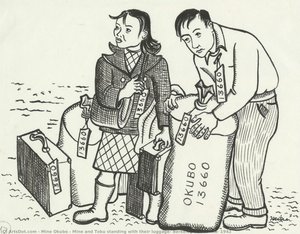
Mine and Toku standing with their luggage, Berkeley, California, 1942 (1944) door Miné Okubo

Mine and Toku standing with their luggage, Berkeley, California, 1942

1944 · Acrylic On Paper · Japanese American National Museum, Los Angeles

Miné Okubo's "Mine and Toku Standing with Their Luggage, Berkeley, California, 1942" isn’t merely a photograph; it’s a distilled essence of experience, a poignant snapshot frozen in time during a profoundly unsettling chapter of American history. Created in 1944, shortly after the internment of Japanese Americans following Pearl Harbor, this deceptively simple drawing offers an intimate and deeply affecting glimpse into the lives of two individuals – Miné and her…

6
Community toilets, Tanforan Assembly Center, San Bruno, California, 1942 (1944) door Miné Okubo

Community toilets, Tanforan Assembly Center, San Bruno, California, 1942

1944 · Ink On Paper · Japanese American National Museum, Los Angeles

Miné Okubo's "Community Toilets, Tanforan Assembly Center, San Bruno, California, 1942" is far more than a simple depiction of a utilitarian space. It’s a poignant and profoundly moving testament to the everyday realities faced by Japanese Americans unjustly incarcerated during World War II. Rendered in stark black ink on white paper, the artwork transcends its subject matter to become a powerful symbol of loss, dignity, and quiet resilience within a…

7
Mine and Toku arrive in their barrack, Central Utah Relocation Project, Topaz, Utah, 1942 (1944) door Miné Okubo

Mine and Toku arrive in their barrack, Central Utah Relocation Project, Topaz, Utah, 1942

1944 · Acrylic On Canvas · Japanese American National Museum, Los Angeles

Miné Okubo's "Mine and Toku arrive in their barrack, Central Utah Relocation Project, Topaz, Utah, 1942" isn’t merely a drawing; it’s a distilled essence of trauma, displacement, and the quiet dignity of survival. Created during her forced incarceration at the Topaz War Relocation Center in 1942, this stark black-and-white image offers an intimate glimpse into a profoundly unsettling chapter of American history – the unjust internment of Japanese Americans during…

8
Eating lunch while awaiting departure inside the Civil Control Station, Berkeley, California, 1942 (1944) door Miné Okubo

Eating lunch while awaiting departure inside the Civil Control Station, Berkeley, California, 1942

1944 · Acrylic On Canvas · Japanese American National Museum, Los Angeles

Miné Okubo's "Eating Lunch while awaiting departure inside the Civil Control Station, Berkeley, California, 1942" isn't merely a depiction of a scene; it’s a distilled essence of wartime anxiety and the profound human cost of forced displacement. Created during a period of immense upheaval – the incarceration of Japanese Americans following Pearl Harbor – this black-and-white pen and ink drawing transcends its documentary origins to become a poignant meditation on…

9
Medical exam in laundry building, Central Utah Relocation Project, Topaz, Utah, 1942 (1944) door Miné Okubo

Medical exam in laundry building, Central Utah Relocation Project, Topaz, Utah, 1942

1944 · Ink · Japanese American National Museum, Los Angeles

The scene unfolds within the stark confines of a laundry building at the Topaz War Relocation Center. Here, in "Medical exam in laundry building, Central Utah Relocation Project, Topaz, Utah, 1942," the artist Miné Okubo captures a moment of quiet, clinical scrutiny. The air feels heavy with the weight of the surrounding enclosure, a space where the routine of a medical examination meets the lived reality of the Topaz camp.…

10
New bachelor dorms at Barrack 14, Tanforan Assembly Center, San Bruno, California, 1942 (1944) door Miné Okubo

New bachelor dorms at Barrack 14, Tanforan Assembly Center, San Bruno, California, 1942

1944 · Acrylic On Canvas · Japanese American National Museum, Los Angeles

Within the stark, geometric confines of the Tanforan Assembly Center during World War II, Miné Okubo captured a poignant and enduring moment – “New Bachelor Dorms at Barrack 14.” This deceptively simple ink-on-paper illustration transcends mere documentation; it’s a testament to human dignity amidst displacement, a quiet observation of daily life within the shadow of internment. Created in 1942-1944, during a period of immense upheaval for Japanese Americans, Okubo's work…

Schilderijen van Miné Okubo, gerangschikt van 11 tot 72

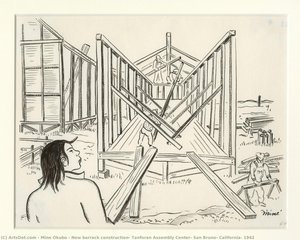
11Army blanket distribution, Central Utah Relocation Project, Topaz, Utah, 1942 (1944) door Miné OkuboArmy blanket distribution, Central Utah Relocation Project, Topaz, Utah, 19421944 · Japanese American National Museum 12Obtaining drinking water, Central Utah Relocation Project, Topaz, Utah, 1942-1944 (1944) door Miné OkuboObtaining drinking water, Central Utah Relocation Project, Topaz, Utah, 1942-19441944 · Japanese American National Museum 13Working at the Topaz Times, Central Utah Relocation Project, Topaz, Utah, 1942 (1944) door Miné OkuboWorking at the Topaz Times, Central Utah Relocation Project, Topaz, Utah, 19421944 · Japanese American National Museum 14Teacher and students in classroom, Central Utah Relocation Project, Topaz, Utah, 1942-1944 (1944) door Miné OkuboTeacher and students in classroom, Central Utah Relocation Project, Topaz, Utah, 1942-19441944 · Japanese American National Museum 15Waiting in line to receive vaccinations, Tanforan Assembly Center, San Bruno, California, 1942 (1944) door Miné OkuboWaiting in line to receive vaccinations, Tanforan Assembly Center, San Bruno, California, 19421944 · Japanese American National Museum 16Mosquitos and flies in the barracks, Central Utah Relocation Project, Topaz, Utah, 1942-1944 (1944) door Miné OkuboMosquitos and flies in the barracks, Central Utah Relocation Project, Topaz, Utah, 1942-19441944 · Japanese American National Museum 17Observing camp activities from a rooftop, Tanforan Assembly Center, San Bruno, California, 1942 (1944) door Miné OkuboObserving camp activities from a rooftop, Tanforan Assembly Center, San Bruno, California, 19421944 · Japanese American National Museum 18Bus ride to Central Utah Relocation Project, Topaz, Utah, 1942 (1944) door Miné OkuboBus ride to Central Utah Relocation Project, Topaz, Utah, 19421944 · Japanese American National Museum 19Listening to radio announcement of bombing of Pearl Harbor, with brother Toku, Berkeley, California, 1941 (1944) door Miné OkuboListening to radio announcement of bombing of Pearl Harbor, with brother Toku, Berkeley, California, 19411944 · Japanese American National Museum 20Registering at the Civil Control Station at Pilgrim Hall of the First Congregational Church, Berkeley, California, 1942 (1944) door Miné OkuboRegistering at the Civil Control Station at Pilgrim Hall of the First Congregational Church, Berkeley, California, 19421944 · Japanese American National Museum 21Arrival at Tanforan Assembly Center, San Bruno, California, 1942 (1944) door Miné OkuboArrival at Tanforan Assembly Center, San Bruno, California, 19421944 · Japanese American National Museum 22Waiting in line for supper, Tanforan Assembly Center, San Bruno, California, 1942 (1944) door Miné OkuboWaiting in line for supper, Tanforan Assembly Center, San Bruno, California, 19421944 · Japanese American National Museum 23Induction at Central Utah Relocation Project, Topaz, Utah, 1942 (1944) door Miné OkuboInduction at Central Utah Relocation Project, Topaz, Utah, 19421944 · Japanese American National Museum 24[Untitled] (1977) door Miné Okubo[Untitled]1977 · Japanese American National Museum 25New barrack construction, Tanforan Assembly Center, San Bruno, California, 1942 (1944) door Miné OkuboNew barrack construction, Tanforan Assembly Center, San Bruno, California, 19421944 · Japanese American National Museum 26Arrival of evacuees from Hawaii, Central Utah Relocation Project, Topaz, Utah, 1942-1944 (1944) door Miné OkuboArrival of evacuees from Hawaii, Central Utah Relocation Project, Topaz, Utah, 1942-19441944 · Japanese American National Museum 27Carrying mattresses to the barrack, Central Utah Relocation Project, Topaz, Utah, 1942 (1944) door Miné OkuboCarrying mattresses to the barrack, Central Utah Relocation Project, Topaz, Utah, 19421944 · Japanese American National Museum 28Eating in the mess hall, Central Utah Relocation Project, Topaz, Utah, 1942-1944 (1944) door Miné OkuboEating in the mess hall, Central Utah Relocation Project, Topaz, Utah, 1942-19441944 · Japanese American National Museum 29Mine with open newspaper, surrounded by anti-Japanese slogans, Berkeley, California, 1941 (1944) door Miné OkuboMine with open newspaper, surrounded by anti-Japanese slogans, Berkeley, California, 19411944 · Japanese American National Museum 30Scavenging lumber to build furniture, Central Utah Relocation Project, Topaz, Utah, 1942 (1944) door Miné OkuboScavenging lumber to build furniture, Central Utah Relocation Project, Topaz, Utah, 19421944 · Japanese American National Museum 31Landscaping with trees, Central Utah Relocation Project, Topaz, Utah, 1942-1944 (1944) door Miné OkuboLandscaping with trees, Central Utah Relocation Project, Topaz, Utah, 1942-19441944 · Japanese American National Museum 32Snowball fight, Central Utah Relocation Project, Topaz, Utah, 1942-1944 (1944) door Miné OkuboSnowball fight, Central Utah Relocation Project, Topaz, Utah, 1942-19441944 · Japanese American National Museum 33Families preparing for evacuation, Berkeley, California, 1942 (1944) door Miné OkuboFamilies preparing for evacuation, Berkeley, California, 19421944 · Japanese American National Museum 34First night at Tanforan Assembly Center, San Bruno, California, 1942 (1944) door Miné OkuboFirst night at Tanforan Assembly Center, San Bruno, California, 19421944 · Japanese American National Museum 35Mine and Toku assemble cots, Tanforan Assembly Center, San Bruno, California, 1942 (1944) door Miné OkuboMine and Toku assemble cots, Tanforan Assembly Center, San Bruno, California, 19421944 · Japanese American National Museum 36Awaiting registration at the Civil Control Station at Pilgrim Hall of the First Congregational Church, Berkeley, California, 1942 (1944) door Miné OkuboAwaiting registration at the Civil Control Station at Pilgrim Hall of the First Congregational Church, Berkeley, California, 19421944 · Japanese American National Museum 37Waiting to disembark from the bus at Tanforan Assembly Center, San Bruno, California, 1942 (1944) door Miné OkuboWaiting to disembark from the bus at Tanforan Assembly Center, San Bruno, California, 19421944 · Japanese American National Museum 38Dining with friends in Berkeley, California, ca.1939-1941 (1944) door Miné OkuboDining with friends in Berkeley, California, ca.1939-19411944 · Japanese American National Museum 39Mine at train station in Berne, Switzerland, 1939 (1944) door Miné OkuboMine at train station in Berne, Switzerland, 19391944 · Japanese American National Museum 40Arrival at Central Utah Relocation Project, Topaz, Utah, 1942 (1944) door Miné OkuboArrival at Central Utah Relocation Project, Topaz, Utah, 19421944 · Japanese American National Museum 41[Untitled] (1978) door Miné Okubo[Untitled]1978 · Japanese American National Museum 42Interior view of Mine and Toku (1944) door Miné OkuboInterior view of Mine and Toku1944 · Japanese American National Museum 43Luggage delivery truck, Tanforan Assembly Center, San Bruno, California, 1942 (1944) door Miné OkuboLuggage delivery truck, Tanforan Assembly Center, San Bruno, California, 19421944 · Japanese American National Museum 44Mine and Toku are shown to their barrack, Tanforan Assembly Center, San Bruno, California, 1942 (1944) door Miné OkuboMine and Toku are shown to their barrack, Tanforan Assembly Center, San Bruno, California, 19421944 · Japanese American National Museum 45Unfinished camp construction, Central Utah Relocation Project, Topaz, Utah, 1942 (1944) door Miné OkuboUnfinished camp construction, Central Utah Relocation Project, Topaz, Utah, 19421944 · Japanese American National Museum 46Mine reads newspaper announcing war declaration against Japan, Berkeley, California, 1941 (1944) door Miné OkuboMine reads newspaper announcing war declaration against Japan, Berkeley, California, 19411944 · Japanese American National Museum 47Walking with guide to Barrack 16, Room 50, Tanforan Assembly Center, San Bruno, California, 1942 (1944) door Miné OkuboWalking with guide to Barrack 16, Room 50, Tanforan Assembly Center, San Bruno, California, 19421944 · Japanese American National Museum 48[Untitled] (1978) door Miné Okubo[Untitled]1978 · Japanese American National Museum 49Interior of Mine and Toku (1944) door Miné OkuboInterior of Mine and Toku1944 · Japanese American National Museum 50[Untitled] (1970) door Miné Okubo[Untitled]1970 · Japanese American National Museum 51Receiving hostile looks while traveling by bus, Berkeley, California, 1941-42 (1944) door Miné OkuboReceiving hostile looks while traveling by bus, Berkeley, California, 1941-421944 · Japanese American National Museum 52Mine and Toku preparing for departure, Berkeley, California, 1942 (1944) door Miné OkuboMine and Toku preparing for departure, Berkeley, California, 19421944 · Japanese American National Museum 53Returning home for curfew, Berkeley, California, 1942 (1944) door Miné OkuboReturning home for curfew, Berkeley, California, 19421944 · Japanese American National Museum 54Mail-order clothing from Sears Roebuck, Central Utah Relocation Project, Topaz, Utah, 1942-1944 (1944) door Miné OkuboMail-order clothing from Sears Roebuck, Central Utah Relocation Project, Topaz, Utah, 1942-19441944 · Japanese American National Museum 55[Untitled] (1969) door Miné Okubo[Untitled]1969 · Japanese American National Museum 56[Untitled] (1968) door Miné Okubo[Untitled]1968 · Japanese American National Museum 57Rocky Ladies ? (1977) door Miné OkuboRocky Ladies ?1977 · Japanese American National Museum 58Bachelor (1944) door Miné OkuboBachelor1944 · Japanese American National Museum 59[Untitled] (1969) door Miné Okubo[Untitled]1969 · Japanese American National Museum 60[Untitled] (1974) door Miné Okubo[Untitled]1974 · Japanese American National Museum 61Victory gardens, Central Utah Relocation Project, Topaz, Utah, 1942-1944 (1944) door Miné OkuboVictory gardens, Central Utah Relocation Project, Topaz, Utah, 1942-19441944 · Japanese American National Museum 62Trimming grass inside living quarters, Tanforan Assembly Center, San Bruno, California, 1942 (1944) door Miné OkuboTrimming grass inside living quarters, Tanforan Assembly Center, San Bruno, California, 19421944 · Japanese American National Museum 63Departure postings at the Civil Control Station, Berkeley, California, 1942 (1944) door Miné OkuboDeparture postings at the Civil Control Station, Berkeley, California, 19421944 · Japanese American National Museum 64Medical exam at Tanforan Assembly Center, San Bruno, California, 1942 (1944) door Miné OkuboMedical exam at Tanforan Assembly Center, San Bruno, California, 19421944 · Japanese American National Museum 65Mine and Toku sweep the stall, Tanforan Assembly Center, San Bruno, California, 1942 (1944) door Miné OkuboMine and Toku sweep the stall, Tanforan Assembly Center, San Bruno, California, 19421944 · Japanese American National Museum 66Inspection of evacuees for contraband, Tanforan Assembly Center, San Bruno, California, 1942 (1944) door Miné OkuboInspection of evacuees for contraband, Tanforan Assembly Center, San Bruno, California, 19421944 · Japanese American National Museum 67Relocation notification, Tanforan Assembly Center, San Bruno, California, 1942 (1944) door Miné OkuboRelocation notification, Tanforan Assembly Center, San Bruno, California, 19421944 · Japanese American National Museum 68Receiving room assignments at Tanforan Assembly Center, San Bruno, California, 1942 (1944) door Miné OkuboReceiving room assignments at Tanforan Assembly Center, San Bruno, California, 19421944 · Japanese American National Museum 69Waiting to use the washrooms, Central Utah Relocation Project, Topaz, Utah, 1942-1944 (1944) door Miné OkuboWaiting to use the washrooms, Central Utah Relocation Project, Topaz, Utah, 1942-19441944 · Japanese American National Museum 70Rest stop with military police, Nevada, 1942 (1944) door Miné OkuboRest stop with military police, Nevada, 19421944 · Japanese American National Museum 71Ondertitel (1978) door Miné OkuboOndertitel1978 · Japanese American National Museum 72Shopping at the canteen, Tanforan Assembly Center, San Bruno, California, 1942 (1944) door Miné OkuboShopping at the canteen, Tanforan Assembly Center, San Bruno, California, 19421944 · Japanese American National Museum

De beroemde schilderijen van Miné Okubo, periode voor periode

De onderwerpen die de aandacht van Miné Okubo troffen

De vier onderwerpen die het meest voorkomen in deze originelen, elk met zijn mooiste voorbeeld.

De musea waar de originele werken van Miné Okubo worden bewaard

Het museum met de meeste schilderijen op deze pagina.

Museum Stad Werken van Miné Okubo Schilderijen uit deze lijst
Japanese American National Museum, Los AngelesJapanese American National Museum Los Angeles 72 (3 Women Going to Church), Walking over muddy ground, Central Utah Relocation Project, Topaz, Utah, 1942-1944, Teaching art classes, Tanforan Assembly Center, San Bruno, California, 1942

Miné Okubo, één iconisch schilderij per decennium

Werken per decennium

Kies een decennium om het origineel te zien dat dit tijdperk definieert.

Schilderijen van Miné Okubo: de galerie geeft antwoord

Welk schilderij van Miné Okubo is het beroemdste van allemaal?Onthul het antwoord

(3 Women Going to Church) (1948), Japanese American National Museum, Los Angeles. Walking over muddy ground, Central Utah Relocation Project, Topaz, Utah, 1942-1944 (1944) en Teaching art classes, Tanforan Assembly Center, San Bruno, California, 1942 (1944) volgen.

Hoe oud was Miné Okubo bij de voltooiing van (3 Women Going to Church)?Onthul het antwoord

36 jaar oud: (3 Women Going to Church) dateert uit 1948, en Miné Okubo werd geboren in 1912.

Wat zijn de top 10 schilderijen van Miné Okubo?Onthul het antwoord

(3 Women Going to Church), Walking over muddy ground, Central Utah Relocation Project, Topaz, Utah, 1942-1944, Teaching art classes, Tanforan Assembly Center, San Bruno, California, 1942, Posting of Civilian Exclusion Order/Evacuation Order No. 19, Berkeley, California, 1942, Mine and Toku standing with their luggage, Berkeley, California, 1942, Community toilets, Tanforan Assembly Center, San Bruno, California, 1942, Mine and Toku arrive in their barrack, Central Utah Relocation Project, Topaz, Utah, 1942, Eating lunch while awaiting departure inside the Civil Control Station, Berkeley, California, 1942, Medical exam in laundry building, Central Utah Relocation Project, Topaz, Utah, 1942 en New bachelor dorms at Barrack 14, Tanforan Assembly Center, San Bruno, California, 1942. De bovenstaande ranglijst vermeldt het jaar en het museum van elk werk.

Hoeveel werken heeft Miné Okubo gemaakt?Onthul het antwoord

Onze catalogus bevat 72 werken van Miné Okubo, daterend van 1944 tot 1978.

Waar hangen de beroemdste originele werken van Miné Okubo?Onthul het antwoord

Voornamelijk in Japanese American National Museum (Los Angeles). De bovenstaande museumtabel bevat een volledig overzicht.

Wanneer creëerde Miné Okubo de beroemdste schilderijen?Onthul het antwoord

In 1940s: 62 van de 72 werken op deze pagina werden toen gemaakt, waaronder (3 Women Going to Church).

Wat zijn de vroegste en laatste beroemde werken van Miné Okubo?Onthul het antwoord

Op deze pagina is het vroegste Walking over muddy ground, Central Utah Relocation Project, Topaz, Utah, 1942-1944 (1944) en het laatste [Untitled] (1978).

Welke onderwerpen keerde Miné Okubo het vaakst naar terug?Onthul het antwoord

Resilience (37), Observation (21) en Japanese american (16), verspreid over de 72 werken op deze pagina.

In welk medium werkte Miné Okubo het meest?Onthul het antwoord

Acrylic On Canvas, voor 34 van de 72 werken op deze pagina.

Bij welke stroming wordt Miné Okubo gerekend?Onthul het antwoord

Social realism, te oordelen aan de originelen op deze pagina.

Welke originelen van Miné Okubo zijn in de collectie van het Japanese American National Museum?Onthul het antwoord

(3 Women Going to Church), Walking over muddy ground, Central Utah Relocation Project, Topaz, Utah, 1942-1944 en Teaching art classes, Tanforan Assembly Center, San Bruno, California, 1942: het Japanese American National Museum, Los Angeles herbergt 72 van de werken op deze pagina.

Miné Okubo: de kunstenaar

Miné Okubo: Een Leven Geëtst in Veerkracht

Miné Okubo, geboren in Riverside, Californië in 1912, was een kunstenares wiens leven onlosmakelijk verbonden raakte aan een cruciale en pijnlijk hoofdstuk in de Amerikaanse geschiedenis. Haar verhaal is niet alleen een verhaal van artistieke talenten, maar ook van diepgaande moed, onwrikbare observatie en de kracht van kunst als getuigenis. Vanaf haar vroege stimulans binnen een familie die creativiteit waardeerde – haar moeder een bekwame kalligrafisch, haar vader een geleerde – begon Okubo aan een pad naar formele opleiding, studeerde aan de Universiteit van Californië, Berkeley, en reisde later in 1938 naar Europa om haar artistieke horizon te verbreden. Deze periode van studie werd abrupt verbroken door de dreigende schaduw van de Tweede Wereldoorlog, waardoor ze terugkeerde naar Amerika net als de wereldspanningen op het hoogtepunt van hun intensiteit stonden. Ze kon zich nooit voorstellen dat deze terugkeer niet zou leiden tot verdere artistieke exploratie, maar tot gedwongen opsluiting en een ervaring die zowel haar leven als haar kunst zou definiëren.

Getuigenis: Kunst in de Muren

De aanval op Pearl Harbor veranderde het leven van Okubo voorgoed, net zoals dit voor talloze andere Japans-Amerikanen gebeurde. In 1942 werd ze samen met haar broer Benji uit hun huis verwijderd en onrechtmatig vastgehouden in de Tanforan Assembly Center, een omgebouwde racebaan die als tijdelijke opslagfaciliteit diende voordat ze naar het permanentere Topaz War Relocation Center in Utah werden overgebracht. Binnen deze prikkeldraadomheining, midden in stof en wanhoop, begon Okubo haar belangrijkste artistieke onderneming. Gedreven door een bijna compulsieve behoefte om de realiteit om haar heen vast te leggen, begon ze een opmerkelijk visueel verslag van kampleven te creëren – meer dan 2.000 tekeningen en schetsen zorgvuldig uitgewerkt in pen en inkt, aquarel en houtskool. Dit waren geen monumentale historische schilderijen of geïdealiseerde portretten; het waren rauwe, eerlijke weergaven van alledaagse bestaande: overvolle woonruimtes, bureaucratische processen, gezichten geëtst met bezorgdheid en wanhoop, momenten van stille waardigheid in de diepte van de ellende. Haar kunst was niet alleen een persoonlijke reactie; het was een daad van verzet, een weigering om stil te blijven of uitwissen.

Citizen 13660: Een Getuigenis van Dehumanisering en Hoop

Na haar vrijlating uit Topaz in 1944 wijdde Okubo haar ervaringen toe aan een baanbrekende kunst- en literaire werk: *Citizen 13660*. Het boek, uitgebracht in 1946, bestond uit 198 van haar tekeningen vergezeld door aangrijpende tekst. De titel zelf is diep symbolisch, verwijzend naar het nummer dat aan haar werd toegekend binnen het opsluitingssysteem – een schokkende herinnering aan het dehumaniserende proces waartoe ze en zo veel anderen werden onderworpen. *Citizen 13660* was niet alleen een kroniek van lijden; het was een genuanceerd portret van menselijke veerkracht in het aangezicht van tegenslag. Okubo schuwde het niet om de onrechtmatigheden en onwaardigheid af te beelden, maar ze legde ook momenten van gemeenschap, humor en stille kracht vast. De tekeningen kenmerken zich door hun directheid, emotionele diepte en meesterlijke gebruik van lijn en schaduw. Het boek werd snel een hoeksteen van de Japanse-Amerikaanse literatuur, die een onweerstaanbaar beeld gaf van een donker hoofdstuk in de Amerikaanse geschiedenis dat velen wilden negeren.

Invloeden en Ontwikkeling

Okubo’s vroege leven was doordrenkt met artistieke invloeden. Haar moeder, een getalenteerde kalligrafisch, en haar vader, een geleerde, stimuleerden haar creatieve geest vanaf jonge leeftijd. Haar oudere broer, Benji Okubo, een pionier in de Nisei-kunst, was een belangrijke inspiratiebron. Ook haar zus Yoshiko Okubo, een kunstenares en galeriebeheerster, had een grote invloed op haar artistieke ontwikkeling. Ze studeerde aan de Universiteit van Californië, Berkeley, waar ze zowel haar bachelor’s als master’s degree behaalde. Na haar studie werkte ze in 1938 met Diego Rivera aan muralen en reisde door Europa om te leren van Europese kunstenaars. Haar artistieke stijl werd sterk beïnvloed door de Sociale Realisme beweging, die gericht was op het weergeven van sociale kwesties en alledaagse bestaande met een eerlijke weergave. Ze studeerde onder de invloed van Käthe Kollwitz, bekend om haar krachtige weergaven van menselijk lijden.

Belangrijke Prestaties

Na de oorlog verhuisde Okubo naar New York City en bleef ze haar artistieke carrière voortzetten, waarbij ze werkte als freelance illustrator voor tijdschriften en boeken, en aan muralprojecten meewerkte. Hoewel ze haar thema’s van sociale rechtvaardigheid en menselijke waardigheid niet volledig verliet, evolueerde haar stijl over de jaren. Ze experimenteerde met verschillende media en technieken, maar bleef altijd toegewijd aan realisme en eerlijke observatie. Okubo ontving talloze prijzen en erkenningen, waaronder subsidies van de National Endowment for the Arts, die het belang van haar bijdragen aan de Amerikaanse kunst en cultuur erkenden. Ze testigde in 1981 voor de Amerikaanse Commissie voor Verplaatsing en Internement van Civilians. In 1984 werd haar meest bekende werk, *Citizen 13660*, bekroond met de American Book Award. Miné Okubo stierf in 2001 op 88-jarige leeftijd. Haar kunst is niet alleen historische documenten; het zijn diep menselijke verhalen geëtst in pen en aquarel, die ons dwingen te onthouden, te leren van en nooit de fouten van het verleden te herhalen.