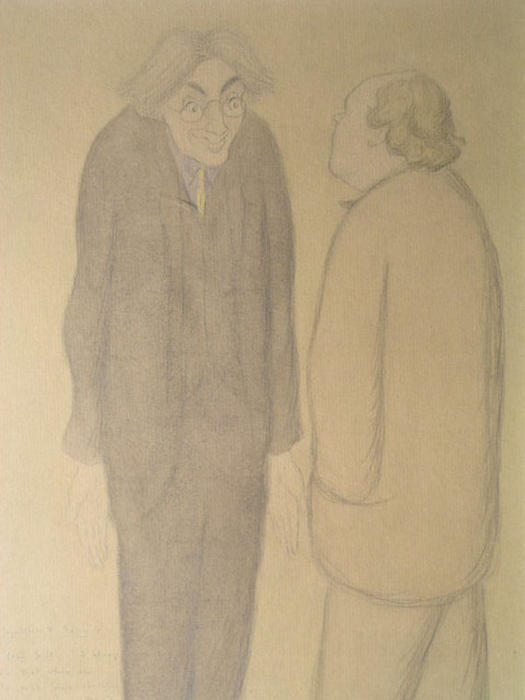
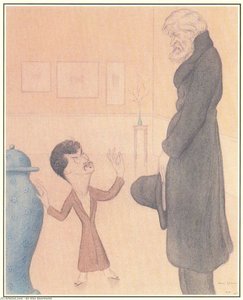
Portret van Max Beerbohm

De 45 beroemdste schilderijen van Max Beerbohm, elk uniek

Bijgewerkt in november 2026 · gerangschikt op basis van onze populariteitsscore (zoekopdrachten, bezoeken en bestellingen per kunstwerk) · 49 werken van Max Beerbohm in onze catalogus

Kortom

John S. Sargent is het schilderij van Max Beerbohm dat de meeste aandacht trekt. Daarna gaat de blik naar D.G. Rossetti Precociously Manifesting ... that Queer Indifference to Politics en Untitled (360). Van de 49 werken van Max Beerbohm in onze catalogus zijn dit de 45 bekendste, elk een uniek origineel gepresenteerd met het jaar, het museum en de reden waarom het blijft voortbestaan.

1872 – 1956, Londen

Top 10 schilderijen van Max Beerbohm, door de ogen van de galerie

De beroemde schilderijen van Max Beerbohm, nummer 11 tot 45

11Frontispiece door Max BeerbohmFrontispiece 12Boy in a high top-hat door Max BeerbohmBoy in a high top-hat 13Annual Banquet. A Suggestion to the New English Art Club door Max BeerbohmAnnual Banquet. A Suggestion to the New English Art Club 14Miss Cornforth. `Oh, very pleased to meet Mr Ruskin, I'm sure door Max BeerbohmMiss Cornforth. `Oh, very pleased to meet Mr Ruskin, I'm sure 15The Small Hours in the ’Sixties at 16, Cheyne Walk door Max BeerbohmThe Small Hours in the ’Sixties at 16, Cheyne Walk 16Caricature of a man in a frock coat door Max BeerbohmCaricature of a man in a frock coat 17Rossetti in his worldlier daysleaving the Arundel Club with George Augustus Sala door Max BeerbohmRossetti in his worldlier daysleaving the Arundel Club with George Augustus Sala 18An introduction door Max BeerbohmAn introduction 19Mr. Browing brings a lady of rank and fashion to see Mr.Rossetti door Max BeerbohmMr. Browing brings a lady of rank and fashion to see Mr.Rossetti 20A Quiet Morning in the Tate Gallery door Max BeerbohmA Quiet Morning in the Tate Gallery 21Swinburne and Miss Sophia Grimes door Max BeerbohmSwinburne and Miss Sophia Grimes 22A Momentary Vision that once befell Young Millais door Max BeerbohmA Momentary Vision that once befell Young Millais 23Mr. Morley of Blackburn, on an afternoon in the Spring of ’69, introduces Mr. John Stuart Mill door Max BeerbohmMr. Morley of Blackburn, on an afternoon in the Spring of ’69, introduces Mr. John Stuart Mill 24Quis Custodiet Ipsum Custodem door Max BeerbohmQuis Custodiet Ipsum Custodem 25The New English Art Club door Max BeerbohmThe New English Art Club 26Mr. Robert Browning, taking tea with the Browning Society door Max BeerbohmMr. Robert Browning, taking tea with the Browning Society 27Mr. Tennyson reading In Memoriam to his Sovereign door Max BeerbohmMr. Tennyson reading In Memoriam to his Sovereign 28Swinburne, Elizabeth Siddal, and Rossetti door Max BeerbohmSwinburne, Elizabeth Siddal, and Rossetti 29Rossetti’s Courtship. Chatham Place door Max BeerbohmRossetti’s Courtship. Chatham Place 30Mr. William Bell Scott wondering what it is those fellows seem to see in Gabriel door Max BeerbohmMr. William Bell Scott wondering what it is those fellows seem to see in Gabriel 31Lord Halsbury door Max BeerbohmLord Halsbury 32Dante Gabriel Rossetti, in his back garden door Max BeerbohmDante Gabriel Rossetti, in his back garden 33Topsy and Ned Jones, settled on the settle in Red Lion Square door Max BeerbohmTopsy and Ned Jones, settled on the settle in Red Lion Square 34Rossetti door Max BeerbohmRossetti 35Blue China door Max BeerbohmBlue China 36Woolner at Farringford door Max BeerbohmWoolner at Farringford 37The sole remark likely to have been made by Benjamin Jowett about the mural paintings at the Oxford Union. door Max BeerbohmThe sole remark likely to have been made by Benjamin Jowett about the mural paintings at the Oxford Union. 38Ford Madox Brown being patronised by Holman Hunt door Max BeerbohmFord Madox Brown being patronised by Holman Hunt 39Riverside Scene door Max BeerbohmRiverside Scene 40Princeps Triplumiferus door Max BeerbohmPrinceps Triplumiferus 41Untitled (730) door Max BeerbohmUntitled (730) 42Sylvester Herringham vainly endeavouring to enlist D. G. R.’s interest in some singulary interesting experiment door Max BeerbohmSylvester Herringham vainly endeavouring to enlist D. G. R.’s interest in some singulary interesting experiment 43Mr.--- and Miss--- nervously perpetuating the touch of a vanished hand door Max BeerbohmMr.--- and Miss--- nervously perpetuating the touch of a vanished hand 44Rossetti insistently exhorted by George Meredith to come forth into the glorius sun and wind for a walk to Hendon and beyond door Max BeerbohmRossetti insistently exhorted by George Meredith to come forth into the glorius sun and wind for a walk to Hendon and beyond 45The name of Dante Gabriel Rossetti is heard for the first time in the Western States of America door Max BeerbohmThe name of Dante Gabriel Rossetti is heard for the first time in the Western States of America

De onderwerpen die de aandacht van Max Beerbohm troffen

De vier onderwerpen die het meest voorkomen in deze originelen, elk met zijn mooiste voorbeeld.

Schilderijen van Max Beerbohm: vragen voor de galerie

Wat is het bekendste werk van Max Beerbohm?Onthul het antwoord

John S. Sargent. D.G. Rossetti Precociously Manifesting ... that Queer Indifference to Politics en Untitled (360) volgen.

Welke tien schilderijen van Max Beerbohm zijn het meest bekend?Onthul het antwoord

John S. Sargent, D.G. Rossetti Precociously Manifesting ... that Queer Indifference to Politics, Untitled (360), Untitled (428), Mr. Arnold Dolmetsch, The Mirror of the Past 1, The Mirror of the Past, Lord Rosebery, Bravura. Sir William Orpen en Significant Form. De bovenstaande ranglijst vermeldt het jaar en het museum van elk werk.

Hoeveel werken van Max Beerbohm zijn er bekend?Onthul het antwoord

Onze catalogus bevat 49 werken van Max Beerbohm.

Welke onderwerpen had Max Beerbohm de voorkeur?Onthul het antwoord

Men (10), Clothing (4) en Caricature (3), verspreid over de 45 werken op deze pagina.

Max Beerbohm: een portret van de kunstenaar

Sir Max Beerbohm: The Wit Behind Elegant Caricatures

Henry Maximilian Beerbohm, born August 24th, 1872, was a singular figure in the British artistic landscape—a writer whose prose possessed an unparalleled blend of erudition and playful irony, coupled with an illustrator celebrated for his exquisitely crafted pen-and-ink drawings that captured the essence of Victorian and Edwardian society with remarkable precision. Unlike many contemporaries striving for grand narratives or dramatic expressions, Beerbohm’s genius lay in distilling complex ideas into deceptively simple forms, delivering biting social commentary disguised beneath a veneer of aristocratic charm—a characteristic that cemented his place as one of the most distinctive voices of his era. Early Life & Education: Born to German parents in Munich, Beerbohm received a privileged education at Eton and Trinity College Cambridge, where he excelled in Classics and Literature. These formative years instilled in him a lifelong fascination with language and intellectual debate—influences that would permeate his writing and artistic endeavors. He demonstrated an exceptional aptitude for observation and analysis from a young age, honing skills that would prove invaluable to both his literary pursuits and his masterful caricaturing technique. His family’s heritage fostered a deep appreciation for tradition and refinement, shaping his worldview and informing his artistic sensibilities. Literary Career: Beerbohm’s literary output spanned essays, novels, and plays, establishing him as one of the foremost satirists of his time. His celebrated work ‘Zuleika Dobson,’ a fantastical reimagining of Shakespeare's Twelfth Night, showcased his masterful command of parody and linguistic dexterity—a feat achieved through meticulous attention to detail and an uncanny ability to capture the absurdities inherent in social conventions. He gained considerable acclaim for his contributions to ‘Saturday Review,’ where he honed his satirical skills and cemented his reputation as a champion of intellectual honesty—a stance that reflected his unwavering belief in the power of reasoned critique and artistic provocation. His prose was marked by elegance, wit, and an understated sophistication that distinguished him from many of his peers. Illustrative Style & Technique: Beerbohm’s artistic style was instantly recognizable—characterized by a distinctive blend of naive realism and stylized elegance. Employing meticulous pen and ink drawings, he achieved remarkable detail while maintaining an ethereal quality that conveyed mood and emotion with subtle grace—a testament to his dedication to craftmanship and his profound understanding of visual perception. His technique involved layering lines to create depth and texture, utilizing hatching and stippling to achieve tonal variations, and employing careful shading to sculpt forms—a process perfected through years of practice and informed by a keen eye for capturing the nuances of human expression. He skillfully blended observation with artistic imagination, producing images that were both aesthetically pleasing and intellectually stimulating. Notable Works & Legacy: Among Beerbohm’s most enduring achievements were portraits of prominent figures – Lord Halsbury, a poignant watercolor capturing the melancholy spirit of Victorian aristocracy; and ‘The New English Art Club,’ an iconic pen and ink drawing reflecting the burgeoning artistic avant-garde movement—demonstrating his ability to distill complex psychological states into visually arresting compositions. These pieces exemplify his mastery of technique and his unwavering commitment to conveying emotion through subtle visual cues. His influence extended far beyond his immediate contemporaries, shaping the trajectory of British satire and establishing a precedent for witty observation combined with artistic sophistication—a legacy secured as one of the most distinctive voices in Victorian and Edwardian art history. Sir Max Beerbohm’s work continues to inspire artists and writers today, demonstrating the enduring power of intellectual humor and stylistic innovation—a testament to his singular genius and lasting contribution to British culture.