Portret van Marcin Kober

Schilderijen van Marcin Kober: De 9 bekendste, door de ogen van een galerie

Bijgewerkt in november 2026 · gerangschikt op basis van onze populariteitsscore (zoekopdrachten, bezoeken en bestellingen per kunstwerk) · 9 werken van Marcin Kober in onze catalogus

Kortom

Volgens de visie van de galerie is het beroemdste schilderij van Marcin Kober Miniature of Queen Anna Habsburg (1598), waarvan het origineel in het Galleria degli Uffizi in Florence hangt. Miniature portrait of King Sigismund III Vasa (1591) en Portrait of King Stephen Bathory (1583) maken het trio compleet dat elk oog herkent. Van de 9 werken van Marcin Kober in onze catalogus presenteert de galerie hieronder de 9 bekendste werken, elk een origineel met de jaartal, het museum en wat het uniek maakt.

Renaissance Meeste werken: Wawel Royal Castle

De top 10 schilderijen van Marcin Kober in de galerie

1
Miniature of Queen Anna Habsburg (1598) door Marcin Kober

Miniature of Queen Anna Habsburg

1598 · Oil On Panel · Galleria degli Uffizi, Florence

Marcin Kober’s “Miniature of Queen Anna Habsburg,” painted in 1598, isn't merely a portrait; it’s a meticulously crafted window into the heart of late 16th-century European courtly life. This exquisite oval painting, encased within an opulent gold frame, transcends its diminutive size to radiate an aura of regal dignity and quiet strength. Kober, considered a pioneer in establishing the Polish royal portraiture tradition, masterfully captures the essence of Queen Anna…

3
Portrait of King Stephen Bathory (1583) door Marcin Kober

Portrait of King Stephen Bathory

1583 · Oil On Canvas

The Portrait of King Stephen Bathory is a formal royal portraiture executed by the artist Marcin Kober. Painted in 1583, the work captures the likeness of King Stephen Bathory of Poland. It remains a significant record of the monarch's presence during his reign.

4
Portrait of Stephen Báthory (1586) door Marcin Kober

Portrait of Stephen Báthory

1586 · Oil On Canvas · Wawel Royal Castle, Krakau

The Portrait of Stephen Báthory by Marcin Kober is a formal, close-up depiction that centers on the subject's face and upper torso. The figure is positioned against a dark background, which isolates the subject and emphasizes the contours of his facial features and clothing. The color palette is dominated by shades of red and brown, accented by touches of black and gold. These tones define the textures of the garments…

5
Portrait of Queen Anna Jagiellon in a widow costume (1595) door Marcin Kober

Portrait of Queen Anna Jagiellon in a widow costume

1595 · Oil On Canvas · Wawel Royal Castle, Krakau

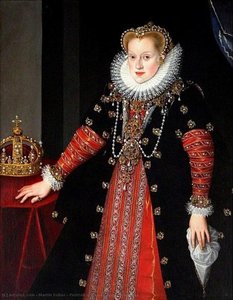
Portrait of Queen Anna Jagiellon in a widow costume by Marcin Kober captures the Polish monarch in a state of formal mourning. The work is dated about 1595. It belongs to a period when Kober served as a court painter, establishing a visual language for the Polish-Lithuanian Commonwealth through a blend of Renaissance realism and the decorative elegance of Spanish-influenced portraiture.

6
Miniature of Sigismund Vasa and Anna Habsburg (1598) door Marcin Kober

Miniature of Sigismund Vasa and Anna Habsburg

1598 · Ivory · Bayerische Staatsgemäldesammlungen, München

The Miniature of Sigismund Vasa and Anna Habsburg presents a quiet, intimate encounter between two figures of immense historical weight. Painted by the court artist Marcin Kober, this work captures the likenesses of Sigismund Vasa and Anna Habsburg in a moment of stillness. The piece dates to 1598. It focuses entirely on the two individuals, drawing the viewer into their immediate presence through a tightly framed composition.

7
Miniature of Anna Maria Vasa and Władysław Vasa (1598) door Marcin Kober

Miniature of Anna Maria Vasa and Władysław Vasa

1598 · Oil On Panel · Bayerische Staatsgemäldesammlungen, München

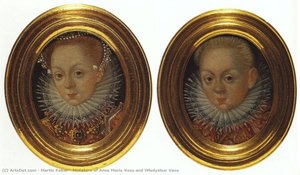
In this intimate Miniature of Anna Maria Vasa and Władysław Vasa, Marcin Kober presents us with a quiet encounter with the Vasa dynasty. Painted about 1598, the work captures two young individuals, likely members of the royal family, in a formal and dignified manner. There is a sense of stillness in their presentation, a characteristic of the courtly portraiture that Kober mastered during his service to the Polish-Lithuanian Commonwealth.

8
Portrait of Queen Anne of Austria (1595) door Marcin Kober

Portrait of Queen Anne of Austria

1595 · Oil On Canvas · Galleria degli Uffizi, Florence

Marcin Kober's “Portrait of Queen Anne of Austria” is more than just a painting; it’s a meticulously crafted window into the heart of 16th-century European courtly life. Completed around 1595, this remarkable work transcends mere portraiture, offering a profound glimpse into the power, grace, and carefully constructed image of Queen Anne – a woman who navigated the turbulent political landscape of Poland and Austria with both strength and diplomacy.

9
Portrait of King Stephen Báthory of Poland (1583) door Marcin Kober

Portrait of King Stephen Báthory of Poland

1583 · Oil On Canvas · Kunsthistorisches Museum, Wenen

Marcin Kober’s “Portrait of King Stephen Báthory of Poland,” painted in 1583, is more than just a royal likeness; it's a meticulously crafted window into the heart of late Renaissance Europe and the burgeoning power of the Polish-Lithuanian Commonwealth. This arresting portrait, now housed within the Congregation of Missions Convent’s Historical-Missionary Museum in Kraków, captures not merely the physical appearance of Stephen Báthory but also his commanding presence, projecting an…

De onderwerpen die de aandacht van Marcin Kober troffen

De vier onderwerpen die het meest voorkomen in deze originelen, elk met zijn mooiste voorbeeld.

De musea waar de originele werken van Marcin Kober worden bewaard

De 4 musea met de meeste schilderijen op deze pagina.

Museum Stad Werken van Marcin Kober Schilderijen uit deze lijst
Wawel Royal Castle, KrakauWawel Royal Castle Krakau 3 Miniature portrait of King Sigismund III Vasa, Portrait of Stephen Báthory, Portrait of Queen Anna Jagiellon in a widow costume
Galleria degli Uffizi, FlorenceGalleria degli Uffizi Florence 2 Miniature of Queen Anna Habsburg, Portrait of Queen Anne of Austria
Bayerische Staatsgemäldesammlungen, MünchenBayerische Staatsgemäldesammlungen München 2 Miniature of Sigismund Vasa and Anna Habsburg, Miniature of Anna Maria Vasa and Władysław Vasa
Kunsthistorisches Museum, WenenKunsthistorisches Museum Wenen 1 Portrait of King Stephen Báthory of Poland

Marcin Kober, de kenmerkende schilderijen van elk jaar

16 jaar aan kunst van Marcin Kober, van 1583 tot 1598: de galerie volgt hen jaar voor jaar, via de meest beroemde originelen van elk jaar.

Werken per jaar

Selecteer een jaar om de originele werken te bekijken.

Schilderijen van Marcin Kober: de galerie geeft antwoord

Welk schilderij van Marcin Kober is het beroemdste van allemaal?Onthul het antwoord

Miniature of Queen Anna Habsburg (1598), Galleria degli Uffizi, Florence. Miniature portrait of King Sigismund III Vasa (1591) en Portrait of King Stephen Bathory (1583) volgen.

Hoeveel werken heeft Marcin Kober gemaakt?Onthul het antwoord

Onze catalogus bevat 9 werken van Marcin Kober, daterend van 1583 tot 1598.

Waar hangen de beroemdste originele werken van Marcin Kober?Onthul het antwoord

Voornamelijk in Wawel Royal Castle (Krakau), Galleria degli Uffizi (Florence) en Bayerische Staatsgemäldesammlungen (München). De bovenstaande museumtabel bevat een volledig overzicht.

Wanneer creëerde Marcin Kober de beroemdste schilderijen?Onthul het antwoord

In 1598: 3 van de 9 werken op deze pagina werden toen gemaakt, waaronder Miniature of Queen Anna Habsburg.

Wat zijn de vroegste en laatste beroemde werken van Marcin Kober?Onthul het antwoord

Op deze pagina is het vroegste Portrait of King Stephen Bathory (1583) en het laatste Miniature of Queen Anna Habsburg (1598).

Welke onderwerpen keerde Marcin Kober het vaakst naar terug?Onthul het antwoord

Portrait (6), Man (4) en Baroque (3), verspreid over de 9 werken op deze pagina.

In welk medium werkte Marcin Kober het meest?Onthul het antwoord

Oil On Canvas, voor 5 van de 9 werken op deze pagina.

Bij welke stroming wordt Marcin Kober gerekend?Onthul het antwoord

Renaissance, te oordelen aan de originelen op deze pagina.

Welke originelen van Marcin Kober zijn in de collectie van het Wawel Royal Castle?Onthul het antwoord

Miniature portrait of King Sigismund III Vasa, Portrait of Stephen Báthory en Portrait of Queen Anna Jagiellon in a widow costume: het Wawel Royal Castle, Krakau herbergt 3 van de werken op deze pagina.

Marcin Kober: de kunstenaar

The Architect of Royal Identity: The Life and Legacy of Marcin Kober

In the grand, sweeping tapestry of Central European history, few artists have played as vital a role in weaving the visual identity of monarchs as Marcin Kober. Born around 1550 in the vibrant city of Wrocław, Poland, Kober was far more than a mere chronicler of faces; he was a pioneer who transformed the way power was perceived and recorded. His journey began not in the courts of kings, but through the rigorous discipline of the guild system. As a young journeyman, he traveled through Germany, absorbing the diverse techniques and stylistic nuances of various workshops. This period of wandering was essential, providing him with a cosmopolitan artistic vocabulary that would later allow him to bridge the gap between the local traditions of the Polish-Lithuanian Commonwealth and the sophisticated, Spanish-influenced aesthetics of the Habsburg courts.

The true metamorphosis of Kober’s career occurred when his path intersected with the highest echelons of European royalty. By 1583, he had arrived in the Polish-Lithuanian Commonwealth, quickly ascending to the position of court painter for King Stephen Báthory and Queen Anna Jagiellon. It was during this era that Kober began to develop what would become known as the "Báthory School." His work during this period was characterized by a profound sense of Renaissance realism, where the physical likeness of the subject was married to a symbolic grandeur. He did not simply paint skin and fabric; he painted authority, legitimacy, and the divine right of kings. His ability to capture the commanding presence of Báthory established a visual language for Polish royalty that would endure for well over a century.

A Master of Courtly Elegance and Symbolism

Kober’s artistic evolution was deeply shaped by his time in Prague, a city that served as a melting pot of international styles under the reign of Emperor Rudolf II. In the vibrant atmosphere of the Imperial court, Kober encountered the subtle, decorative elegance of Spanish portraiture, which favored a meticulous attention to detail and a refined use of color. This influence is palpable in his later works, where the heavy, regal textures of velvet and lace are rendered with such precision that they seem almost tactile. His portraits became masterclasses in psychological depth; he possessed a rare ability to present a sovereign as both an untouchable icon of state and a human being possessing quiet strength and introspective grace.

The breadth of his technical mastery is perhaps best seen in the diversity of his formats. While his large-scale royal portraits commanded the halls of palaces, Kober also excelled in the intimate medium of miniatures. His Miniature of Queen Anna Habsburg serves as a breathtaking example of how he could condense an entire aura of majesty into a small, oval frame. In these smaller works, every brushstroke carries weight, using light and shadow to create a sense of three-dimensional life that transcends the physical limitations of the medium. His work was never merely decorative; it was a carefully constructed instrument of diplomacy and propaganda, designed to project an image of stability and continuity during turbulent political eras.

Historical Significance and the Polish Portrait Tradition

The historical importance of Marcin Kober cannot be overstated. Before his emergence, portraiture in Poland had not yet established itself as a dominant or specialized branch of fine art. Kober changed this trajectory forever, acting as the precursor to the Polish Sarmatian portrait genre. By integrating the sophisticated humanist ideals of the Renaissance with the specific cultural identity of the Polish nobility, he provided the foundation upon which future generations of Polish artists would build. His influence can be traced through the decades, as the iconography he established for the Vasa dynasty became the standard for how the Commonwealth viewed its own leadership.

Even as his career took him across borders—from the workshops of Germany to the Imperial splendor of Prague and back to the royal centers of Kraków and Warsaw—his core mission remained the same: the documentation of a changing world through the lens of royal dignity. Today, his works reside in prestigious museums across Europe, serving as silent witnesses to the grandeur of a bygone era. To study Kober is to study the very birth of a national artistic identity, making him one of the most significant figures in the history of Central European portraiture.