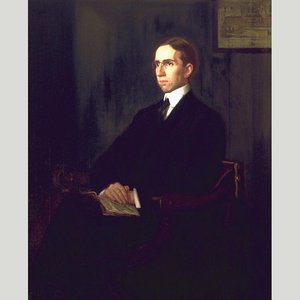
1858 - 1930

Hoogtepunten

  • Typical colors: phthalo green
  • Top-ranked work: Maria, (painting)
  • Died: 1930
  • Born: 1858, Detroit, United States
  • Also known as:
    • Julius C. Rolshoven
    • Rolshoven
    • ジュリアス・ロルショーヴェン
  • Color intensity:
    • monochromatic
    • balanced
  • Museums on this site:
    • El Paso Museum of Art
    • National Portrait Gallery
    • American Museum of Western Art

Julius Rolshoven: A Life in Art

Early Life and Education

  • Born: October 28, 1858, in Detroit, Michigan.
  • Rolshoven’s artistic journey began with formal training at the Cooper Union Art School in New York City.
  • He continued his studies abroad, first at the Düsseldorf Academy and then in Munich, seeking a rigorous academic foundation.
  • A pivotal moment came when he studied under Frank Duveneck in Venice and Florence, becoming one of the esteemed “Duveneck Boys.” This experience profoundly shaped his artistic style and approach.

Artistic Development and Influences

  • Duveneck’s Influence: Rolshoven absorbed Duveneck's emphasis on direct painting, realism, and a rejection of academic conventions. This influence is evident in his early portraits and genre scenes.
  • Years spent in Paris and London broadened his exposure to diverse artistic trends, but he ultimately found himself drawn back to the Italian Renaissance tradition.
  • His work reflects a blend of realism, impressionistic touches, and a keen eye for capturing character and atmosphere.

Life in Florence and “Castello del Diavolo”

  • In 1902, Rolshoven made the significant decision to settle in Florence, Italy.
  • Discovery of “Devil’s Castle”: In 1905, while painting outdoors, he stumbled upon a dilapidated castle known as "Castello del Diavolo" (Devil's Castle), belonging to the Talani family.
  • Enthralled by its charm and history, Rolshoven purchased the property in 1907 and embarked on an extensive restoration project. The estate became his home and a source of inspiration for decades.
  • The Italian government eventually recognized the Castello del Diavolo’s historical significance, designating it as a national monument, a testament to Rolshoven's dedication to its preservation.

Return to America and Southwestern Period

  • The outbreak of World War I prompted Rolshoven’s return to the United States in 1915. He married Harriette Haynes Blazo in Los Angeles.
  • Santa Fe and the Taos Society: By 1916, he had established a studio in Santa Fe, New Mexico, at the Governor’s Palace.
  • He became an early member of the prestigious Taos Society of Artists, contributing to the burgeoning art scene in the American Southwest.
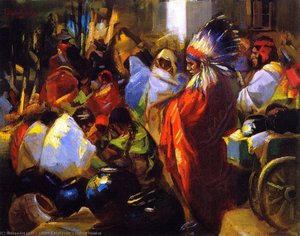
  • His Southwestern landscapes and depictions of Native American life reflect his adaptation to a new environment while maintaining his distinctive artistic style.

Later Life and Legacy

  • From 1920 until his death, Rolshoven divided his time between Florence, Detroit, and Santa Fe, reflecting his enduring connections to these places.
  • Death at Sea: He passed away on December 8, 1930, while traveling by ship across the Atlantic Ocean.
  • His widow, Harriette Haynes Blazo Rolshoven, generously donated a substantial sum and twenty of his artworks to the University of New Mexico in 1957, ensuring his legacy would be preserved and appreciated for generations to come.
  • Rolshoven’s work offers a glimpse into a cosmopolitan life, bridging European traditions with American landscapes and cultural encounters. His paintings continue to captivate viewers with their realism, sensitivity, and historical resonance.

Quiz

Er is slechts één goed antwoord op elke vraag.

Vraag 1:
Julius Rolshoven was significantly influenced by which artist and his school?
Vraag 2:
After studying in several European cities, Rolshoven ultimately settled for a significant period in which city?
Vraag 3:
What is the name of the historic building that captivated Rolshoven and he eventually purchased?
Vraag 4:
Rolshoven became an early member of which art society in the American Southwest?
Vraag 5:
Where did Rolshoven set up a studio after returning to the United States at the beginning of World War I?

Vraag en antwoord

Waar zijn de kunstwerken van Julius Rolshoven gegroepeerd per kunststroming te vinden?

De pagina Alle stromingen groepeert de kunstwerken van Julius Rolshoven op kunststroming.

Is er een virtuele 3D-rondleiding door de werken van Julius Rolshoven?

De kunstwerken van Julius Rolshoven zijn te bewonderen in een 3D-galerie op de 3D-galerie-pagina van de kunstenaar.

In welke perioden is de carrière van Julius Rolshoven onderverdeeld?

De carrière van Julius Rolshoven ontvouwt zich periode voor periode op de Loopbaanoverzicht pagina van de kunstenaar: een horizontale tijdlijn van de kunstwerken, gegroepeerd in hoofdstukken per carrièreperiode.

Waar kan ik de kunstwerken van Julius Rolshoven bekijken, gesorteerd op kleur?

De Sorteren op kleur van Julius Rolshoven biedt een overzicht van de kunstwerken van de kunstenaar, georganiseerd op kleur.

In welke historische periode werkte Julius Rolshoven?

Julius Rolshoven werkte in de 19th Century-periode. Deze periode plaatst het oeuvre van de kunstenaar in een historisch kader.

Is er een overzicht van alle onderwerpen die Julius Rolshoven heeft geschilderd?

De Onderwerpsindex-pagina brengt de kunstwerken van Julius Rolshoven in kaart op basis van onderwerp.

Waar komt Julius Rolshoven vandaan?

Julius Rolshoven werd geboren in United States.

In welke stad en welk land is Julius Rolshoven geboren?

Julius Rolshoven werd geboren in Detroit, in United States.

Waar kan ik het kleurprofiel van het oeuvre van Julius Rolshoven bekijken?

Het kleurgebruik van Julius Rolshoven in de werken die op deze website worden vermeld, kan worden bestudeerd op de Kleurenpalet van de kunstenaar pagina van de kunstenaar.