The Visionary Brush of Joseph Syddall
In the quiet, storied landscapes of the late Victorian and Edwardian eras, few artists captured the delicate intersection of social grace and atmospheric beauty as poignantly as Joseph Syddall. Born in Derby in 1864, Syddall emerged from a period of profound transition, where the rigid structures of the nineteenth century were beginning to soften under the influence of modern light and movement. His journey into the heart of the British art scene was marked by a rigorous pursuit of excellence, beginning with his formative studies at the prestigious Royal Academy in London. It was here that he began to cultivate the meticulous eye for detail that would later define his legacy, blending a classical foundation with an burgeoning fascination for the Impressionistic movement.
Syddall’s artistic evolution was deeply enriched by his exposure to the vibrant art scenes of continental Europe. The influence of Parisian aesthetics breathed new life into his work, encouraging him to look beyond mere anatomical precision toward the ephemeral qualities of light and atmosphere. This stylistic synthesis allowed him to master the art of the sfumato effect, where edges softened and colors bled into one another to evoke a sense of lived experience. His technique was characterized by remarkably smooth brushstrokes and subtle tonal gradations, creating canvases that felt less like static images and more like windows into a tranquil, bygone world. Whether he was rendering the interior of a sun-drenched room or the textured impasto of a Derbyshire landscape, his hand remained guided by a desire for profound realism.
A Legacy of Portraits and Landscapes
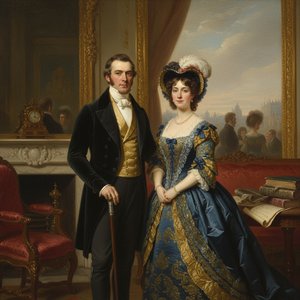
The breadth of Syddall’s oeuvre is a testament to his versatility and his deep connection to the social fabric of his time. He became a sought-after portraitist, earning the trust of the aristocracy, prominent businessmen, and fellow artists who wished to immortalize their likenesses through his refined lens. These portraits were more than mere likenesses; they were psychological studies that captured the dignity and domestic tranquility of the era. Beyond the studio, Syddall found immense inspiration in the natural world, producing works that celebrated the serene beauty of the English countryside. His paintings, such as Hasland House, Derbyshire, showcase a masterful use of muted tones to evoke a sense of historical weight and pastoral peace.
Among his most enduring contributions to the art historical record are works that capture the social dynamics of leisure. His celebrated painting, ‘The Tennis Party’ (1914), serves as a vibrant, Impressionistic tableau of Edwardian life, frozen in a moment of joyful social interaction. This piece, currently held within the Chesterfield Museum and Art Gallery, exemplifies his ability to weave human emotion into a larger narrative of cultural movement. His repertoire also extended into more evocative, singular subjects, ranging from the atmospheric Pêcheur de nuit to the pastoral charm of The Orchard, each piece reflecting a different facet of his observational mastery.
Historical Significance and Artistic Heritage
Though the passage of time has often obscured the names of many regional masters, the significance of Joseph Syddall remains anchored in his role as a chronicler of British life. His work serves as a vital visual archive of the late 19th and early 20th centuries, preserving the textures, fashions, and social nuances of a world on the brink of modernity. Influenced by the classical compositions of Frederic Leighton and the naturalistic precision of Jules Bastien-Lepage, Syddall bridged the gap between traditional academicism and the emotive freedom of modernism.
Today, his legacy is preserved through the collections of institutions like the Chesterfield Museum, where his paintings continue to invite viewers into a period of elegance and quiet reflection. His life’s work—comprising approximately 300 paintings—stands as a monumental achievement in British portraiture and landscape art, reminding us of the power of the brush to capture not just the sight of a moment, but its very soul.
Vraag & Antwoord
Hoe vind ik werken van Joseph Syddall met een specifiek thema?
Om werken van Joseph Syddall met een specifiek thema te vinden, kunt u de Op trefwoorden pagina van de kunstenaar gebruiken, waarop de kunstwerken per trefwoord zijn gegroepeerd.
Hoe populair zijn de kunstwerken van Joseph Syddall?
Er bestaat een Statistieken-pagina voor Joseph Syddall, met statistieken over de kunstwerken van de kunstenaar op deze website.
Hoeveel kunstwerken van Joseph Syddall zijn beschikbaar om te bekijken?
U kunt 32 kunstwerken werken van Joseph Syddall bekijken op de Alle kunstwerken-pagina.
Hoe kan ik alle kunstwerken van Joseph Syddall bekijken?
Alle werken van Joseph Syddall op deze website zijn te bekijken op de Alle kunstwerken pagina van de kunstenaar.
Waar kan ik de kunstwerken van Joseph Syddall bekijken in een 3D-galerie?
Een virtueel bezoek is mogelijk: de 3D-museum pagina van Joseph Syddall presenteert de werken van de kunstenaar in een driedimensionale galerie.
Waar zijn de kunstwerken van Joseph Syddall gegroepeerd per techniek te vinden?
De pagina Alle media groepeert de kunstwerken van Joseph Syddall op techniek.
In welke historische periode werkte Joseph Syddall?
Joseph Syddall werkte in de 19th Century-periode. Deze periode plaatst het oeuvre van de kunstenaar in een historisch kader.