Joan Kathleen Harding Eardley (1921–1963): A Visionary Bridging Realism and Emotion
Joan Kathleen Harding Eardley, a name synonymous with the raw beauty of Scotland and the poignant realities of post-war life, remains one of Britain’s most compelling artists. Born in 1921 in Sussex to parents grappling with the lingering shadows of the First World War – her father suffering from shell shock – Eardley's early years were marked by instability that perhaps fostered within her a deep empathy for those living on the fringes of society. This sensitivity would become a defining characteristic of her artistic vision. Her family’s move to Glasgow in 1939 proved pivotal, leading her to enroll at the Glasgow School of Art, where she honed her skills under Hugh Adam Crawford and absorbed the vibrant legacy of the Scottish Colourists. Though briefly diverted into teacher training, Eardley's spirit yearned for creative expression, finding a temporary outlet as a joiner’s apprentice – a practical pursuit that nonetheless allowed space for artistic exploration.- Early Life & Influences:
- Glasgow School of Art & The Scottish Colourists
- Travel to Italy: Renaissance Inspiration
- The Glasgow Street Children Project
- Catterline Landscapes & Late Style
Glasgow School of Art & The Scottish Colourists
Eardley’s artistic journey began at the Glasgow School of Art in 1948, where she studied under Hugh Adam Crawford and was profoundly influenced by the stylistic innovations of the Scottish Colourists – Samuel John Peploe and Francis Cadell. These artists championed bold palettes and expressive brushwork, prioritizing emotion over meticulous detail—a technique that would permeate Eardley’s own oeuvre. The legacy of Peploe and Cadell instilled in her a belief that art should capture not just what is seen but how it *feels*, shaping her approach to portraying the human condition. Crawford encouraged her to explore sculptural forms, mirroring the humanist ideals prevalent in Renaissance art, particularly those championed by Giotto and Masaccio.Travel to Italy: Renaissance Inspiration
A scholarship enabled Eardley to embark on a transformative journey through Italy in 1948. Immersed in the grandeur of Florence and Rome, she encountered masterpieces that captivated her imagination—works by Michelangelo and Raphael—inspiring her to adopt a similar sculptural sensibility. The experience solidified her conviction that art should strive for depth and resonance, mirroring the profound contemplation evoked by the Renaissance masters.The Glasgow Street Children Project
Returning to Glasgow in 1949, Eardley established herself as an artist at Cochrane Street, where she began documenting the lives of children residing in the city’s impoverished tenement districts. Her portraits of these youngsters—rendered in charcoal and imbued with remarkable tenderness—became emblematic of her artistic mission: to portray social realities with unflinching honesty while simultaneously conveying compassion. These weren't sentimental depictions; they were powerful statements about poverty and resilience, captured with a visceral energy that resonated deeply with contemporaries like Peter Blake and John Bratby.Catterline Landscapes & Late Style
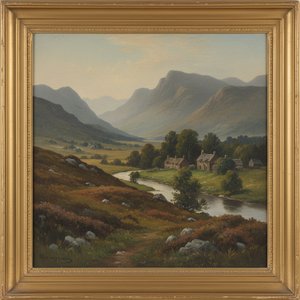
In 1951 Eardley discovered Catterline, a remote fishing village on Scotland’s northeast coast, where she would spend her formative years as an artist. Drawn to the dramatic vistas of the sea and sky—influenced by artists like Chaim Soutine and Wassily Kandinsky—Eardley embraced bolder techniques, experimenting with impasto and incorporating natural materials directly onto her canvases. Her later works demonstrated a move towards greater abstraction, yet they remained firmly rooted in observation, conveying not just what she *saw*, but how it *felt* to be present in that landscape. She famously remarked that she would never go completely abstract, preferring instead to honor the immediacy of experience.Legacy & Enduring Influence
Tragically, Joan Eardley’s artistic career was cut short by breast cancer in 1963 at the age of just forty-two. Despite her brief life, she left behind a substantial body of work that continues to inspire artists today—particularly her poignant portraits of Glasgow street children and her evocative landscapes of Catterline. Her unwavering commitment to portraying human dignity alongside social injustice cemented her place in art history as a visionary artist whose voice persists long after her passing.Vraag & Antwoord
Hoeveel kunstwerken van Joan Kathleen Harding Eardley zijn beschikbaar om te bekijken?
U kunt 43 kunstwerken werken van Joan Kathleen Harding Eardley bekijken op de Alle kunstwerken-pagina.
Hoe kan ik het werk van Joan Kathleen Harding Eardley jaar voor jaar volgen?
De Tijdlijn kunstwerken pagina van de kunstenaar presenteert de werken van Joan Kathleen Harding Eardley, chronologisch geordend per jaar.
Kan ik het kleurgebruik van Joan Kathleen Harding Eardley in al het werk bestuderen?
Het kleurprofiel van het werk van Joan Kathleen Harding Eardley is te vinden op de Paletgenoom pagina van de kunstenaar.