

1


Bijgewerkt in november 2026 · gerangschikt op basis van onze populariteitsscore (zoekopdrachten, bezoeken en bestellingen per kunstwerk) · 2 werken van Jacopo Ripanda in onze catalogus
Kortom
Volgens de visie van de galerie is het beroemdste schilderij van Jacopo Ripanda Naval Combat, waarvan het origineel in het Capitoolse Musea in Rome hangt. Van de 2 werken van Jacopo Ripanda in onze catalogus presenteert de galerie hieronder de 2 bekendste werken, elk een origineel met de jaartal, het museum en wat het uniek maakt.

Een Fascinerende Kijk Op De Oudheid Door Jacopo Ripanda Jacopo Ripanda (c. 1401 – Rome, c. 1516) blijft een figuur gehuld in mysterie—een Renaissance kunstenaar waarvan zijn briljantie voornamelijk schoot door zijn uitzonderlijke observatie en ongeëvenaarde bekwaamheid om het grandeur van de oudheid vast te leggen. Ondanks dat biografische gegevens schaars zijn, schilderen overlevende bewijs een portret van een bijzonder getalenteerde Bolognese kunstenaar die pauselijke bescherming aantrok en zichzelf veiligstelde…
De 2 musea met de meeste schilderijen op deze pagina.
| Museum | Stad | Werken van Jacopo Ripanda | Schilderijen uit deze lijst |
|---|---|---|---|
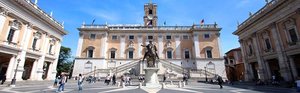 Capitoolse Musea |
Rome | 1 | Naval Combat |
 Palazzo dei Conservatori |
Rome | 1 | Nep Neptunus en Amphitrite |
Elk gedateerd origineel van Jacopo Ripanda op deze pagina is gemaakt in 1505: hier zijn ze, de bekendste eerst.
Selecteer een jaar om de originele werken te bekijken.
Een Fascinerende Kijk Op De Oudheid Door Jacopo Ripanda Jacopo Ripanda (c. 1401 – Rome, c. 1516) blijft een figuur gehuld in mysterie—een Renaissance kunstenaar waarvan zijn briljantie voornamelijk schoot door zijn uitzonderlijke observatie en ongeëvenaarde bekwaamheid om het grandeur van de oudheid vast te leggen. Ondanks dat biografische gegevens schaars zijn, schilderen overlevende bewijs een portret van een bijzonder getalenteerde Bolognese kunstenaar die pauselijke bescherming aantrok en zichzelf veiligstelde…
Naval Combat
Onze catalogus bevat 2 werken van Jacopo Ripanda.
Voornamelijk in Capitoolse Musea (Rome) en Palazzo dei Conservatori (Rome). De bovenstaande museumtabel bevat een volledig overzicht.
Jacopo Ripanda lived a life that felt deeply connected to the stones and shadows of ancient Rome. Though he was born in Bologna, his heart belonged to the ruins of the imperial past. Very little is known about his early years or the specific moments that shaped his youth, but he emerged from the artistic circles of his home city, learning under masters like Ercole Grandi and Lorenzo Costa. These teachers provided him with a foundation in the Emilian tradition, yet Ripanda sought something more than the devotional subjects common to his peers. He looked toward the weathered marble and the silent monuments left behind by a lost era.
His time in Rome during the reign of Pope Alexander VI changed everything. It was here that he began to look at the city not just as a resident, but as an observer seeking truth in detail. He became famous for a peculiar and clever invention: a viewing device consisting of a sighting tube and a plumb bob. This simple tool allowed him to see the far-off carvings on Trajan’s Column with a clarity that others could not achieve. By using this apparatus, he could resolve distant friezes and capture the minute details of the stone. This method brought a new level of accuracy to his drawings and sparked much conversation among the scholars of his day.
The patronage of the papacy provided Ripanda with the opportunity to leave his mark on the very walls of Rome. Under Alexander VI, he was entrusted with painting four rooms in the Palazzo dei Conservatori on the Capitoline Hill. These rooms were intended to tell stories from classical history. The Sala di Annibale and the Sala della Lupa remain as the most visible parts of this work. In these spaces, his style merged the soft influences of his Bolognese training with a new, rigorous focus on Roman antiquity. He used light and shadow to give form to his figures, much like the architectural precision he practiced when studying the city's monuments.
His work was not limited to the halls of power. In 1505, he painted frescoes in the Palazzo Doria-Pamphili that depicted the lives of Julius Caesar and Trajan. These works used a technique called chiaroscuro to create depth and presence. While some of his later projects, including commissions for the Vatican, were halted when Pope Julius II took office, his influence continued through others. His detailed drawings of Roman designs were eventually published as engravings by Girolamo Muziano in 1576, long after Ripanda himself had passed away.
The legacy of this painter is found in the way he bridged the gap between scientific observation and artistic expression. He did not merely paint what he imagined; he painted what he could prove to be true through measurement and sight. His approach left a mark on later artists like Baldassare Peruzzi and Michelangelo, who would also grapple with the challenge of depicting monumental architecture with accuracy. Even as his personal biography remains largely hidden by time, the precision of his gaze remains visible in the history of Roman art.