Portret van François Bonvin

De 68 beroemdste schilderijen van François Bonvin, elk uniek

Bijgewerkt in november 2026 · gerangschikt op basis van onze populariteitsscore (zoekopdrachten, bezoeken en bestellingen per kunstwerk) · 70 werken van François Bonvin in onze catalogus

Kortom

Woman Ironing (1858) is het schilderij van François Bonvin dat de meeste aandacht trekt; het origineel bevindt zich in het Philadelphia Museum of Art, Philadelphia. Daarna gaat de blik naar Sophie Unternährer at her easel (1848) en Woman Playing Games (1853). Van de 70 werken van François Bonvin in onze catalogus zijn dit de 68 bekendste, elk een uniek origineel gepresenteerd met het jaar, het museum en de reden waarom het blijft voortbestaan.

1817 – 1887, Parijs Realism Meeste werken: Burrell Collection

Top 10 schilderijen van François Bonvin, door de ogen van de galerie

1
Woman Ironing (1858) door François Bonvin

Woman Ironing

1858 · Oil · Philadelphia Museum of Art, Philadelphia

A single woman leans into her labor. The scene is tight, a quiet corner of a room where the air feels heavy with the scent of heated fabric. She is bent over her task, her body forming a soft curve against the stark, bright white of the linens. The light does not flood the room; it strikes only what is necessary. It catches the ridge of her shoulder, the pale…

2
Sophie Unternährer at her easel (1848) door François Bonvin

Sophie Unternährer at her easel

1848 · Oil

The studio is swallowed by shadow, leaving only a single, concentrated pool of light to illuminate the scene. Within this luminous circle, Sophie Unternährer leans toward her canvas, her entire being pulled into the act of making. She is a figure of intense focus, caught in a private stillness that feels almost sacred. The light, spilling from the upper left, catches the heavy, creamy folds of her voluminous white dress,…

3
Woman Playing Games (1853) door François Bonvin

Woman Playing Games

1853 · Oil On Panel · Centraal Museum, Utrecht

The oil painting titled Woman Playing Games captures a singular, quiet moment of domesticity. Created by the French artist François Bonvin, the work belongs to the genre art tradition. It focuses on the private, unadorned rhythms of daily life, finding weight in the stillness of a single figure.

5
The Embroideress (La Brodeuse) (1857) door François Bonvin

The Embroideress (La Brodeuse)

1857 · Oil · Museum Gouda, Gouda

The Embroideress (La Brodeuse) is a realist oil painting from 1857 that captures a solitary woman immersed in the quiet task of embroidery. The composition is centered on the seated figure, creating an atmosphere of domestic devotion and stillness. The scene is characterized by a dark, muted color palette of deep blacks and browns, which serves to highlight the stark white of the woman's collar and the warm, reddish-orange hue…

6
Drawing Water (1858) door François Bonvin

Drawing Water

1858 · Oil On Canvas · Walters Art Museum, Baltimore

In "Drawing Water" by François Bonvin, a quiet moment of domestic labor unfolds within a vertically oriented space. The scene captures a solitary woman engaged in her daily chore, positioned slightly to the right of center. She leans toward a water dispenser, her form defined by the steady rhythm of her task. In the immediate foreground, a bucket sits waiting, grounding the viewer in this intimate, private sphere. The perspective…

7
Ave Maria : interior of the  Aramont convent (1870) door François Bonvin

Ave Maria : interior of the Aramont convent

1870 · Oil On Canvas · Musée d'Orsay, Parijs

The scene unfolds within the quietude of Ave Maria : interior of the Aramont convent, a work that captures a moment of stillness through the eyes of François Bonvin. This painting emerges from the year 1870, offering a glimpse into a world of devotion and architectural weight. The atmosphere feels heavy with the presence of the past, as if the very air within the convent holds its breath.

8
Woman in White (1865) door François Bonvin

Woman in White

1865 · Oil On Canvas · Musée des Beaux-Arts, Reims

In Woman in White, François Bonvin captures a moment of quietude through a vertically oriented composition. The subject is positioned slightly off-center, a profile of a woman seen from the side. She gazes downward, her eyes cast toward an unseen point below. This posture creates a sense of stillness against a dark, indistinct background that offers no distraction from her form. The space around her feels heavy and silent.

10
Interior of a Tavern (1867) door François Bonvin

Interior of a Tavern

1867 · Oil On Canvas · Walters Art Museum, Baltimore

In Interior of a Tavern by François Bonvin, we find ourselves within a quiet, somber moment of 19th-century life. The scene is anchored by a woman in a red bodice and white apron, who occupies the center of the composition. To her left, a man sits quietly at a wooden table, while to her right, a standing man wearing a red vest and a dark hat directs his gaze toward…

De beroemde schilderijen van François Bonvin, nummer 11 tot 68

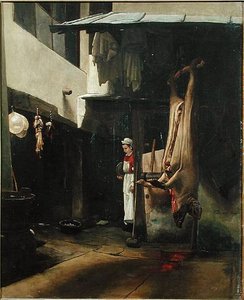
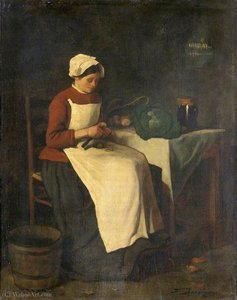
11Young Woman with a Mandolin, Portrait of Louison Köhler (1873) door François BonvinYoung Woman with a Mandolin, Portrait of Louison Köhler1873 · Cleveland Museum of Art 12The Scrubber (1887) door François BonvinThe Scrubber1887 · Musée des Beaux-Arts 13La Servante indiscrete (1871) door François BonvinLa Servante indiscrete1871 · Art Gallery of Hamilton 14Still Life with Oyster (1860) door François BonvinStill Life with Oyster1860 · Yale University Art Gallery 15Still Life with Asparagus (1867) door François BonvinStill Life with Asparagus1867 · Kröller-Müller Museum 16Attributes of Music (1863) door François BonvinAttributes of Music1863 · Cleveland Museum of Art 17Still Life (1858) door François BonvinStill Life1858 · Museum of Fine Arts, Houston 18Landscape with Barn (1869) door François BonvinLandscape with Barn1869 · Museum Gouda 19Still Life with Oysters (1865) door François BonvinStill Life with Oysters1865 · National Gallery of Ireland 20Still life with cherries. (1865) door François BonvinStill life with cherries.1865 · Museum of John Paul II Collection 21The Candlestick (Still Life with Candle) (1878) door François BonvinThe Candlestick (Still Life with Candle)1878 · Museum Gouda 22Still Life with Grapes (1877) door François BonvinStill Life with Grapes1877 · Museum Gouda 23Still Life with Clogs (1875) door François BonvinStill Life with Clogs1875 · Museum Gouda 24Port-Marly (1872) door François BonvinPort-Marly1872 · Musée d'Orsay 25The Trio (1880) door François BonvinThe Trio1880 · Centraal Museum 26Still Life with Vegetables (1880) door François BonvinStill Life with Vegetables1880 · Museum Gouda 27Still Life With Brass Kettle (1883) door François BonvinStill Life With Brass Kettle1883 · Museum Boijmans Van Beuningen 28Still life, two glazed earthenware pots. (1887) door François BonvinStill life, two glazed earthenware pots.1887 · Musée des Beaux-Arts de Rouen 29Femme lisant door François BonvinFemme lisantMusée Fabre 30'Miss' door François Bonvin'Miss'Burrell Collection 31The Butcher door François BonvinThe Butcher 32A woman ironing door François BonvinA woman ironingNational Museum Cardiff 33Two countrywomen door François BonvinTwo countrywomenBowes Museum 34The winder door François BonvinThe winder 35The Blacksmiths, Memory of Treport door François BonvinThe Blacksmiths, Memory of Treport 36Still life, François Bonvin, 1871 (1871) door François BonvinStill life, François Bonvin, 18711871 · Rijksmuseum 37Stilleven met vier vruchten, glas en aardewerk, François Bonvin, 1827 - 1887 (1887) door François BonvinStilleven met vier vruchten, glas en aardewerk, François Bonvin, 1827 - 18871887 · Rijksmuseum 38Still Life door François BonvinStill LifeMusée des Beaux-Arts 39Still life door François BonvinStill lifeYork Art Gallery 40Still Life with Jar of Cherries door François BonvinStill Life with Jar of Cherries 41Woman at a Spinet door François BonvinWoman at a SpinetBurrell Collection 42The crow door François BonvinThe crowBurrell Collection 43Interior of a Tavern door François BonvinInterior of a Tavern 44Grandmamma's breakfast door François BonvinGrandmamma's breakfastBowes Museum 45Still Life with a Copper Pot door François BonvinStill Life with a Copper PotBurrell Collection 46The violin door François BonvinThe violinBurrell Collection 47The meadow door François BonvinThe meadowNational Gallery 48The young housewife door François BonvinThe young housewifeNational Museum Cardiff 49The Letter of Recommendation door François BonvinThe Letter of Recommendation 50Housemaid At The Wasserholen door François BonvinHousemaid At The WasserholenMusée d'Orsay 51Oysters door François BonvinOystersBurrell Collection 52Interior door François BonvinInteriorFitzwilliam Museum 53Charity door François BonvinCharity 54Still Life with Game door François BonvinStill Life with GameBurrell Collection 55Still Life with Oysters, a Wine Bottle and a Glass of Wine door François BonvinStill Life with Oysters, a Wine Bottle and a Glass of WineBurrell Collection 56Peasant knitting door François BonvinPeasant knitting 57Still Life with Book, Papers and Inkwell door François BonvinStill Life with Book, Papers and InkwellNational Gallery 58Still Life with Apples and a Silver Goblet door François BonvinStill Life with Apples and a Silver GobletKelvingrove Art Gallery and Museum 59Interior with an Old Woman Kneeling door François BonvinInterior with an Old Woman Kneeling 60The Attributes of Painting door François BonvinThe Attributes of PaintingBarber Institute of Fine Arts 61Nature morte door François BonvinNature morteBerwick Museum and Art Gallery 62Still Life with a Tobacco Pot and a Pipe door François BonvinStill Life with a Tobacco Pot and a PipeBurrell Collection 63Still Life with a Jug, Cheese, Onions, Fish and a Knife door François BonvinStill Life with a Jug, Cheese, Onions, Fish and a KnifeBurrell Collection 64Still Life with a Glass, Pears and a Knife door François BonvinStill Life with a Glass, Pears and a KnifeBurrell Collection 65Still Life with Asparagus door François BonvinStill Life with AsparagusScottish National Gallery 66Still Life with a Book and an Ink Well door François BonvinStill Life with a Book and an Ink WellBurrell Collection 67Still Life with Vegetables and Cooking Utensils door François BonvinStill Life with Vegetables and Cooking UtensilsBurrell Collection 68Self portrait door François BonvinSelf portraitBowes Museum

De onderwerpen die de aandacht van François Bonvin troffen

De vier onderwerpen die het meest voorkomen in deze originelen, elk met zijn mooiste voorbeeld.

De musea waar de originele werken van François Bonvin worden bewaard

De 8 musea met de meeste schilderijen op deze pagina.

Museum Stad Werken van François Bonvin Schilderijen uit deze lijst
Burrell Collection, GlasgowBurrell Collection Glasgow 13 'Miss', Woman at a Spinet, The crow
Museum Gouda, GoudaMuseum Gouda Gouda 6 The Embroideress (La Brodeuse), Landscape with Barn, The Candlestick (Still Life with Candle)
Musée d'Orsay, ParijsMusée d'Orsay Parijs 3 Ave Maria : interior of the Aramont convent, Port-Marly, Housemaid At The Wasserholen
Bowes Museum, Barnard CastleBowes Museum Barnard Castle 3 Two countrywomen, Grandmamma's breakfast, Self portrait
Centraal Museum, UtrechtCentraal Museum Utrecht 2 Woman Playing Games, The Trio
Walters Art Museum, BaltimoreWalters Art Museum Baltimore 2 Drawing Water, Interior of a Tavern
Musée des Beaux-Arts, ReimsMusée des Beaux-Arts Reims 2 Woman in White, The Scrubber
Cleveland Museum of Art, ClevelandCleveland Museum of Art Cleveland 2 Young Woman with a Mandolin, Portrait of Louison Köhler, Attributes of Music

François Bonvin door de decennia heen: elk een uniek origineel

Werken per decennium

Kies een decennium om het origineel te zien dat dit tijdperk definieert.

Schilderijen van François Bonvin: vragen voor de galerie

Wat is het bekendste werk van François Bonvin?Onthul het antwoord

Woman Ironing (1858), Philadelphia Museum of Art, Philadelphia. Sophie Unternährer at her easel (1848) en Woman Playing Games (1853) volgen.

Op welke leeftijd creëerde François Bonvin Woman Ironing?Onthul het antwoord

41 jaar oud: Woman Ironing dateert uit 1858, en François Bonvin werd geboren in 1817.

Welke tien schilderijen van François Bonvin zijn het meest bekend?Onthul het antwoord

Woman Ironing, Sophie Unternährer at her easel, Woman Playing Games, The Guitar Player, The Embroideress (La Brodeuse), Drawing Water, Ave Maria : interior of the Aramont convent, Woman in White, Portrait of a Seated Woman en Interior of a Tavern. De bovenstaande ranglijst vermeldt het jaar en het museum van elk werk.

Hoeveel werken van François Bonvin zijn er bekend?Onthul het antwoord

Onze catalogus bevat 70 werken van François Bonvin, daterend van 1848 tot 1887.

Waar kunnen de beroemdste originelen van François Bonvin worden bekeken?Onthul het antwoord

Voornamelijk in Burrell Collection (Glasgow), Museum Gouda (Gouda) en Musée d'Orsay (Parijs). De bovenstaande museumtabel bevat een volledig overzicht.

In welke periode creëerde François Bonvin de bekendste schilderijen?Onthul het antwoord

In 1870s: 9 van de 68 werken op deze pagina werden toen gemaakt, waaronder Ave Maria : interior of the Aramont convent.

Welk beroemd schilderij van François Bonvin is de vroegste, en welke de laatste?Onthul het antwoord

Op deze pagina is het vroegste Sophie Unternährer at her easel (1848) en het laatste The Scrubber (1887).

Welke onderwerpen had François Bonvin de voorkeur?Onthul het antwoord

Woman (12), Life (12) en Table (5), verspreid over de 68 werken op deze pagina.

Met welke materialen schilderde François Bonvin het meest?Onthul het antwoord

Oil On Canvas, voor 10 van de 68 werken op deze pagina.

Bij welke stroming behoort het werk van François Bonvin?Onthul het antwoord

Realism en Contemporary realism, te oordelen aan de originelen op deze pagina.

Welke originele werken van François Bonvin kan ik zien in het Burrell Collection?Onthul het antwoord

'Miss', Woman at a Spinet en The crow: het Burrell Collection, Glasgow herbergt 13 van de werken op deze pagina.

François Bonvin: een portret van de kunstenaar

De Stille Beschouwer: Het Leven en de Nalatenschap van François Bonvin

In het bruisende, transformerende landschap van het negentiende-eeuwse Parijs, waar de schaduwen van de Industriële Revolutie begonnen te groeien over de kasseien van de stad, bestond een schilder die een diepe schoonheid vond in de meest bescheiden uithoeken van het bestaan. François Bonvin (1817–1887) was geen chroniqueur van grote historische veldslagen of mythologische epen; in plaats daarvan was hij een meester van het intieme, een realist wiens penseel de stille waardigheid van het alledaagse vastlegde. Zijn leven, getekend door vroege tegenspoed en een veerkrachtige geest, weerspiegelde de zeer onderwerpen die hij schilderde—onverbloemd, eerlijk en diep menselijk.

Geboren in bescheiden omstandigheden als zoon van een politieagent en een naaister, was de jeugd van Bonvin ver verwijderd van de geromantiseerde versie van het Parijse leven die vaak in de literatuur wordt beschreven. Het verlies van zijn moeder aan tuberculose toen hij pas vier jaar oud was, maakte hem kwetsbaar voor een wereld van schaarste en verwaarlozing. Opgevoed in een druk huishouden met talrijke broers en zussen, en geconfronteerd met de harde realiteit van een ondervoede opvoeding, gaven deze vroege strijd hem een diep empathisch vermogen voor de gemarginaliseerden. Het was deze gevoeligheid die later zijn artistieke visie zou definiëren, waardoor hij de poëtische waarde kon zien in een eenvoudig mandje fruit of de stille arbeid van een huishoudster.

Een Reis door Licht en Schaduw

Bonvins weg naar het kunstenaarschap was evenzeer een product van doorzettingsvermogen als van talent. Hoewel zijn formele opleiding begon aan de École de dessin, gesteund door de vrijgevigheid van een familievriend, vond het grootste deel van zijn ware ontwikkeling plaats door eenzame toewijding en zelfstudie. Zijn tijd als leerling bij een drukker gaf hem een gedisciplineerd oog voor detail, maar het waren zijn frequente pelgrimages naar het Louvre die zijn ziel werkelijk vormgaven. Daar, te midden van de meesterwerken uit het verleden, vond hij zijn spirituele voorvaderen. Hij raakte diep verboeid door de Hollandse Meesters, in het bijzonder het dramatische chiaroscuro van Rembrandt en de levendige penseelvoering van Frans Hals.

Deze fascinatie voor Noord-Europese tradities stelde Bonvin in staat een techniek te ontwikkelen die uniek voor hem was—een versmelting van Franse precisie en de Nederlandse tonale diepte. Hij beheerste de kunst van het vangen van licht zoals het valt op uiteenlopende texturen: de koude glans van een metalen beker, de zachte dons van een rijpende aardbei, of het zware, organische gewicht van een oesterschelp. Zijn werk kenmerkt zich vaak door een gedempt, aards palet dat de schreeuwerigheid van hedendaagse trends vermijdt, en kiest in plaats daarvan voor een genuanceerde gradatie van tinten die een gevoel van tastbare atmosfeer en stilte creëert.

De Kunst van het Alledaagse

De betekenis van Bonvins oeuvre ligt in het vermogen om het banale naar het monumentale te verheffen. Zijn schilderijen fungeren vaak als vensters naar de private, huiselijke sferen van het negentiende-eeuwse Frankrijk. Of hij nu een stilleven met vier vruchten afbeeldt of de aangrijpende scène van Een Vrouw die strijkt, er is een onmiskenbaar gevoel van aanwezigheid en respect voor het onderwerp. Hij zocht er niet naar de realiteit te embelleren, maar om haar te eren.

Zijn bijdragen aan de Realistische beweging kunnen worden samengevat aan de hand van enkele cruciale artistieke kenmerken:

  • Meesterschap in Textuur: Een voortreffelijk vermogen om de tactiele kwaliteiten van voedsel, keramiek en stof weer te geven.
  • Chiaroscuro Invloed: Het gebruik van dramatisch licht en schaduw om diepte en emotionele resonantie te creëren.
  • Empathisch Realisme: Een focus op de waardigheid van het gewone leven en de schoonheid die men vindt in de huiselijkheid.
  • Tonale Nuance: Een verfijnde benadering van kleur die de voorkeur geeft aan subtiele, atmosferische overgangen boven felle pigmenten.

Hoewel hij wellicht niet de brede roem heeft bereikt van zijn tijdgenoten zoals Courbet, blijft François Bonvin een vitale figuur voor hen die de ziel zoeken in het gewone. Zijn nalatenschap is te vinden in elke penseelstreek die het stille, het over het hoofd geziene en de blijvend mooie aspecten van onze gedeelde menselijke ervaring viert.