Kortom
Van alle originele werken die Fairlie Harmar heeft nagelaten, is After A Game Of Tennis (1923) het bekendst, in de collectie van het Birmingham Museum and Art Gallery, Birmingham. Direct daarna volgen St Giles, Oxford en The Bridge at Monxton (1916). Onze catalogus bevat 18 werken van Fairlie Harmar; de galerie heeft de 18 meest bewonderde werken ter wereld bewaard, elk voorzien van de datum, het museum en het verhaal erachter.
De top 10 schilderijen van Fairlie Harmar: de selectie van de galerie
De selectie van Fairlie Harmar gaat verder, van 11 tot 18
De onderwerpen die de aandacht van Fairlie Harmar troffen
De vier onderwerpen die het meest voorkomen in deze originelen, elk met zijn mooiste voorbeeld.
British painting 2 werken
De musea waar de originele werken van Fairlie Harmar worden bewaard
De 5 musea met de meeste schilderijen op deze pagina.
| Museum | Stad | Werken van Fairlie Harmar | Schilderijen uit deze lijst |
|---|---|---|---|
| Wolverhampton | 2 | Ships on the Thames, Flowers | |
| Birmingham | 1 | After A Game Of Tennis | |
| Liverpool | 1 | The Bridge at Monxton | |
| Oxford | 1 | The Laurel Walk | |
| Darlington | 1 | Chibbet, Exmoor, Somerset |
Fairlie Harmar decennium voor decennium: het origineel dat elk tijdperk definieert
Werken per decennium
Kies een decennium om het origineel te zien dat dit tijdperk definieert.
Vragen van verzamelaars over de schilderijen van Fairlie Harmar
Waar is Fairlie Harmar het meest bekend om?Onthul het antwoord
After A Game Of Tennis (1923), Birmingham Museum and Art Gallery, Birmingham. St Giles, Oxford en The Bridge at Monxton (1916) volgen.
Hoe oud was Fairlie Harmar toen After A Game Of Tennis werd gemaakt?Onthul het antwoord
47 jaar oud: After A Game Of Tennis dateert uit 1923, en Fairlie Harmar werd geboren in 1876.
Wat zijn de tien beroemdste schilderijen van Fairlie Harmar?Onthul het antwoord
After A Game Of Tennis, St Giles, Oxford, The Bridge at Monxton, The Laurel Walk, Women's Royal Air Force Workers Drilling at Andover Aerodrome, Birthday Celebration, Garden Gate, L'Aveyron, Cheyne Walk Gardens en Sarson Farm, Early Spring. De bovenstaande ranglijst vermeldt het jaar en het museum van elk werk.
Hoeveel schilderijen heeft Fairlie Harmar nagelaten?Onthul het antwoord
Onze catalogus bevat 18 werken van Fairlie Harmar, daterend van 1912 tot 1938.
In welke musea hangen de meesterwerken van Fairlie Harmar?Onthul het antwoord
Voornamelijk in Wolverhampton Art Gallery (Wolverhampton), Birmingham Museum and Art Gallery (Birmingham) en Walker Art Gallery (Liverpool). De bovenstaande museumtabel bevat een volledig overzicht.
In welke jaren schilderde Fairlie Harmar de beroemdste werken?Onthul het antwoord
In 1920s: 4 van de 18 werken op deze pagina werden toen gemaakt, waaronder After A Game Of Tennis.
Wat zijn de eerste en de laatste beroemde originelen van Fairlie Harmar?Onthul het antwoord
Op deze pagina is het vroegste The Laurel Walk (1912) en het laatste Cheyne Walk Gardens (1938).
Welke werken van Fairlie Harmar hangen in het Wolverhampton Art Gallery?Onthul het antwoord
Ships on the Thames en Flowers: het Wolverhampton Art Gallery, Wolverhampton herbergt 2 van de werken op deze pagina.
Fairlie Harmar: leven en werk
Fairlie Harmar (1876–1945): A Painter of Quiet Landscapes and Intimate Portraits
Fairlie Harmar (1876-1945) was an English painter who quietly established herself as a significant figure in early 20th-century British art. Born in Weymouth, Dorset, she pursued her artistic ambitions at the Slade School of Fine Art under the tutelage of Henry Tonks and Fred Brown—a formative experience that instilled in her a meticulous approach to observation and representation. Her oeuvre is characterized by evocative landscapes imbued with subtle tonal harmonies alongside delicately rendered portraits capturing fleeting moments of human emotion. Harmar’s work offers a poignant glimpse into the domestic life and artistic sensibilities of her era, reflecting both Impressionistic influences and a deep connection to the natural world.- Early Life & Education: Fairlie Harmar's formative years were spent in Weymouth, Dorset, where she absorbed the beauty of the coastal landscape—a visual element that would permeate much of her subsequent artistic output. Her studies at the Slade School of Fine Art provided her with invaluable technical skills and intellectual grounding, fostering a disciplined eye for detail and composition.
- Style & Technique: Harmar’s distinctive style leaned heavily towards Impressionism, prioritizing capturing atmospheric conditions and conveying subjective experience rather than striving for photographic accuracy. She skillfully employed muted palettes—often dominated by greens, blues, and browns—to evoke mood and atmosphere, layering brushstrokes to create textured surfaces that subtly shimmered with light.
- Notable Works: Among Harmar’s most celebrated paintings are “A la Chaumière” (1928), a luminous depiction of a Parisian apartment interior bathed in diffused sunlight, and “St Giles, Oxford” (1920), which captures the serene grandeur of Oxford University Chapel. These pieces exemplify her ability to distill complex emotions into simple visual forms—a hallmark of her artistic vision.
- Influences & Connections: Harmar’s artistic sensibilities were undoubtedly shaped by the broader intellectual currents of her time, including discussions surrounding Symbolism and Modernism. Her association with Ezra Pound and fellow artists fostered a stimulating environment for experimentation and critical engagement.
- Legacy & Recognition: Fairlie Harmar's contribution to British art history is recognized through inclusion in prominent collections such as the Ashmolean Museum and the Royal Collection, where her paintings continue to inspire admiration for their understated beauty and psychological depth. Her work stands as a testament to the power of quiet observation and skillful execution—qualities that resonate powerfully with viewers today.
Exploring Landscapes & Domestic Interiors
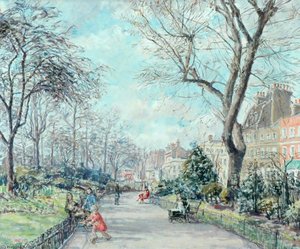
Harmar’s landscapes frequently depict tranquil scenes of Dorset countryside, capturing the subtle shifts in light and color throughout the seasons. She meticulously rendered details—such as foliage textures and reflections on water surfaces—to convey a profound sense of place. Simultaneously, her portraits delve into the inner lives of her subjects, portraying them with sensitivity and empathy. These intimate depictions reveal nuanced expressions of emotion and capture fleeting moments of human connection. Her ability to translate psychological states onto canvas solidified her reputation as one of Britain’s foremost portrait artists.- “Cheyne Walk Gardens” (1938): This Impressionistic landscape showcases Harmar's masterful use of color and brushwork, capturing the autumnal splendor of Cheyne Walk Gardens in Chelsea.