Portret van Ewart Johns

Schilderijen van Ewart Johns: De 6 bekendste, door de ogen van een galerie

Bijgewerkt in november 2026 · gerangschikt op basis van onze populariteitsscore (zoekopdrachten, bezoeken en bestellingen per kunstwerk) · 6 werken van Ewart Johns in onze catalogus

Kortom

Volgens de visie van de galerie is het beroemdste schilderij van Ewart Johns Blue and Black Abstract, waarvan het origineel in het University of Exeter Museum in Exeter hangt. Sun Worship 1989 (Sandra) (1989) en Sophia (1993) maken het trio compleet dat elk oog herkent. Van de 6 werken van Ewart Johns in onze catalogus presenteert de galerie hieronder de 6 bekendste werken, elk een origineel met de jaartal, het museum en wat het uniek maakt.

Meeste werken: St John’s College

De top 10 schilderijen van Ewart Johns in de galerie

4
Patterned Figure (1990) door Ewart Johns

Patterned Figure

1990 · St John’s College, Cambridge

The painting 'Patterned Figure' by Ewart Johns is a remarkable piece of art that showcases the artist's skill and attention to detail. Created in 1990, this oil on canvas painting measures 77 x 56 cm and is currently located at St John's College in Cambridge, United Kingdom. Artist and Style Ewart Johns is a talented artist known for his unique style, which blends traditional techniques with modern themes. His use…

De musea waar de originele werken van Ewart Johns worden bewaard

De 2 musea met de meeste schilderijen op deze pagina.

Museum Stad Werken van Ewart Johns Schilderijen uit deze lijst
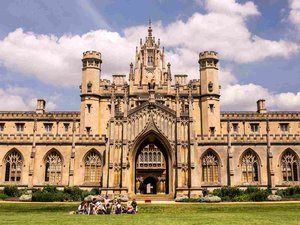
St John’s College, CambridgeSt John’s College Cambridge 4 Sun Worship 1989 (Sandra), Sophia, Patterned Figure
University of Exeter Museum, ExeterUniversity of Exeter Museum Exeter 2 Blue and Black Abstract, Three Figures

Ewart Johns, de kenmerkende schilderijen van elk jaar

5 jaar, van 1989 tot 1993, toont deze pagina de volledige carrière van Ewart Johns: een kort overzicht, hier jaar voor jaar gepresenteerd via de meest beroemde originele werken.

Werken per jaar

Selecteer een jaar om de originele werken te bekijken.

Schilderijen van Ewart Johns: de galerie geeft antwoord

Welk schilderij van Ewart Johns is het beroemdste van allemaal?Onthul het antwoord

Blue and Black Abstract, University of Exeter Museum, Exeter. Sun Worship 1989 (Sandra) (1989) en Sophia (1993) volgen.

Hoeveel werken heeft Ewart Johns gemaakt?Onthul het antwoord

Onze catalogus bevat 6 werken van Ewart Johns, daterend van 1989 tot 1993.

Waar hangen de beroemdste originele werken van Ewart Johns?Onthul het antwoord

Voornamelijk in St John’s College (Cambridge) en University of Exeter Museum (Exeter). De bovenstaande museumtabel bevat een volledig overzicht.

Wat zijn de vroegste en laatste beroemde werken van Ewart Johns?Onthul het antwoord

Op deze pagina is het vroegste Sun Worship 1989 (Sandra) (1989) en het laatste Sophia (1993).

Welke originelen van Ewart Johns zijn in de collectie van het St John’s College?Onthul het antwoord

Sun Worship 1989 (Sandra), Sophia en Patterned Figure: het St John’s College, Cambridge herbergt 4 van de werken op deze pagina.

Ewart Johns: de kunstenaar

Early Life and Artistic Foundations

Ewart Johns, born in Barry, Glamorgan, Wales in 1923 and passing away in 2013, was a British artist whose prolific career spanned over six decades. His journey began at Cardiff College of Art, where he received formative training under the guidance of Ceri Richards—a pivotal figure in Welsh modernism known for his expressive style and bold use of color. This early exposure instilled in Johns a deep appreciation for artistic experimentation and a willingness to push boundaries. However, Johns’ intellectual curiosity extended beyond the purely visual realm; he pursued further studies at St John’s College, Cambridge, earning a First-Class Honours degree in Geography. This seemingly disparate academic pursuit would prove profoundly influential on his later work, particularly his explorations of urban design and landscape painting. The grounding in geography provided a unique lens through which to view and interpret the world, shaping his artistic vision with an understanding of spatial relationships and environmental context.

A Dual Path: Academia and Artistic Practice

Johns uniquely balanced a distinguished academic career with a vibrant life as a freelance artist. From 1948 until 1971, he lectured in the Department of Geography at Exeter University, specializing in urban design—a field where his artistic sensibility and geographical knowledge converged seamlessly. He published extensively on British townscapes, demonstrating a keen analytical mind alongside his creative talents. In 1972, Johns took on the role of founding head of the Department of Visual Arts at Lancaster University, an endeavor that allowed him to nurture and shape arts education in Britain for many years. Despite these demanding academic commitments, he maintained a consistent artistic output, exhibiting widely across the UK and internationally. Solo shows at the Grabowski Gallery in London, beginning in 1961, and a major retrospective in 1981—held jointly at the University College of Wales, Cardiff, and Lancaster University—provided significant platforms for showcasing his evolving style and deepening critical engagement with his work.

Evolution of Style: From Cubism to Luminous Abstraction

Johns’ artistic development was marked by a continuous process of exploration and refinement. His early works often reflected the influence of Cubism, characterized by structural concerns and a subdued palette. These pieces reveal a fascination with form and fragmentation, hinting at an underlying desire to deconstruct and reimagine reality. Over time, however, Johns moved away from these rigid structures, embracing freer compositions and a more vibrant use of color. His work became increasingly focused on the expressive potential of the human figure and landscape, imbued with a sense of energy and emotional depth. A period spent in the United States in 1969-70 further broadened his artistic horizons, exposing him to contemporary movements that he skillfully integrated into his own practice. In his later years, as his eyesight began to deteriorate, Johns turned to wood sculpture—a medium that allowed him to continue exploring visual concepts through tactile means and a renewed focus on form.

Themes and Influences

Throughout his career, Ewart Johns’ work was characterized by a strong emphasis on line and color, often delving into the complexities of human experience and the natural world. His paintings frequently feature figures—often women—depicted in evocative settings, suggesting narratives that are open to interpretation. The landscapes he created were not merely representations of physical places but rather emotional responses to them, imbued with a sense of atmosphere and personal meaning. While Johns drew inspiration from various 20th-century artistic movements, his work resisted easy categorization. He possessed a distinctive voice—a unique blend of intellectual rigor, artistic sensitivity, and emotional depth—that set him apart from his contemporaries. His collaborative spirit was also evident in projects like the video documentation of his creative process undertaken with Exeter University’s Psychology Department, revealing a desire to understand the psychological underpinnings of artistic creation.

Legacy and Historical Significance

Ewart Johns' contribution to British art extends beyond his own prolific output. As an educator, he played a vital role in shaping generations of artists, fostering creativity and critical thinking at Lancaster University and beyond. His work continues to be exhibited and studied today, offering valuable insights into the development of modern British painting. The preservation of his legacy is largely thanks to the dedication of his family—his son Nick Johns and grandson Philip Johns maintain his website and archive, ensuring that his art remains accessible to a wider audience. While specific details regarding close artistic peers are less documented, Johns’ influence on the broader art scene is undeniable. He was a versatile artist who seamlessly blended academic inquiry with creative expression, leaving behind a body of work that is both intellectually stimulating and emotionally resonant—a testament to his enduring fascination with form, color, and the human condition. His paintings offer a captivating glimpse into the mind of an artist deeply engaged with the world around him, making him a significant figure in the history of modern British art.