A Life Interrupted: The Poetic Vulnerability of Eva Hesse
Eva Hesse’s story is one of profound displacement and a relentless pursuit of artistic expression in the face of personal tragedy. Born in 1936 in Hamburg, Germany, her early life was irrevocably altered by the looming shadow of Nazism. Fleeing persecution, her family sought refuge in the United States in 1938, an act that would forever shape Hesse’s identity as a displaced person navigating two worlds. This sense of rootlessness, coupled with the emotional trauma of her parents' separation and her mother’s subsequent suicide when Hesse was just ten years old, became a subtle yet powerful undercurrent in her art—a haunting exploration of fragility, loss, and the ephemeral nature of existence. Her formal artistic training began at the Pratt Institute in Brooklyn, followed by studies at Cooper Union and Yale University School of Art and Architecture, where she encountered the rigorous material explorations championed by Josef Albers. However, it was not within the confines of traditional painting that Hesse found her true voice; rather, she embarked on a path of radical experimentation with materials and form, ultimately becoming a pivotal figure in the development of Postminimalism and Eccentric Abstraction.
Early Life: Displacement and Trauma
Eva Hesse’s formative years were marked by upheaval and loss. Born to an Orthodox Jewish family in Hamburg during the rise of Nazism, she experienced firsthand the terror of antisemitic persecution. In 1938, her parents bravely relocated their family to the United States, driven by a determination to protect their children from Nazi violence—a decision that profoundly impacted Hesse’s worldview and instilled within her a deep awareness of displacement. The separation of her parents created an emotional void that shaped her artistic sensibility, while her mother’s suicide at age ten left an indelible scar on Hesse’s psyche. These experiences fueled her desire to grapple with themes of vulnerability, trauma, and the complexities of human emotion—themes that would permeate throughout her oeuvre. Her childhood in New York City was characterized by loneliness and insecurity, as she struggled to adapt to a new culture while grappling with unresolved grief. Despite these challenges, Hesse possessed an unwavering passion for art, nurtured by her father’s encouragement and fueled by her own innate curiosity.
The Influence of Surrealism and Abstract Expressionism
Hesse’s artistic sensibilities were profoundly influenced by the avant-garde movements of her time—particularly Surrealism and Abstract Expressionism. She was captivated by Surrealist artists like René Magritte and Joan Miró, who explored dreamlike imagery and subconscious associations to challenge rational thought and reveal hidden truths. Hesse admired the gestural energy and emotional intensity of Abstract Expressionists such as Jackson Pollock and Willem de Kooning, recognizing in their work a liberation from formal constraints and an embrace of spontaneous expression. These influences instilled within her a belief that art could transcend literal representation and communicate profound feelings—a conviction that would guide her artistic explorations for decades to come. Hesse’s fascination with the biomorphic sculptures of Hans Arp and Jean Dubuffet further broadened her understanding of sculptural form and technique, exposing her to innovative approaches to material manipulation and spatial arrangement.
A Sculptural Revolution: Embracing Materiality
Initially drawn to abstract painting, Hesse quickly felt stifled by its conventional limitations—the need for precise lines and balanced compositions seemed to contradict her desire to express raw emotion and explore the unpredictable nature of existence. She yearned for a more direct engagement with materiality—a way to imbue her sculptures with the visceral immediacy of feeling and experience. This yearning led her to abandon painting altogether, embarking on a path of radical experimentation with unconventional materials such as latex rubber, plastic sheeting, fiberglass, resin, and wire mesh. Hesse deliberately rejected traditional sculptural techniques, favoring methods that allowed for chance encounters and unpredictable transformations—a strategy that reflected her belief in the importance of embracing imperfection and accepting the limitations inherent in any artistic endeavor. She meticulously studied the properties of these materials, observing how they responded to gravity, temperature, and humidity—transforming them into instruments of exploration and expression.
Postminimalism and Eccentric Abstraction: Defining a Unique Aesthetic
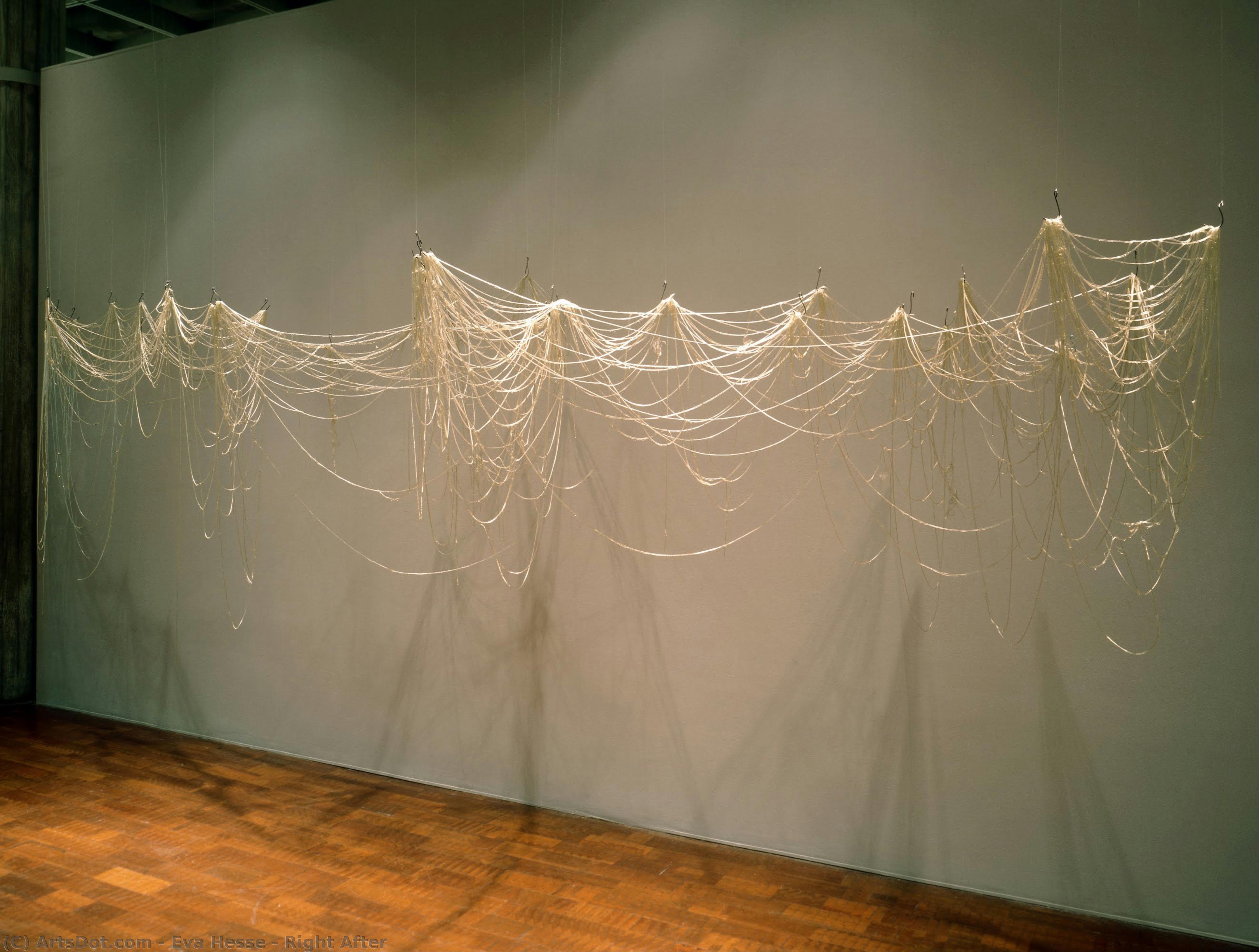
Hesse’s sculptural innovations cemented her position as a pioneer in Postminimalism and Eccentric Abstraction—movements that emerged in the wake of Minimalism’s dominance in the 1960s, rejecting its austere aesthetic and embracing subjectivity, emotion, and organic form. Like other artists of her generation—Robert Morris, Bruce Nauman, Richard Serra, and Robert Smithson—Hesse challenged formalism by introducing elements of chance and spontaneity into her work, disrupting established conventions and pushing boundaries of sculptural practice. Her sculptures are characterized by a distinctive aesthetic—one that embraces fragility, vulnerability, and organic irregularity. Often featuring repetitive forms arranged in grid structures or clustered arrangements, Hesse’s work evokes a sense of both order and chaos, control and surrender.
“Hang Up” (1966), for example, is a striking early exploration of these themes—a seemingly simple arrangement of painted circles suspended from cords that Hesse herself described as expressing “absurdity or extreme feeling.” The
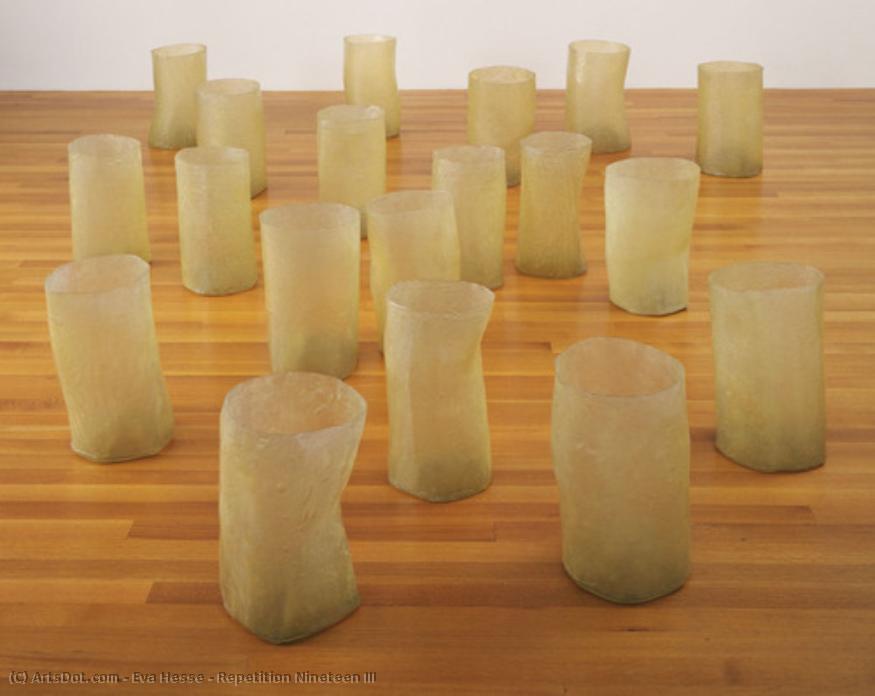
Repetition Nineteen III series (1968) further exemplifies her fascination with repetition and material properties, showcasing translucent fiberglass buckets arranged in a grid, each containing subtly different forms. Hesse’s willingness to embrace imperfection and explore deeply personal themes resonated with feminist art critics and artists, who saw in her work a powerful expression of female experience and a rejection of patriarchal norms. Her sculptures are imbued with psychological intensity—a testament to her ability to convey complex emotions through minimalist forms and unconventional materials. Hesse’s legacy lies not only in the beauty and originality of her work but also in her courage to confront difficult emotions and explore the complexities of human existence with honesty and vulnerability.
- Useful Links:
- Addendum: A minimalist wire & wood sculpture embodying Postminimalism.
- Hang Up: Showcasing Hesse’s mastery of space and form.