Portret van Ernest Board

De 49 bekendste schilderijen van Ernest Board, een selectie uit de galerie

Bijgewerkt in november 2026 · gerangschikt op basis van onze populariteitsscore (zoekopdrachten, bezoeken en bestellingen per kunstwerk) · 57 werken van Ernest Board in onze catalogus

Kortom

Van alle originele werken die Ernest Board heeft nagelaten, is Latimer Preaching before Edward VI at Paul's Cross, 1521 (1910) de bekendste. Direct daarna volgen The Departure of John and Sebastian Cabot on their First Voyage of Discovery, 1497 (1906) en The Unloading of Two Captured Spanish Treasure Ships at Bristol in September, 1745 (1927). Onze catalogus bevat 57 werken van Ernest Board; de galerie heeft de 49 meest bewonderde werken ter wereld bewaard, elk voorzien van de datum, het museum en het verhaal erachter.

1877 – 1934, Worcester Neoclassicism Meeste werken: Bristol Museum - Art Gallery

De top 10 schilderijen van Ernest Board: de selectie van de galerie

1
Latimer Preaching before Edward VI at Paul's Cross, 1521 (1910) door Ernest Board

Latimer Preaching before Edward VI at Paul's Cross, 1521

1910 · Oil

In this 1910 oil painting, Ernest Board captures a dense, atmospheric gathering at Paul's Cross. The scene focuses on the preacher Latimer, whose presence commands the attention of a vast, layered crowd. There is a palpable sense of stillness despite the multitude, as if the air itself has thickened with the weight of the sermon. The composition draws the eye through the assembly, moving from the figures in the immediate…

2
The Departure of John and Sebastian Cabot on their First Voyage of Discovery, 1497 (1906) door Ernest Board

The Departure of John and Sebastian Cabot on their First Voyage of Discovery, 1497

1906 · Oil · Bristol Museum - Art Gallery, Bristol

The scene captures a crowded harbor at the cusp of the late 15th century, a moment of high ceremony and mounting tension. Figures of varying social strata—armored knights, solemn clergy, and high-ranking royalty—converge in a dense, rhythmic composition. The air feels heavy with the weight of impending departure. Amidst the sea of humanity, birds scatter through a cloudy sky, adding a sense of restless movement to the structured assembly. Ships…

3
The Unloading of Two Captured Spanish Treasure Ships at Bristol in September, 1745 (1927) door Ernest Board

The Unloading of Two Captured Spanish Treasure Ships at Bristol in September, 1745

1927 · Oil · Bristol Museum - Art Gallery, Bristol

In his sweeping 1927 oil masterpiece, The Unloading of Two Captured Spanish Treasure Ships at Bristol in September, 1745, Ernest Board invites the viewer into a moment of profound historical jubilation. The canvas erupts with the kinetic energy of a port city transformed by the arrival of unimaginable wealth and naval prestige. At the heart of this bustling scene, a grand sailing ship looms majestically over the docks, its sails…

4
Dioscorides describing the mandrake (1909) door Ernest Board

Dioscorides describing the mandrake

1909 · Oil

In this oil painting, titled Dioscorides describing the mandrake, Ernest Board presents a scene rooted in historical scientific documentation. Created about 1909, the work captures a moment of quiet study within a classical setting. The subject matter focuses on the intersection of botanical observation and the recording of medical knowledge, centering on the figure of Dioscorides as he documents the properties of the mandrake plant.

5
Edward IV being Entertained by William Canynges at His House in Redcliff Street, 1461 (1918) door Ernest Board

Edward IV being Entertained by William Canynges at His House in Redcliff Street, 1461

1918 · Oil · Bristol Museum - Art Gallery, Bristol

The scene unfolds within an ornate, Gothic interior, capturing a moment of high ceremony and hospitality. A central female figure in white commands the space, her raised hands suggesting a moment of presiding over the assembly. Around her, a complex arrangement of nobles and attendants engages in the rituals of feasting and conversation. The composition utilizes a somewhat flattened perspective to prioritize the central action, drawing the eye through layers…

7
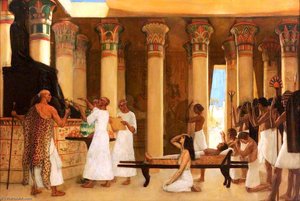
Joseph Priestley, the Discoverer of Oxygen (1912) door Ernest Board

Joseph Priestley, the Discoverer of Oxygen

1912

The painting Joseph Priestley, the Discoverer of Oxygen by Ernest Board is a remarkable work of art that showcases the discovery of oxygen by Joseph Priestley. Created in 1912, this oil on canvas painting is a testament to the artist's skill and attention to detail. The painting is housed in the Wellcome Library in the United Kingdom, a renowned institution for medical history and art. The Artist and His Work…

De selectie van Ernest Board gaat verder, van 11 tot 49

11The Discovery of Quinine, 1820 (1910) door Ernest BoardThe Discovery of Quinine, 18201910 12Dioscorides Describing the Mandrake (1909) door Ernest BoardDioscorides Describing the Mandrake1909 13Mundinus, the Italian Anatomist, Making His First Dissection in the Anatomy Theatre at Bologna, 1318 door Ernest BoardMundinus, the Italian Anatomist, Making His First Dissection in the Anatomy Theatre at Bologna, 1318 14The Marriage of William Penn and Hannah Callowhill, 1696 (1915) door Ernest BoardThe Marriage of William Penn and Hannah Callowhill, 16961915 · Bristol Museum And Art Gallery 15An Allegorical Picture of Bristol (1917) door Ernest BoardAn Allegorical Picture of Bristol1917 · Bristol Museum - Art Gallery 16The Burial of William Canynges at Redcliffe Church, 1474 (1915) door Ernest BoardThe Burial of William Canynges at Redcliffe Church, 14741915 · Bristol Museum - Art Gallery 17Sir Patrick Manson (1844–1922), Experimenting with Filaria sanguinis hominis in Amoy (Xiamen), China (1912) door Ernest BoardSir Patrick Manson (1844–1922), Experimenting with Filaria sanguinis hominis in Amoy (Xiamen), China1912 18The Marriage of William Penn and Hannah Callowhill at the Friends' Meeting House, The Friary, Bristol, 1696 (1916) door Ernest BoardThe Marriage of William Penn and Hannah Callowhill at the Friends' Meeting House, The Friary, Bristol, 16961916 · Bristol Museum - Art Gallery 19Blue and Gold (1918) (1918) door Ernest BoardBlue and Gold (1918)1918 · Fitzwilliam Museum 20First World War A Scottish Soldier, Wearing the Kilt, Lying Wounded on a Battlefield (1918) door Ernest BoardFirst World War A Scottish Soldier, Wearing the Kilt, Lying Wounded on a Battlefield1918 21'Sumer Is Icumen In' (1920) door Ernest Board'Sumer Is Icumen In'1920 · Reading Museum - Town Hall 22Edward IV being Entertained by William Canynges at His House in Redcliff Street, 1461 (1918) door Ernest BoardEdward IV being Entertained by William Canynges at His House in Redcliff Street, 14611918 · Bristol Museum And Art Gallery 23First World War A Scottish Soldier, Wearing the Kilt, Lying Wounded on a Battlefield (1918) door Ernest BoardFirst World War A Scottish Soldier, Wearing the Kilt, Lying Wounded on a Battlefield1918 24King Edward IV and His Queen, Elizabeth Woodville at Reading Abbey, 1464 (1923) door Ernest BoardKing Edward IV and His Queen, Elizabeth Woodville at Reading Abbey, 14641923 · Reading Museum 25Blue and Gold (1918) door Ernest BoardBlue and Gold1918 · Fitzwilliam College 26The Discovery of Quinine, 1820 (1919) door Ernest BoardThe Discovery of Quinine, 18201919 27Some Who Have Made Bristol Famous (1930) door Ernest BoardSome Who Have Made Bristol Famous1930 · Bristol Museum - Art Gallery 28The Earthly Army door Ernest BoardThe Earthly ArmyBristol Museum - Art Gallery 29Lavoisier Explaining to His Wife the Result of His Experiments on Air door Ernest BoardLavoisier Explaining to His Wife the Result of His Experiments on Air 30The First Use of Ether in Dental Surgery, 1846 door Ernest BoardThe First Use of Ether in Dental Surgery, 1846 31Mundinus, the Italian Anatomist, Making His First Dissection in the Anatomy Theatre at Bologna, 1318 door Ernest BoardMundinus, the Italian Anatomist, Making His First Dissection in the Anatomy Theatre at Bologna, 1318 32Robert, Earl of Gloucester, Building the Great Keep of Bristol Castle, 1116 door Ernest BoardRobert, Earl of Gloucester, Building the Great Keep of Bristol Castle, 1116Bristol Museum - Art Gallery 33An Invocation to I em hetep, the Egyptian Deity of Medicine door Ernest BoardAn Invocation to I em hetep, the Egyptian Deity of Medicine 34Leeuwenhoek with His Microscope door Ernest BoardLeeuwenhoek with His Microscope 35Patients Sleeping in the Temple of Aesculapius at Epidaurus door Ernest BoardPatients Sleeping in the Temple of Aesculapius at Epidaurus 36Roger Bacon in His Observatory at Merton College, Oxford door Ernest BoardRoger Bacon in His Observatory at Merton College, Oxford 37Albucasis Blistering a Patient in the Hospital at Cordoba door Ernest BoardAlbucasis Blistering a Patient in the Hospital at Cordoba 38Study of a Young Girl in a Rowing Boat with a Dog door Ernest BoardStudy of a Young Girl in a Rowing Boat with a DogRoyal West of England Academy 39Albertus Magnus Expounding His Doctrines of Physical Science in the Streets of Paris, c.1245 door Ernest BoardAlbertus Magnus Expounding His Doctrines of Physical Science in the Streets of Paris, c.1245 40The Healing Art in Pre Historic Times door Ernest BoardThe Healing Art in Pre Historic Times 41Christopher Wren Demonstrating His Method of Introducing Drugs into a Vein, before Dr Willis, 1667 door Ernest BoardChristopher Wren Demonstrating His Method of Introducing Drugs into a Vein, before Dr Willis, 1667 42Pascal's Experiment in the Puy de Dôme to Test the Relation between Atmospheric Pressure and Altitude door Ernest BoardPascal's Experiment in the Puy de Dôme to Test the Relation between Atmospheric Pressure and Altitude 43Abbaye of Saint Antoine, Sologne, France Pilgrims Suffering from St Antony's Fire Approach the Infirmary door Ernest BoardAbbaye of Saint Antoine, Sologne, France Pilgrims Suffering from St Antony's Fire Approach the Infirmary 44The First Use of Ether in Dental Surgery, 1846 door Ernest BoardThe First Use of Ether in Dental Surgery, 1846 45William Gilbert Demonstrating the Magnet before Elizabeth I, 1598 door Ernest BoardWilliam Gilbert Demonstrating the Magnet before Elizabeth I, 1598 46Guy de Chauliac Bandaging the Leg of Pope Clement VI at Avignon, c.1348 door Ernest BoardGuy de Chauliac Bandaging the Leg of Pope Clement VI at Avignon, c.1348 47William Harvey Demonstrating His Theory of Circulation of Blood before Charles I door Ernest BoardWilliam Harvey Demonstrating His Theory of Circulation of Blood before Charles I 48Ambroise Paré Using the Ligature when Amputating on the Battlefield at the Siege of Bramvilliers, 1552 door Ernest BoardAmbroise Paré Using the Ligature when Amputating on the Battlefield at the Siege of Bramvilliers, 1552 49Rhazes, Persian Physician and Alchemist, in His Laboratory at Baghdad (originally titled by the artist 'Rhazes, Arab Physician and Alchemist, in His Laboratory at Baghdad') door Ernest BoardRhazes, Persian Physician and Alchemist, in His Laboratory at Baghdad (originally titled by the artist 'Rhazes, Arab Physician and Alchemist, in His Laboratory at Baghdad')

De onderwerpen die de aandacht van Ernest Board troffen

De vier onderwerpen die het meest voorkomen in deze originelen, elk met zijn mooiste voorbeeld.

De musea waar de originele werken van Ernest Board worden bewaard

De 7 musea met de meeste schilderijen op deze pagina.

Museum Stad Werken van Ernest Board Schilderijen uit deze lijst
Bristol Museum - Art Gallery, BristolBristol Museum - Art Gallery Bristol 11 The Departure of John and Sebastian Cabot on their First Voyage of Discovery, 1497, The Unloading of Two Captured Spanish Treasure Ships at Bristol in September, 1745, Edward IV being Entertained by William Canynges at His House in Redcliff Street, 1461
Bristol Museum And Art Gallery, BristolBristol Museum And Art Gallery Bristol 3 The Heavenly Army, The Marriage of William Penn and Hannah Callowhill, 1696, Edward IV being Entertained by William Canynges at His House in Redcliff Street, 1461
Fitzwilliam MuseumFitzwilliam Museum 1 Blue and Gold (1918)
Reading Museum - Town Hall, ReadingReading Museum - Town Hall Reading 1 'Sumer Is Icumen In'
Reading Museum, ReadingReading Museum Reading 1 King Edward IV and His Queen, Elizabeth Woodville at Reading Abbey, 1464
Fitzwilliam College, CambridgeFitzwilliam College Cambridge 1 Blue and Gold
Royal West of England Academy, BristolRoyal West of England Academy Bristol 1 Study of a Young Girl in a Rowing Boat with a Dog

Ernest Board decennium voor decennium: het origineel dat elk tijdperk definieert

Werken per decennium

Kies een decennium om het origineel te zien dat dit tijdperk definieert.

Vragen van verzamelaars over de schilderijen van Ernest Board

Waar is Ernest Board het meest bekend om?Onthul het antwoord

Latimer Preaching before Edward VI at Paul's Cross, 1521 (1910). The Departure of John and Sebastian Cabot on their First Voyage of Discovery, 1497 (1906) en The Unloading of Two Captured Spanish Treasure Ships at Bristol in September, 1745 (1927) volgen.

Hoe oud was Ernest Board toen Latimer Preaching before Edward VI at Paul's Cross, 1521 werd gemaakt?Onthul het antwoord

33 jaar oud: Latimer Preaching before Edward VI at Paul's Cross, 1521 dateert uit 1910, en Ernest Board werd geboren in 1877.

Wat zijn de tien beroemdste schilderijen van Ernest Board?Onthul het antwoord

Latimer Preaching before Edward VI at Paul's Cross, 1521, The Departure of John and Sebastian Cabot on their First Voyage of Discovery, 1497, The Unloading of Two Captured Spanish Treasure Ships at Bristol in September, 1745, Dioscorides describing the mandrake, Edward IV being Entertained by William Canynges at His House in Redcliff Street, 1461, Sketch for 'Some Who Have Made Bristol Famous', Joseph Priestley, the Discoverer of Oxygen, The Heavenly Army, The Heavenly Army en Vaccination Dr Jenner Performing His First Vaccination, 1796. De bovenstaande ranglijst vermeldt het jaar en het museum van elk werk.

Hoeveel schilderijen heeft Ernest Board nagelaten?Onthul het antwoord

Onze catalogus bevat 57 werken van Ernest Board, daterend van 1906 tot 1930.

In welke musea hangen de meesterwerken van Ernest Board?Onthul het antwoord

Voornamelijk in Bristol Museum - Art Gallery (Bristol), Bristol Museum And Art Gallery (Bristol) en Fitzwilliam Museum. De bovenstaande museumtabel bevat een volledig overzicht.

In welke jaren schilderde Ernest Board de beroemdste werken?Onthul het antwoord

In 1910s: 15 van de 49 werken op deze pagina werden toen gemaakt, waaronder Latimer Preaching before Edward VI at Paul's Cross, 1521.

Wat zijn de eerste en de laatste beroemde originelen van Ernest Board?Onthul het antwoord

Op deze pagina is het vroegste The Departure of John and Sebastian Cabot on their First Voyage of Discovery, 1497 (1906) en het laatste Some Who Have Made Bristol Famous (1930).

Welke onderwerpen koos Ernest Board het vaakst?Onthul het antwoord

Man (2), Woman (2) en Dramatic lighting (2), verspreid over de 49 werken op deze pagina.

Welke techniek gebruikte Ernest Board het meest?Onthul het antwoord

Oil, voor 5 van de 49 werken op deze pagina.

Bij welke kunststroming behoort Ernest Board?Onthul het antwoord

Neoclassicism, te oordelen aan de originelen op deze pagina.

Welke werken van Ernest Board hangen in het Bristol Museum - Art Gallery?Onthul het antwoord

The Departure of John and Sebastian Cabot on their First Voyage of Discovery, 1497, The Unloading of Two Captured Spanish Treasure Ships at Bristol in September, 1745 en Edward IV being Entertained by William Canynges at His House in Redcliff Street, 1461: het Bristol Museum - Art Gallery, Bristol herbergt 11 van de werken op deze pagina.

Ernest Board: leven en werk

The Precision of Vision: The Life and Legacy of Ernest Board

In the grand tapestry of late Victorian and Edwardian art, where many masters sought the ethereal light of landscapes or the romanticized grandeur of portraits, Ernest Board (1877–1934) carved a unique and vital niche. He was an artist who found profound beauty in the empirical, a man whose brush served as both a creative instrument and a scientific tool. As a pioneer of scientific illustration, Board possessed the rare ability to marry the meticulous accuracy required by the burgeoning medical sciences with the aesthetic grace of the fine arts. His work does not merely observe; it illuminates, bringing clarity to the complex structures of life and the monumental moments of human discovery.

Board’s artistic foundation was laid in the vibrant intellectual atmosphere of London, where he studied at the prestigious Slade School of Fine Art. It was here that he walked alongside luminaries such as William Holman Hunt and John Ruskin, figures whose devotion to the Pre-Raphaelite ideal of "truth to nature" would deeply inform his professional ethos. From these mentors, Board inherited a reverence for minute detail and an uncompromising commitment to observational accuracy. This influence is evident in his refusal to rely on mere stylistic embellishment, choosing instead to let the inherent complexity of his subjects—be they anatomical or historical—speak through precise tonal subtlety and structural integrity.

Bridging the Gap Between Art and Science

The true brilliance of Board’s career lay in his ability to navigate the intersection of the laboratory and the studio. During the Edwardian era, as scientific understanding expanded at a breathtaking pace, there arose a desperate need for visual communication that could transcend the limitations of early photographic technology. Board rose to this challenge with unparalleled skill, securing prestigious commissions from seminal scientific journals such as Nature and The Lancet. His illustrations were far more than decorative accompaniments; they were essential pedagogical instruments that allowed surgeons and researchers to visualize the unseen.

His mastery of the medium allowed him to transform daunting anatomical diagrams into captivating visual narratives. Whether rendering the intricate layers of human musculature or the precise mechanics of surgical instruments, Board imbued his subjects with a sense of vitality. This period of his work represents a significant achievement in the history of medical illustration, as he helped foster public and professional comprehension of groundbreaking medical advancements through images that were as educationally rigorous as they were visually arresting.

Historical Narratives and Scientific Milestones

Beyond the microscopic and the anatomical, Board’s repertoire extended into the realm of historical and scientific commemoration. He possessed a remarkable talent for capturing the "eureka" moments of history, painting scenes that celebrated the giants of science with a Neoclassical dignity. His work often focused on pivotal discoveries that altered the course of human knowledge, such as:

  • Joseph Priestley, the Discoverer of Oxygen: A profound 1912 oil painting that captures the essence of scientific breakthrough through a lens of historical significance and classical beauty.
  • The Discovery of Quinine, 1820: An exploration of medical history that highlights his ability to dramatize the moment scientific progress meets human necessity.
  • Regional Tributes: His ability to connect science with local heritage, as seen in works documenting those who shaped the identity of cities like Bristol.

Through these works, Board ensured that the triumphs of the intellect were preserved within the canon of fine art. His legacy remains a testament to the idea that science and art are not opposing forces, but rather two different languages describing the same magnificent reality. In an age of rapid industrial and scientific change, Ernest Board provided a visual anchor, documenting the evolution of human understanding with a steady, masterful hand.