Portret van Edward Lamson Henry

De 100 bekendste schilderijen van Edward Lamson Henry, een selectie uit de galerie

Bijgewerkt in november 2026 · gerangschikt op basis van onze populariteitsscore (zoekopdrachten, bezoeken en bestellingen per kunstwerk) · 106 werken van Edward Lamson Henry in onze catalogus

Kortom

Van alle originele werken die Edward Lamson Henry heeft nagelaten, is Sir William Johnson Presenting Medals to the Indian Chiefs of the Six Nations at Johnstown, N.Y. (1903) de bekendste. Direct daarna volgen The Camden and Amboy Railroad with the Engine Planet'' in 1834'' (1904) en Saint George's Church, New York (1875). Onze catalogus bevat 106 werken van Edward Lamson Henry; de galerie heeft de 100 meest bewonderde werken ter wereld bewaard, elk voorzien van de datum, het museum en het verhaal erachter.

1841 – 1919, Charleston Realism Meeste werken: Metropolitan Museum of Art

De top 10 schilderijen van Edward Lamson Henry: de selectie van de galerie

1
Sir William Johnson Presenting Medals to the Indian Chiefs of the Six Nations at Johnstown, N.Y. (1903) door Edward Lamson Henry

Sir William Johnson Presenting Medals to the Indian Chiefs of the Six Nations at Johnstown, N.Y.

1903 · Oil On Canvas

In this 1903 oil on canvas, Edward Lamson Henry captures a specific intersection of colonial diplomacy and indigenous leadership. The work, titled Sir William Johnson Presenting Medals to the Indian Chiefs of the Six Nations at Johnstown, N.Y., reconstructs a gathering from 1772. The scene focuses on a conference held at Johnson Hall, where Sir William Johnson meets with the Iroquois. It is a moment of formal recognition, frozen in…

2
The Camden and Amboy Railroad with the Engine Planet'' in 1834'' (1904) door Edward Lamson Henry

The Camden and Amboy Railroad with the Engine Planet'' in 1834''

1904 · Oil On Canvas

The steam and iron of a transformative era emerge through the brush of Edward Lamson Henry in his work, The Camden and Amboy Railroad with the Engine Planet'' in 1834''. Created in 1904, this piece looks back across the decades to capture a specific, bustling moment in American transit. The scene centers on the Camden and Amboy Railroad, frozen in the year 1834, as the engine known as the "Planet"…

3
Saint George's Church, New York (1875) door Edward Lamson Henry

Saint George's Church, New York

1875 · Lithograph · Metropolitan Museum of Art, New York

To stand before this evocative print is to step directly into the vibrant, yet sepia-toned, heart of New York City circa 1875. Edward Lamson Henry, through his masterful rendering, has gifted us more than just a depiction of architecture; he has captured the very breath of a bygone era. The composition centers unwaveringly on Saint George's Church, its spire piercing the hazy expanse as a beacon against the dense tapestry…

4
Westover, Virginia (1865) door Edward Lamson Henry

Westover, Virginia

1865 · Oil

The composition centers on a large red brick mansion characterized by white trim and a prominent steeple, which lends the structure the appearance of a church. A layer of white snow covers the ground, establishing a cold, wintry atmosphere across the landscape. In the foreground and middle ground, several horses are positioned near the house; some stand in close proximity to one another, while others are scattered across the snowy…

5
A Summer Day (1890) door Edward Lamson Henry

A Summer Day

1890 · Oil

In this 1890 composition, we find ourselves transported to a tranquil rural landscape, where the pace of life is dictated by the steady rhythm of hoofbeats on a dirt path. The scene captures a group of riders on horseback, moving leisurely through a sun-drenched country setting. There is a certain stillness here, despite the movement of the animals. A wagon rests in the distance, and a solitary chair sits near…

6
The Departure (1901) door Edward Lamson Henry

The Departure

1901 · Oil

The painting depicts a small town street populated by several figures on horseback. In the foreground, horses and riders move through the thoroughfare, some positioned closer to the viewer while others recede into the background. To the right, a carriage is parked or moving along the edge of the scene. A wooden bench sits in the middle of the composition, offering a stationary point amidst the movement. The architecture and…

7
Waiting for the Ferry (1906) door Edward Lamson Henry

Waiting for the Ferry

1906 · Watercolor

Waiting for the Ferry is a work by Edward Lamson Henry. Created about 1906, the piece reflects the artist's established interest in capturing specific moments of American life. Henry was born in 1841 and lived until May 9, 1919.

8
St. Mark's in the Bowery in the Early Forties (1917) door Edward Lamson Henry

St. Mark's in the Bowery in the Early Forties

1917

The scene captures a moment of urban movement near St. Mark's in the Bowery in New York City. Pedestrians navigate the grounds of the church, their figures scattered across the foreground and middle distance. The composition is anchored by the church's architecture, specifically a prominent clock tower that rises above the street-level activity. Horses and carriages, typical of the era, populate the thoroughfare, suggesting the rhythmic, animal-powered pulse of a…

9
Een Philadelphia Poortwachter (1882) door Edward Lamson Henry

Een Philadelphia Poortwachter

1882 · Olieverf op canvas · Yale University Art Gallery, Hartford

Een Philadelphia Poort Een Symbool van Nostalgie en Detail De schilderij “Een Philadelphia Poort” van Edward Lamson Henry, geschreven in 1882, is een prachtige afbeelding van een man die staat voor een deur met zijn hond. De man lijkt naar het uitzicht te kijken terwijl hij een kamerplant vasthoudt. Het tafereel speelt zich buiten af, zoals blijkt uit de aanwezigheid van een bank en een stoel in de buurt. Er…

10
Interior (1870) door Edward Lamson Henry

Interior

1870 · Oil · Smithsonian American Art Museum, Washington, D.C.

In Interior, Edward Lamson Henry invites us into a quiet, historical setting that feels deeply lived-in. The scene captures a subtle moment of interaction between two figures within an ornate room. To the left, a woman sits at a table near a large leaded-glass window, her form catching the bright, directional light that pours into the space. Opposite her, a man stands before a fireplace, his presence grounding the domestic…

De selectie van Edward Lamson Henry gaat verder, van 11 tot 100

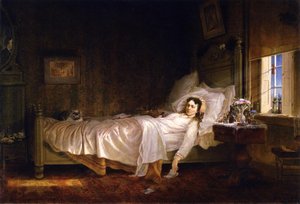
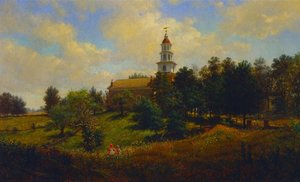
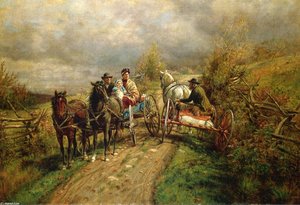
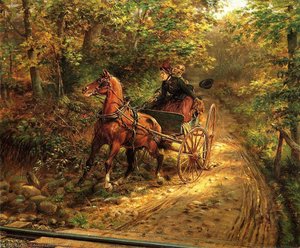
11A Carriage Ride (1885) door Edward Lamson HenryA Carriage Ride1885 · Metropolitan Museum of Art 12Country Breakfast (1884) door Edward Lamson HenryCountry Breakfast1884 · New Britain Museum of American Art 13Capital and Labor (1881) door Edward Lamson HenryCapital and Labor1881 · New York Historical Society 14Forty Winks (1880) door Edward Lamson HenryForty Winks1880 15East Hampton Beach (1880) door Edward Lamson HenryEast Hampton Beach1880 16Teatime (1890) door Edward Lamson HenryTeatime1890 · New Britain Museum of American Art 17Carriage Ride (1886) door Edward Lamson HenryCarriage Ride1886 18Stopping for a Chat (1889) door Edward Lamson HenryStopping for a Chat1889 19In The Shenandoah Valley (Off the Main Road) (1897) door Edward Lamson HenryIn The Shenandoah Valley (Off the Main Road)1897 · New Britain Museum of American Art 20The Ferry Crossing at Von Steuben Tavern (1909) door Edward Lamson HenryThe Ferry Crossing at Von Steuben Tavern1909 21Changing Horses (1880) door Edward Lamson HenryChanging Horses1880 22The North Dutch Church, Fulton and William Streets, New York (1869) door Edward Lamson HenryThe North Dutch Church, Fulton and William Streets, New York1869 · Metropolitan Museum of Art 23Village Squire Entertaining the New Minister door Edward Lamson HenryVillage Squire Entertaining the New Minister 24In the Roaring Forties (1884) door Edward Lamson HenryIn the Roaring Forties1884 25Parlor on Brooklyn Heights of Mr. and Mrs. John Ballard (1872) door Edward Lamson HenryParlor on Brooklyn Heights of Mr. and Mrs. John Ballard1872 26Moonlight Landscape with House (1860) door Edward Lamson HenryMoonlight Landscape with House1860 27A Chat after Meeting (1871) door Edward Lamson HenryA Chat after Meeting1871 28Descending the Stairs (1870) door Edward Lamson HenryDescending the Stairs1870 29On the James River, Virginia (1864) door Edward Lamson HenryOn the James River, Virginia1864 30The John Hancock House (1865) door Edward Lamson HenryThe John Hancock House1865 · Yale University Art Gallery 31The Invalid (1868) door Edward Lamson HenryThe Invalid1868 · Fogg Art Museum 32The Old Westover House (1869) door Edward Lamson HenryThe Old Westover House1869 · National Gallery of Art 33Drafting the Letter (1871) door Edward Lamson HenryDrafting the Letter1871 34Station on the Morris and Essex Railroad (1864) door Edward Lamson HenryStation on the Morris and Essex Railroad1864 35The Old Clock on the Stairs (1868) door Edward Lamson HenryThe Old Clock on the Stairs1868 36The Attack on Chew's House during the Battle of Germantown, 1777 (1878) door Edward Lamson HenryThe Attack on Chew's House during the Battle of Germantown, 17771878 · Art Institute of Chicago 37The Widower (1873) door Edward Lamson HenryThe Widower1873 · Smithsonian American Art Museum 38Can They Go Too. (1877) door Edward Lamson HenryCan They Go Too.1877 39Totally Absorbed (1874) door Edward Lamson HenryTotally Absorbed1874 40The Lafayette Reception (1874) door Edward Lamson HenryThe Lafayette Reception1874 41Examining Illustrations by the Fire (1872) door Edward Lamson HenryExamining Illustrations by the Fire1872 42City Point, Virginia, Headquarters of General Grant (1873) door Edward Lamson HenryCity Point, Virginia, Headquarters of General Grant1873 · Addison Gallery of American Art 43Le Paresseuse (also known as The Idle One) (1876) door Edward Lamson HenryLe Paresseuse (also known as The Idle One)1876 44The Old Dutch Church, Bruynswick (1878) door Edward Lamson HenryThe Old Dutch Church, Bruynswick1878 45The Meeting of General Washington and Rochambeau (1873) door Edward Lamson HenryThe Meeting of General Washington and Rochambeau1873 · Virginia Museum of Fine Arts 46Miss X and Sister (1884) door Edward Lamson HenryMiss X and Sister1884 47Still LIfe of Rhododendrons (1885) door Edward Lamson HenryStill LIfe of Rhododendrons1885 48The Little Flower Girl (1880) door Edward Lamson HenryThe Little Flower Girl1880 49Old Enemies (1885) door Edward Lamson HenryOld Enemies1885 50The Conversation (1882) door Edward Lamson HenryThe Conversation1882 51The Latest Village Scandal (1885) door Edward Lamson HenryThe Latest Village Scandal1885 52The King of the Montauks (1880) door Edward Lamson HenryThe King of the Montauks1880 · Detroit Institute of Arts 53Stagecoach (1881) door Edward Lamson HenryStagecoach1881 54The Sunny Hours of Childhood (1879) door Edward Lamson HenryThe Sunny Hours of Childhood1879 55On the Way to Market (1888) door Edward Lamson HenryOn the Way to Market1888 56The New Woman (1892) door Edward Lamson HenryThe New Woman1892 57Interior at Petworth (1886) door Edward Lamson HenryInterior at Petworth1886 58Horse and Buggy on Main Street (1889) door Edward Lamson HenryHorse and Buggy on Main Street1889 59A Country School (1890) door Edward Lamson HenryA Country School1890 · Yale University Art Gallery 60A Lover of Old China (1889) door Edward Lamson HenryA Lover of Old China1889 61A Virginia Wedding (1890) door Edward Lamson HenryA Virginia Wedding1890 62A Moment of Peril (1890) door Edward Lamson HenryA Moment of Peril1890 63Mrs. Lydig and Her Daughter Greeting Their Guest (1891) door Edward Lamson HenryMrs. Lydig and Her Daughter Greeting Their Guest1891 64Visit to the Plantation (1898) door Edward Lamson HenryVisit to the Plantation1898 65Return to the Farm (1895) door Edward Lamson HenryReturn to the Farm1895 66An Informal Call (1895) door Edward Lamson HenryAn Informal Call1895 67A Country Lawyer (1895) door Edward Lamson HenryA Country Lawyer1895 68Waiting for the Ferry, Shelter Island, New York (1895) door Edward Lamson HenryWaiting for the Ferry, Shelter Island, New York1895 69The Pillory and Whipping Post, New Castle, Delaware (1896) door Edward Lamson HenryThe Pillory and Whipping Post, New Castle, Delaware1896 70The Message (1893) door Edward Lamson HenryThe Message1893 · Fogg Art Museum 71Vespers (1898) door Edward Lamson HenryVespers1898 72A Stormy Morning (also known as Leaving in the Early Morn in a Nor’easter) (1899) door Edward Lamson HenryA Stormy Morning (also known as Leaving in the Early Morn in a Nor’easter)1899 73What's That You Say (1905) door Edward Lamson HenryWhat's That You Say1905 74One Sunday Afternoon (1902) door Edward Lamson HenryOne Sunday Afternoon1902 75An October Day (also known as Cragsmoor Post Office) (1903) door Edward Lamson HenryAn October Day (also known as Cragsmoor Post Office)1903 76Waiting for the Stagecoach (1905) door Edward Lamson HenryWaiting for the Stagecoach1905 77Passing the Outposts on the Old Kingsbridge Road (1903) door Edward Lamson HenryPassing the Outposts on the Old Kingsbridge Road1903 78The Homecoming (1899) door Edward Lamson HenryThe Homecoming1899 79Stopping to Water His Horse (1904) door Edward Lamson HenryStopping to Water His Horse1904 80Young Girl with a Parrot door Edward Lamson HenryYoung Girl with a Parrot 81Horse and Buggy door Edward Lamson HenryHorse and Buggy 82Scene along Delaware and Hudson Canal (1907) door Edward Lamson HenryScene along Delaware and Hudson Canal1907 83In East Tennessee (1906) door Edward Lamson HenryIn East Tennessee1906 84What Luck (1910) door Edward Lamson HenryWhat Luck1910 85What's the News. (also known as Stopping for a Chat) (1909) door Edward Lamson HenryWhat's the News. (also known as Stopping for a Chat)1909 86Unexpected Visitors (1909) door Edward Lamson HenryUnexpected Visitors1909 87Colonial Wedding (1911) door Edward Lamson HenryColonial Wedding1911 88St. John's Church, Varick Street, New York (1914) door Edward Lamson HenrySt. John's Church, Varick Street, New York1914 · New York Historical Society 89News of the War of 1812 (1913) door Edward Lamson HenryNews of the War of 18121913 90Gathering Flowers (1913) door Edward Lamson HenryGathering Flowers1913 91The Sitting Room (1883) door Edward Lamson HenryThe Sitting Room1883 92Memories (1873) door Edward Lamson HenryMemories1873 · Yale University Art Gallery 93Later Afternoon on the Old Delaware and Hudson Canal, at Port Ben, Ulster County, New York (1894) door Edward Lamson HenryLater Afternoon on the Old Delaware and Hudson Canal, at Port Ben, Ulster County, New York1894 94Going to Town door Edward Lamson HenryGoing to TownThe Phillips Collection 95Country Landscape door Edward Lamson HenryCountry Landscape 96Leaving Home door Edward Lamson HenryLeaving Home 97Nearing the Bend door Edward Lamson HenryNearing the Bend 98Coming Home door Edward Lamson HenryComing Home 99Early Days of Rapid Transit door Edward Lamson HenryEarly Days of Rapid Transit 100The Village Street door Edward Lamson HenryThe Village Street

De beroemde schilderijen van Edward Lamson Henry, periode voor periode

De onderwerpen die de aandacht van Edward Lamson Henry troffen

De vier onderwerpen die het meest voorkomen in deze originelen, elk met zijn mooiste voorbeeld.

De musea waar de originele werken van Edward Lamson Henry worden bewaard

De 8 musea met de meeste schilderijen op deze pagina.

Museum Stad Werken van Edward Lamson Henry Schilderijen uit deze lijst
Metropolitan Museum of Art, New YorkMetropolitan Museum of Art New York 4 Saint George's Church, New York, A Carriage Ride, The North Dutch Church, Fulton and William Streets, New York
New Britain Museum of American Art, New BritainNew Britain Museum of American Art New Britain 3 Country Breakfast, Teatime, In The Shenandoah Valley (Off the Main Road)
Smithsonian American Art Museum, Washington, D.C.Smithsonian American Art Museum Washington, D.C. 4 Interior, The Widower
Yale University Art Gallery, HartfordYale University Art Gallery Hartford 2 Een Philadelphia Poortwachter, Memories
New York Historical Society, New York CityNew York Historical Society New York City 2 Capital and Labor, St. John's Church, Varick Street, New York
Yale University Art Gallery, New HavenYale University Art Gallery New Haven 2 The John Hancock House, A Country School
Fogg Art Museum, CambridgeFogg Art Museum Cambridge 2 The Invalid, The Message
National Gallery of Art, WashingtonNational Gallery of Art Washington 1 The Old Westover House

Edward Lamson Henry decennium voor decennium: het origineel dat elk tijdperk definieert

Werken per decennium

Kies een decennium om het origineel te zien dat dit tijdperk definieert.

Vragen van verzamelaars over de schilderijen van Edward Lamson Henry

Waar is Edward Lamson Henry het meest bekend om?Onthul het antwoord

Sir William Johnson Presenting Medals to the Indian Chiefs of the Six Nations at Johnstown, N.Y. (1903). The Camden and Amboy Railroad with the Engine Planet'' in 1834'' (1904) en Saint George's Church, New York (1875) volgen.

Hoe oud was Edward Lamson Henry toen Sir William Johnson Presenting Medals to the Indian Chiefs of the Six Nations at Johnstown, N.Y. werd gemaakt?Onthul het antwoord

62 jaar oud: Sir William Johnson Presenting Medals to the Indian Chiefs of the Six Nations at Johnstown, N.Y. dateert uit 1903, en Edward Lamson Henry werd geboren in 1841.

Wat zijn de tien beroemdste schilderijen van Edward Lamson Henry?Onthul het antwoord

Sir William Johnson Presenting Medals to the Indian Chiefs of the Six Nations at Johnstown, N.Y., The Camden and Amboy Railroad with the Engine Planet'' in 1834'', Saint George's Church, New York, Westover, Virginia, A Summer Day, The Departure, Waiting for the Ferry, St. Mark's in the Bowery in the Early Forties, Een Philadelphia Poortwachter en Interior. De bovenstaande ranglijst vermeldt het jaar en het museum van elk werk.

Hoeveel schilderijen heeft Edward Lamson Henry nagelaten?Onthul het antwoord

Onze catalogus bevat 106 werken van Edward Lamson Henry, daterend van 1860 tot 1917.

In welke musea hangen de meesterwerken van Edward Lamson Henry?Onthul het antwoord

Voornamelijk in Metropolitan Museum of Art (New York), New Britain Museum of American Art (New Britain) en Smithsonian American Art Museum (Washington, D.C.). De bovenstaande museumtabel bevat een volledig overzicht.

In welke jaren schilderde Edward Lamson Henry de beroemdste werken?Onthul het antwoord

In 1880s: 23 van de 100 werken op deze pagina werden toen gemaakt, waaronder Een Philadelphia Poortwachter.

Wat zijn de eerste en de laatste beroemde originelen van Edward Lamson Henry?Onthul het antwoord

Op deze pagina is het vroegste Moonlight Landscape with House (1860) en het laatste St. Mark's in the Bowery in the Early Forties (1917).

Welke onderwerpen koos Edward Lamson Henry het vaakst?Onthul het antwoord

People (13), Horse (11) en Woman (9), verspreid over de 100 werken op deze pagina.

Welke techniek gebruikte Edward Lamson Henry het meest?Onthul het antwoord

Oil On Canvas, voor 18 van de 100 werken op deze pagina.

Bij welke kunststroming behoort Edward Lamson Henry?Onthul het antwoord

Realism, te oordelen aan de originelen op deze pagina.

Welke werken van Edward Lamson Henry hangen in het Metropolitan Museum of Art?Onthul het antwoord

Saint George's Church, New York, A Carriage Ride en The North Dutch Church, Fulton and William Streets, New York: het Metropolitan Museum of Art, New York herbergt 3 van de werken op deze pagina.

Edward Lamson Henry: leven en werk

Een Nostalgisch Beeld van Amerika: Het Leven en de Kunst van Edward Lamson Henry

Edward Lamson Henry, geboren in Charleston, South Carolina, in 1841, was niet zomaar een schilder van taferelen; hij was een chroniqueur van een verdwijnende Amerikaanse identiteit. Zijn doeken roepen een diep gevoel van nostalgie op, waarbij hij momenten uit het verleden van de natie nauwgezet reconstrueert—van de bruisende energie van vroege spoorreizen tot de stille intimiteit van het dagelijks leven en de aanhoudende schaduwen van de Burgeroorlog. Hoewel zijn vroege leven gekenmerkt werd door tragedie – hij werd op zevenjarige leeftijd wees – kan dit hem misschien een verlangen hebben gegeven om herinneringen te bewaren, een wereld vast te leggen die met elk verstrijdend jaar wegvloeit. Hij verhuisde naar New York City om bij zijn neven en nichten te wonen, waar hij zijn artistieke reis begon in het opkomende culturele landschap van de metropool en later zijn opleiding formaliseerde aan de Pennsylvania Academy of Fine Arts in Philadelphia.

Parissen Invloeden en de Zaadjes van het Realisme

Het keerpunt in Henry's ontwikkeling kwam in 1860 toen hij naar Parijs verhuisde. Dit was een periode van immense artistieke fermentatie, en Henry vond zichzelf ondergedompeld in een kring van baanbrekende schilders, waaronder Claude Monet, Pierre-Auguste Renoir, Frédéric Bazille en Alfred Sisley—kunstenaars die de grenzen van de kunst binnenkort zouden herdefiniëren. Hij studeerde bij Charles Gleyre en nam klassieke technieken over, maar het onverbloemde realisme van Gustave Courbet sprak hem werkelijk aan. Courbet's toewijding om het dagelijks leven zonder idealisering af te beelden, beïnvloedde Henry's eigen artistieke richting diepgaand. Hoewel hij Impressionisme niet volledig omarmde zoals zijn tijdgenoten, gaf de Parijse ervaring hem een toewijding om authentieke momenten vast te leggen en een scherp oog voor licht en sfeer. Deze periode was vormend, en legde de basis voor zijn onderscheidende stijl—een mengeling van minutieus detail en suggestief verhaalvertellen.

Dienst tijdens de Burgeroorlog en de Opkomst van het Genregenre

Het uitbreken van de Amerikaanse Burgeroorlog onderbrak Henry's artistieke bezigheden. Hij keerde terug naar de Verenigde Staten en diende als klerk op een Unie transportschip, een ervaring die zijn latere werk diepgaand zou beïnvloeden. De nasleep van de oorlog voedde een reeks schilderijen geïnspireerd door zijn observaties—scènes niet van grote veldslagen, maar van het dagelijks leven geraakt door conflict. Hij vestigde zich in New York City en werd deel van de levendige artistieke gemeenschap rond het Tenth Street Studio Building, waar hij ruimte deelde met grootheden als Winslow Homer. Het was in deze tijd dat Henry volledig omarmde wat men het genregenre noemde—het afbeelden van scènes van gewone mensen en hun dagelijks leven. Hij won snel erkenning voor zijn vermogen om historische momenten met opmerkelijke nauwkeurigheid en een vleugje pittoreske humor te recreëren. In 1869 bevestigde zijn verkiezing tot de National Academy of Design zijn positie binnen de Amerikaanse kunstwereld.

Een Meester van Detail: Historische Fictie op Canvas

Henry's schilderijen worden gekenmerkt door een buitengewone aandacht voor detail—een minutieuze reconstructie van kostuums uit die tijd, architectuur en alledaagse objecten. Hij schilderde niet zomaar scènes; hij bouwde werelden. Zijn onderwerpen draaiden vaak om koloniale en vroege Amerikaanse thema's, spoorreizen, koetsreizen en het leven op kanalen. Hij stond bekend om het weergeven van deze scènes in een minuscule schaal, waardoor kijkers werden uitgenodigd zich onder te dompelen in de ingewikkelde details van het verleden. Het is echter belangrijk op te merken dat Henry's werk niet puur documentair was. Hij gaf vrijelijk toe aan artistieke licentie, waarbij hij sfeer en verhaal boven strikte historische nauwkeurigheid stelde—waardoor wat tijdgenoten "historische ficties" noemden, ontstond. Deze bereidheid om te embelliseren voor emotioneel effect is een sleutelonderdeel van zijn aantrekkingskracht; hij was niet geïnteresseerd in simpelweg geschiedenis vastleggen, maar in het oproepen van een specifieke stemming en gevoel van nostalgie. Zijn vrouw, Frances Livingston Wells, speelde een cruciale rol in dit proces door de authenticiteit van details te waarborgen met uitgebreid onderzoek met antiek, oude foto's en allerlei Americana.

Nalatenschap en Historisch Belang

Edward Lamson Henry's werk biedt een uniek venster op de Amerikaanse cultuur uit de 19e eeuw—een geromantiseerd beeld van een eenvoudigere tijd. Zijn schilderijen raakten een publiek dat hunkerde naar het omarmen van een gevoel van nationale identiteit en nostalgie voor een vergane tijdperk. Hij was lid van de New-York Historical Society, wat zijn rol als visuele historicus verder bevestigde. Zijn toewijding aan detail leidde ertoe dat tijdgenoten zijn werk beschouwden als authentieke reconstructies, ook al stelde hij vaak het artistieke effect boven strikte nauwkeurigheid. Later in het leven richtte Henry een kunstenaarskolonie op in Cragsmoor, New York, en stimuleerde zo een gemeenschap gewijd aan het bewaren en vieren van de Amerikaanse erfgoed. Hoewel misschien niet zo breed erkend vandaag als sommige van zijn Impressionistische tijdgenoten, blijft Edward Lamson Henry een belangrijke figuur in de Amerikaanse kunstgeschiedenis—een meester van het genregenre wiens suggestieve doeken kijkers blijven betoveren met hun charme, detail en blijvend gevoel van nostalgie.