


1


Bijgewerkt in november 2026 · gerangschikt op basis van onze populariteitsscore (zoekopdrachten, bezoeken en bestellingen per kunstwerk) · 27 werken van David Donaldson in onze catalogus
Kortom
In het oog van de galerie is het beroemdste schilderij van David Donaldson Maria (1948). Sir James Wilson Mackay (1912–1992), DLitt, Lord Provost of Edinburgh (1969–1972) en Arrangement in White maken het trio compleet dat elk oog herkent. Van de 27 werken van David Donaldson in onze catalogus presenteert de galerie hieronder de 27 bekendste werken, elk een origineel met de jaartal, het museum en wat het uniek maakt.


 Marysia
12
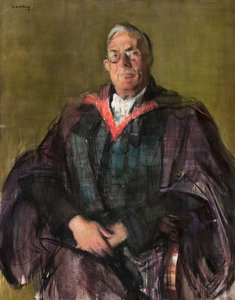 Sir Hector Hetherington, Principal of the University of Glasgow (1936–1961)1945
13
 Landscape outside Glasgow1955
14
 Sir Graham J. Hills (b.1926)1991
15
 Still Life
16
 Sir Hector Hetherington (1888–1965)University of Exeter
17
 Man in a Landscape
18
 The Pink Room, Young Girl
19
 Sir Alexander Gibson (1926–1995)
20
 Catriona Campbell
21
 AbsalomHigh Life Highland Exhibitions Unit
22
 Still Life in Blue
23David, 4th Marquess of AberdeenThe National Trust For Scotland
24
 Sir Robin Philipson (1916–1992), PRSARoyal Scottish Academy of Art - Architecture
25
 David DonaldThe Fleming Collection
26
 Drymen Church
27
 Still Life of FranceCulturenl
De vier onderwerpen die het meest voorkomen in deze originelen, elk met zijn mooiste voorbeeld.
De 7 musea met de meeste schilderijen op deze pagina.
| Museum | Stad | Werken van David Donaldson | Schilderijen uit deze lijst |
|---|---|---|---|
 The Fleming Collection |
London | 2 | Arrangement in White, David Donald |
 Maclaurin Art Gallery at Rozelle House |
Ayr | 1 | Caroline on Roller Skates |
 University of Exeter |
Exeter | 1 | Sir Hector Hetherington (1888–1965) |
 High Life Highland Exhibitions Unit |
Inverness | 1 | Absalom |
 The National Trust For Scotland |
Elgin | 1 | David, 4th Marquess of Aberdeen |
 Royal Scottish Academy of Art - Architecture |
Edinburgh | 1 | Sir Robin Philipson (1916–1992), PRSA |
 Culturenl |
Coatbridge | 1 | Still Life of France |
Kies een decennium om het origineel te zien dat dit tijdperk definieert.
Maria (1948). Sir James Wilson Mackay (1912–1992), DLitt, Lord Provost of Edinburgh (1969–1972) en Arrangement in White volgen.
32 jaar oud: Maria dateert uit 1948, en David Donaldson werd geboren in 1916.
Maria, Sir James Wilson Mackay (1912–1992), DLitt, Lord Provost of Edinburgh (1969–1972), Arrangement in White, Judith, Dr Winifred Margaret Ewing (b.1929), Caroline on Roller Skates, Sir Harry Jefferson Barnes (1915–1982), Director of The Glasgow School of Art, Portrait of a Young Man, Maria Donaldson and 'Ciao' en Sir John Greig Dunbar (b.1907), Lord Provost of Edinburgh (1960–1963). De bovenstaande ranglijst vermeldt het jaar en het museum van elk werk.
Onze catalogus bevat 27 werken van David Donaldson, daterend van 1945 tot 1991.
Voornamelijk in The Fleming Collection (London), Maclaurin Art Gallery at Rozelle House (Ayr) en University of Exeter (Exeter). De bovenstaande museumtabel bevat een volledig overzicht.
In 1940s: 2 van de 27 werken op deze pagina werden toen gemaakt, waaronder Maria.
Op deze pagina is het vroegste Sir Hector Hetherington, Principal of the University of Glasgow (1936–1961) (1945) en het laatste Sir Graham J. Hills (b.1926) (1991).
Portrait (3), Scottish art (3) en Victorian (2), verspreid over de 27 werken op deze pagina.
Contemporary realism en Impressionism, te oordelen aan de originelen op deze pagina.
Arrangement in White en David Donald: het The Fleming Collection, London herbergt 2 van de werken op deze pagina.
In the annals of twentieth-century Scottish art, few names evoke the grandeur and tradition of the nation quite like David Donaldson. A master of the decorative mural and a sensitive portraitist, Donaldson occupied a unique position in the cultural landscape, serving with distinction as the official Painter and Limner to Queen Elizabeth II in Scotland. This ancient title was not merely an honorific but a reflection of his ability to capture the very essence of Scottish identity through a lens of meticulous detail and classical grace. Born in Chryston, Lanarkshire, in 1916, Donaldson’s early life in Coatbridge, amidst the industrious atmosphere of rolling mills, provided a grounded foundation for an artistic journey that would eventually traverse the most prestigious studios of Europe.
His formal education at the Glasgow School of Art between 1932 and 1937 served as the crucible for his developing technique. It was here that his extraordinary talent was first recognized, earning him the prestigious Director's Prize in 1936. This achievement acted as a gateway to the wider world, allowing him to study in the historic art centers of Paris and Florence. These travels were transformative; the profound influence of Renaissance masters instilled in him a lifelong reverence for composition, light, and the structural integrity of the human form. Upon his return to Glasgow, Donaldson’s work began to synthesize this continental sophistication with a deep-seated devotion to his Scottish roots, creating a style that felt both timeless and intimately connected to the rugged beauty of the Highlands.
Donaldson’s career was marked by an ambitious pursuit of large-scale storytelling. One of the most significant, yet poignant, chapters of his early career involved the 1938 Empire Exhibition in Glasgow. Tasked with creating a monumental mural to adorn the exhibition pavilions, Donaldson sought to encapsulate the vibrant spirit of Scotland within a single, sweeping vision. Though this ambitious work was tragically lost during the demolition of the exhibition structures, the endeavor solidified his reputation as an artist capable of handling immense scale and complex narrative themes. This period of his life demonstrated a fearless approach to public art, where the boundaries between fine art and decorative architecture began to blur.
As his career progressed, Donaldson’s mastery of portraiture became a hallmark of his oeuvre. His ability to blend realism with impressionistic brushwork allowed him to imbue his subjects with a sense of quiet dignity and psychological depth. Whether capturing the formal regalia of the 4th Marquess of Aberdeen or the intimate, symbolic beauty of personal portraits like 'Maria', his work resonated with an emotional truth. His technical prowess was further recognized by the Royal Scottish Academy, where he secured the Guthrie Award in 1941, a testament to his rising stature within the British art establishment.
Beyond the easel, Donaldson played a pivotal role in shaping the future of Scottish art through his dedication to pedagogy. Ascending to the position of Head of Drawing and Painting at the Glasgow School of Art in 1967, he became a mentor to generations of emerging artists, passing on the rigorous standards of technique and the appreciation for classical foundations that had defined his own training. His life was a testament to the endurance of tradition in a rapidly changing modern world, maintaining a bridge between the historical importance of the limner tradition and the evolving sensibilities of the twentieth century.
The conclusion of his life was as poetic as his art. In 1996, during a retrospective exhibition celebrating his eight decades of life—held at both the University of Edinburgh's Talbot Rice Gallery and the Glasgow School of Art—Donaldson passed away. This final tribute allowed the art community to reflect on a lifetime of service to the visual culture of Scotland. His legacy remains preserved in the vibrant landscapes, the dignified portraits, and the enduring spirit of Highland majesty that he so masterfully rendered for the world to admire.


