Portret van Carlo Cignani

Schilderijen van Carlo Cignani: De 55 bekendste, door de ogen van een galerie

Bijgewerkt in november 2026 · gerangschikt op basis van onze populariteitsscore (zoekopdrachten, bezoeken en bestellingen per kunstwerk) · 56 werken van Carlo Cignani in onze catalogus

Kortom

In het oog van de galerie is het beroemdste schilderij van Carlo Cignani The Judgment of Paris (1653). Isaac Blesses Jacob (1673) en Jupiter as a Child, Nursed by the Goat Amalthea (1673) maken het trio compleet dat elk oog herkent. Van de 56 werken van Carlo Cignani in onze catalogus presenteert de galerie hieronder de 55 bekendste werken, elk een origineel met de jaartal, het museum en wat het uniek maakt.

1628 – 1719, Bologna Baroque Meeste werken: Bayerische Staatsgemäldesammlungen

De top 10 schilderijen van Carlo Cignani in de galerie

1
The Judgment of Paris (1653) door Carlo Cignani

The Judgment of Paris

1653 · Oil

The Judgment of Paris is a mythological painting by Carlo Cignani. Created about 1653, the work depicts a specific episode from classical antiquity. The scene features a group of figures positioned within a landscape. On the left side of the composition, three female figures are arranged in various states of undress. One figure is shown in profile, while another faces forward with draped fabric, and a third figure is seen…

2
Isaac Blesses Jacob (1673) door Carlo Cignani

Isaac Blesses Jacob

1673 · Oil On Canvas · Bayerische Staatsgemäldesammlungen, München

In this eighteenth-century copy of a work by Carlo Cignani, we encounter the profound tension of a pivotal biblical moment. The scene captures Isaac Blesses Jacob, a subject that relies on the quiet gravity of familial deception. Isaac, aged and blind, is seated and wrapped in heavy sheets and blankets, his physical vulnerability contrasting with the weight of the blessing he is about to bestow. He reaches out to touch…

3
Jupiter as a Child, Nursed by the Goat Amalthea (1673) door Carlo Cignani

Jupiter as a Child, Nursed by the Goat Amalthea

1673 · Oil On Canvas · Bayerische Staatsgemäldesammlungen, München

In this 1673 oil painting, we find ourselves drawn into a quiet, yet intensely dramatic, mythological encounter. The scene depicts the infant Jupiter being nursed by the goat Amalthea, a moment of survival and nourishment set within a crowded, dynamic composition. The arrangement of the figures follows a pyramidal structure, guiding the eye toward the central interaction between the animal and the child. There is a palpable sense of movement…

4
Female Head (1673) door Carlo Cignani

Female Head

1673 · Oil On Canvas · Bayerische Staatsgemäldesammlungen, München

In the portrait "Female Head" by Carlo Cignani, the composition is organized as a close-up bust view of a single female figure. The subject is positioned slightly off-center and is captured in a side profile facing toward the left. This perspective emphasizes the contours of the facial structure and the layering of the head covering. The arrangement focuses the viewer's attention on the head and the upper shoulders, creating a…

5
Birth of Adonis (1673) door Carlo Cignani

Birth of Adonis

1673 · Oil On Canvas · Bayerische Staatsgemäldesammlungen, München

The canvas holds a crowded, pyramidal arrangement of figures, all leaning toward a single, central infant. Light spills from the upper left, catching the soft anatomy of the newborn and the heavy, tactile folds of drapery. Shadows pool deeply in the background, creating a sense of mystery around the unfolding event. This is the work of Carlo Cignani, a painter who bridged the gap between the heavy drama of the…

6
Charity with Child in the Cradle (1673) door Carlo Cignani

Charity with Child in the Cradle

1673 · Oil On Canvas · Bayerische Staatsgemäldesammlungen, München

In this intimate scene, we encounter Charity with Child in the Cradle, a work that captures a profound moment of maternal devotion. The artist, Carlo Cignani, directs our gaze toward a central figure who embodies the very essence of selfless love. This is not merely a portrait of a woman, but a deliberate allegory of Charity, expressed through the tender and constant nurturing of the young lives surrounding her. The…

7
Mary with Child and Infant John (1673) door Carlo Cignani

Mary with Child and Infant John

1673 · Oil · Bayerische Staatsgemäldesammlungen, München

In this intimate and dynamic work, Mary with Child and Infant John, painted by Carlo Cignani about 1673, utilizes a pyramidal arrangement of figures to guide the viewer's gaze. The composition directs the eye upward, following the movement of the Christ Child as he reaches toward a descending dove. This celestial symbol of the Holy Spirit acts as the apex of the spiritual movement within the frame. Mary is depicted…

8
Samson and Delilah (1673) door Carlo Cignani

Samson and Delilah

1673 · Oil · Bayerische Staatsgemäldesammlungen, München

In this oil painting from 1673, the scene unfolds through a crowded and dynamic arrangement of figures. A central female figure, Delilah, occupies the mid-ground. She is depicted looking back over her shoulder, her face turned away from the primary action, while her left hand holds a small object aloft. Below her, a muscular male figure, Samson, is slumped forward. His back and shoulder are positioned toward the viewer, his…

9
Penitent Magdalene (1673) door Carlo Cignani

Penitent Magdalene

1673 · Oil On Canvas · Bayerische Staatsgemäldesammlungen, München

Penitent Magdalene is an oil on canvas by the Italian painter Carlo Cignani. Executed about 1673, the work belongs to the Bolognese school, a tradition characterized by refined elegance and intellectual depth. Cignani, born in Bologna, Italy, was a significant figure of the late seventeenth century, known for a style that bridged the High Baroque and the emerging Rococo.

10
Charity (1673) door Carlo Cignani

Charity

1673 · Oil On Copper · Bayerische Staatsgemäldesammlungen, München

In this intimate scene, the virtue of Charity takes a human form through the tender act of nurturing. The painting, titled Charity, captures a quiet moment of devotion as a central maternal figure gathers three young children into her embrace. There is a profound sense of closeness in the way the figures occupy the space, drawing the viewer into their private circle of care. The composition focuses entirely on this…

Schilderijen van Carlo Cignani, gerangschikt van 11 tot 55

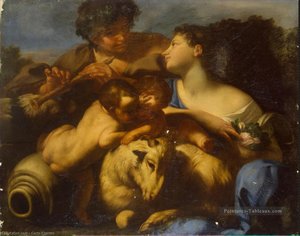
11The Death of Camilla (1682) door Carlo CignaniThe Death of Camilla1682 · Yekaterinburg Museum of Fine Arts 12The Penitent Magdalen (1683) door Carlo CignaniThe Penitent Magdalen1683 · Belton House 13A Cupid, Blindfold, Seated on an Eagle (1678) door Carlo CignaniA Cupid, Blindfold, Seated on an Eagle1678 · Royal Collection 14A Cupid, Blindfold, Seated on a Globe (1678) door Carlo CignaniA Cupid, Blindfold, Seated on a Globe1678 · Royal Collection 15Joseph and Potiphar's Wife (1681) door Carlo CignaniJoseph and Potiphar's Wife1681 · Statens Museum for Kunst 16The Chastity of Joseph (1681) door Carlo CignaniThe Chastity of Joseph1681 · Statens Museum for Kunst 17The Holy Kinship (1676) door Carlo CignaniThe Holy Kinship1676 18Roman Caritas (Cimon and Pero) (1695) door Carlo CignaniRoman Caritas (Cimon and Pero)1695 · Kunsthistorisches Museum 19Saint Augustine (1700) door Carlo CignaniSaint Augustine1700 · Nationaal Museum in Warschau 20Portrait of Marcello Malpighi (1683) door Carlo CignaniPortrait of Marcello Malpighi1683 · Accademia di Belle Arti di Bologna 21Shepherd and Shepherdess (1670) door Carlo CignaniShepherd and Shepherdess1670 · Hermitage Museum 22Joseph and Potiphar's Wife (1678) door Carlo CignaniJoseph and Potiphar's Wife1678 · Gemäldegalerie Alte Meister 23Charity (1680) door Carlo CignaniCharity1680 · Metropolitan Museum of Art 24Mary with Child door Carlo CignaniMary with ChildKunsthistorisches Museum 25Hercules and Omphale door Carlo CignaniHercules and OmphaleStaatliche Kunsthalle Karlsruhe 26Laughing, Gesturing Youth door Carlo CignaniLaughing, Gesturing Youth 27Moise Sauve Des Eaux, Tableau Attribue A Carlo Cignani door Carlo CignaniMoise Sauve Des Eaux, Tableau Attribue A Carlo CignaniMusée des Beaux-Arts de Nancy 28Jupiter door Carlo CignaniJupiterPalazzo Ducale del Giardino 29Apparition To A Saint door Carlo CignaniApparition To A Saint 30Venus with Cherubs door Carlo CignaniVenus with CherubsFondazione Cariplo 31Virgen Con El Niño door Carlo CignaniVirgen Con El Niño 32Giuseppe Fugge La Moglie Di Putifar door Carlo CignaniGiuseppe Fugge La Moglie Di Putifar 33Bologna door Carlo CignaniBologna 34San Giovannino E L'agnello door Carlo CignaniSan Giovannino E L'agnello 35Venus And Adonis door Carlo CignaniVenus And Adonis 36Daphne And Apollo door Carlo CignaniDaphne And Apollo 37Cimon And Pero door Carlo CignaniCimon And Pero 38Praying Magdalene door Carlo CignaniPraying Magdalene 39Daphne's Metamorphosis door Carlo CignaniDaphne's Metamorphosis 40Jael And Sisera door Carlo CignaniJael And Sisera 41Der Triumph Amors. Ol Auf Leinwand door Carlo CignaniDer Triumph Amors. Ol Auf Leinwand 42Bacco E Arianna door Carlo CignaniBacco E Arianna 43Woman And Child door Carlo CignaniWoman And Child 44Christ Walking On The Water And Saint Peter door Carlo CignaniChrist Walking On The Water And Saint Peter 45Esther And Ahasuerus door Carlo CignaniEsther And Ahasuerus 46A Putto With A Tambourine And An Infant Satyr With A Panpipe door Carlo CignaniA Putto With A Tambourine And An Infant Satyr With A Panpipe 47The Penitent Magdalen door Carlo CignaniThe Penitent MagdalenDulwich Picture Gallery 48Jupiter door Carlo CignaniJupiterPalazzo Ducale del Giardino 49Jupiter door Carlo CignaniJupiterPalazzo Ducale del Giardino 50Affresco Di Carlo Cignani Nel Palazzo Ducale Del Giardino door Carlo CignaniAffresco Di Carlo Cignani Nel Palazzo Ducale Del Giardino 51Jupiter door Carlo CignaniJupiterPalazzo Ducale del Giardino 52Jupiter door Carlo CignaniJupiterPalazzo Ducale del Giardino 53Jupiter door Carlo CignaniJupiterPalazzo Ducale del Giardino 54Jupiter door Carlo CignaniJupiterPalazzo Ducale del Giardino 55Jupiter door Carlo CignaniJupiterPalazzo Ducale del Giardino

De beroemde schilderijen van Carlo Cignani, periode voor periode

De onderwerpen die de aandacht van Carlo Cignani troffen

De vier onderwerpen die het meest voorkomen in deze originelen, elk met zijn mooiste voorbeeld.

De musea waar de originele werken van Carlo Cignani worden bewaard

De 8 musea met de meeste schilderijen op deze pagina.

Museum Stad Werken van Carlo Cignani Schilderijen uit deze lijst
Bayerische Staatsgemäldesammlungen, MünchenBayerische Staatsgemäldesammlungen München 9 Isaac Blesses Jacob, Jupiter as a Child, Nursed by the Goat Amalthea, Female Head
Palazzo Ducale del Giardino, ParmaPalazzo Ducale del Giardino Parma 8 Jupiter, Jupiter, Jupiter
Royal Collection, LondenRoyal Collection Londen 2 A Cupid, Blindfold, Seated on an Eagle, A Cupid, Blindfold, Seated on a Globe
Statens Museum for Kunst, KopenhagenStatens Museum for Kunst Kopenhagen 2 Joseph and Potiphar's Wife, The Chastity of Joseph
Kunsthistorisches Museum, WenenKunsthistorisches Museum Wenen 2 Roman Caritas (Cimon and Pero), Mary with Child
Yekaterinburg Museum of Fine Arts, JekaterinburgYekaterinburg Museum of Fine Arts Jekaterinburg 1 The Death of Camilla
Belton House, GranthamBelton House Grantham 1 The Penitent Magdalen
Nationaal Museum in Warschau, WarschauNationaal Museum in Warschau Warschau 1 Saint Augustine

Carlo Cignani, één iconisch schilderij per decennium

Werken per decennium

Kies een decennium om het origineel te zien dat dit tijdperk definieert.

Schilderijen van Carlo Cignani: de galerie geeft antwoord

Welk schilderij van Carlo Cignani is het beroemdste van allemaal?Onthul het antwoord

The Judgment of Paris (1653). Isaac Blesses Jacob (1673) en Jupiter as a Child, Nursed by the Goat Amalthea (1673) volgen.

Hoe oud was Carlo Cignani bij de voltooiing van The Judgment of Paris?Onthul het antwoord

25 jaar oud: The Judgment of Paris dateert uit 1653, en Carlo Cignani werd geboren in 1628.

Wat zijn de top 10 schilderijen van Carlo Cignani?Onthul het antwoord

The Judgment of Paris, Isaac Blesses Jacob, Jupiter as a Child, Nursed by the Goat Amalthea, Female Head, Birth of Adonis, Charity with Child in the Cradle, Mary with Child and Infant John, Samson and Delilah, Penitent Magdalene en Charity. De bovenstaande ranglijst vermeldt het jaar en het museum van elk werk.

Hoeveel werken heeft Carlo Cignani gemaakt?Onthul het antwoord

Onze catalogus bevat 56 werken van Carlo Cignani, daterend van 1653 tot 1700.

Waar hangen de beroemdste originele werken van Carlo Cignani?Onthul het antwoord

Voornamelijk in Bayerische Staatsgemäldesammlungen (München), Palazzo Ducale del Giardino (Parma) en Royal Collection (Londen). De bovenstaande museumtabel bevat een volledig overzicht.

Wanneer creëerde Carlo Cignani de beroemdste schilderijen?Onthul het antwoord

In 1670s: 14 van de 55 werken op deze pagina werden toen gemaakt, waaronder Isaac Blesses Jacob.

Wat zijn de vroegste en laatste beroemde werken van Carlo Cignani?Onthul het antwoord

Op deze pagina is het vroegste The Judgment of Paris (1653) en het laatste Saint Augustine (1700).

Welke onderwerpen keerde Carlo Cignani het vaakst naar terug?Onthul het antwoord

Woman (15), Drapery (13) en Man (8), verspreid over de 55 werken op deze pagina.

In welk medium werkte Carlo Cignani het meest?Onthul het antwoord

Oil On Canvas, voor 14 van de 55 werken op deze pagina.

Bij welke stroming wordt Carlo Cignani gerekend?Onthul het antwoord

Baroque, te oordelen aan de originelen op deze pagina.

Welke originelen van Carlo Cignani zijn in de collectie van het Bayerische Staatsgemäldesammlungen?Onthul het antwoord

Isaac Blesses Jacob, Jupiter as a Child, Nursed by the Goat Amalthea en Female Head: het Bayerische Staatsgemäldesammlungen, München herbergt 9 van de werken op deze pagina.

Carlo Cignani: de kunstenaar

Een Erfenis van Zachte Barok: Het Leven en de Kunst van Carlo Cignani

Carlo Cignani, geboren rond 1630 in Bologna, vormt een fascinerende figuur die de Hoogbarok overbruggen met de opkomende Rococo-stijl. Hij was geen revolutionair zoals sommige van zijn tijdgenoten, maar eerder een meesterlijke consolidator, de laatste grote exponent van het Bolognese classicisme dat generaties lang had bloeien. Zijn kunst belichaamt een ‘nieuwe manier’, zoals deze bekend stond – een verzachting van de dramatische intensiteit die door eerdere Barokmeesters werd bevoorderd, vervangen door een intieme en reflectieve kwaliteit die subtiel kunstenaars als Guido Reni en Guercino beïnvloedde. Cignani’s pad was er niet één van radicaal vernieuwen, maar eerder van verfijnde elegantie en intellectuele diepgang, waarmee hij zijn plaats vestigde als een significant, zij het soms over het hoofd geziene figuur in de 17e-eeuwse Italiaanse schilderkunst. Details over zijn vroege leven blijven enigszins spaarzaam; we weten dat hij afkomstig was van een adellijke, hoewel bescheiden familie, en dat hij later zowel een zoon, Felice Cignani, eveneens schilder, als een neef, Paolo Cignani, zou hebben die in de familietraditie volgde.

Vroege Jaren en Artistieke Ontwikkeling

Cignani’s artistieke reis begon onder de begeleiding van Battista Cairo, maar het was zijn leerlingstijd bij Francesco Albani die werkelijk zijn fundamentele stijl vorm gaf. Hij absorbeerde Albani's nauwgezette techniek, zijn levendige gebruik van kleur en zijn toewijding aan een gepolijnde afwerking. Echter, Cignani imiteerde niet simpelweg zijn meester; hij bezat een intellectuele nieuwsgierigheid die hem ertoe bracht andere invloeden te verkennen. De fresco’s van Correggio in de Dom van Parma hadden een diepgaande impact op zijn begrip van compositie en chromatische harmonie, terwijl Melozzo da Forlì's meesterschap in perspectief zijn interesse wekte om illusoir ruimte te creëren. Deze synthese van invloeden stelde Cignani in staat een eigen stem te ontwikkelen – één gekenmerkt door gracieuze vormen, gebalanceerde composities en een subtiele emotionele resonantie. Hij richtte een *accademia del nudo* op in Bologna, waarmee hij een toewijding aan anatomisch onderzoek demonstreerde en instructie gaf aan veelbelovende jonge kunstenaars, waaronder Giuseppe Maria Crespi, die zelf een gerespecteerd schilder zou worden.

Belangrijke Werken en Artistieke Hoogtepunten

Cignani’s carrière omvatte meerdere decennia, resulterend in een divers oeuvre bestaande uit religieuze taferelen, mythologische verhalen en portretten. De *Hemelopname van Sint Rosa van Lima*, geschilderd voor de kerk in Forlì, wordt algemeen beschouwd als zijn meest gevierde prestatie. Dit monumentale fresco toont zijn vermogen om dramatische composities te creëren binnen architectonische omgevingen, waarbij hij Correggio’s invloed weerspiegelt en tegelijkertijd zijn eigen unieke stijl vestigt. Andere opmerkelijke werken zijn de *Intrede van Paulus III in Bologna*, een historische voorstelling doordrenkt van intellectuele ernst, en *Franciscus I die aanraakt voor het Koningsziekte*, dat zijn vaardigheid demonstreert om koninklijke figuren met waardigheid en gevoeligheid af te beelden. Hij blinkte ook uit in plafondschilderingen, zoals blijkt uit *De Kracht der Liefde*, gecreëerd in samenwerking met Agostino Carracci. Zijn *Adam en Eva* verwierf internationale erkenning door tentoonstellingen in Dresden en Kopenhagen, wat de groeiende vraag naar zijn werk buiten Italië benadrukte. Er bestaan meerdere versies van *Josef en Potiphar’s Vrouw*, een bewijs van het blijvende appèl van dit bijbelse thema binnen zijn oeuvre.

Een Duurzame Invloed op de Bolognese Kunst

Carlo Cignani’s historische significantie ligt niet alleen in zijn artistieke output, maar ook in zijn rol als behouders en overdragers van de Bologese schildertraditie. Hij vertegenwoordigde het hoogtepunt van een school die bekend stond om zijn classicisme, intellectuele strengheid en technische beheersing. Zijn toewijding aan anatomisch onderzoek, aangetoond door zijn *accademia del nudo*, hielp hoge kwaliteitsnormen te handhaven onder aspirant-kunstenaars. Naast Crespi begeleidde hij Paolo Antonio Paderna en Sante Vandi, waarmee hij verder bijdroeg aan de ontwikkeling van de Bolognese kunst. Zijn werk vond een thuis in prominente collecties door heel Europa, waaronder Dresden en Kopenhagen, wat zijn internationale reputatie consolideerde. Tegenwoordig worden verschillende van zijn schilderijen bewaard in de Pinacoteca Civica in Forlì, waardoor toekomstige generaties zijn kunstenaarschap kunnen waarderen. Hoewel hij misschien niet zo wijdverspreid erkend wordt als sommige van zijn Barok-tijdgenoten, blijft Carlo Cignani een vitale figuur in de kunstgeschiedenis – een meester van zachte Barok wiens nalatenschap voortleeft en inspireert. Zijn latere jaren bracht hij door met ijverig te blijven werken, waaronder het schilderen van de *Aurora* bij Circolo della Scranna in Forlì, en het voltooien van de *Incoronazione di Santa Rosa (Hemelopname van Sint Rosa van Lima)* voor de Pinacoteca Civica voordat hij ergens na 1719 overleed.