Portret van Barnett Newman

De 62 beroemdste schilderijen van Barnett Newman, elk uniek

Bijgewerkt in november 2026 · gerangschikt op basis van onze populariteitsscore (zoekopdrachten, bezoeken en bestellingen per kunstwerk) · 69 werken van Barnett Newman in onze catalogus

Kortom

Black Fire I (1963) is het schilderij van Barnett Newman dat de meeste aandacht trekt. Daarna gaat de blik naar Vir Heroicus Sublimis (1950) en Prometheus Bound. Van de 69 werken van Barnett Newman in onze catalogus zijn dit de 62 bekendste, elk een uniek origineel gepresenteerd met het jaar, het museum en de reden waarom het blijft voortbestaan.

1905 – 1970, New York Color field Meeste werken: National Gallery of Art

Top 10 schilderijen van Barnett Newman, door de ogen van de galerie

1
Black Fire I (1963) door Barnett Newman

Black Fire I

1963 · Olieverf op canvas

In 1963 bracht Barnett Newman Black Fire I tot leven. Het canvas is een monumentale aanwezigheid van 289 x 213 cm die de ruimte vult met een zware, verstilde kracht. Deze schaal dwingt een fysieke reactie af bij iedereen die er voor staat. Het werk kwam voort als een hoogtepunt van de Color Field painting, waarbij de chaos van de zichtbare wereld werd weggefilterd om iets fundamenteelers te onthullen.

2
Vir Heroicus Sublimis (1950) door Barnett Newman

Vir Heroicus Sublimis

1950 · Oil On Canvas

The canvas of Vir Heroicus Sublimis looms large, a monumental presence that demands immediate attention. Created by the American painter Barnett Newman, this work carries a title that translates from Latin as "Man, Heroic and Sublime." It is a massive expanse, reaching nearly 8 feet in height and stretching 18 feet wide, a scale that envelops the viewer's field of vision. The sheer size of the painting transforms the space…

3
Prometheus Bound door Barnett Newman

Prometheus Bound

Oil On Canvas · Museum Folkwang, Essen

In the vast, quiet landscape of Abstract Expressionism, few works command the room with such profound, understated authority as Barnett Newman’s "Prometheus Bound." To encounter this painting is to step away from the clamor of the material world and enter a space of pure, meditative stillness. Eschewing the traditional impulse to depict recognizable figures or dramatic narratives, Newman invites the viewer into a realm of Color Field Painting, where the…

4
Onement I (1948) door Barnett Newman

Onement I

1948 · Oil On Canvas · MoMA - Museum of Modern Art, New York City

In the landscape of twentieth-century modernism, few works possess the quiet, seismic power of Barnett Newman’s Onement I. Completed in 1948, this masterpiece serves as a profound emblem of Abstract Expressionism and stands as a foundational cornerstone for the Color Field movement. To encounter this painting is to witness a pivotal moment in art history where the boundaries of representation were irrevocably dissolved, replaced by an exploration of pure perception.…

5
Be I (1970) door Barnett Newman

Be I

1970 · Acrylic On Canvas · Detroit Institute of Arts, Detroit

The canvas holds a heavy, dark cadmium red. This color occupies the space like the earth itself, unmodulated and thick with presence. A single white stripe, known as a zip, cuts vertically through the center of the field. It is precise and thin. This line acts as a flash of lightning against the saturated background, an instantaneous moment that breaks the stillness of the red expanse.

6
Onement, III (1949) door Barnett Newman

Onement, III

1949 · Oil On Canvas

In the vast landscape of mid-20th-century abstraction, few works command the room with such singular, quiet intensity as Barnett Newman’s Onement, III. Created in 1949, this masterpiece stands as a seminal pillar of the Color Field painting movement, offering much more than a mere arrangement of pigment on canvas. It is an invitation to experience the sublime. The painting presents a breathtaking expanse of deep, dominant red, a field of…

7
Be I (1970) door Barnett Newman

Be I

1970 · Acrylic On Canvas

To stand before Be I is to encounter a profound silence that speaks with startling intensity. Created in 1970, the final year of Barnett Newman’s life, this monumental work serves as a definitive statement of the Color Field movement. The painting does not rely on the traditional vocabulary of figures or landscapes; instead, it commands the viewer's attention through a singular, immersive expanse of deep red. This is not merely…

8
The Third (1964) door Barnett Newman

The Third

1964 · Oil On Canvas

The canvas breathes through a field of orange. It is a hue that does not merely sit upon the surface but seems to vibrate, a steady heat radiating from the center of the frame. This is the world of 1964, where color is stripped of its duty to represent objects and is instead allowed to exist as pure energy. Through the application of pigment, a flat, non-hierarchical space emerges, inviting…

9
Twelfth Station (1965) door Barnett Newman

Twelfth Station

1965 · Acrylic On Canvas · National Gallery of Art, Washington

Barnett Newman created Twelfth Station in 1965. This acrylic on canvas exists as a single movement within a larger sequence. It belongs to the series titled The Stations of the Cross / Lema Sabachthani. The work emerged from a period of intense philosophical inquiry, seeking to find a visual language for the silent weight of existence.

10
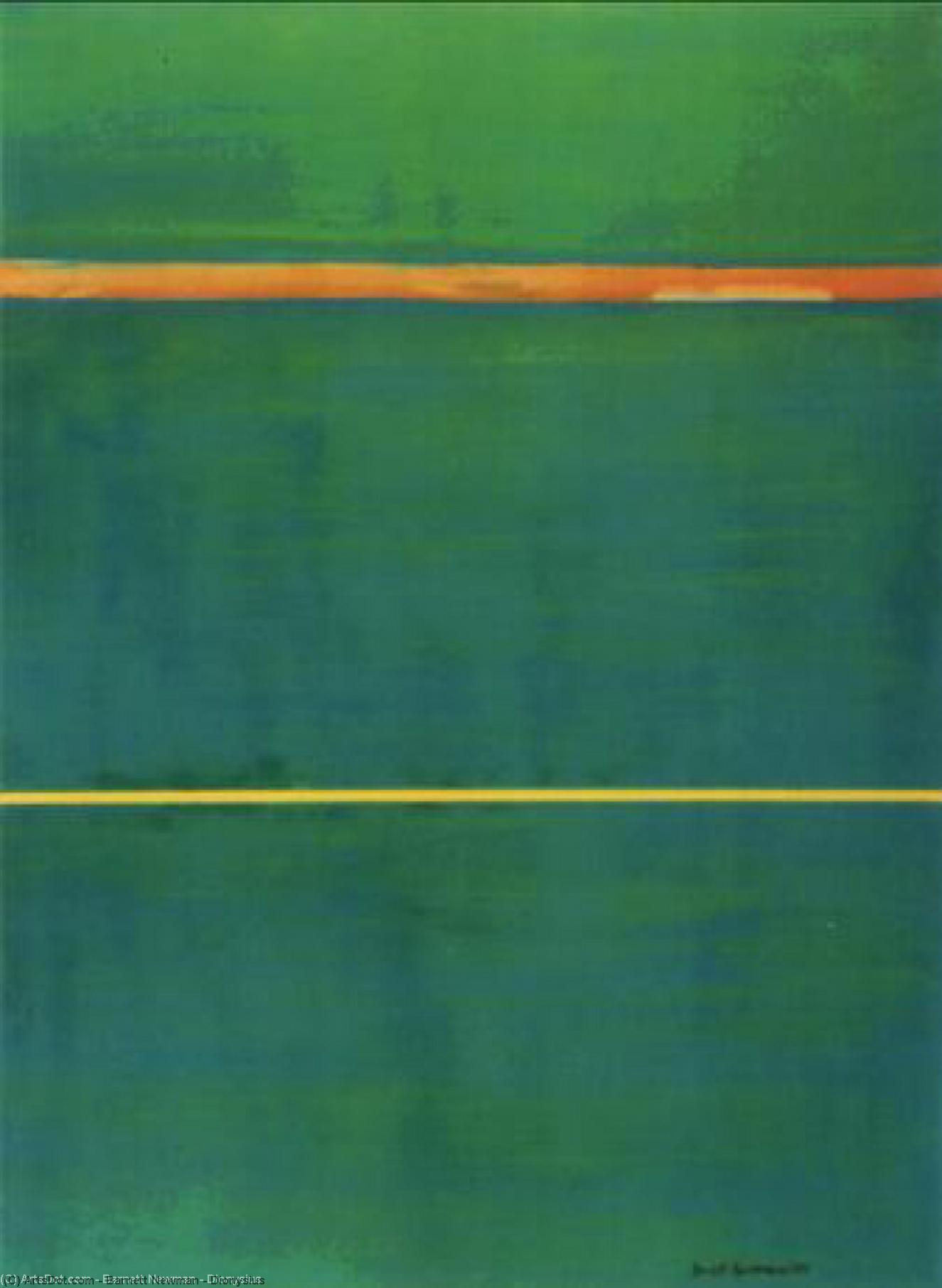
Dionysius (1949) door Barnett Newman

Dionysius

1949 · Oil On Canvas

Dionysius is a work by Barnett Newman. Created in 1949, this oil on canvas piece belongs to the Color Field style. The artist's approach here focuses on the expansive application of pigment to establish a specific spatial presence.

De beroemde schilderijen van Barnett Newman, nummer 11 tot 62

De beroemde schilderijen van Barnett Newman, periode voor periode

Mid-Career

1944 – 1950 · 3 werken in deze lijst

De onderwerpen die de aandacht van Barnett Newman troffen

De vier onderwerpen die het meest voorkomen in deze originelen, elk met zijn mooiste voorbeeld.

De musea waar de originele werken van Barnett Newman worden bewaard

De 5 musea met de meeste schilderijen op deze pagina.

Museum Stad Werken van Barnett Newman Schilderijen uit deze lijst
National Gallery of Art, WashingtonNational Gallery of Art Washington 13 Twelfth Station, Fourth Station, Second Station
Museum Folkwang, EssenMuseum Folkwang Essen 1 Prometheus Bound
MoMA - Museum of Modern Art, New York CityMoMA - Museum of Modern Art New York City 1 Onement I
Detroit Institute of Arts, DetroitDetroit Institute of Arts Detroit 1 Be I
Museum Ludwig, KölnMuseum Ludwig Köln 1 Midnight Blue

Barnett Newman door de decennia heen: elk een uniek origineel

Werken per decennium

Kies een decennium om het origineel te zien dat dit tijdperk definieert.

Schilderijen van Barnett Newman: vragen voor de galerie

Wat is het bekendste werk van Barnett Newman?Onthul het antwoord

Black Fire I (1963). Vir Heroicus Sublimis (1950) en Prometheus Bound volgen.

Op welke leeftijd creëerde Barnett Newman Black Fire I?Onthul het antwoord

58 jaar oud: Black Fire I dateert uit 1963, en Barnett Newman werd geboren in 1905.

Welke tien schilderijen van Barnett Newman zijn het meest bekend?Onthul het antwoord

Black Fire I, Vir Heroicus Sublimis, Prometheus Bound, Onement I, Be I, Onement, III, Be I, The Third, Twelfth Station en Dionysius. De bovenstaande ranglijst vermeldt het jaar en het museum van elk werk.

Hoeveel werken van Barnett Newman zijn er bekend?Onthul het antwoord

Onze catalogus bevat 69 werken van Barnett Newman, daterend van 1944 tot 1970.

Waar kunnen de beroemdste originelen van Barnett Newman worden bekeken?Onthul het antwoord

Voornamelijk in National Gallery of Art (Washington), Museum Folkwang (Essen) en MoMA - Museum of Modern Art (New York City). De bovenstaande museumtabel bevat een volledig overzicht.

In welke periode creëerde Barnett Newman de bekendste schilderijen?Onthul het antwoord

In 1960s: 32 van de 62 werken op deze pagina werden toen gemaakt, waaronder Black Fire I.

Welk beroemd schilderij van Barnett Newman is de vroegste, en welke de laatste?Onthul het antwoord

Op deze pagina is het vroegste The Song of Orpheus (1944) en het laatste Be I (1970).

Welke onderwerpen had Barnett Newman de voorkeur?Onthul het antwoord

Vertical lines (5), Geometric (4) en Spirituality (2), verspreid over de 62 werken op deze pagina.

Met welke materialen schilderde Barnett Newman het meest?Onthul het antwoord

Oil On Canvas, voor 8 van de 62 werken op deze pagina.

Bij welke stroming behoort het werk van Barnett Newman?Onthul het antwoord

Color field en Abstract expressionism, te oordelen aan de originelen op deze pagina.

Welke originele werken van Barnett Newman kan ik zien in het National Gallery of Art?Onthul het antwoord

Twelfth Station, Fourth Station en Second Station: het National Gallery of Art, Washington herbergt 13 van de werken op deze pagina.

Barnett Newman: een portret van de kunstenaar

A Pioneer of Abstract Expressionism: The Life and Art of Barnett Newman

Barnett Newman, born in 1905 in New York City to Jewish immigrant parents from Poland, emerged as a pivotal figure in the landscape of American art. His journey wasn’t one of immediate recognition but rather a slow burn of artistic exploration and philosophical inquiry that ultimately redefined the possibilities of abstract painting. Initially studying at the Art Students League and later at the City College of New York, Newman absorbed the influences of his time – the burgeoning Cubism of Picasso and the vibrant color palettes of Matisse were early touchstones. However, he soon felt constrained by these established modes of representation, sensing a need to forge a new visual language capable of expressing the anxieties and spiritual longings of the post-war era. He even destroyed much of his earlier representational work, a deliberate act signifying his commitment to an entirely new artistic path. This period of self-imposed creative destruction was crucial; it cleared the ground for the radical simplicity that would come to define his mature style. Newman’s formative years were marked by intellectual curiosity and engagement with philosophy—a passion he carried throughout his life. He pursued a doctorate in philosophy at Columbia University, delving into existentialist thought and grappling with questions of meaning and purpose. This philosophical grounding profoundly shaped his artistic vision, informing his rejection of traditional conventions and his insistence on exploring the inner landscape of experience. His early paintings reflected influences from Surrealism, experimenting with dreamlike imagery and subconscious associations—a stylistic detour that ultimately served as a springboard for his groundbreaking breakthrough.

The Birth of the “Zip” and the Expansion of Color

Newman’s artistic revolution began in 1948 with *Onement I*, a monumental canvas dominated by a single field of dark red bisected by a vertical stripe of orange. This seemingly simple composition—a radical departure from representational art—became his signature style, establishing him as one of the foremost practitioners of Color Field painting. The “zip,” as Newman termed it, wasn’t merely a line; it was a dynamic force, asserting presence within the expansive emptiness of the canvas and simultaneously dividing and uniting the composition. He meticulously crafted these zips using pigment dispersions—a technique that prioritized color saturation and tonal variation over traditional brushstrokes—creating an immersive experience for the viewer. This method allowed him to convey profound emotional resonance without resorting to explicit imagery or narrative content. Newman’s exploration of color extended beyond mere aesthetic considerations; he believed that color possessed inherent spiritual significance, reflecting the underlying rhythms and harmonies of existence. He painstakingly researched pigments and experimented with layering techniques to achieve optimal tonal balance—a dedication to craftsmanship that underscored his conviction that art could communicate truths inaccessible to rational thought. His subsequent works continued to refine this approach, culminating in monumental canvases like *Vir Heroicus Sublimis*, which incorporated multiple zips to evoke a sense of spatial depth and grandeur. These paintings were conceived as arenas for confronting existential anxieties—a reflection of the turbulent postwar period and Newman’s own personal struggles with faith and identity.

Spirituality, The Sublime, and Philosophical Underpinnings

Newman's artistic philosophy was deeply intertwined with his intellectual convictions. He rejected the notion that painting should merely depict the external world, believing instead that it could serve as a vehicle for exploring profound existential questions—questions of mortality, meaninglessness, and transcendence. Influenced by thinkers like Sartre and Heidegger, he sought to capture what he called “the sublime”—an experience of overwhelming grandeur and awe—through his abstract forms. This wasn’t about religious iconography but rather an attempt to evoke a primal sense of wonder in the viewer—a desire to confront the immensity of existence without resorting to comforting illusions. He saw his work as a rejection of societal norms and an affirmation of individual freedom, striving to create art that was both intellectually rigorous and emotionally powerful. Newman’s unwavering commitment to philosophical inquiry permeated every aspect of his life—from his academic pursuits to his engagement with political activism. He championed the cause of civil liberties and passionately defended artistic expression as a fundamental human right—a stance that reflected his belief in the transformative potential of art to challenge conventional wisdom and inspire social change. His profound understanding of human psychology informed his artistic process, guiding him toward creating works that resonated deeply with viewers on an emotional level. Newman’s legacy extends beyond his paintings; he remains an enduring symbol of intellectual courage and artistic integrity—a testament to the power of art to grapple with existential dilemmas and illuminate the mysteries of consciousness. Newman's influence on subsequent generations of artists is undeniable. His pioneering use of color and form challenged established aesthetic conventions, paving the way for Minimalism and inspiring countless painters to explore new expressive possibilities. He demonstrated that art could transcend representational limitations—that it could communicate profound truths without resorting to visual imagery—a conviction that continues to resonate with contemporary artists today. Barnett Newman’s enduring contribution to modern art lies not only in his iconic canvases but also in his unwavering belief in the transformative power of artistic contemplation—a legacy that ensures his place as one of the most visionary figures of the 20th century.