Portret van Antonio Visentini

Schilderijen van Antonio Visentini: De 19 bekendste, door de ogen van een galerie

Bijgewerkt in november 2026 · gerangschikt op basis van onze populariteitsscore (zoekopdrachten, bezoeken en bestellingen per kunstwerk) · 19 werken van Antonio Visentini in onze catalogus

Kortom

Volgens de visie van de galerie is het beroemdste schilderij van Antonio Visentini The Adoration of the Kings (1721), waarvan het origineel in het Statens Museum for Kunst in Kopenhagen hangt. The Canal Grande from Santa Croce to the East (1742) en San Geremia and the Entrance of Cannaregio (1735) maken het trio compleet dat elk oog herkent. Van de 19 werken van Antonio Visentini in onze catalogus presenteert de galerie hieronder de 19 bekendste werken, elk een origineel met de jaartal, het museum en wat het uniek maakt.

1688 – 1782, Venice Meeste werken: Royal Collection

De top 10 schilderijen van Antonio Visentini in de galerie

1
The Adoration of the Kings (1721) door Antonio Visentini

The Adoration of the Kings

1721 · Oil On Canvas · Statens Museum for Kunst, Kopenhagen

The scene unfolds in a dense, pyramidal arrangement of figures. This geometric weight pulls the eye toward the center, where the infant Jesus and the kneeling king meet in a quiet collision of light and shadow. The Baroque style lends a heavy, dramatic tension to the moment. Every gesture is charged with the weight of reverence and the sudden recognition of divinity. Shadows press in from the edges, carving out…

3
San Geremia and the Entrance of Cannaregio (1735) door Antonio Visentini

San Geremia and the Entrance of Cannaregio

1735 · Etching · Royal Collection, Londen

This black and white etching, dated 1735, presents a detailed view of a Venetian canal scene. The composition centers on the San Geremia church, where a prominent bell tower creates a vertical axis that directs the eye upward toward a cloud-filled sky. The waterway occupies the foreground and middle ground, populated by several gondolas, some of which contain visible occupants. Buildings line both sides of the canal, displaying varying heights…

4
Landscape with a Triumphal Arch to George II (1746) door Antonio Visentini

Landscape with a Triumphal Arch to George II

1746 · Oil On Canvas · Royal Collection, Londen

The sun hangs high in a pale blue sky, casting a soft, warm light across a sprawling landscape that feels both ancient and newly born. At the heart of this scene, a massive triumphal arch rises from the earth, its light-colored stone glowing against the lush greenery of the surrounding hills. This is no mere ruin; it is a grand, monumental structure, detailed with Corinthian columns and decorative friezes that…

7
Piazza Santi Giovanni e Paolo door Antonio Visentini

Piazza Santi Giovanni e Paolo

Etching · Hermitage Museum, Sint-Petersburg

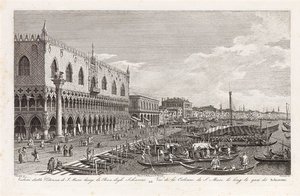
Antonio Visentini’s Piazza Santi Giovanni e Paolo: A Venetian Vision of Harmony Piazza Santi Giovanni e Paolo stands as one of Venice's most enduring emblems—a testament to the city’s architectural grandeur and its connection to the spiritual heart of Christendom. But it is Antonio Visentini’s etching, completed around 1735, that captures not merely a snapshot of this iconic space but embodies a profound philosophical contemplation on beauty and order. Produced…

8
The Canal Grande with San Simeone Piccolo and the Scalzi (1742) door Antonio Visentini

The Canal Grande with San Simeone Piccolo and the Scalzi

1742 · Etching · Royal Collection, Londen

The Canal Grande with San Simeone Piccolo and the Scalzi is an etching by Antonio Visentini. Created about 1742, this work captures a realistic depiction of Venice's Canal Grande. The scene focuses on the architectural grandeur of the waterway and the bustling activity that defines the city. San Simeone Piccolo and the Scalzi church emerge as significant landmarks, anchoring the view within Venetian history and culture.

9
View of Old Somerset House (1746) door Antonio Visentini

View of Old Somerset House

1746 · Oil On Canvas · Royal Collection, Londen

The oil on canvas painting titled View of Old Somerset House was executed by the artist Antonio Visentini. This work is dated 1746. The subject of the piece is a grand architectural view of Somerset House, a large structure situated on the south side of the Strand in central London. The composition focuses on the scale of the building and its relationship to the surrounding landscape.

10
View of the Pavilion or Bagnio at Eastbury (1746) door Antonio Visentini

View of the Pavilion or Bagnio at Eastbury

1746 · Oil On Canvas · Royal Collection, Londen

The scene unfolds within the oil on canvas of View of the Pavilion or Bagnio at Eastbury. Antonio Visentini captures a moment of quiet grandeur, presenting a grand neoclassical structure that dominates the landscape. This architectural vision, rendered with precise lines and a sense of immense space, invites the eye to wander through its sprawling, serene surroundings. The work emerges from a period of intense artistic activity in Venice, reflecting…

Schilderijen van Antonio Visentini, gerangschikt van 11 tot 19

De onderwerpen die de aandacht van Antonio Visentini troffen

De vier onderwerpen die het meest voorkomen in deze originelen, elk met zijn mooiste voorbeeld.

De musea waar de originele werken van Antonio Visentini worden bewaard

De 4 musea met de meeste schilderijen op deze pagina.

Museum Stad Werken van Antonio Visentini Schilderijen uit deze lijst
Royal Collection, LondenRoyal Collection Londen 10 The Canal Grande from Santa Croce to the East, San Geremia and the Entrance of Cannaregio, Landscape with a Triumphal Arch to George II
Statens Museum for Kunst, KopenhagenStatens Museum for Kunst Kopenhagen 1 The Adoration of the Kings
Hermitage Museum, Sint-PetersburgHermitage Museum Sint-Petersburg 1 Piazza Santi Giovanni e Paolo
Gallerie dell'Accademia di Venezia, VenetiëGallerie dell'Accademia di Venezia Venetië 1 Architectural Fantasy

Antonio Visentini, één iconisch schilderij per decennium

Werken per decennium

Kies een decennium om het origineel te zien dat dit tijdperk definieert.

Schilderijen van Antonio Visentini: de galerie geeft antwoord

Welk schilderij van Antonio Visentini is het beroemdste van allemaal?Onthul het antwoord

The Adoration of the Kings (1721), Statens Museum for Kunst, Kopenhagen. The Canal Grande from Santa Croce to the East (1742) en San Geremia and the Entrance of Cannaregio (1735) volgen.

Hoe oud was Antonio Visentini bij de voltooiing van The Adoration of the Kings?Onthul het antwoord

33 jaar oud: The Adoration of the Kings dateert uit 1721, en Antonio Visentini werd geboren in 1688.

Wat zijn de top 10 schilderijen van Antonio Visentini?Onthul het antwoord

The Adoration of the Kings, The Canal Grande from Santa Croce to the East, San Geremia and the Entrance of Cannaregio, Landscape with a Triumphal Arch to George II, Capriccio with a View of Burlington House, London, Capriccio with a View of Mereworth Castle, Kent, Piazza Santi Giovanni e Paolo, The Canal Grande with San Simeone Piccolo and the Scalzi, View of Old Somerset House en View of the Pavilion or Bagnio at Eastbury. De bovenstaande ranglijst vermeldt het jaar en het museum van elk werk.

Hoeveel werken heeft Antonio Visentini gemaakt?Onthul het antwoord

Onze catalogus bevat 19 werken van Antonio Visentini, daterend van 1721 tot 1764.

Waar hangen de beroemdste originele werken van Antonio Visentini?Onthul het antwoord

Voornamelijk in Royal Collection (Londen), Statens Museum for Kunst (Kopenhagen) en Hermitage Museum (Sint-Petersburg). De bovenstaande museumtabel bevat een volledig overzicht.

Wanneer creëerde Antonio Visentini de beroemdste schilderijen?Onthul het antwoord

In 1740s: 8 van de 19 werken op deze pagina werden toen gemaakt, waaronder The Canal Grande from Santa Croce to the East.

Wat zijn de vroegste en laatste beroemde werken van Antonio Visentini?Onthul het antwoord

Op deze pagina is het vroegste The Adoration of the Kings (1721) en het laatste Architectural Fantasy (1764).

Welke onderwerpen keerde Antonio Visentini het vaakst naar terug?Onthul het antwoord

Architecture (9), Landscape (7) en Sky (5), verspreid over de 19 werken op deze pagina.

In welk medium werkte Antonio Visentini het meest?Onthul het antwoord

Oil On Canvas, voor 5 van de 19 werken op deze pagina.

Welke originelen van Antonio Visentini zijn in de collectie van het Royal Collection?Onthul het antwoord

The Canal Grande from Santa Croce to the East, San Geremia and the Entrance of Cannaregio en Landscape with a Triumphal Arch to George II: het Royal Collection, Londen herbergt 10 van de werken op deze pagina.

Antonio Visentini: de kunstenaar

Giuseppe Castiglione: Bridging East and West in Qing Dynasty Art

Giuseppe Castiglione, a name perhaps less familiar than many of his contemporaries, stands as a pivotal figure in the history of Western art’s encounter with China. Born in Milan in 1688, Castiglione's life was one of extraordinary circumstance – a Jesuit missionary who spent over half a century immersed within the opulent and complex world of the Qing court. His unique position allowed him to become not just an artist, but a cultural translator, meticulously blending European artistic techniques with the established traditions of Chinese painting and sculpture. This synthesis resulted in a body of work that remains both strikingly beautiful and profoundly revealing about the dynamics of intercultural exchange during a crucial period of Chinese history.

Castiglione’s early life was marked by a rigorous Jesuit education, a common path for young men of his social standing. He entered the Society of Jesus in Genoa at the age of nineteen, an institution that would profoundly shape his worldview and ultimately lead him to China. Initially assigned to work in the palace enameling workshop, Castiglione’s talent quickly caught the eye of the Kangxi Emperor, who recognized his potential as a court artist. This marked a dramatic shift in his career, propelling him into a role of immense prestige and influence. His journey was not without its challenges; he faced the difficulties inherent in adapting to a vastly different culture, navigating complex social hierarchies, and mastering the nuances of Chinese artistic conventions.

A Master of Illusion: Style and Technique

Castiglione’s distinctive style is perhaps his most enduring legacy. He didn't simply replicate Chinese art; he actively engaged with it, transforming European techniques to suit the aesthetic sensibilities of the Qing court. His paintings are characterized by a remarkable degree of naturalism – an unprecedented level of detail and realism for a Western artist working within a Chinese context. He meticulously rendered textures, capturing the sheen of silk robes, the weight of jade ornaments, and the intricate details of animal fur with astonishing accuracy. However, this realism was always tempered by a deliberate illusionistic quality.

Castiglione’s approach to composition often drew upon Western principles of perspective and spatial arrangement, but he skillfully integrated these elements with traditional Chinese techniques of layering and atmospheric perspective. He frequently employed a technique known as “bianiao,” or ‘scroll painting,’ creating monumental handscrolls that unfolded across entire walls, allowing for a panoramic view of the subject matter. His use of color was equally innovative, incorporating vibrant pigments alongside more subdued earth tones to create a dynamic and engaging visual experience. Notably, he moved away from the stark contrasts of chiaroscuro favored by European painters, opting instead for softer gradations of light and shadow, reflecting the Chinese preference for subtlety and harmony.

The Emperor’s Horses: A Defining Work

Perhaps Castiglione's most celebrated achievement is his monumental handscroll, *Láng Shìníng* (Painting of One Hundred Horses), commissioned by the Yongzheng Emperor in 1735. This vast work, measuring nearly eight meters in length, depicts a cavalry charge – a subject rarely represented in Chinese imperial art. The painting’s creation represents a watershed moment in Castiglione's career and a testament to his ability to bridge artistic traditions. The horses themselves are rendered with an astonishing level of detail, capturing their musculature, movement, and individual personalities. Beyond the technical mastery, *Láng Shìníng* embodies Castiglione’s broader project of cultural synthesis – a deliberate attempt to translate European artistic principles into a distinctly Chinese idiom.

The preparatory drawing for *Láng Shìníng*, recently rediscovered, offers invaluable insight into Castiglione's working methods. It reveals the meticulous planning and experimentation that went into creating this ambitious masterpiece. The drawing is executed in a Western style, with figures sketched in charcoal and rendered in bold ink outlines – a stark contrast to the loose brushstrokes and calligraphic flourishes characteristic of traditional Chinese drawings. This demonstrates Castiglione’s conscious effort to adapt his techniques while retaining a distinctly European sensibility.

A Lasting Legacy: Influence and Significance

Giuseppe Castiglione's impact on Qing Dynasty art was profound and enduring. He not only revolutionized the depiction of animals, particularly horses, but also influenced the style of portraiture and landscape painting. His work served as a model for subsequent court artists, shaping the aesthetic standards of the Qianlong era and beyond. Furthermore, Castiglione’s career highlights the complex dynamics of cultural exchange during the 18th century – a period marked by both cooperation and competition between East and West.

Castiglione's legacy extends far beyond the confines of China. His story serves as a compelling reminder of the transformative power of art, and the ability of an individual to transcend cultural boundaries through creativity and dedication. His paintings continue to be studied and admired by scholars and art enthusiasts alike, offering a unique window into a fascinating chapter in world art history.