Portret van Albert Bouts

De 85 beroemdste schilderijen van Albert Bouts, elk uniek

Bijgewerkt in november 2026 · gerangschikt op basis van onze populariteitsscore (zoekopdrachten, bezoeken en bestellingen per kunstwerk) · 93 werken van Albert Bouts in onze catalogus

Kortom

Head of Saint John the Baptist on a Charger (1500) is het schilderij van Albert Bouts dat de meeste aandacht trekt; het origineel bevindt zich in het Metropolitan Museum of Art, New York. Daarna gaat de blik naar The Annunciation (1474) en Head of Christ (1500). Van de 93 werken van Albert Bouts in onze catalogus zijn dit de 85 bekendste, elk een uniek origineel gepresenteerd met het jaar, het museum en de reden waarom het blijft voortbestaan.

1450 – 1549, Leuven Early netherlandish Meeste werken: New York Historical Society

Top 10 schilderijen van Albert Bouts, door de ogen van de galerie

1
Head of Saint John the Baptist on a Charger (1500) door Albert Bouts

Head of Saint John the Baptist on a Charger

1500 · Oil On Panel · Metropolitan Museum of Art, New York

To gaze upon this depiction of Saint John the Baptist’s severed head is to confront the profound intersection of piety, artistry, and the inescapable reality of human mortality. It is a work steeped in the rich, somber atmosphere of the early Northern Renaissance. Rather than presenting mere gore, Aelbrecht Bouts transforms the subject into an object of deep, almost melancholic contemplation. The saint’s visage, rendered with painstaking detail, captures not…

3
Head of Christ (1500) door Albert Bouts

Head of Christ

1500 · Oil On Panel · Museo del Prado, Madrid

The face of Christ emerges from a dark, circular void, pulling the viewer into an intimate encounter with suffering. Every detail of the head is rendered with a precision that feels almost tactile. Sharp, jagged thorns press into the skin, forming a crown that encircles the brow. From these wounds, thick, visceral red blood trickles down the forehead, the cheeks, and the neck, its wetness catching the light against the…

4
Mater Dolorosa (1500) door Albert Bouts

Mater Dolorosa

1500 · Oil · Fogg Museum, Cambridge

The air feels heavy with a quiet, sacred sorrow as we gaze upon the Mater Dolorosa. She sits in a moment of profound stillness, her hands clasped tightly in a gesture of desperate prayer. A dark teal mantle wraps around her shoulders, its heavy folds catching the soft light that descends from the upper left. Beneath this, a crisp white wimple frames a face marked by deep, human suffering. Tears…

5
Holy Countenance (1500) door Albert Bouts

Holy Countenance

1500 · Oil On Panel · Museu Nacional d'Art de Catalunya, Barcelona

A single, frontal bust-length portrait emerges from a deep, dark crimson background, creating an immediate and intimate connection with the viewer. The subject, likely representing Christ, is rendered with a stillness that defines the Early Netherlandish tradition. Pale, luminous skin contrasts sharply against the dark, warm tones of the backdrop, drawing the eye to the symmetrical features of the face. Soft, diffused lighting minimizes harsh shadows, instead utilizing subtle tonal…

6
The Transfiguration (1450) door Albert Bouts

The Transfiguration

1450 · Oil On Panel · Fitzwilliam Museum

A sudden, celestial light breaks through the earthly realm, transforming the very air of the mountain. At the center of this luminous event, Christ stands in a state of pure, blinding white, his robes catching a light that seems to emanate from his own being rather than from an external sun. He is flanked by two figures, their presence marked by a quiet, holy stillness that contrasts with the dynamic…

7
The Penitent Saint Hieronymus in the Desert (1480) door Albert Bouts

The Penitent Saint Hieronymus in the Desert

The Penitent Saint Hieronymus in the Desert emerges from the brush of Aelbrecht Bouts as a profound meditation on faith. Created about 1480, this work captures a singular, heavy moment of religious penitence. The scene finds Saint Jerome alone in a rugged landscape, his spirit turned inward as he seeks atonement. He holds a stone, a tool for his ascetic devotion, while the weight of his spiritual transformation hangs in…

8
The Annunciation (1480) door Albert Bouts

The Annunciation

1480 · Oil On Panel · Cleveland Museum of Art, Cleveland

In this oil on wood panel, we find ourselves within a structured, domestic interior where the air seems to hold its breath. The scene captures the precise instant of the Annunciation, a quiet intersection between the earthly and the divine. On the left, the Archangel Gabriel enters the space, while on the right, the Virgin Mary receives the message. There is a profound sense of stillness here, a stillness that…

9
S. Christopher (1485) door Albert Bouts

S. Christopher

1485 · Oil On Panel

In this late 15th-century oil on panel, we find a moment of profound stillness amidst movement. A bearded man, likely St. John the Baptist, wades through a river landscape, his presence marked by the saturated red of his cloak. This heavy drapery, rendered with a meticulous attention to the weight of the fabric, creates a sharp contrast against the muted earth tones of the surrounding cliffs. He carries a wooden…

10
Christ with the Crown of Thorns (1500) door Albert Bouts

Christ with the Crown of Thorns

1500 · Oil On Panel · Gemäldegalerie, Berlijn

In this intimate portrait, we are brought into a quiet, intense encounter with the suffering of Christ. The composition is tightly framed within an oval format, drawing the eye immediately to the face of the subject. There is a profound sense of weight in the gaze, a weary look that seems to reach out from the shadows. The lighting, appearing to descend from the upper left, casts a gentle shadow…

De beroemde schilderijen van Albert Bouts, nummer 11 tot 85

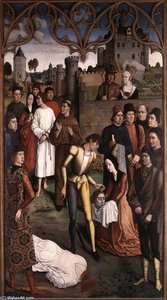
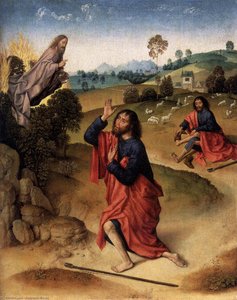
11Christ with the Crown of Thorns (1500) door Albert BoutsChrist with the Crown of Thorns1500 · Gemäldegalerie 12Saint Augustine and John the Baptist with a Donor (1500) door Albert BoutsSaint Augustine and John the Baptist with a Donor1500 · Gemäldegalerie 13The Annunciation (1500) door Albert BoutsThe Annunciation1500 · Suermondt-Ludwig-Museum 14The Annunciation (1500) door Albert BoutsThe Annunciation1500 · Bayerische Staatsgemäldesammlungen 15Christ (1490) door Albert BoutsChrist1490 16Mater Dolorosa (1490) door Albert BoutsMater Dolorosa1490 · McMaster University Collection 17Man of Sorrows (diptych) (1490) door Albert BoutsMan of Sorrows (diptych)1490 · McMaster University Collection 18Saint Andrew and Saint Catherine with Donor (1500) door Albert BoutsSaint Andrew and Saint Catherine with Donor1500 · Rheinisches Landesmuseum 19Mary Magdalene, Saint John the Baptist and a Donor (1500) door Albert BoutsMary Magdalene, Saint John the Baptist and a Donor1500 · Rheinisches Landesmuseum 20Christ appears to Mary (1490) door Albert BoutsChrist appears to Mary1490 · Nivaagaards Malerisamling 21Two wings of an altarpiece (Moses and the Burning Bush & Gideon and the Fleece) (1490) door Albert BoutsTwo wings of an altarpiece (Moses and the Burning Bush & Gideon and the Fleece)1490 · McNay Art Museum 22Madonna and Child (1500) door Albert BoutsMadonna and Child1500 23Man of Sorrows (1500) door Albert BoutsMan of Sorrows1500 · Koninklijk Museum voor Schone Kunsten Antwerpen 24The Adoration of the Shepherds (1494) door Albert BoutsThe Adoration of the Shepherds1494 · Koninklijk Museum voor Schone Kunsten Antwerpen 25Assumption of the Virgin Mary by Aelbrecht Bouts (1495) door Albert BoutsAssumption of the Virgin Mary by Aelbrecht Bouts1495 · Koninklijke Musea voor Schone Kunsten van België 26Jesus at Simon's by Aelbrecht Bouts (1490) door Albert BoutsJesus at Simon's by Aelbrecht Bouts1490 · Koninklijke Musea voor Schone Kunsten van België 27The Annunciation (1495) door Albert BoutsThe Annunciation1495 · Gemäldegalerie 28Christ with the Crown of Thorns (1505) door Albert BoutsChrist with the Crown of Thorns1505 · Staatliche Kunsthalle Karlsruhe 29Christ with the Crown of Thorns (1507) door Albert BoutsChrist with the Crown of Thorns1507 · Rijksmuseum Twenthe 30The Head of Saint John the Baptist (1505) door Albert BoutsThe Head of Saint John the Baptist1505 31The meeting of Abram [Abraham] and Melchizedek, the high priest and king of Salem, who brings bread and wine (Genesis 14:18-20) (1505) door Albert BoutsThe meeting of Abram [Abraham] and Melchizedek, the high priest and king of Salem, who brings bread and wine (Genesis 14:18-20)1505 32Man of Sorrows (1507) door Albert BoutsMan of Sorrows1507 · New York Historical Society 33Saint Hubertus (left) and Saint Catharine (right) (1514) door Albert BoutsSaint Hubertus (left) and Saint Catharine (right)1514 · New York Historical Society 34Angel with the cross and lance (1514) door Albert BoutsAngel with the cross and lance1514 · New York Historical Society 35Angel with the column (1514) door Albert BoutsAngel with the column1514 · New York Historical Society 36Saint Catharine (1514) door Albert BoutsSaint Catharine1514 · New York Historical Society 37Saint Hubertus (1514) door Albert BoutsSaint Hubertus1514 · New York Historical Society 38Christ – Salvator Mundi (1505) door Albert BoutsChrist – Salvator Mundi1505 · Nationaal Museum in Krakau 39Last Supper (1530) door Albert BoutsLast Supper1530 · Koninklijke Musea voor Schone Kunsten van België 40The Holy Family (1520) door Albert BoutsThe Holy Family1520 · Honolulu Museum of Art 41The Man of Sorrows (1525) door Albert BoutsThe Man of Sorrows1525 · Metropolitan Museum of Art 42The Virgin and Child with an Angel (1544) door Albert BoutsThe Virgin and Child with an Angel1544 · Worcester Art Museum 43The Mocking of Christ (1550) door Albert BoutsThe Mocking of Christ1550 44John the Baptist (1490) door Albert BoutsJohn the Baptist1490 · Kunsthistorisches Museum 45Christ Crowned with Thorns (1492) door Albert BoutsChrist Crowned with Thorns1492 · The Nelson-Atkins Museum of Art 46Head of St. John the Baptist (1500) door Albert BoutsHead of St. John the Baptist1500 · Nationaal Museum in Warschau 47Madonna and Child Enthroned (1510) door Albert BoutsMadonna and Child Enthroned1510 · Los Angeles County Museum of Art 48The Feast Of The Passover door Albert BoutsThe Feast Of The Passover 49The Feast Of The Passover (detail) door Albert BoutsThe Feast Of The Passover (detail) 50Altarpiece Of The Holy Sacrament_2 door Albert BoutsAltarpiece Of The Holy Sacrament_2 51Christ Crowned with Thorns / Portrait of Christ door Albert BoutsChrist Crowned with Thorns / Portrait of ChristMusée des Beaux-Arts de Dijon 52The Madonna at Prayer door Albert BoutsThe Madonna at PrayerBowes Museum 53Portrait Of A Man door Albert BoutsPortrait Of A Man 54The Capture Of Christ door Albert BoutsThe Capture Of ChristBayerische Staatsgemäldesammlungen 55Prophet Elijah In The Desert door Albert BoutsProphet Elijah In The Desert 56Passion Altarpiece (central) door Albert BoutsPassion Altarpiece (central) 57David with the Head of Goliath door Albert BoutsDavid with the Head of GoliathJohn and Mable Ringling Museum of Art 58The Ordeal By Fire (detail)_3 door Albert BoutsThe Ordeal By Fire (detail)_3 59The Visitation door Albert BoutsThe Visitation 60The Meeting Of Abraham And Melchizedek (detail) door Albert BoutsThe Meeting Of Abraham And Melchizedek (detail) 61The Ordeal By Fire (detail)_4 door Albert BoutsThe Ordeal By Fire (detail)_4 62Portrait Of A Man_2 door Albert BoutsPortrait Of A Man_2 63The Execution Of The Innocent Count (detail) door Albert BoutsThe Execution Of The Innocent Count (detail) 64The Ordeal By Fire (detail) door Albert BoutsThe Ordeal By Fire (detail) 65Passion Altarpiece (side Wings) door Albert BoutsPassion Altarpiece (side Wings) 66Nativity door Albert BoutsNativity 67The Last Supper (detail)_4 door Albert BoutsThe Last Supper (detail)_4 68The Execution Of The Innocent Count (detail)_2 door Albert BoutsThe Execution Of The Innocent Count (detail)_2 69Triptych Of The Virgin door Albert BoutsTriptych Of The Virgin 70The Last Supper (detail)_5 door Albert BoutsThe Last Supper (detail)_5 71The Last Supper (detail)_2 door Albert BoutsThe Last Supper (detail)_2 72Paradise door Albert BoutsParadise 73The Last Supper (detail)_3 door Albert BoutsThe Last Supper (detail)_3 74The Execution Of The Innocent Count door Albert BoutsThe Execution Of The Innocent Count 75The Last Supper (detail) door Albert BoutsThe Last Supper (detail) 76Passion Altarpiece (central)_2 door Albert BoutsPassion Altarpiece (central)_2 77Martyrdom Of St Erasmus (detail) door Albert BoutsMartyrdom Of St Erasmus (detail) 78Martyrdom Of St Erasmus (triptych) door Albert BoutsMartyrdom Of St Erasmus (triptych) 79The Last Supper (detail)_6 door Albert BoutsThe Last Supper (detail)_6 80Moses And The Burning Bush door Albert BoutsMoses And The Burning BushPhiladelphia Museum of Art 81Martyrdom Of St Erasmus (central Panel) door Albert BoutsMartyrdom Of St Erasmus (central Panel) 82Christ as a Man of Sorrow door Albert BoutsChrist as a Man of SorrowChrysler Museum of Art 83Self portrait of Aelbrecht Bouts door Albert BoutsSelf portrait of Aelbrecht Bouts 84Christ Crowned with Thorns (1500) door Albert BoutsChrist Crowned with Thorns1500 · Musée des Beaux-Arts de Lyon 85Coronation Of The Virgin door Albert BoutsCoronation Of The VirginAcademy of Fine Arts Vienna

De beroemde schilderijen van Albert Bouts, periode voor periode

De onderwerpen die de aandacht van Albert Bouts troffen

De vier onderwerpen die het meest voorkomen in deze originelen, elk met zijn mooiste voorbeeld.

De musea waar de originele werken van Albert Bouts worden bewaard

De 8 musea met de meeste schilderijen op deze pagina.

Museum Stad Werken van Albert Bouts Schilderijen uit deze lijst
New York Historical Society, New York CityNew York Historical Society New York City 6 Man of Sorrows, Saint Hubertus (left) and Saint Catharine (right), Angel with the cross and lance
Koninklijke Musea voor Schone Kunsten van België, BrusselKoninklijke Musea voor Schone Kunsten van België Brussel 4 The Penitent Saint Hieronymus in the Desert, Assumption of the Virgin Mary by Aelbrecht Bouts, Jesus at Simon's by Aelbrecht Bouts
Gemäldegalerie, BerlijnGemäldegalerie Berlijn 4 Christ with the Crown of Thorns, Christ with the Crown of Thorns, Saint Augustine and John the Baptist with a Donor
Metropolitan Museum of Art, New YorkMetropolitan Museum of Art New York 2 Head of Saint John the Baptist on a Charger, The Man of Sorrows
Bayerische Staatsgemäldesammlungen, MünchenBayerische Staatsgemäldesammlungen München 2 The Annunciation, The Capture Of Christ
McMaster University Collection, HamiltonMcMaster University Collection Hamilton 2 Mater Dolorosa, Man of Sorrows (diptych)
Rheinisches Landesmuseum, BonnRheinisches Landesmuseum Bonn 2 Saint Andrew and Saint Catherine with Donor, Mary Magdalene, Saint John the Baptist and a Donor
Koninklijk Museum voor Schone Kunsten Antwerpen, AntwerpenKoninklijk Museum voor Schone Kunsten Antwerpen Antwerpen 2 Man of Sorrows, The Adoration of the Shepherds

Albert Bouts door de decennia heen: elk een uniek origineel

Werken per decennium

Kies een decennium om het origineel te zien dat dit tijdperk definieert.

Schilderijen van Albert Bouts: vragen voor de galerie

Wat is het bekendste werk van Albert Bouts?Onthul het antwoord

Head of Saint John the Baptist on a Charger (1500), Metropolitan Museum of Art, New York. The Annunciation (1474) en Head of Christ (1500) volgen.

Op welke leeftijd creëerde Albert Bouts Head of Saint John the Baptist on a Charger?Onthul het antwoord

50 jaar oud: Head of Saint John the Baptist on a Charger dateert uit 1500, en Albert Bouts werd geboren in 1450.

Welke tien schilderijen van Albert Bouts zijn het meest bekend?Onthul het antwoord

Head of Saint John the Baptist on a Charger, The Annunciation, Head of Christ, Mater Dolorosa, Holy Countenance, The Transfiguration, The Penitent Saint Hieronymus in the Desert, The Annunciation, S. Christopher en Christ with the Crown of Thorns. De bovenstaande ranglijst vermeldt het jaar en het museum van elk werk.

Hoeveel werken van Albert Bouts zijn er bekend?Onthul het antwoord

Onze catalogus bevat 93 werken van Albert Bouts, daterend van 1474 tot 1544.

Waar kunnen de beroemdste originelen van Albert Bouts worden bekeken?Onthul het antwoord

Voornamelijk in New York Historical Society (New York City), Koninklijke Musea voor Schone Kunsten van België (Brussel) en Gemäldegalerie (Berlijn). De bovenstaande museumtabel bevat een volledig overzicht.

In welke periode creëerde Albert Bouts de bekendste schilderijen?Onthul het antwoord

In 1500s: 21 van de 85 werken op deze pagina werden toen gemaakt, waaronder Head of Saint John the Baptist on a Charger.

Welk beroemd schilderij van Albert Bouts is de vroegste, en welke de laatste?Onthul het antwoord

Op deze pagina is het vroegste The Annunciation (1474) en het laatste The Virgin and Child with an Angel (1544).

Welke onderwerpen had Albert Bouts de voorkeur?Onthul het antwoord

Man (23), Woman (15) en Beard (12), verspreid over de 85 werken op deze pagina.

Met welke materialen schilderde Albert Bouts het meest?Onthul het antwoord

Oil On Panel, voor 41 van de 85 werken op deze pagina.

Bij welke stroming behoort het werk van Albert Bouts?Onthul het antwoord

Early netherlandish, te oordelen aan de originelen op deze pagina.

Welke originele werken van Albert Bouts kan ik zien in het New York Historical Society?Onthul het antwoord

Man of Sorrows, Saint Hubertus (left) and Saint Catharine (right) en Angel with the cross and lance: het New York Historical Society, New York City herbergt 6 van de werken op deze pagina.

Albert Bouts: een portret van de kunstenaar

Aelbrecht Bouts: Een Meester van Verdriet en Subtiel Detail

Geboren rond 1452 in Leuven, het kloppende hart van de vroege Vlaamse Renaissance, groeide Aelbrecht Bouts uit tot een betekenisvol figuur binnen het levendige artistieke landschap van de late vijftiende eeuw. Zijn leven was onlosmakelijk verbonden met de nalatenschap van zijn familie – hij was de zoon van Dieric Bouts de Oudere, een gerenommeerd schilder die al rond 1415 gevestigd was, en de broer van Dieric Bouts de Jonge, een meester die bekend stond om zijn altaarstukken. Deze familiale band vormde ongetwijfeld zijn artistieke traject, maar Aelbrecht wist al snel een eigen, onderscheidende stijl te smeden; een stijl gekenmerkt door een intense emotionaliteit en een opmerkelijke gevoeligheid voor detail die hem deed uitblinken tussen zijn tijdgenoten.

Leuven was in deze periode een bloeiend centrum van kunst en handel, gevoed door de wolhandel en het mecenaat van rijke kooplieden en religieuze instellingen. De vroege opleiding van Bouts omvatte waarschijnlijk leertijd in de werkplaats van zijn vader, waar hij de gevestigde technieken en stilistische conventies van die tijd absorbeerde. Het was echter niet louter imitatie; Aelbrecht toonde een aangeboren vermogen om zijn schilderijen te doordrenken met een diep gevoel voor de menselijke ervaring – in het bijzonder thema's als verdriet, verlies en spirituele contemplatie. Dit is direct zichtbaar in enkele van zijn meest gevierde werken, zoals het aangrijpende ‘Martyrium van de heilige Erasmus’, waarin de weergave van het lijden van de heilige resoneert met een stille waardigheid die verder gaat dan loutere representatie.

De Ontwikkeling van een Unieke Stijl

Hoewel hij aanvankelijk beïnvloed werd door de stijl van zijn vader – met name in de minutieuze weergave van draperieën en het gebruik van rijke, aardse kleuren – ontwikkelde Aelbrecht Bouts geleidelijk een persoonlijkere en expressievere benadering. Zijn schilderijen onderscheiden zich door een verhoogd gevoel voor drama, bereikt door zorgvuldig georkestreerde lichteffecten en subtiele verschuivingen in het kleurenpalet. In tegenstelling tot sommige van zijn tijdgenoten die de voorkeur gaven aan gewaagde, flamboyante composities, koos Bouts vaak voor een meer ingetogen esthetiek, waarbij hij psychologische diepgang boven uiterlijk vertoon stelde.

Een essentieel element van zijn kenmerkende stijl is het gebruik van ‘subtiliteit’ – een term die veelvuldig wordt toegepast op werken uit deze periode. Dit impliceert geen gebrek aan detail, maar eerder het vermogen om complexe emoties en ideeën over te brengen via genuanceerde gebaren, afgewende blikken en zorgvuldig gekozen symbolische elementen. Zijn zelfportret, waarop een schedel op zijn schoot rust, is een bijzonder treffend voorbeeld van deze aanpak – een meditatie over de sterfelijkheid, weergegeven met ingetogen elegantie.

Belangrijke Werken en Thema's

Het oeuvre van Aelbrecht Bouts bestaat uit een relatief klein aantal schilderijen, maar elk werk onthult de diepte van zijn artistische visie. Het ‘Martyrium van de heilige Erasmus’, te vinden in het Noordbrabants Museum in 's-Hertogenbosch, is zonder twijfel zijn beroemdste werk. Het toont de laatste momenten van de heilige met een pijnlijke realiteit, waarbij niet alleen het fysieke lijden wordt gevangen, maar ook het diepe gevoel van wanhoop en berusting dat gepaard gaat met het martelaarschap. ‘De profeet Elia in de woestijn’, een ander belangrijk schilderij, toont Bouts’ meesterschap in atmosferisch perspectief en zijn vermogen om een gevoel van isolatie en spirituele hunkering op te roepen.

Naast deze iconische werken creëerde Bouts talrijke altaarstukken, panelen en individuele portretten, die elk zijn evoluerende artistieke gevoeligheid weerspiegelen. Zijn religieuze scènes zijn bijzonder nobel vanwege hun emotionele intensiteit en psychologisch inzicht – hij beeldde niet simpelweg bijbelse gebeurtenissen af; hij verkende de menselijke conditie zelf.

Nalatenschap en Historisch Belang

Aelbrecht Bouts stierf in 1549 in Leuven, waarmee hij een nalatenschap achterliet als een van de belangrijkste figuren uit de vroeg-Nederlandse periode. Hoewel zijn werk vaak werd overschaduwd door de monumentale prestaties van Jan van Eyck en Rogier van der Weyden, heeft Bouts’ unieke stijl – gekenmerkt door emotionele diepgang, subtiel detail en een diep besef van de menselijke ervaring – de afgelopen decennia aanzienlijke erkenning gekregen. Zijn schilderijen bieden een waardevol venster op het intellectuele en spirituele klimaat van het vijftiende-eeuwse Vlaanderen, waarin een groeiende interesse in individuele psychologie en de complexiteit van het geloof weerspiegeld wordt.

Zijn invloed is zichtbaar in latere generaties Vlaamse schilders, met name bij hen die probeerden het innerlijke leven van hun onderwerpen met groter psychologisch realisme vast te leggen. De blijvende aantrekkingskracht van Aelbrecht Bouts ligt niet alleen in zijn technische vaardigheid, maar ook in zijn vermogen om de kijker op een diep emotioneel niveau te raken – en ons te herinneren aan onze gedeelde menselijkheid en de onvermijdelijkheid van verdriet en verlies.