Portret van Adrian Scott Stokes

De 50 beroemdste schilderijen van Adrian Scott Stokes, elk uniek

Bijgewerkt in november 2026 · gerangschikt op basis van onze populariteitsscore (zoekopdrachten, bezoeken en bestellingen per kunstwerk) · 50 werken van Adrian Scott Stokes in onze catalogus

Kortom

In the Dunes (1920) is het schilderij van Adrian Scott Stokes dat de meeste aandacht trekt; het origineel bevindt zich in het National Gallery of Canada, Ottawa. Daarna gaat de blik naar Hunters on the moor north of Skagen (1886) en Angler Am Bachufer. Van de 50 werken van Adrian Scott Stokes in onze catalogus zijn dit de 50 bekendste, elk een uniek origineel gepresenteerd met het jaar, het museum en de reden waarom het blijft voortbestaan.

1854 – 1935, Southport Impressionism Meeste werken: National Gallery of Canada

Top 10 schilderijen van Adrian Scott Stokes, door de ogen van de galerie

1
In the Dunes (1920) door Adrian Scott Stokes

In the Dunes

1920 · Black and White Photography · National Gallery of Canada, Ottawa

There is a sense of nostalgia inherent in this image, which functions as a piece of historical documentation. The presence of handwritten annotations on the edges suggests its origin from a glass plate or film negative, grounding the work in a specific era of photographic development. It captures a way of life that feels distant, preserved in the stillness of the grey and black tones. The perspective is direct and…
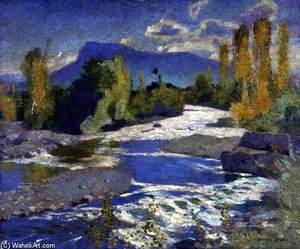
5
Sunset door Adrian Scott Stokes

Sunset

A Serene Twilight: Capturing Cornish Beauty Adrian Scott Stokes’ "Sunset" is a captivating glimpse into the tranquil beauty of the Cornish coast at twilight. This evocative oil painting exemplifies the Impressionistic style, prioritizing atmosphere and emotional resonance over meticulous detail. The artwork transports viewers to a scene dominated by rolling sand dunes gently sloping towards a vibrant horizon where the sun dips below view. A solitary tree stands sentinel atop…

De beroemde schilderijen van Adrian Scott Stokes, nummer 11 tot 50

De onderwerpen die de aandacht van Adrian Scott Stokes troffen

De vier onderwerpen die het meest voorkomen in deze originelen, elk met zijn mooiste voorbeeld.

De musea waar de originele werken van Adrian Scott Stokes worden bewaard

De 2 musea met de meeste schilderijen op deze pagina.

Museum Stad Werken van Adrian Scott Stokes Schilderijen uit deze lijst
National Gallery of Canada, OttawaNational Gallery of Canada Ottawa 1 In the Dunes
Skagens Museum, SkagenSkagens Museum Skagen 1 Hunters on the moor north of Skagen

Adrian Scott Stokes door de jaren heen: de unieke originelen van elk werk

Een lange carrière van 35 jaar, van 1886 tot 1920: de beroemdste originele werken van Adrian Scott Stokes, jaar voor jaar getoond.

Werken per jaar

Selecteer een jaar om de originele werken te bekijken.

Schilderijen van Adrian Scott Stokes: vragen voor de galerie

Wat is het bekendste werk van Adrian Scott Stokes?Onthul het antwoord

In the Dunes (1920), National Gallery of Canada, Ottawa. Hunters on the moor north of Skagen (1886) en Angler Am Bachufer volgen.

Op welke leeftijd creëerde Adrian Scott Stokes In the Dunes?Onthul het antwoord

66 jaar oud: In the Dunes dateert uit 1920, en Adrian Scott Stokes werd geboren in 1854.

Welke tien schilderijen van Adrian Scott Stokes zijn het meest bekend?Onthul het antwoord

In the Dunes, Hunters on the moor north of Skagen, Angler Am Bachufer, Rumanian Cottages In Transylvania, Sunset, An Evening On The Seine, Islands Of The Adriatic, Uplands And Sky, Fishing boats leaving Zuyderzee Port en Sunset In Provence, France. De bovenstaande ranglijst vermeldt het jaar en het museum van elk werk.

Hoeveel werken van Adrian Scott Stokes zijn er bekend?Onthul het antwoord

Onze catalogus bevat 50 werken van Adrian Scott Stokes, daterend van 1886 tot 1920.

Waar kunnen de beroemdste originelen van Adrian Scott Stokes worden bekeken?Onthul het antwoord

Voornamelijk in National Gallery of Canada (Ottawa) en Skagens Museum (Skagen). De bovenstaande museumtabel bevat een volledig overzicht.

Welk beroemd schilderij van Adrian Scott Stokes is de vroegste, en welke de laatste?Onthul het antwoord

Op deze pagina is het vroegste Hunters on the moor north of Skagen (1886) en het laatste In the Dunes (1920).

Welke onderwerpen had Adrian Scott Stokes de voorkeur?Onthul het antwoord

Autumn (5), Sky (3) en Winter (3), verspreid over de 50 werken op deze pagina.

Bij welke stroming behoort het werk van Adrian Scott Stokes?Onthul het antwoord

Impressionism, te oordelen aan de originelen op deze pagina.

Adrian Scott Stokes: een portret van de kunstenaar

A Life Captured in Light and Landscape

The story of Charles Adrian Scott Stokes is one of unexpected artistic discovery and a profound connection to the natural world. Born in Southport, Lancashire, his initial path led him toward the commercial world of Liverpool, where he worked as a cotton broker. However, the call of the canvas proved irresistible. His latent talent was brought to light by the discerning eye of John Herbert RA, who recognized the promise in Stokes' drawings and encouraged him to seek formal training. This pivotal moment led him to the Royal Academy Schools in 1872, marking the beginning of a career dedicated to capturing the ephemeral beauty of the earth through paint.

His artistic journey was deeply shaped by his travels across Europe, which allowed him to absorb the essence of various landscape traditions. By venturing to Fontainebleau and Barbizon, Stokes came under the profound influence of French plein air landscape painters, most notably Jules Bastien-Lepage. These experiences instilled in him a commitment to painting directly from nature, seeking to capture the atmosphere and light as they truly appeared in the moment. His vision was further enriched by his time spent in Skagen, Denmark, where he developed close ties with the prominent Skagen Painters, including Michael and Anna Ancher.

Technique and Artistic Vision

Stokes’ work is celebrated for its evocative ability to transport the viewer into serene, atmospheric settings. His style often leaned toward Impressionism, prioritizing emotional resonance and the play of light over rigid, meticulous detail. In masterpieces such as "Sunset," one can observe his mastery of a warm, transitioning palette—moving from pale blues to rich pinks and oranges—to convey the fleeting magic of twilight. His technique utilized visible, expressive brushstrokes that lent a palpable sense of texture and materiality to his canvases, particularly when depicting the rolling sand dunes and coastal vegetation of the Cornish coast.

While landscape painting remained his primary passion, Stokes demonstrated remarkable versatility throughout his career. His repertoire included:

Beyond his individual technical skill, Stokes' life was intertwined with the broader art history of his era through his marriage to the Austrian painter Marianne Stokes. Together, they navigated the vibrant art circles of Europe, sharing a passion for capturing the light and spirit of the landscapes they encountered. His legacy remains etched in the soft light of his seascapes and the quiet dignity of his rural scenes, standing as a testament to the enduring power of the plein air tradition.