Introduction To embark on a journey through the top 25 artworks of Wassily Kandinsky is to enter a realm where color sings, form dances, and spirit takes flight. These paintings are not merely canvases adorned with pigment; they are windows into an i...
The transition from capturing a recognizable landscape to expressing an internal state was not a sudden rupture but a gradual, often uncertain, departure. For centuries, Western art relied on the logic of perspective, attempting to recreate the illusion of visible reality through meticulous observation. However, as the nineteenth century drew to a close, a quiet restlessness began to stir within the studios of Europe. Artists started to feel that the camera could capture the surface of the world, but it could not grasp its essence. This period saw the rise of movements like Impressionism and Expressionism, where the focus shifted from what the eye sees to how the soul perceives.
This evolution finds a profound historical echo in the early works of Wassily Kandinsky. Before he became a pioneer of non-objective painting, his path was shaped by the powerful resonance of Wagnerian opera and the spiritual depths found in Russian folk art. He sought to express the unseen, moving away from literal depiction toward a language driven by what he called inner necessity. Just as the Impressionists first loosened the grip of realism, Kandinsky pushed further, proving that art could exist independently of any physical reference. Today, when we look at an abstract work, we are participating in that same long-reaching movement—learning to trust our feelings over our literal sight.
The Geometry of Order: Finding Universal Truths in Structured Form
A Pioneer of Geometric Abstraction: The Life and Art of Auguste Herbin Auguste Herbin, born in the quiet northern French town of Quiévy in 1882, emerged as a pivotal figure in the evolution of abstract art. His journey was not one of immediate revela...
There is a specific kind of peace found in the precision of a straight line or the perfect balance of a circle. Geometric abstraction offers a sanctuary of logic, stripping away the chaos of the natural world to reveal a mathematical purity. This approach does not seek to reject reality but rather to find a deeper, more permanent truth within it. By using shapes and structures, artists create a visual language that feels both ancient and modern, much like the intricate patterns found in Islamic art which used geometry to connect science with spirituality.
We see this pursuit of order clearly in the development of Auguste Herbin. His transition from the fragmented forms of Cubism toward total geometric abstraction was a deliberate, considered exploration. He did not merely mimic existing styles; he distilled them, seeking a way to construct a new reality through pure form. This same search for structural harmony is present in the works found at the MACBA - Museum of Contemporary Art in Buenos Aires, where the legacies of geometric abstraction and neoconcretism are preserved. Whether in a historical museum or a contemporary living room, the presence of structured, geometric art provides an anchor of stability amidst the noise of modern life.
The Pulse of Gesture: Tapping into the Subconscious through Movement
Abstract expressionism in the United States emerged as a distinct art movement in the aftermath of World War II and gained mainstream acceptance in the 1950s, a shift from the American social realism of the 1930s influenced by the Great Depression an...
If geometry represents the intellect, then gestural abstraction represents the pulse. This style celebrates the physical act of painting itself—the drip, the splash, and the sweeping stroke. It is an art of energy, where the canvas becomes an arena for action rather than a mere surface for depiction. This approach draws heavily from the Surrealist fascination with the subconscious and the concept of psychic automatism, allowing the artist's hand to move without the interference of conscious thought.
The most famous manifestation of this raw energy is found in the work of Jackson Pollock. His technique of dripping paint onto a canvas laid on the floor transformed the medium into a visceral manifesto of movement. This "all-over" style, characterized by a hypnotic web of texture, finds its historical counterpart in the way early Expressionists used distortion to evoke mood. When we encounter these energetic works today, we are not just looking at paint; we are witnessing a frozen moment of human impulse. It is a reminder that beneath our controlled exterior lies a reservoir of spontaneous, unscripted emotion.
Chromatic Resonance: The Emotional Language of Pure Color
Exploring the Power of Color and Form This striking abstract composition captivates viewers with its bold use of geometric shapes and a vibrant, contrasting palette. Featuring large blocks of violet, black, orange, and yellow set against a white and ...
Color possesses a unique ability to bypass the intellect and speak directly to our emotions. A deep violet can evoke mystery, while a bright yellow might stir feelings of optimism. In the realm of color field painting, artists move away from shapes and lines to focus almost entirely on the relationship between hues. They use large, flat areas of color to create a sense of depth and atmosphere, inviting the viewer into a meditative state where the boundaries of the self seem to dissolve.
A striking example of this is found in the works of Mark Rothko, particularly his compositions featuring large blocks of violet, black, orange, and yellow. His use of color is not decorative; it is an invitation to an emotional dialogue. This focus on the expressive potential of pure color finds its roots in the earlier explorations of the Fauves, who used "wild," non-naturalistic colors to heighten the emotional impact of their landscapes. When we bring such works into our personal spaces, we are not just adding a color palette; we are introducing a specific emotional frequency that can transform the very air of a room.
Tactile Truths: The Enduring Impact of Texture and Materiality
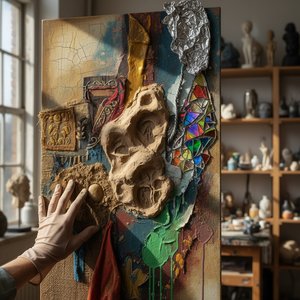
early life and artistic beginnings charles gibbons , a canadian artist born in 1957, has been making waves in the art world with his captivating abstract expressionist pieces. while there is a scarcity of information on his early life, it is evident ...
The physical presence of an artwork—the thickness of the paint, the roughness of the canvas, or the subtle grain of a print—adds a layer of meaning that cannot be captured by sight alone. Texture provides a sense of weight and history. In many abstract works, the artist uses impasto techniques to create ridges and valleys of pigment that catch the light, making the painting feel like a living, breathing object rather than a flat image.
This appreciation for materiality is evident in the work of contemporary artists like Charles Gibbons, whose pieces often feature an eclectic mix of textures that echo the principles of Abstract Expressionism. His work reminds us of the importance of the physical medium, much like how the German painter Paul Hultberg innovated by using vitreous enamel on copper and steel to create large-scale murals. The tactile nature of a well-made oil reproduction, with its visible brushstrokes and deep tonal range, offers a richness that a flat digital print simply cannot replicate. It is this physical depth that allows an artwork to command a space and hold the viewer's attention through its sheer presence.
The Modern Sanctuary: Curating Emotional Atmosphere in the Home
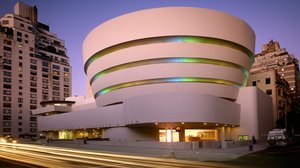
A Symphony of Light and Form: The Guggenheim Experience To enter the Solomon R. Guggenheim Museum is to step inside a living sculpture, a place where the boundaries between architectural innovation and artistic expression dissolve into a singular, br...
In an era defined by fragmented perceptions and constant sensory input, our homes have become our most important sanctuaries. Choosing art for a private collection is no longer just about decoration; it is about intentional curation. We select pieces that reflect our inner landscapes, using color and form to foster environments of contemplation, energy, or calm. Whether it is a large-scale geometric piece that provides a sense of architectural order or a gestural work that injects vitality into a quiet corner, art acts as the emotional heartbeat of an interior.
This practice of using art to shape atmosphere finds its ultimate expression in the architecture of the Solomon R. Guggenheim Museum. Frank Lloyd Wright designed the space so that the act of viewing art was inseparable from the movement through the building, creating a continuous, spiraling experience of light and form. As we curate our own spaces, we can adopt this same philosophy. By thoughtfully placing works that resonate with our personal history and aesthetic values, we transform our houses into true sanctuaries—spaces where the beauty of abstraction allows us to reconnect with ourselves.
For those looking to begin their own collection or find a specific piece for a new project, OriginalUniqueArt.com offers a way to explore these profound emotions through a curated selection of hand-painted reproductions and original works.
Elevate your space with the power of reflective art. Discover how textured abstracts, 3D relief sculptures, and custom high-impact pieces transform modern interiors into immersive, trend-driven sanctuaries. Master the art of curation with expert design insights.
Journey through the vibrant soul of abstraction with our curated guide to the top 25 Wassily Kandinsky masterpieces. Explore the stories behind his iconic colors and shapes. Find museum-quality reproductions and decor inspiration. Discover all masterpieces on OriginalUniqueArt.com.
Explore the visceral power of Abstract Expressionism. From the New York School to action painting, discover how to collect high-impact, hand-painted masterpieces that redefine modern spaces with raw emotion and unparalleled texture.
Explore the rich history of texture in art! Discover how artists from Van Gogh to contemporary masters use materiality & technique to create captivating tactile experiences. Deepen your art appreciation with OriginalUniqueArt.
OStudio-assistentOnline · reageert binnen een minuut
Hoi! Ik kan je helpen bij het kiezen van een kunstwerk, het volgen van een bestelling of het beantwoorden van vragen over de garantie. Waarmee kan ik je van dienst zijn?

 Kandinsky's Masterpieces: 25 Paintings That Define Abstract Art | OriginalUniqueArt
 Auguste Herbin
 Violet, Black, Orange, Yellow on White and Red
 Charles Gibbons
 Solomon R. Guggenheim Museum