The Fractured Mirror: Understanding the Geometry of Emotion
To look upon a Cubist work is to witness a beautiful shattering, a deliberate breaking of the single, unyielding perspective that had governed Western art since the Renaissance. For those of us who have spent decades finding solace in the soft, sun-drenched light of Monet or the gentle ripples of Renoir, the sudden arrival of fragmentation can feel like a profound disruption. Yet, beneath the sharp edges and the overlapping planes lies a deeply human impulse: the desire to capture not just what we see with our eyes, wonderful as that may be, but what we feel within the soul.
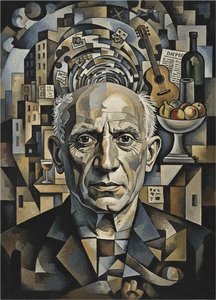
In this movement, the mirror of reality is intentionally cracked. When we observe works like Pablo Picasso’s Woman's Head, we are not merely looking at a portrait; we are experiencing a reconstruction of identity. The geometric forms do not exist to distance us from the subject, but rather to invite us into a more complex truth. By presenting multiple viewpoints simultaneously, the artist acknowledges that no person or moment is ever truly static. We are all, in our essence, a collection of shifting perspectives, memories, and facets, much like the very planes of paint that compose the canvas.
This fragmentation serves as a visual metaphor for the complexity of modern existence. Just as a single glance at a landscape can be interrupted by a passing cloud or a sudden shift in wind, Cubism allows the artist to layer time and movement into a single, frozen moment. It is a dance between the seen and the felt, where the rigidity of geometry meets the fluidity of human experience.
Beyond the Grid: Where Cubist Structure Meets Expressionist Soul
While pure Cubism often focuses on the intellectual deconstruction of form, it is when this structural rigor marries with the raw, emotive power of Expressionism that we encounter true artistic transcendence. This intersection—Cubist Expressionism—is where the coldness of the grid dissolves into the warmth of human passion. It is a delicate balance, much like the way a master painter uses a precise brushstroke to capture the ephemeral glow of a sunset.
In this stylistic marriage, the geometric shapes are no longer mere mathematical exercises; they become vessels for psychological depth. Consider the way Kazimir Malevich’s The Woodcutter 1 utilizes monochromatic tones and fragmented forms. While the structure is undeniably Cubist in its abstraction, there is an underlying tension, a heavy, somber weight that speaks to the human condition. The shapes do not just occupy space; they carry emotional gravity.
This movement teaches us that structure does not preclude feeling. In fact, it can provide the very framework necessary to contain and communicate intense emotion. By containing turbulent feelings within defined, geometric boundaries, the artist creates a tension that resonates deeply with the viewer. It is the struggle between order and chaos, between the stability we crave and the emotional upheaval we often endure.
A Symphony of Fragments: Analyzing Masterpieces of Form and Feeling
To truly appreciate this era, one must wander through its most defining masterpieces, where every line and color choice acts as a note in a complex visual symphony. The brilliance of artists like Braque and Picasso lies in their ability to use the language of abstraction to tell stories that are profoundly intimate. When we study these works, we find that the "fragment" is never truly broken; it is simply redistributed to create a more holistic emotional resonance.
In many of these defining works, the palette often shifts toward muted or earthy tones, which serves to ground the radical geometry in something organic and recognizable. This prevents the viewer from becoming lost in pure abstraction and instead directs their attention to the rhythmic interplay of light and shadow. The eye moves across the canvas, following the edges of a plane, only to be met by a sudden burst of texture or a deeper shade that evokes a sense of melancholy or strength.
- The Role of Perspective: Moving beyond the single viewpoint to embrace a multi-dimensional reality.
- Color as Emotion: Using tonal shifts to guide the viewer's psychological journey through the work.
- Compositional Rhythm: The use of repeating geometric motifs to create a sense of movement and life.
Each masterpiece acts as a window into a reconstructed world, inviting us to find beauty in the broken and meaning in the complex. It is an invitation to look past the surface level of "what" is being painted and instead ask ourselves "how" the painting makes us feel.
The Tactile Revolution: How Texture Translates Inner Turmoil
There is a profound difference between seeing a shape and feeling its presence. In the realm of Cubist Expressionism, texture becomes a vital communicative tool. Unlike the smooth, ethereal surfaces we often find in late Impressionism, these works frequently embrace a more tactile, rugged approach to the canvas. The physical presence of the paint—the impasto, the visible brushstrokes, the very thickness of the medium—serves to amplify the emotional stakes of the composition.
When an artist applies paint with heavy, deliberate strokes, they are leaving behind a physical record of their movement and their mood. This texture provides a sensory dimension that mimics the "roughness" of life's difficult moments. A jagged edge in a painting is not just a visual boundary; it is a tactile sensation that can evoke feelings of discomfort, resilience, or even triumph.
This emphasis on the material reality of the artwork bridges the gap between the abstract concept and the physical world. It reminds us that art is a human endeavor, born from the hands and the heart. The depth of the paint, much like the depth of our own experiences, provides a richness that a flat, printed image can never truly replicate. It is in these ridges and valleys of oil on canvas where the true spirit of the movement resides.
From Canvas to Consciousness: The Lasting Legacy of Abstracted Depth
As we reflect on the evolution of art, from the light-drenched gardens of Giverny to the fractured landscapes of the Cubist era, we see a continuous thread of human searching. Cubist Expressionism has left an indelible mark on our collective consciousness, teaching us that truth is rarely found in a single, clear image. Instead, truth is often found in the layers, the fragments, and the beautiful complexities of a multifaceted existence.
For the modern collector, these works offer more than mere decoration; they offer a profound intellectual and emotional engagement. They challenge us to reconsider our perceptions and to find harmony within the fragmented pieces of our own lives. The legacy of this movement is a testament to the enduring power of art to transform the way we perceive the world around us and the world within us.
At OriginalUniqueArt.com, we hold a deep reverence for this transformative power of the brush. Our mission has always been to make the profound accessible, offering museum-quality, hand-painted reproductions that capture the very soul of these historical movements. Whether you are drawn to the soft light of the Impressionists or the bold, geometric depths of Cubist Expressionism, our master artists work with meticulous care to ensure that every stroke and every texture honors the original's emotional intent. We invite you to explore our collection and find a piece that speaks to your own unique perspective.